
The One Ring corrupts by design.
It is not a passive object radiating abstract evil, nor does it operate like a simple curse that weakens anyone who touches it. Throughout The Lord of the Rings, the Ring behaves with a disturbing degree of precision. It presses differently on each bearer, shaping its influence according to what already exists within them.
Fear.
Hope.
Ambition.
Responsibility.
The Ring does not create these things. It searches for them.
This is why its effect on Samwise Gamgee feels so unusual.
Sam carries the Ring in Mordor itself. He bears it at the point in the story when its power should be at its strongest—near the land of its making, under the shadow of its master. He even wears it. And yet, the overwhelming psychological pressure that slowly crushes Frodo never takes hold in the same way.
This difference is not accidental. And it is not because Sam is immune.
Tolkien never suggests that immunity to the Ring exists.
The answer lies instead in how the Ring tempts—and what it requires in order to succeed.
The Ring Tempts According to Desire
The Ring does not invent desire. It amplifies what is already present.
This pattern is consistent across the text, and it becomes clearer the more closely the major temptations are compared.
Boromir is not tempted with abstract evil. He is tempted with strength—strength to save Gondor, strength to win a war he believes is already lost. The Ring presses against his fear of failure and his belief that victory justifies the means.
Galadriel, when offered the Ring, immediately imagines herself as a queen: beautiful, terrible, and adored. Her temptation is not conquest for its own sake, but preservation—holding back decay through absolute power.
Gandalf’s refusal is perhaps the most revealing. He does not fear becoming cruel or chaotic. He fears becoming too right. A ruler who enforces good through domination, convinced that his wisdom justifies his authority.
Each temptation is carefully fitted.
The Ring offers not random visions, but fulfillment. It promises to complete the bearer’s deepest inclination, while quietly reshaping it into something absolute.
This is why Frodo’s burden grows heavier over time.
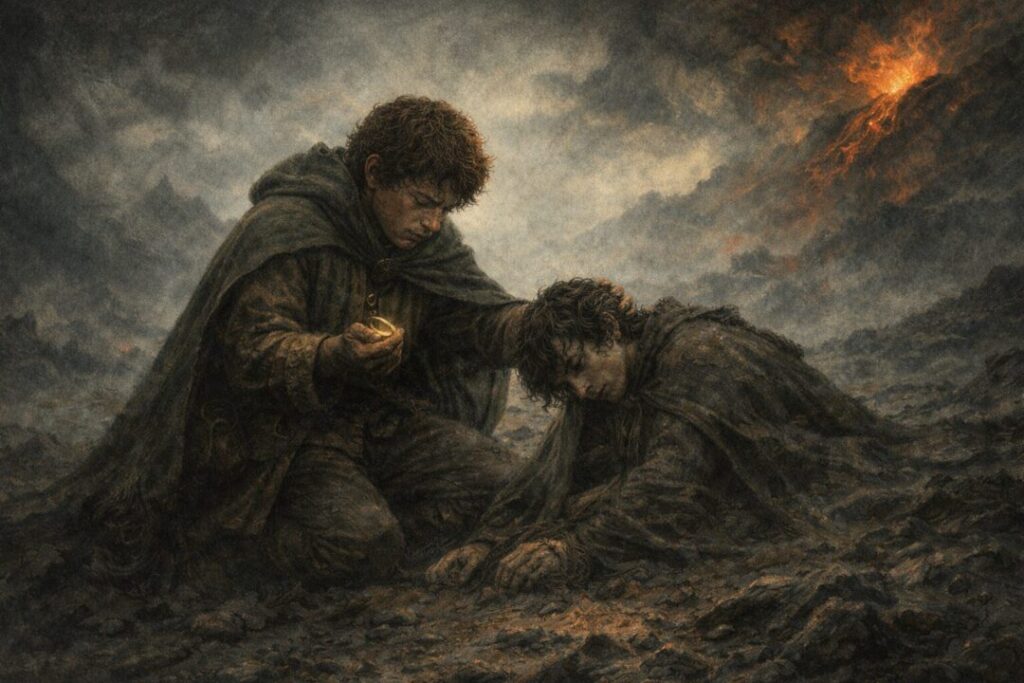
Frodo’s Growing Isolation
Frodo Baggins does not begin the quest as a figure of great ambition. He is cautious, reluctant, and deeply aware of his own limits. But as the journey progresses, something shifts.
Responsibility accumulates.
Frodo begins to internalize the quest as something only he can carry. This belief is not arrogance—it is a reaction to pressure. Again and again, he is told that the fate of the world depends on him. Again and again, he chooses to go on when others fall away.
The Ring feeds on this isolation.
As Frodo’s sense of duty becomes more personal, more inward, the Ring gains more leverage. It presses against his fear of failure and his belief that the burden cannot be shared.
By the time Frodo reaches Mordor, the Ring has entwined itself with his identity. Letting go of it feels indistinguishable from letting go of purpose itself.
Sam never reaches that point.
What the Ring Actually Shows Sam
Tolkien gives the reader one direct, unambiguous glimpse of the Ring’s attempt to tempt Sam in The Return of the King.
When Sam bears the Ring on the borders of Mordor, it does not remain silent. It does offer him a vision.
But the vision is strange.
Sam does not imagine himself as a king, a general, or a ruler. Instead, the Ring offers him a transformed world: Mordor turned into a vast garden, made fertile and beautiful, with Sam as its keeper.
This moment is crucial.
The Ring reaches for the strongest desire it can find—and the strongest desire it finds in Sam is care.
Not authority.
Not dominance.
Not legacy.
Care.
The scale of the vision is immense, but its nature is deeply personal. Sam is not imagined as a tyrant commanding others. He is imagined as someone tending, cultivating, and preserving.
Even this temptation does not last.
Sam recognizes, almost immediately, that the vision is hollow. The land is too big. The responsibility is meaningless. It does not connect to the life he actually wants.
He does not resist through heroic effort. He simply lets the thought go.

Sam’s Strength Is Not Purity — It Is Limitation
It is tempting to describe Sam as morally superior to Frodo.
The text does not support this.
Sam is afraid.
Sam doubts.
Sam is affected by the Ring’s weight and presence.
What distinguishes him is not moral perfection, but narrowness of desire.
Sam wants very little.
He wants:
- A home
- A garden
- A quiet life
- Frodo’s safety
These are not small things—but they are bounded. They do not expand endlessly when magnified.
The Ring requires ambition in order to grow roots. It requires a desire that can be inflated without losing its appeal. Sam’s wants resist that inflation.
A garden scaled to the size of Mordor ceases to be a garden at all.
Why the Ring Cannot Build Momentum in Sam
The Ring’s power is not instantaneous. It works through persistence, repetition, and gradual normalization. It revisits thoughts. It reframes desires. It waits.
This process depends on engagement.
With Frodo, the Ring’s presence becomes constant. His thoughts circle back to it. His identity increasingly revolves around the burden he carries.
With Sam, this cycle never establishes itself.
Sam never thinks of the Ring as a solution.
He never imagines himself as its rightful bearer.
He never ties it to his sense of worth.
The Ring cannot sustain temptation without participation.
This is why Sam can carry the Ring briefly without collapse—but also why he could never have carried it far.

Why Sam Could Not Be the Ring-bearer
It might be tempting to conclude that Sam would have been a better Ring-bearer than Frodo.
Tolkien’s text argues the opposite.
Sam’s resistance works because the Ring is not central to his identity. But the Ring-bearer’s role eventually requires precisely that centrality. It requires someone willing to accept total responsibility, even at the cost of self.
Sam never claims the quest as his own.
And that is his greatest strength—and his limitation.
Frodo breaks at the end not because he is weak, but because he carries the burden to its absolute limit. Sam never reaches that point because he never internalizes the burden in the same way.
This does not diminish Frodo.
It explains why Frodo falls.
A Quiet, Uncomfortable Truth
Sam resists the Ring not because he is stronger than Frodo, but because he never allows the Ring to define him.
The Ring cannot promise him meaning he does not seek.
It cannot offer him a self he wants to become.
This is why its attempts are brief, muted, and ultimately ineffective.
The Ring does not fail on Sam because he is invincible.
It fails because he wants too little.
And in a world where evil feeds on excess—on domination, preservation, control, and fear—that may be the most quietly powerful resistance of all.