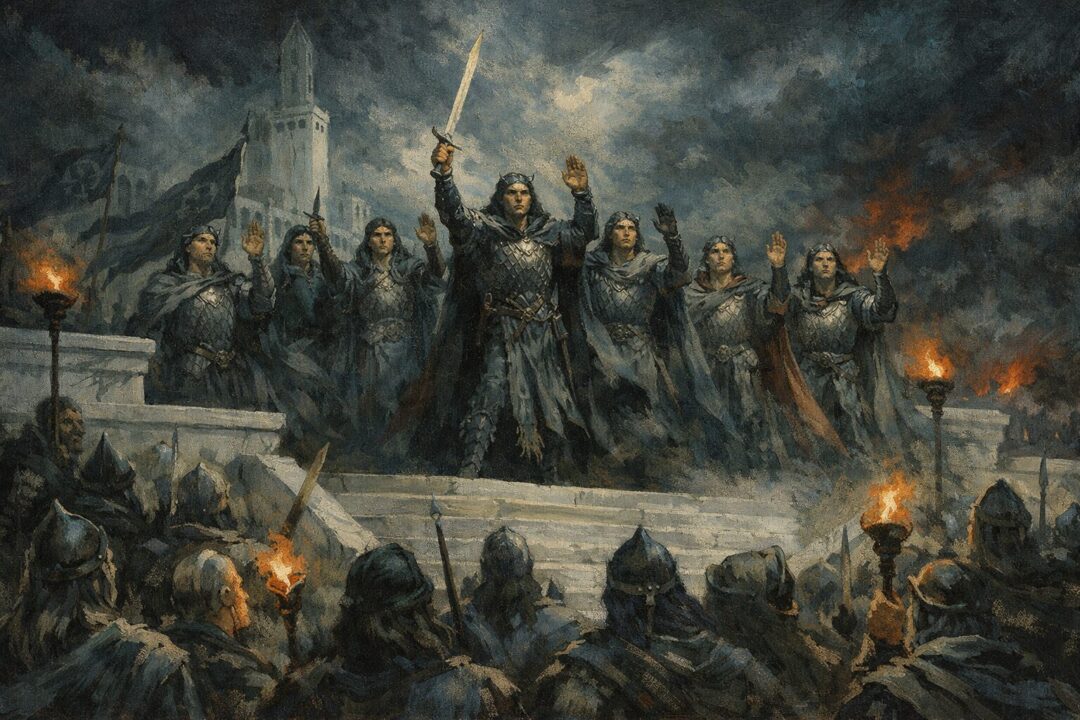
The Sons of Fëanor are easy to summarize badly.
They swear a terrible oath. They pursue the Silmarils across the First Age. Wherever the claim of that oath awakens, slaughter follows.
From a distance, the pattern can look almost mechanical. A Silmaril appears in someone else’s keeping, and the sons of Fëanor do the most catastrophic thing available.
But the texts make their tragedy darker than that.
Because they are not always shown acting instantly, mindlessly, or without warning. At key moments, there is delay. There is debate. There are messages sent before swords are drawn. Maedhros, in particular, appears at times as someone who sees more clearly than the rest and yet cannot finally break the pattern.
That is why their story matters.
The Sons of Fëanor do not keep making the worst possible choice simply because they love evil or chaos for its own sake. They keep making it because they have bound themselves to a vow so absolute that every lesser evil begins to look, from inside that oath, like necessity.
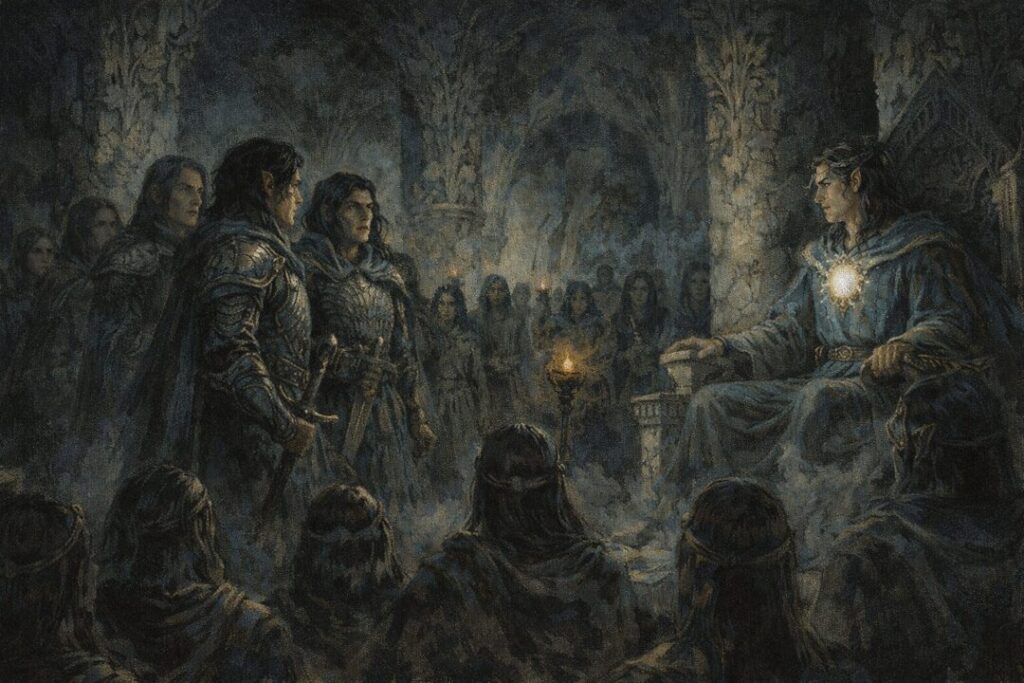
The Oath Is the Real Engine of the Tragedy
Everything begins with the Oath.
After Morgoth steals the Silmarils and Finwë is slain, Fëanor and his seven sons swear that they will pursue with vengeance anyone in Arda who keeps a Silmaril from them. The tradition surrounding it treats the oath not as brave resolve but as something dreadful, irrevocable, and spiritually destructive from the beginning.
That matters because the oath does more than give them a goal.
It changes the moral structure of every later decision.
A normal promise can be weighed against mercy, prudence, kinship, or repentance. The Oath of Fëanor is presented as something harsher. It narrows the world. Once it is sworn, the question is no longer simply, “What is right?” It becomes, “How can this vow be fulfilled without total ruin?” And the answer, again and again, is that it cannot.
This is why the sons often feel terrifying even when they are not at their most violent.
The violence is only the visible part.
The real disaster is that they have created a condition in which mercy begins to feel like betrayal of their father, betrayal of their house, and betrayal of their own spoken word.
They Are Not Blind to Consequences
One of the most important details in this whole pattern is that the Sons of Fëanor are not always depicted as charging forward without hesitation.
When word comes that the Silmaril is in Doriath with Dior, the sources indicate that the brothers hold council. Maedhros restrains his brethren at first. A message is sent demanding the return of the Jewel. Dior gives no answer. Only after that comes the attack that leads to the ruin of Doriath and the deaths of Celegorm, Curufin, and Caranthir.
That sequence is crucial.
It means the story is not written as if the brothers are incapable of pause. They can hesitate. They can delay. They can choose demand before slaughter.
But delay is not deliverance.
Because the Oath remains.
And once Dior does not yield the Silmaril, the same structure returns: either abandon the claim and become forsworn, or attack kin for the sake of the Jewel. The choice is horrible either way, but within the logic of the Oath, the second option continues to present itself as the one they are bound to take.
That is what makes their decisions feel so relentlessly bad.
Not because no crossroads exist, but because every crossroads has already been poisoned.
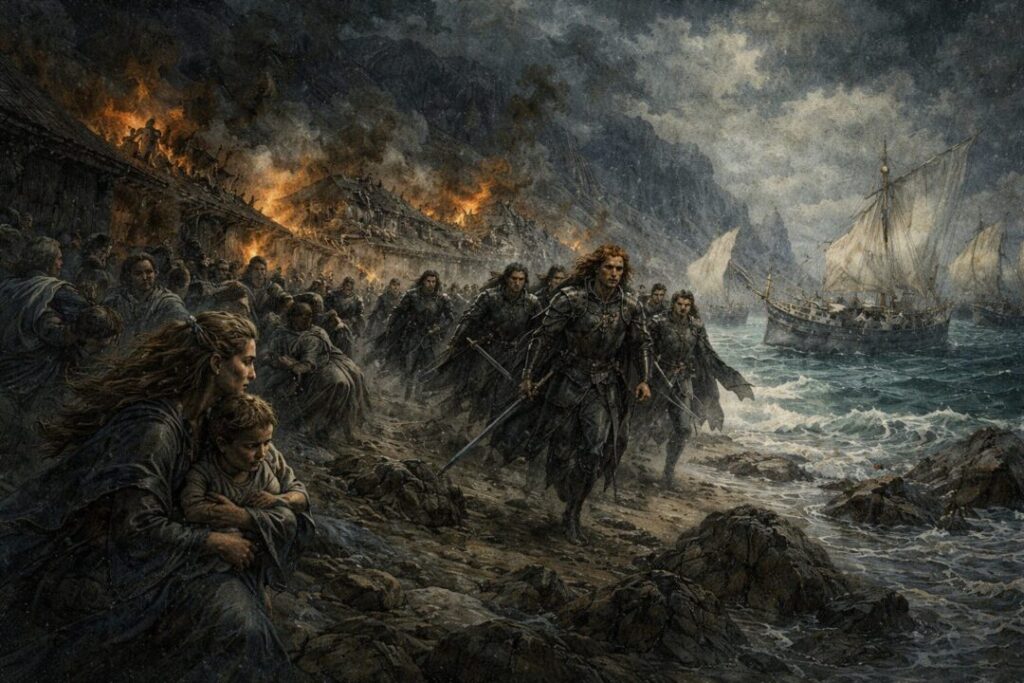
Doriath Shows the Pattern in Full
The ruin of Doriath is one of the clearest examples of this structure.
The Silmaril that Beren won from Morgoth passes, after Beren and Lúthien, into the keeping of Dior. Once the sons of Fëanor learn this, their old claim wakes again. The result is not immediate reconciliation, nor any acknowledgment that this Jewel has been recovered through sufferings wholly outside their own power. Instead, the old demand is repeated: return the Silmaril to the House of Fëanor. Dior does not submit. Doriath is attacked.
The disaster that follows is not merely military.
It is moral collapse inside the Elvish world itself.
This is already the second great kinslaying associated with Fëanor’s house. The first had come at Alqualondë, when the Noldor took the ships of the Teleri by force. Now the descendants of that same oath bring destruction into Doriath, one of the great realms of the Eldar in Beleriand. Dior is slain. Elwing escapes with the Silmaril. Doriath does not recover.
And yet even this does not free the surviving brothers.
They have committed the deed.
They have lost brothers in the deed.
And still they do not gain what they sought.
That failure is essential to understanding them.
Every escalation costs them more, but never truly resolves the claim.
Sirion Is Even Worse Because They Know More
If Doriath shows the pattern, Sirion shows its final hardening.
After Elwing escapes, the Silmaril remains beyond their reach. Later the remaining sons hear of her dwelling at the Mouths of Sirion. Again the texts record that messages are sent, asking for surrender of the Jewel. Again that request is refused. And again the Oath moves toward bloodshed.
By this point the surviving brothers have already seen what their claim has done.
They know what kinslaying looks like.
They know what it costs.
They know that no victory gained this way remains clean.
And still they attack the Havens.
This matters because it removes the last easy explanation.
They are not doing this because they still believe one decisive strike will restore honor and set things right. The sources suggest something darker: they are tormented by their unfulfilled Oath. In other words, the vow has become less like a mission and more like an affliction.
The assault on Sirion is remembered as the cruelest of the kinslayings. Amrod and Amras are slain there, leaving only Maedhros and Maglor. Elwing escapes the full design of her enemies, and from the ruin that follows come consequences that shape the end of the First Age.
The irony is almost unbearable.
The brothers keep doing the worst thing as if catastrophe might finally complete their oath.
Instead catastrophe only reduces them further.
Maedhros Is the Key to Reading the Whole Tragedy
If one brother best reveals the true shape of this story, it is Maedhros.
He is not presented as the simplest or most reckless among them. Earlier in the First Age he is capable of forming alliances, seeking unity against Morgoth, and at times restraining harsher impulses among his brothers. The tradition even preserves a point at which he forswears the oath for a time regarding Sirion, before the torment returns later.
That does not make him innocent.
He still stands among the oath-bound.
He still takes part in the later disasters.
But it does make the tragedy clearer.
Maedhros appears to understand more than enough to stop.
He simply does not stop.
That is different from ignorance. It is nearer to bondage.
The texts do not frame the Oath as mind control in any simplistic sense. The Sons of Fëanor still act, choose, deliberate, and bear responsibility. But the repeated language of torment and the repeated return to the same destructive claim strongly imply that they have created for themselves a moral prison.
And the more clearly Maedhros sees, the worse that prison feels.
Even the End Does Not Vindicate Them
The final proof that the Sons of Fëanor keep choosing ruin is that even at the end, after Morgoth’s overthrow, the pattern does not break.
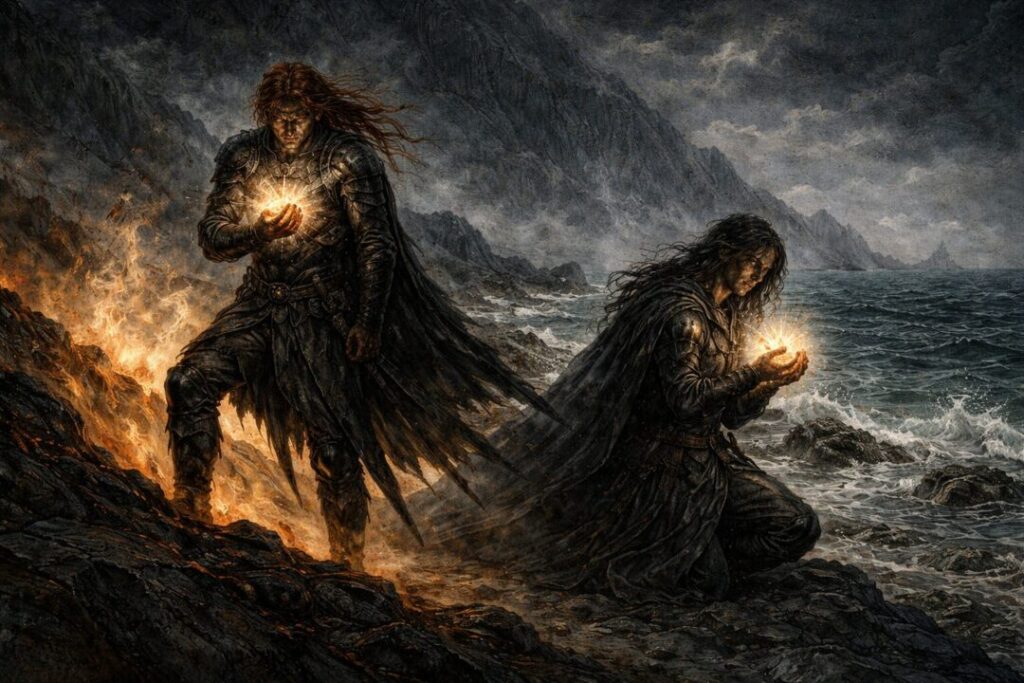
Maedhros and Maglor, now the only surviving brothers, seize the remaining Silmarils in a last desperate attempt to fulfill the Oath. But the jewels burn them. The sacred light they claimed as their inheritance rejects their hands. Maedhros throws himself with his Silmaril into a fiery chasm. Maglor casts his into the Sea and wanders in sorrow.
This ending is devastating because it reveals what their whole history has become.
They were not simply trying to reclaim stolen family treasures.
By the end, they are pursuing objects they can no longer rightfully bear.
The Silmarils themselves become a judgment.
And that judgment does not merely say, “You failed.”
It says something worse: that the oath-driven road they chose has made possession itself impossible.
So Why Do They Keep Choosing Wrong?
The simplest answer is not that they are uniquely foolish.
It is that they have sworn a vow that makes every tolerable choice feel like treason.
Give way, and they break the Oath.
Wait, and they remain in torment.
Claim mercy, and the Silmaril remains in another’s keeping.
Attack, and they preserve the claim while destroying their people.
Again and again, they choose the option that keeps faith with the Oath at the expense of everything else.
That is why they keep making the worst possible choice.
Because after the Oath, “worst” and “required” begin to overlap.
Not in any just or moral sense.
Not because the texts excuse them.
But because they have bound themselves to a standard that leaves repentance feeling like annihilation.
And in Middle-earth, that is one of the darkest forms of self-destruction there is.
Why This Story Matters
The Sons of Fëanor are not frightening merely because they spill blood.
They are frightening because they show what happens when pride, inheritance, grief, and a falsely absolute promise harden into destiny.
Their tragedy is not that no better path ever appeared.
It is that better paths did appear, and each time the Oath taught them to treat those paths as impossible.
That is why the story never reads like ordinary villainy.
It reads like a long collapse of moral vision.
By the time Maedhros and Maglor finally touch the Silmarils again, there is almost nothing left to win. Their brothers are dead. The great Elvish realms of Beleriand are ruined or gone. And the jewels themselves bring not triumph, but unbearable fire.
The Sons of Fëanor keep making the worst possible choice because they made the first one too absolutely.
Everything after that is only the echo.