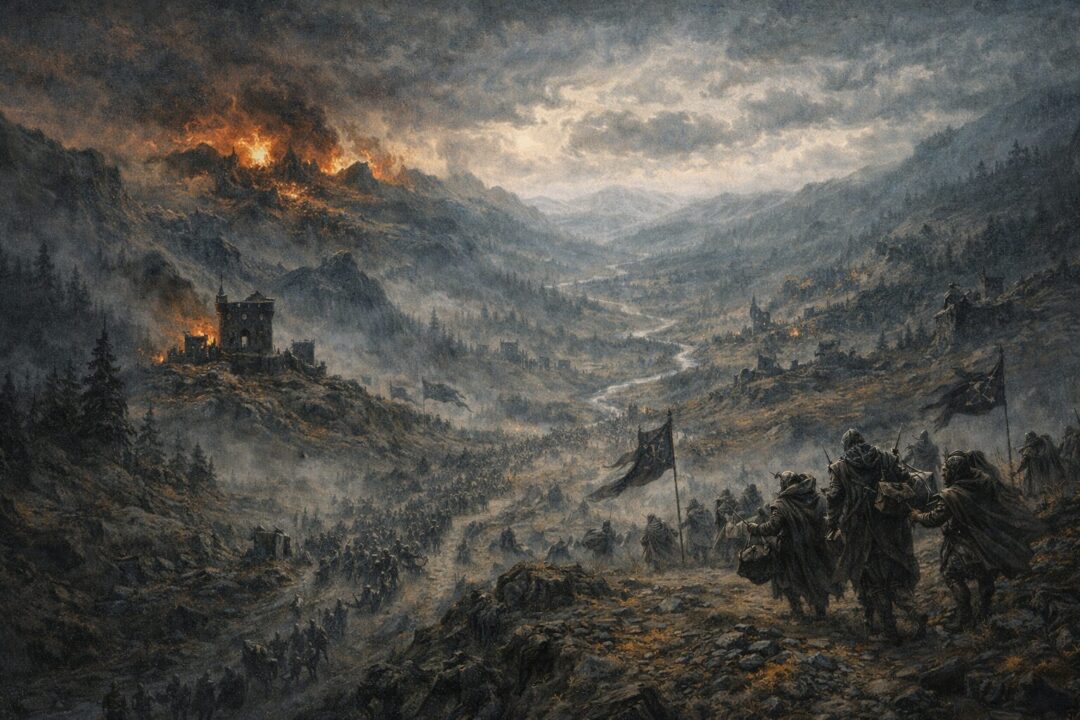
At first glance, the question feels simple.
If the Witch-king of Angmar was building a northern war against the heirs of Isildur, and if Rivendell was the chief refuge of Elrond in Eriador, why not strike Imladris first and hardest?
Why spend generations tearing at Arnor, corrupting Rhudaur, breaking Cardolan, and grinding down Arthedain before bringing the full pressure of Angmar against the hidden valley?
It is the kind of question that seems to invite an easy answer.
But the texts are more careful than that.
They do not plainly tell us that the Witch-king had already assembled the “full might” of Angmar and then consciously withheld it from Rivendell. What they do give us is a sequence: Angmar rises in the North around T.A. 1300; Arnor is already divided; Rhudaur becomes hostile; war spreads over generations; and in T.A. 1409 comes the great invasion that destroys Amon Sûl, ravages Cardolan, and drives many fugitives to Rivendell. Afterward, Elrond receives aid and Angmar is subdued for a long while.
That chronology matters more than it first appears.
Because once you follow the order of events, Rivendell starts to look less like Angmar’s obvious first target—and more like the stronghold Angmar could best reach only after the North-kingdom had already been cut apart.
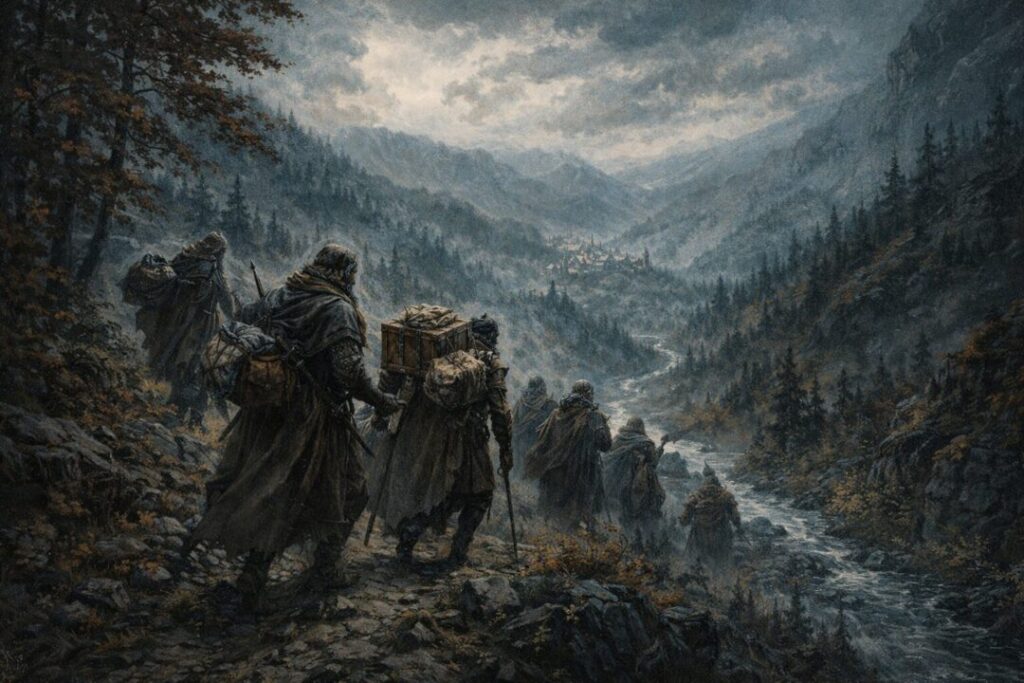
Angmar’s war begins as a war against Arnor
The first important thing is this: Angmar enters the history of the Third Age not as a wandering terror, but as a realm established in the North specifically in hostility to the Dúnedain of Arnor. The surviving account in Appendix A places its rise around T.A. 1300, when “the realm of Angmar” appears beyond the Ettenmoors and gathers evil men, Orcs, and other dark things to itself. Its long pressure falls on the fractured successor kingdoms of Arnor: Arthedain, Cardolan, and Rhudaur.
That already suggests something important.
The Witch-king does not begin with a clean map containing only one prize called Rivendell. He begins in a political landscape shaped by the breakup of Arnor. That breakup gives him openings. Rhudaur can be turned. Border struggles can be exploited. Claims over Amon Sûl can deepen division. The northern war becomes a campaign of erosion before it becomes one of annihilation.
So the simplest lore-accurate answer is not that Rivendell was forgotten.
It is that Arnor was the nearer structure to unmake.
Rivendell was important—but not the first thing that had to fall
That point is easy to miss, because Rivendell looms very large in the imagination of the later story.
By the end of the Third Age it feels central. It is where the Ring-bearer is healed. It is where the Council gathers. It is where the line of Isildur endures in secret. But in the Angmar wars, the textual emphasis falls first on the kingdoms of Men and their defensive line, especially the contested frontier around the Weather Hills and Amon Sûl.
That does not make Rivendell unimportant.
It makes it differently important.
Rivendell is a refuge. A surviving center. A place men can flee to when the outer defenses fail. And that is exactly what happens in T.A. 1409: Amon Sûl is destroyed, Cardolan is laid waste, and many of the surviving Dúnedain escape westward, some taking refuge in Rivendell.
In other words, the texts present Rivendell not first as the front line, but as what remains when the front line is broken.
That changes the logic of the war.
If Angmar’s purpose was to dismantle northern resistance, then destroying Arnor’s outer strength first was not a distraction from Rivendell. It was the process by which Rivendell became more vulnerable.
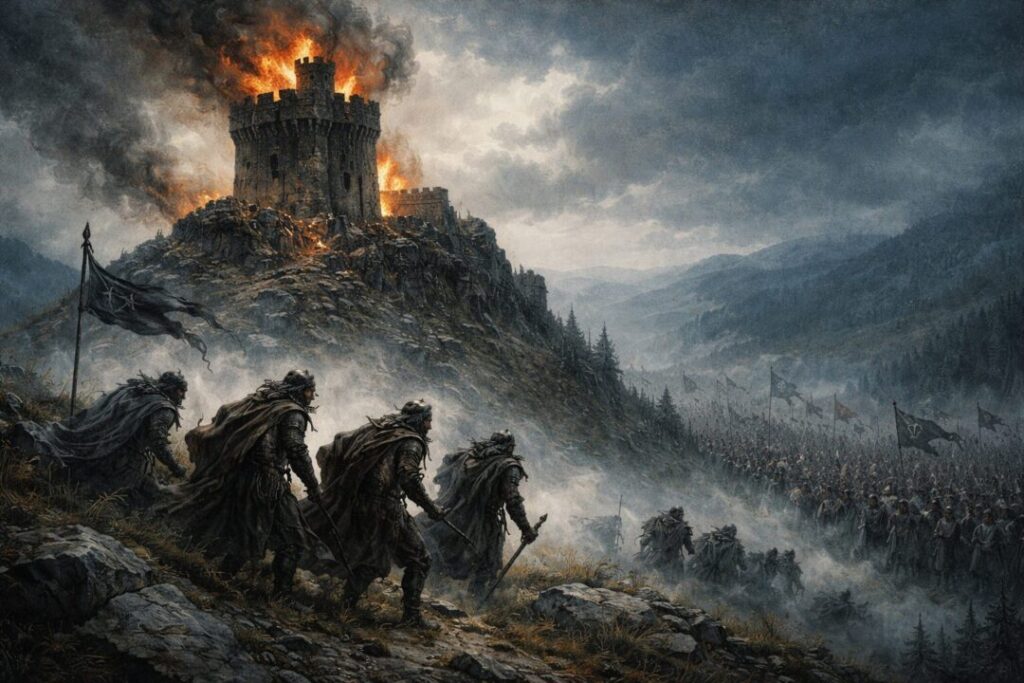
The texts suggest pressure on Rivendell came later
There is another detail that sharpens the picture.
The tradition summarized in Tolkien reference material notes that Rivendell was besieged in the late reign of Arveleg I, which places that danger close to the great crisis that culminated in the invasion of 1409. After that invasion, Elrond is said to have brought help from over the Mountains, while Círdan sent aid from Lindon, and Angmar’s power was checked for many years.
This is important because it points away from the idea of an immediate all-out northern assault on Imladris at the start of Angmar’s history.
Instead, the pressure appears to mount over time.
First Rhudaur is corrupted. Then border war intensifies. Then comes the major breakthrough at Amon Sûl and Cardolan. Then Rivendell stands in direct danger.
That is not proof of motive.
But it is the clearest pattern the chronology offers.
Why Rivendell may have been a harder target than Arnor’s frontier
This next point must be phrased carefully, because the texts imply it more than they directly spell it out.
Rivendell was not simply another city on open ground. It was a hidden refuge in the foothills near the Misty Mountains, founded in an earlier age precisely as a place of resistance and shelter. Even in the late Third Age it remains difficult for enemies to approach suddenly; the Nazgûl can reach the Ford, but not seize the house itself. That does not prove Angmar could not have attacked it earlier. But it supports the idea that Rivendell was not the easiest first objective compared with Arnor’s exposed political fractures and contested borderlands.
So when readers ask why the Witch-king did not bring everything against Rivendell earlier, one answer suggested by the evidence is this:
Because a hidden stronghold backed by Elrond was a difficult prize, while Arnor’s divided kingdoms offered a slower but more profitable path. Break Rhudaur. Pressure Cardolan. Contest Amon Sûl. Exhaust Arthedain. Turn the region around Rivendell into ruins and refuge. Then the valley matters in a different way.
That is an inference.
But it is an inference that fits the order the texts preserve.
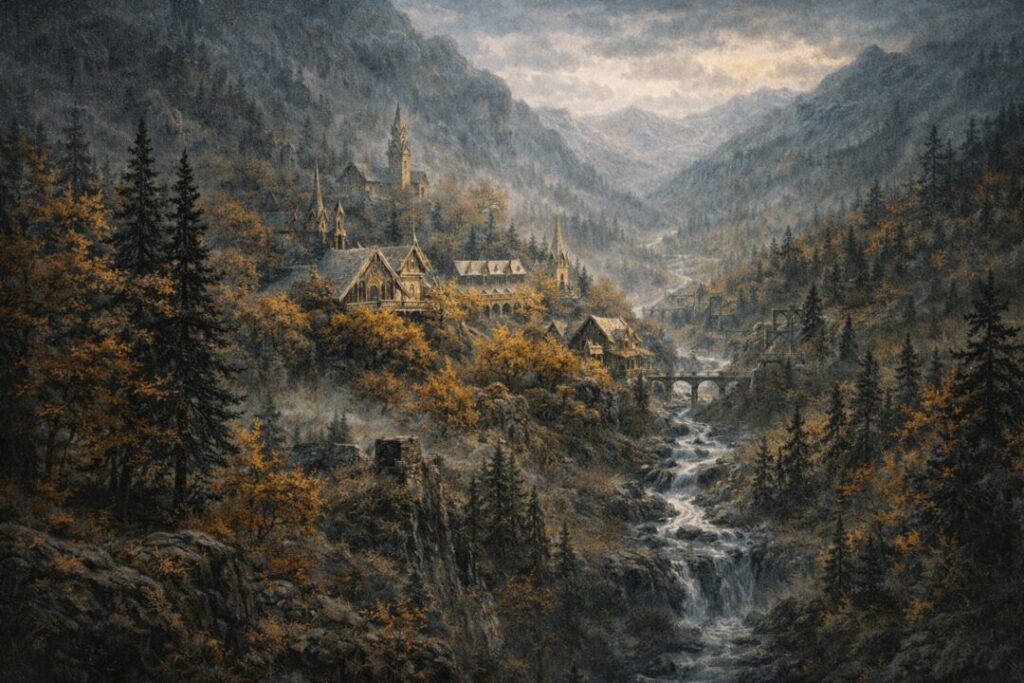
The fall of Amon Sûl explains more than people think
The destruction of Amon Sûl in T.A. 1409 is one of the most revealing moments in the whole northern war.
It is not only a military defeat. It is the collapse of a meeting point—strategic, political, and symbolic. Amon Sûl had been desired by both Rhudaur and Cardolan because it was a place of authority and observation; its loss marks the failure of any stable northern frontier. Once that tower falls, Angmar is no longer merely harrying the Dúnedain. It is breaking the architecture of their survival.
And what follows?
Flight to Rivendell.
That sequence matters. The road to Imladris is opened not because Rivendell was always the first and only target, but because everything before it has been smashed or scattered.
So the question almost turns around on itself.
The Witch-king did not need to bring the full might of Angmar against Rivendell at the beginning, because Rivendell was not isolated from the rest of the North. It was protected, indirectly, by the continued existence of the North-kingdom’s resistance. Once that resistance had been broken enough, Rivendell entered the war in a more exposed way.
And yet Angmar still did not finish the work
This is where the story becomes even more revealing.
Even after the great assault, Angmar does not simply erase Rivendell. Instead, Elrond gathers strength. Aid comes from Lindon, and forces are brought over the Mountains. The Witch-king is checked “for many years.” Much later, when Angmar is finally destroyed in T.A. 1975, a force from Rivendell under Glorfindel is still strong enough to take part in the final defeat.
That suggests a limit in Angmar’s power that is just as important as its victories.
The Witch-king could devastate kingdoms. He could exploit division. He could burn towers and ruin principalities.
But Rivendell was not just another northern holding.
It was a surviving Elvish center with deep alliances, hidden strength, and a lord who endured exactly this kind of storm. The war’s chronology implies that Angmar could pressure it, threaten it, perhaps even besiege it—but not easily extinguish it.
So why didn’t he do it earlier?
The strictest answer is this:
The texts never directly say.
But they strongly suggest that Angmar’s real campaign was the long destruction of Arnor first. Rivendell was not ignored; it was approached through the ruin of the North. The Witch-king’s war works by corruption, attrition, and fragmentation before it reaches the valley of Elrond in full crisis. And even then, Angmar fails to turn that crisis into final victory.
That is why the question matters.
Because it changes Rivendell from a missed target into something more interesting: the stronghold that becomes vulnerable only after an entire world around it has been worn down.
And even then, it does not fall.
That may be the clearest answer the northern war gives us.
Not that the Witch-king overlooked Rivendell.
But that he spent generations trying to make a world in which Rivendell could finally be reached—and discovered that even a broken North still had one refuge he could not easily master.