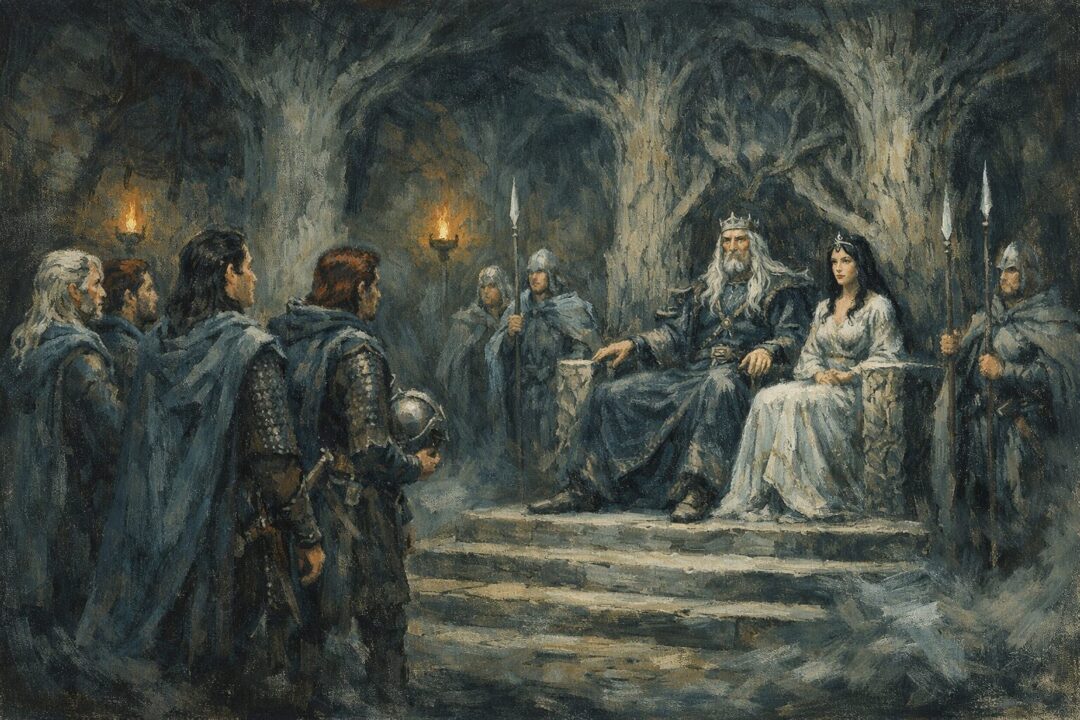
Thingol is easy to misread.
In many retellings, he appears as a proud king who resented the return of greater Elven lords to lands he wanted to call his own. He can seem possessive, suspicious, and too ready to take offense. Since later parts of his story do include serious faults, it is tempting to read his refusal of the Noldor as one more example of arrogance.
But that reading flattens the situation too much.
Thingol did not react to the Noldor in only one way, and he did not reject them for only one reason. At first, he was wary before he knew the worst. Later, when the truth of Alqualondë came out, that wariness hardened into judgment. Even then, his response was not completely indiscriminate. The texts make an important distinction between the house of Finarfin and the sons of Fëanor.
That distinction matters.
Because the deeper question is not whether Thingol was pleasant, generous, or politically graceful.
It is whether he recognized a real danger in the Noldorin return.
And on that point, the answer is much closer to yes than many readers expect.
Thingol Did Not Welcome the Noldor as Masters of Beleriand
Before Thingol learned of the Kinslaying, he was already cautious.
That is significant.
The Noldor arrived in Beleriand as a formidable force: proud princes, armed hosts, new realms in the making, and a clear intention to fight Morgoth on their own terms. To the Noldor, this likely felt justified. They had suffered loss, exile, and humiliation. They had also just won great victories over Morgoth’s Orcs soon after their arrival.
But from Thingol’s side, the sight was not so simple.
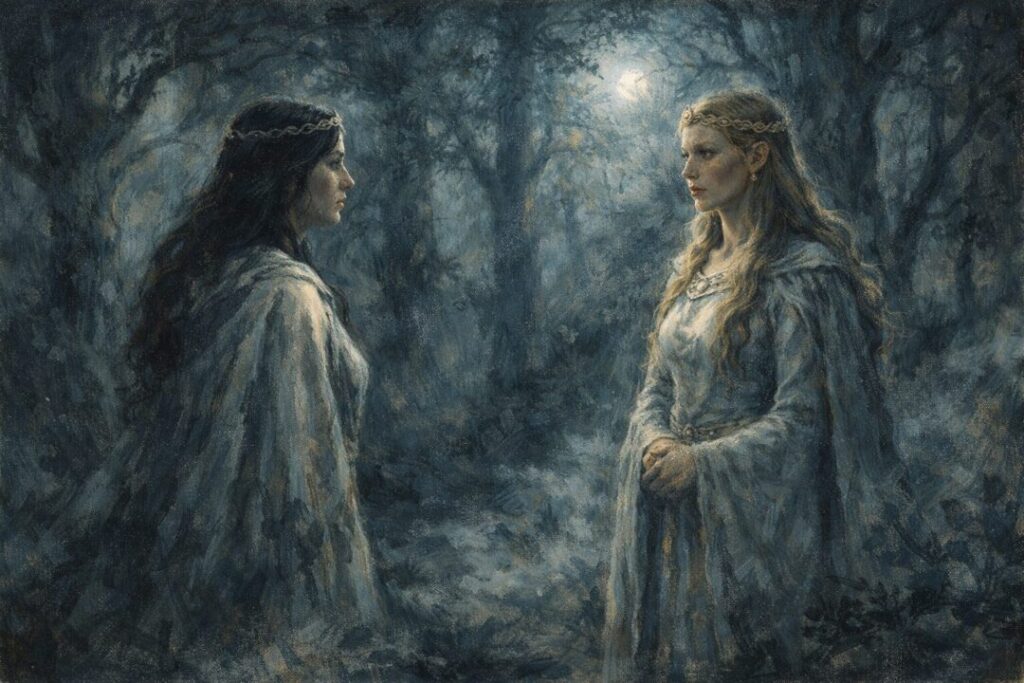
He was already king in Beleriand. The Sindar were not newcomers awaiting rescue and instruction. They were the people of the land, and Doriath was their strongest realm. So when Thingol sent word allowing the Noldor to dwell in Hithlum, Dorthonion, and the empty wild lands east of Doriath, his message was not an embrace. It was a limitation. He was drawing political boundaries and insisting that the newcomers would not simply divide Beleriand as though no one lived there before them.
This tends to be remembered as hauteur.
In part, it was.
But it was also statecraft.
Thingol saw that the Noldor were not merely refugees. They were founders, claimants, and war-leaders. He understood immediately that their arrival would reshape the map, the balance of power, and the future of every Elvish people in Beleriand. On that point, he was plainly right.
His Distrust Deepened for a Reason
The decisive change came when the truth of Alqualondë reached Doriath.
At first, the full story had been concealed. Galadriel told Melian much, but not all. Melian perceived that something dark had been left unsaid. Later, rumor and testimony brought the truth fully to Thingol: the Noldor had slain the Teleri at Alqualondë, who were Thingol’s own kin through his brother Olwë.
This was no minor political insult.
It was kin-slaying.
And not in the abstract. Thingol was not hearing that “some Elves somewhere” had done evil. He was learning that the returning princes of the West were bound up with the slaughter of his own people across the Sea.
That changes the entire moral frame.
From that moment, his suspicion no longer looks like territorial insecurity. It becomes a response to a revealed atrocity. The Noldor were not simply brilliant, wronged, and dangerous. Some among them had already crossed one of the clearest moral boundaries in the legendarium.
Thingol’s anger, in that light, is not hard to understand.
Indeed, anything less would feel strangely muted.
He Did Not Condemn Every Noldo in the Same Way
This is where the common version of the story usually becomes too broad.
Thingol did not respond by treating all the Noldor as equally guilty.
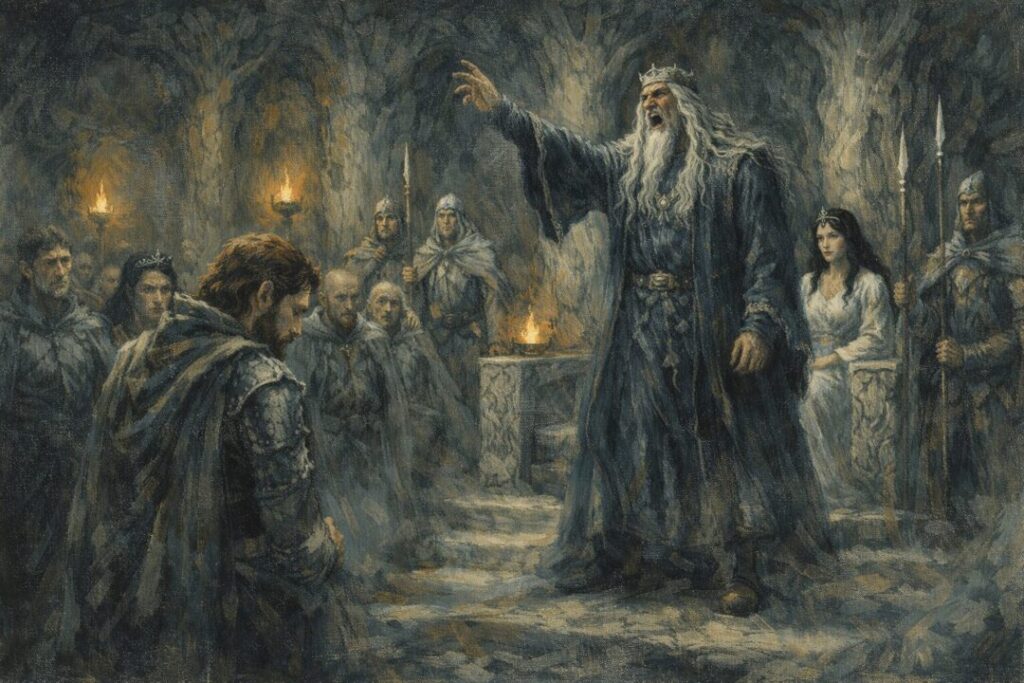
His wrath fell most heavily on the sons of Fëanor. The texts also make clear that his relations with the children of Finarfin were different. Because of their kinship through Eärwen, they were permitted to enter Doriath. His anger toward Finrod and his brothers was softened when the story was fully told. That does not mean he became trusting, but it does mean he distinguished between those most responsible and those entangled in the exile without sharing the same guilt.
That distinction is one of the strongest signs that Thingol’s judgment was not merely blind hatred.
He was harsh, but not wholly undiscerning.
This matters because it shows that his refusal of the Noldor was never simply racial or cultural rejection. He was not saying, in effect, that all Noldor were corrupt by nature. He was responding to specific deeds, specific houses, and specific dangers.
In other words, he was making a moral and political judgment, not merely indulging wounded pride.
The Ban on Quenya Was Severe, but It Was Not Random
Thingol’s ban on Quenya is one of the clearest outward signs of that judgment.
He forbade the language of the Noldorin exiles in his realm, and the effects of that decree echoed far beyond Doriath. In time, Sindarin became the common Elvish tongue in Middle-earth, while Quenya survived more as a learned and preserved language.
The ban can look excessive.
And in one sense, it was.
A language is not guilty. Many who spoke Quenya had not drawn sword at Alqualondë. The decree therefore carries an element of overreach, especially if measured against individual guilt. Thingol was making the speech of the exiles bear the mark of their rebellion and bloodshed.
Yet even here, the act was not arbitrary.
In the First Age, language is bound to identity, memory, allegiance, and legitimacy. Thingol was not only punishing. He was refusing to let the prestige of the returning Noldor set the cultural order of Beleriand. Quenya came from across the Sea with ancient glory attached to it. By banning it, Thingol denied the exiles that symbolic supremacy in his lands.
That was a political act.
It was also a moral one.
He was saying that what had happened in Aman would not be absorbed into ordinary life as though no stain lay on it.
Whether the ban was fully just is another question.
But it was not meaningless.
What Thingol Saw in the Sons of Fëanor
This is the point where his judgment looks least petty and most prophetic.
The sons of Fëanor did not leave their old fire behind in Aman.
They brought it with them.
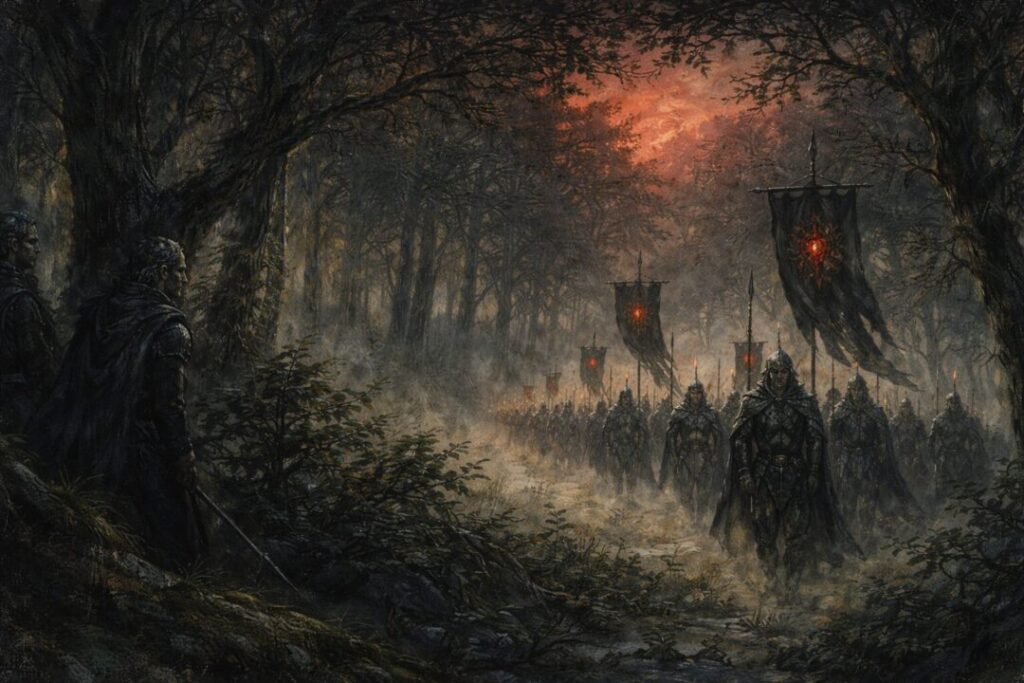
The oath remained. Their rivalries remained. Their capacity to place possession above kinship remained. And as the story unfolds, again and again, the sons of Fëanor prove that the original horror at Alqualondë was not an isolated rupture safely buried in the past. It was the first sign of what the oath would continue to do.
That matters enormously.
Because Thingol’s refusal was not based on a false intuition later disproved by events. It was based on a danger that the story repeatedly confirms. Celegorm and Curufin later brought ruin into Nargothrond’s affairs and threatened the designs surrounding Lúthien and Beren. Thingol also would not join himself to the Union of Maedhros, and the text links that refusal to the prior deeds of the Feanorians. Later still, Doriath itself would fall in the Second Kinslaying at the hands of the sons of Fëanor.
That does not mean Thingol foresaw every detail.
But it does mean he was right about the center of the threat.
He understood that the problem was not only Morgoth in the north. Another doom had entered Beleriand with the Noldorin return, and it wore a fairer face.
Why His Refusal Was Not Pure Folly
It is easy, from a strategic distance, to argue that all Elves should have united completely against Morgoth.
In abstract terms, that sounds reasonable.
But the texts do not present “unity” as a simple solution when one of the chief forces involved is internally fractured, oath-bound, and capable of treachery against its own kind. Alliances in the First Age are not strengthened merely by sharing an enemy. They are also limited by trust, and the sons of Fëanor repeatedly damage that trust wherever they go.
Thingol’s caution therefore had a rational basis.
He was not refusing aid from proven faithful allies without cause. He was keeping his realm from deep dependence on a house already marked by concealed guilt and by a claim on the Silmarils that would later consume friend and kin alike.
This does not make every choice of isolation wise.
But it does make the instinct behind it intelligible.
There is a difference between failing to join a necessary war out of vanity and refusing to bind yourself to people whose loyalties are visibly unstable. Thingol belongs more to the second category than the first.
What He Got Wrong
Still, the story is not asking us to treat Thingol as wholly vindicated.
His pride remains real.
He could be possessive, sharp in judgment, and too conscious of rank. His manner toward others was often colder than wisdom required. Later in life, especially around the Silmaril itself, he also became vulnerable to the same kind of possessive imagination that had already ruined others. So the legendarium does not invite a simple reversal where Thingol becomes the one truly clear-sighted king among fools.
He was not that.
And his ban on Quenya, though understandable, likely exceeded strict justice for some who bore no personal blame for Alqualondë. There is also a cost to standing apart. Distance can preserve a realm, but it can also narrow its horizons and harden its judgments.
So the point is not that Thingol was flawless and the Noldor deserved every coldness they received.
The point is narrower, and stronger.
On the specific question of whether the returning Noldor brought with them a real moral and political danger that Beleriand ignored at its peril, Thingol saw truly.
Why This Matters
Thingol’s refusal of the Noldor matters because it reveals something central about the Elder Days.
Greatness is not the same as trustworthiness.
The Noldor are among the most gifted peoples in all the histories of Arda. They bring knowledge, craft, heroism, splendor, and terrible courage. But they also bring exile, secrecy, wounded pride, divided loyalties, and the long poison of the oath. To focus only on their brilliance is to miss the shape of the tragedy.
Thingol did not miss it.
He may not have understood everything. He certainly did not act perfectly. But he recognized that the danger in Beleriand would not come only from black armor, iron gates, and the armies of Angband.
Some of it would come crowned, eloquent, kin to the Wise, and terrible in its own righteousness.
That is what he got right.
And once you see that, Thingol’s refusal stops looking like a king merely guarding his pride.
It starts looking like one of the earliest correct judgments in the long disaster of the First Age.