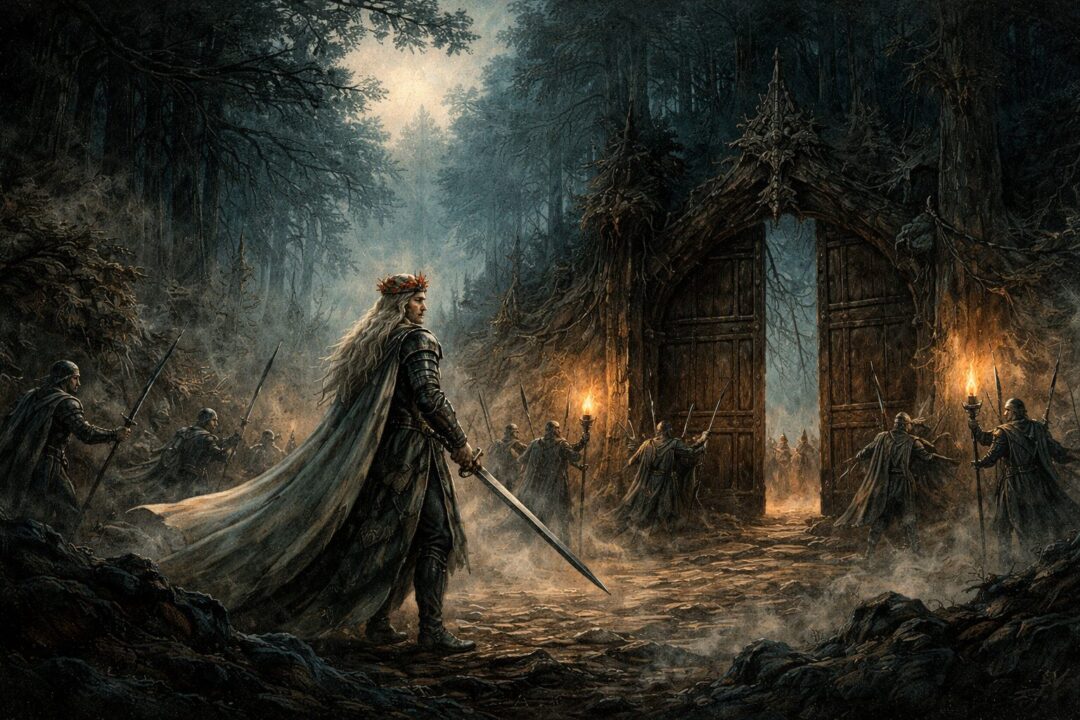
Among Tolkien’s rulers, few are judged as harshly — and as inaccurately — as Thranduil, King of the Woodland Realm. During the War of the Ring, when armies march south and the fate of Middle-earth appears to hinge on great set-piece battles, Thranduil does something that unsettles modern readers: he does not send his host to Minas Tirith. He does not ride beneath banners into Gondor. Instead, he fortifies his borders and turns inward.
To many, this feels like abandonment. To some, even cowardice.
But Tolkien does not frame it that way — and when we look closely at the wider war Tolkien describes, Thranduil’s choice emerges not as fear, but as grim clarity.
Thranduil’s War Was Already Underway
One of the most persistent misconceptions about the War of the Ring is that it happens primarily in the South. Minas Tirith. Helm’s Deep. The Black Gate. These are the moments Tolkien dramatizes most fully, but they are not the whole war.
By the time Frodo reaches Mordor, Middle-earth is under coordinated assault on multiple fronts.
In The Return of the King, Tolkien tells us explicitly that Sauron launches simultaneous attacks against the Free Peoples. While Gondor and Rohan face the full weight of Mordor’s armies, the North is not spared. From Dol Guldur, Orcs and other creatures pour into surrounding lands, striking both Lothlórien and the Woodland Realm.
Thranduil’s kingdom is not watching the war from a distance. It is fighting for its life.
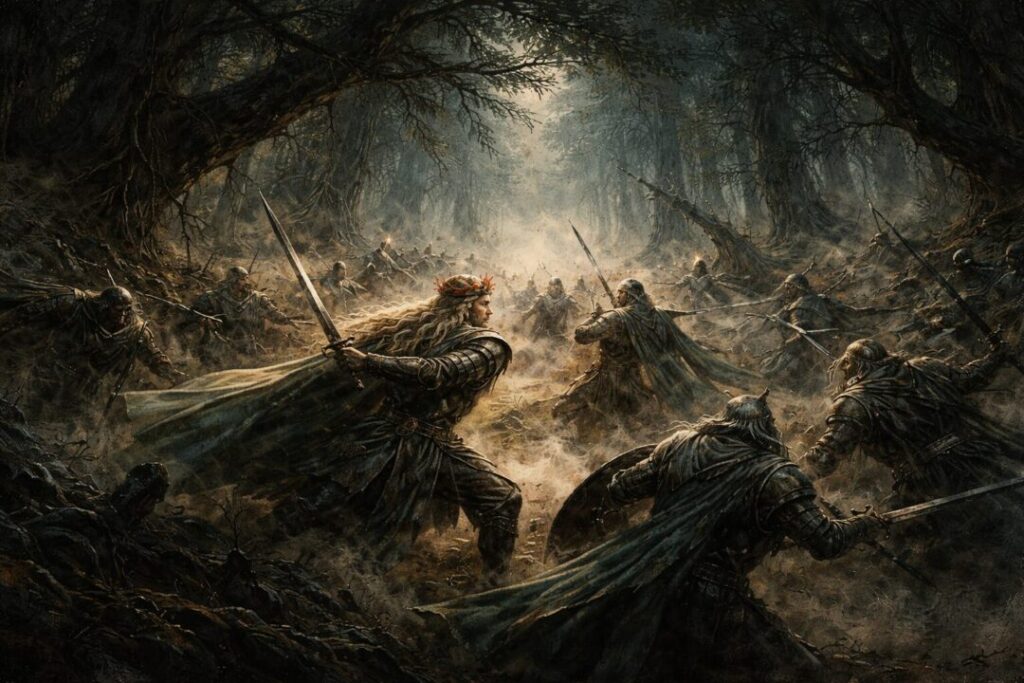
Tolkien records that the Elves of the Woodland Realm endure three separate assaults from the forces of Dol Guldur. These are not raids or skirmishes. They are sustained attacks meant to break resistance and open the forest fully to Sauron’s influence.
This is not theoretical danger. It is immediate, relentless pressure.
Had Thranduil marched south, Mirkwood would have fallen.
And had Mirkwood fallen, the entire North of Middle-earth would have been exposed.
What Mirkwood Represents
To understand Thranduil’s decision, we need to understand what Mirkwood is in the Third Age.
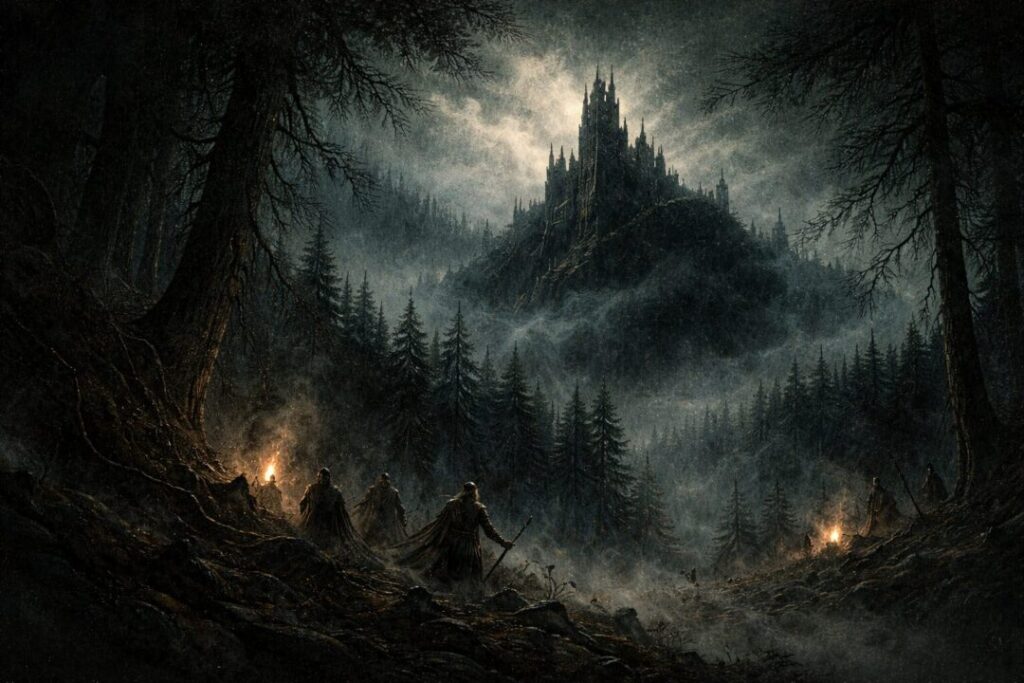
Once known as Greenwood the Great, it is already a wounded land. The shadow of Dol Guldur has poisoned its heart for centuries. Spiders, dark creatures, and fear infest its depths. Thranduil’s realm exists as a fragile pocket of light in a forest slowly succumbing to darkness.
If that pocket collapses, there is nothing behind it.
No great city. No allied realm waiting to reclaim it.
Just open land and vulnerable peoples.
Thranduil is not guarding a symbol. He is guarding a dam holding back a flood.
Memory Is the Burden of the Elves
Another crucial difference between Thranduil and many of the leaders we follow closely in The Lord of the Rings is memory.
Men remember through stories and records.
Elves remember because they were there.
Thranduil fought in the War of the Last Alliance. He stood beneath the banners of Gil-galad, the last High King of the Noldor. He watched the great coalition of Elves and Men defeat Sauron — and then watched the world fail to heal.
Kings died. Entire peoples diminished. The victory did not restore what was lost.
Tolkien emphasizes repeatedly that Elves understand decline in a way Men cannot. Their victories do not renew them. Each war, even a just one, accelerates their fading.
For Elves, there is no triumphant rebuilding phase.
There is only survival, and then departure.
So when war comes again, Thranduil does not think in terms of glory, honor, or heroic sacrifice.
He thinks in terms of preservation.
The Wisdom — and Limits — of Withdrawal
Closing borders is often read as indifference. Tolkien presents it as something more complex.
Thranduil’s strategy mirrors that of Elrond and Galadriel: protect what can still be protected, so that darkness does not spread unchecked.
Elrond does not lead armies into the South. Galadriel does not abandon Lothlórien. Each understands that their realms serve as anchors — places of resistance that prevent Sauron’s shadow from consuming everything at once.
Thranduil’s choice belongs to the same philosophy.
He is not refusing to fight.
He is choosing where to fight.
Why Thranduil Could Not Gamble
Men can afford bold risks because their world is still growing.
Elves cannot.
If Gondor falls, Men may one day rebuild it. If the Woodland Realm falls, it will not be reborn. The Elves will diminish further, scatter, and eventually leave Middle-earth altogether.
Thranduil knows this. Tolkien does not present him as blind to the suffering elsewhere — only as unwilling to sacrifice his people for a chance at victory elsewhere.
This is not selfishness.
It is triage.
The Fall of Dol Guldur Changes Everything
The strongest evidence that Thranduil was not “waiting out” the war comes after Sauron’s defeat.
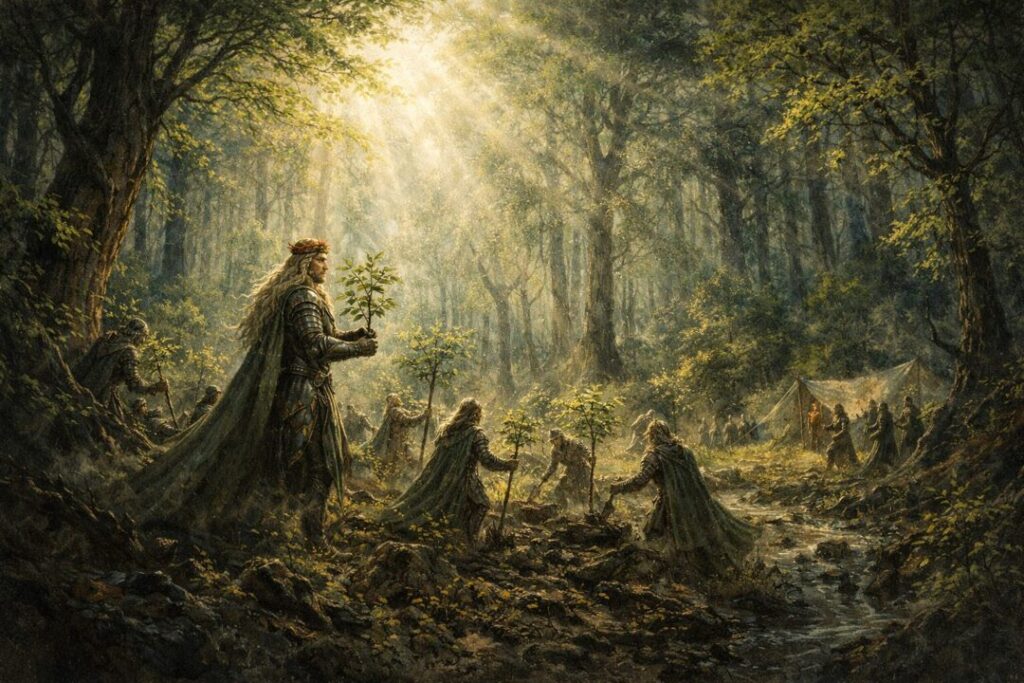
Once the Dark Lord falls and Dol Guldur is overthrown, Thranduil acts immediately. He pushes his borders south, reclaiming territory long poisoned by shadow. Greenwood is cleansed and renamed Eryn Lasgalen, the Wood of Green Leaves.
This is not the action of a ruler who avoided responsibility.
It is the action of one who was waiting for the war to end before rebuilding.
Containment first. Restoration second.
The Difference Between Elves and Men
Tolkien draws a quiet but profound contrast between Elves and Men throughout his legendarium.
Men fight for what might be rebuilt.
Elves fight knowing nothing will ever be the same again.
This is why Thranduil’s choices feel cold to some readers — and deeply tragic to others. He is not wrong. He is exhausted. He has watched ages pass and victories fail to heal the wounds they inflicted.
Tolkien does not condemn this weariness.
He honors it.
A Different Kind of Leadership
In a genre often obsessed with heroic sacrifice, Tolkien gives us something rarer in Thranduil: a ruler who understands the cost of winning.
The Woodland Realm survives the Third Age because Thranduil refused to gamble it away for distant glory. His people endure long enough to see the shadow lifted, the forest healed, and their time in Middle-earth reach a peaceful close.
That, too, is a victory.
And Tolkien leaves it to us to decide whether wisdom sometimes looks too much like withdrawal — especially to those who have never had to remember what was lost the last time the world burned.