The Shire is introduced like a promise.
It is quiet, local, almost stubbornly uninterested in the world beyond its hedges. News arrives late. Great names mean little. Even danger, at first, feels like something that happens elsewhere.
That is why the ending matters.
Because Tolkien does not allow the Shire to remain a sealed garden.
He allows it to be touched—scarred—made briefly into a battlefield.
And he insists, in his own foreword, that this was not an optional flourish. “The Scouring of the Shire,” he says, was “an essential part of the plot, foreseen from the outset,” even if it was later “modified” as Saruman’s role developed.
If you want to understand why the Shire must be defended at the end, you have to see what kind of story The Lord of the Rings is trying to complete.
Not only a quest.
A return.
A journey can’t end in a far country
The War of the Ring ends where it must: at the Cracks of Doom.
But the story of the Hobbits does not end there, because their beginning was not there.
It began in a small land where people believed history was something you read about, not something that entered your lane at night.
So if the Hobbits are changed—if they have truly crossed the world and come back different—then the narrative needs one more proof.
Not a speech.
Not an honor.
A test that can only happen at home.
The Shire becoming dangerous is the outward journey’s answer to a simple question:
What does courage mean when it is no longer “over there”?
Because it is easy, in a tale of distant mountains and ancient towers, to treat evil like a foreign climate.
The Shire chapter refuses that comfort.
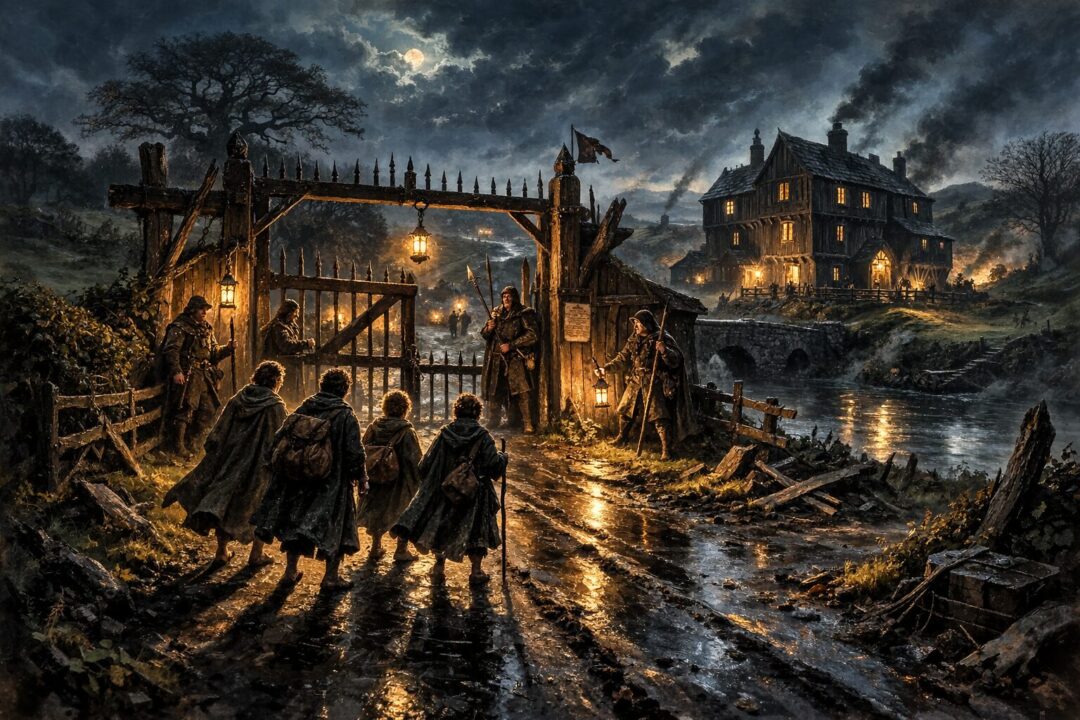
The first sign is not an Orc—it’s a gate
When Frodo, Sam, Merry, and Pippin come back over the Brandywine, the shock is not a battlefield of bodies.
It is administration.
Rules. Barriers. Watchmen.
A spiked gate stands on the Bridge, and beyond it are new houses, “gloomy and un-Shirelike,” with narrow windows and straight sides.
This is important.
Tolkien does not bring Mordor home by making it look like Mordor.
He brings it home by making home feel slightly wrong: fenced, controlled, joyless, and afraid.
The Shire has not been conquered in the manner of Gondor.
It has been reduced.
And that reduction is exactly the kind of evil Hobbits might tolerate at first—because it arrives with explanations, and because it asks for small surrenders before it asks for larger ones.
That is why the chapter begins with a gate, not a massacre.
“Worse than Mordor” and why that line exists
Sam’s reaction is one of the most quoted in the entire ending:
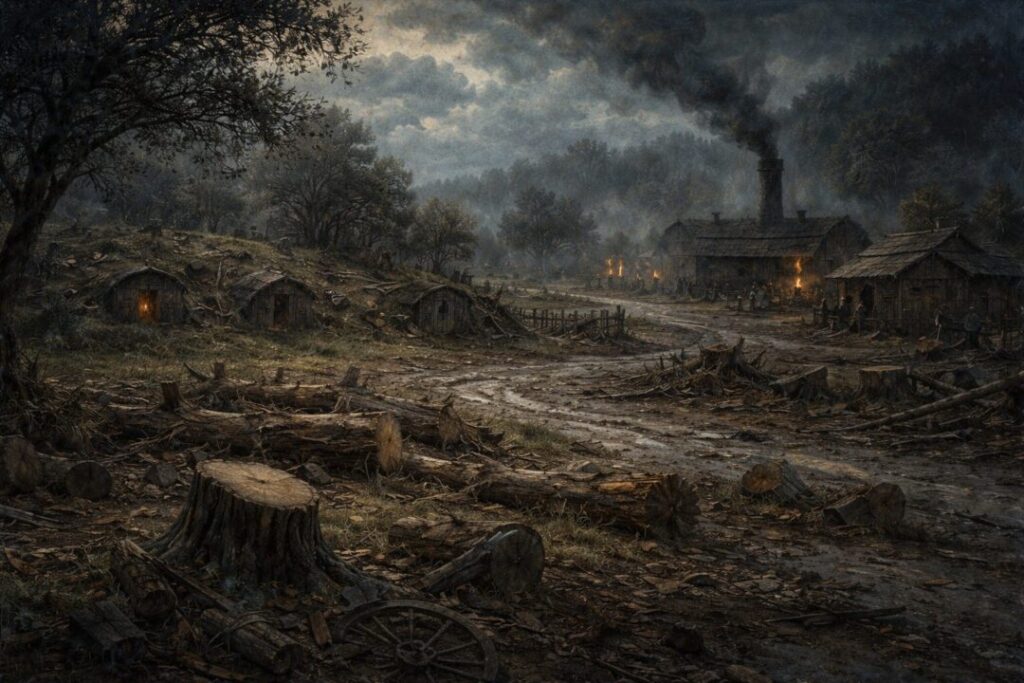
“This is worse than Mordor… Much worse in a way. It comes home to you… because it is home, and you remember it before it was all ruined.”
The power of the line is not that Sam suddenly prefers distant horror to local harm.
It’s that memory becomes a weapon against you.
In Mordor, you expect ruin.
In the Shire, ruin feels personal—almost insulting—because you carry a picture of what it should be. The wound is not just what is happening; it is the contrast with what was.
That contrast is structural.
The story began with a world so safe that the greatest danger seemed to be an overdue birthday present.
Now it ends with that world asking: will you defend me?
And if you do… what kind of defender will you become?
Shock is not enough
One of the most quietly clarifying moments comes when Merry tells Frodo what the Shire requires now:
“If there are many of these ruffians… it will certainly mean fighting. You won’t rescue Lotho, or the Shire, just by being shocked and sad.”
This line is doing more than stiffening resolve.
It marks the boundary between two kinds of goodness.
There is a kind that feels the right feelings.
And there is a kind that acts, at cost, to stop harm.
The Shire’s final crisis forces the Hobbits to choose the second kind.
Not because they want to be warriors, but because their land has been treated like something that can be managed by fear.
The “home must be defended” thesis is not a call for glory.
It is a refusal to outsource responsibility forever.
Why the Shire cannot be saved by Gandalf
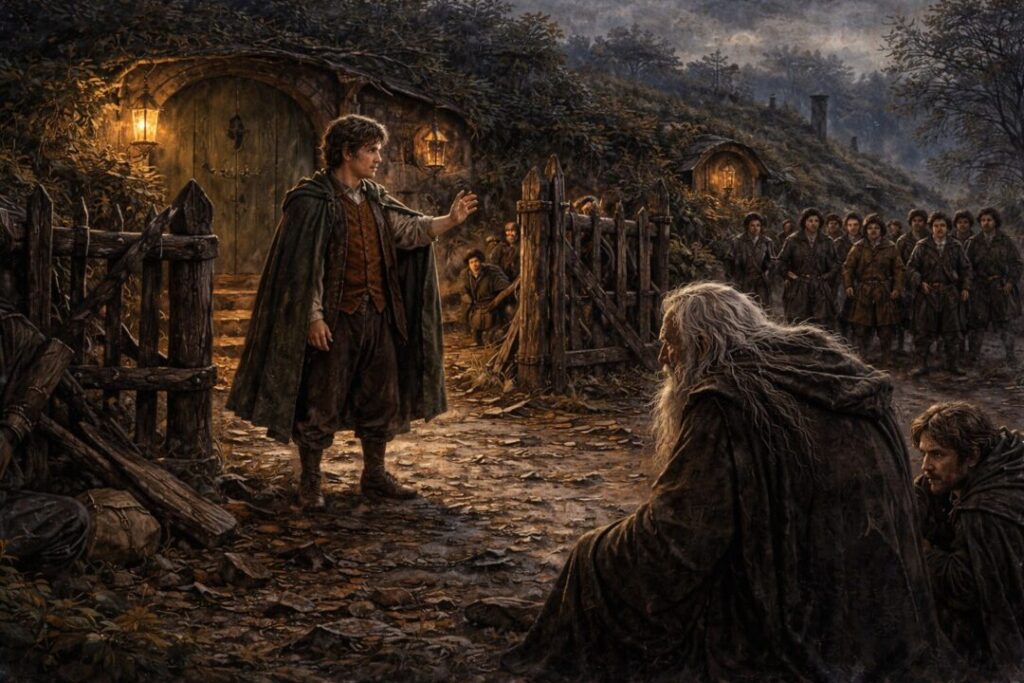
If the Shire is to be defended, it cannot be defended by outsiders.
Not in this story.
A final rescue by Wizards, Kings, or Elves would turn the Hobbits back into what they were at the start: small people swept along by large events.
But the point of the quest was never only that the world needed saving.
It was that the Hobbits needed to grow large enough—inside themselves—to save what was theirs.
So when the crisis arrives, the narrative does something precise.
It makes the danger local.
It makes the stakes intimate.
And it makes the defenders the people who once could not imagine defending anything.
This is why the chapter feels “smaller” than Pelennor, yet remains essential.
It is the same moral story, but scaled down until it can happen in a kitchen, a lane, a mill-yard, a Party Field.
Because if the moral can’t survive in ordinary life, then it was never truly learned.
The battlefield is real—but it’s not the whole point
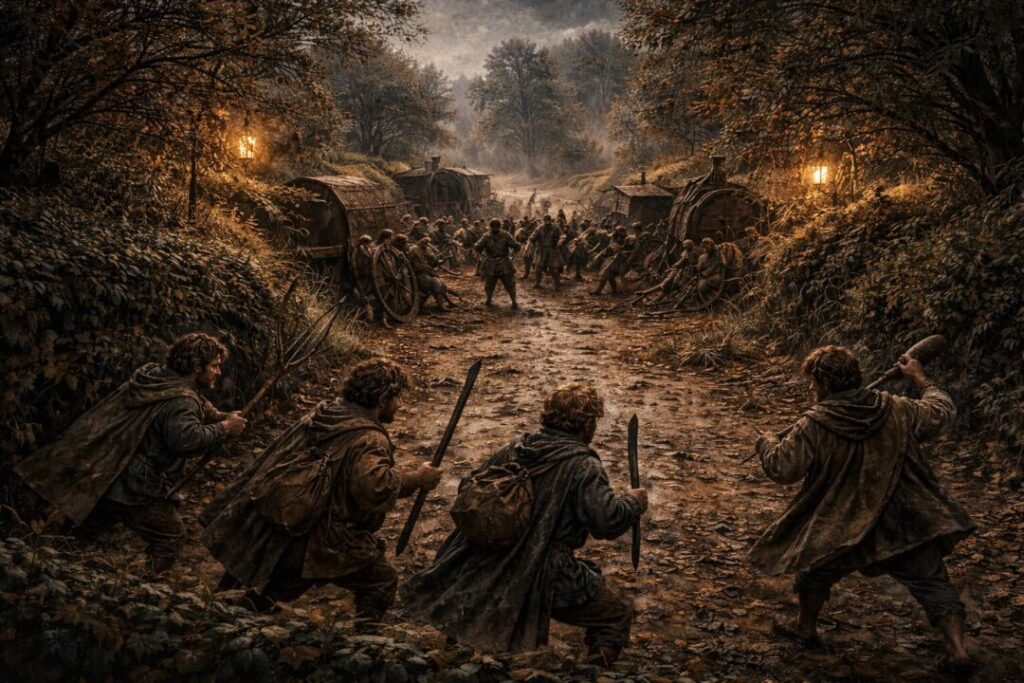
Yes, there is fighting.
There is a real battle at Bywater, with real deaths.
The Shire does not escape the cost of resistance.
But Tolkien does something unusual with Frodo.
He returns with authority, not appetite.
When violence becomes possible, Frodo’s defining act is restraint.
Other Hobbits are ready to kill; Frodo repeatedly refuses needless bloodshed and insists on mercy even toward those who have harmed them. (The text is explicit that Frodo does not take part in the fighting at Bywater, and later forbids killing in the Shire’s “clearing up.”)
That choice is not presented as weakness.
It is presented as the wound the quest left in him—and also as the highest lesson he brings home.
So the Shire is defended two ways at once:
By the readiness to fight when fighting is necessary.
And by the refusal to let victory become cruelty.
This is where the ending stops being a simple “local adventure” and becomes the final statement of the journey.
Why it had to be Saruman’s kind of evil
The foreword note matters: Tolkien says the “Scouring” was foreseen, but later modified by Saruman’s developed character.
That implies something important without over-claiming it.
The story needed a home crisis.
But the particular shape of that crisis—petty rules, spiteful ruin, mean-spirited destruction—fits Saruman as he becomes in the narrative: reduced from would-be ruler to bitter vandal.
It is not a new Dark Lord.
It is a fallen power lashing out where it still can.
That kind of evil is exactly what can creep into a place like the Shire: not an army that storms the borders, but men who take over mills, cut down trees, and make fear feel normal.
The Shire becomes a battlefield because battle is what’s required when intimidation becomes law.
And it becomes a moral testing-ground because the Hobbits must prove they can resist without becoming what they resist.
The real structural necessity: victory must be kept
Destroying the Ring ends Sauron.
It does not end the need for courage.
That is one of the harshest truths in the entire book, and the Shire ending embodies it.
If the War of the Ring ends and the Shire is instantly restored untouched, then the reader is tempted to believe evil is only a distant thing—something defeated once, somewhere else, by someone greater.
The “battlefield” ending denies that fantasy.
It says: even after the great victory, your small world can still be threatened.
So what will you do then?
The answer is not: wait for the next Wizard.
The answer is: become the kind of person who can stand up in your own lane, among your own trees, and say: not here.
And then, when the fighting ends, the deeper question arrives—quietly, but relentlessly:
Can you rebuild without bitterness?
Because the Shire is not only defended.
It is repaired.
And if you follow the story into the aftermath, the restoration is not magic that erases pain.
It is labor, planting, and time.
Which is to say: the final victory is not the battle.
It is the decision to love the Shire enough to do the long work after.
That is why Tolkien lets the Shire become a battlefield.
Not to extend the action.
But to complete the meaning of the return.