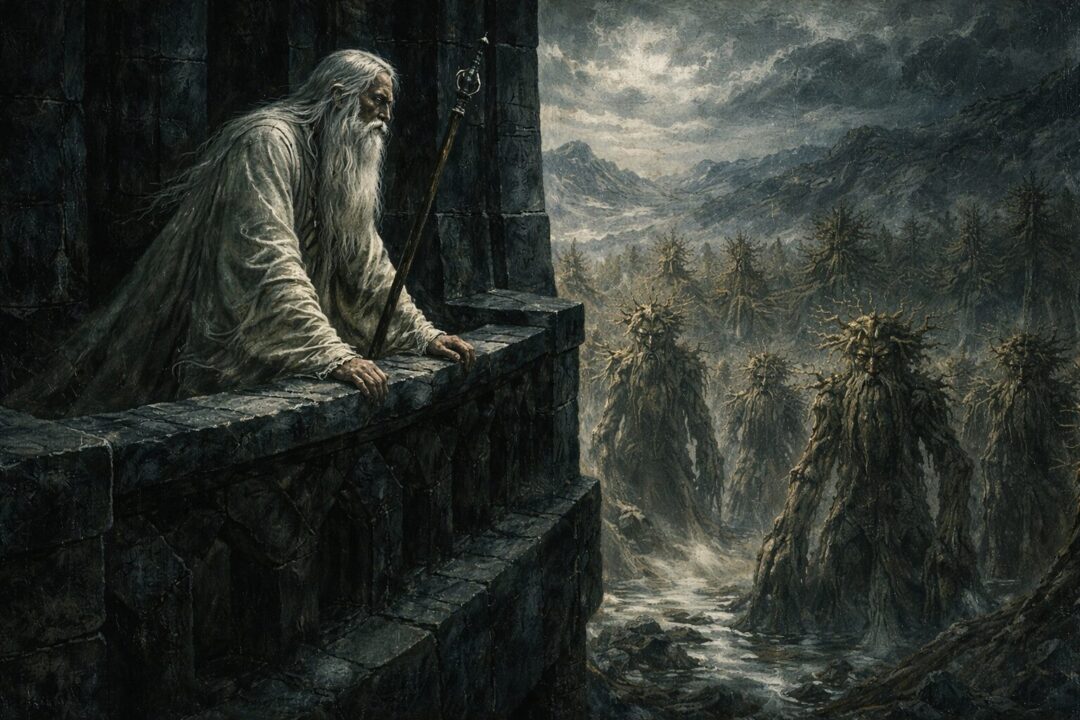
When Isengard falls, Saruman’s power is effectively ended.
His armies are scattered.
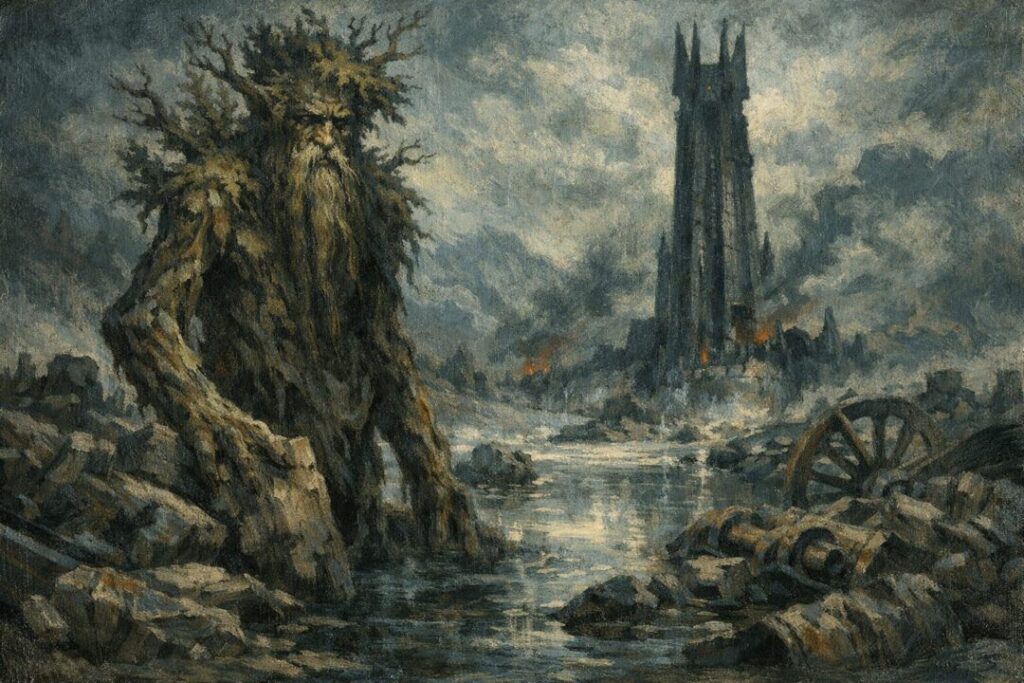
His war-machines lie broken and drowned beneath the waters of the Isen.
The ring of stone that once protected Orthanc is flooded, choked with debris and the wreckage of industry.
And the tower itself—black, smooth, and impregnable—stands surrounded by Ents who could, if they chose, tear it down stone by stone.
Yet Saruman survives.
Not only that—after a time, he is allowed to leave Orthanc under guard, free to wander Middle-earth.
For readers who expect clear moral accounting, this moment is deeply unsettling. Saruman’s crimes are vast, deliberate, and ongoing. He has ravaged forests, enslaved and deceived peoples, bred armies, betrayed his allies, and sought mastery over the Free Peoples through domination rather than wisdom. Even Gandalf, once his equal, calls him “a broken staff,” acknowledging both his defeat and his continued danger.
So why does Treebeard permit his release?
The answer lies not in sentimentality or oversight, but in how The Lord of the Rings frames authority, judgment, and restraint—especially among ancient beings who understand the cost of power better than most.
The Ents Are Not Judges by Nature
The Ents were not created to rule, to judge, or to punish.
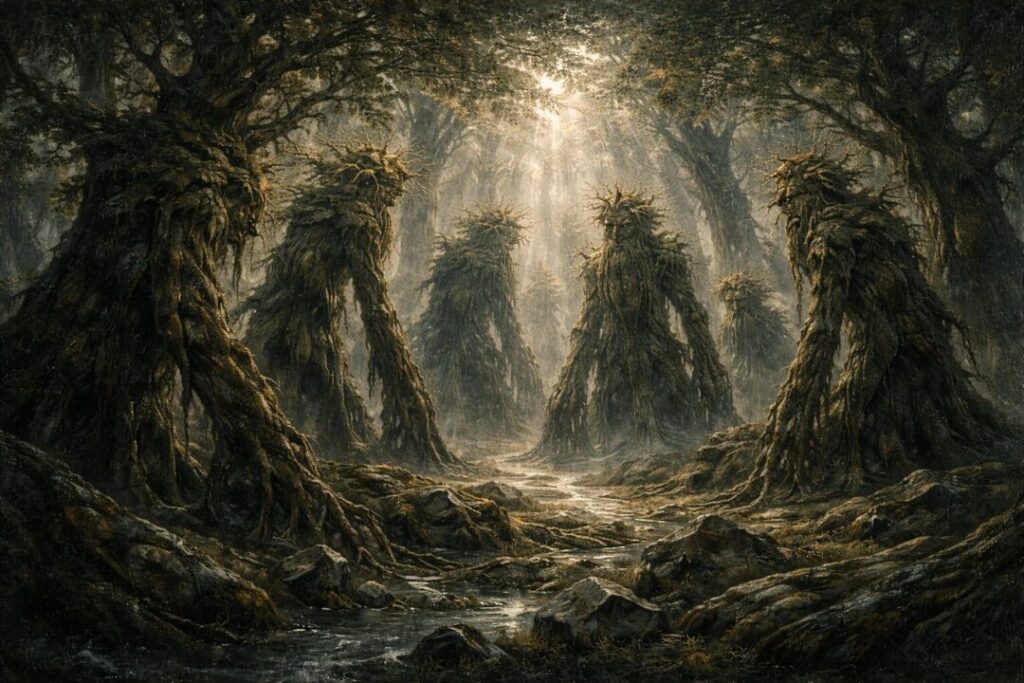
Their purpose, as described in the text, is guardianship: of trees, of forests, and of the slow, living rhythms of the natural world. They are shepherds, not kings. Even their speech reflects this—measured, deliberate, and resistant to haste.
War, for the Ents, is not a normal condition. It is an aberration.
Treebeard makes this clear when he explains how difficult it is to rouse the Ents to action. The Entmoot takes days not because the Ents are indecisive, but because they understand that once they act, the consequences will echo for ages. Their slowness is not weakness; it is moral caution.
Executing Saruman would not simply be an act of justice. It would represent a fundamental shift in what the Ents allow themselves to become.
To kill Saruman deliberately—after his defeat—would mean claiming the authority to judge and execute one of the Children of Ilúvatar. That role has never belonged to them. Treebeard understands that once such a line is crossed, it cannot easily be uncrossed.
This reluctance is never stated as a written law. Tolkien does not give us an explicit Entish code forbidding execution. But the text strongly implies it through Treebeard’s tone, his repeated warnings against haste, and his discomfort with decisive final judgment—even when anger is justified.
The Ents go to war to stop destruction. They do not go to war to dominate the fate of others.
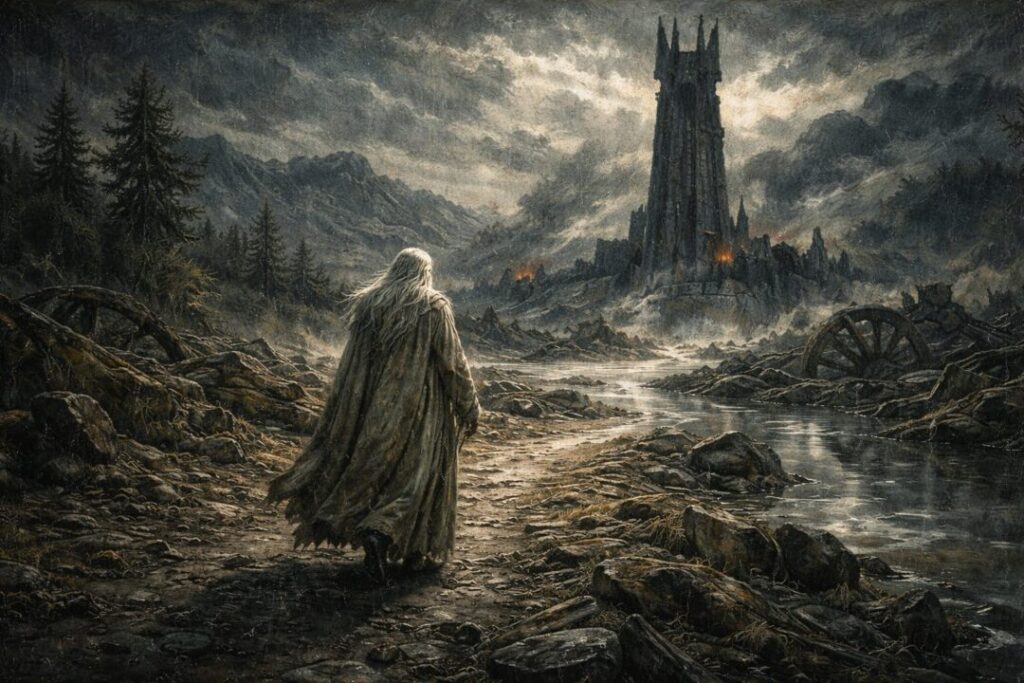
Saruman Is Already Judged
Another crucial detail is often overlooked: by the time Treebeard considers Saruman’s fate, Saruman has already been judged.
Gandalf confronts him at Orthanc.
Saruman’s staff is broken.
His title as the head of the White Council is revoked.
And his voice—once capable of bending the wills of the wise—loses its authority.
This moment is not merely symbolic. In Tolkien’s world, authority is not just political or military; it is moral and spiritual. Saruman’s power rested on his role, his wisdom, and the trust placed in him. Once those are stripped away, he is no longer what he was.
From the Entish perspective, this matters deeply.
Saruman is no longer a rival power standing in opposition to Fangorn. He is a fallen figure—still capable of harm, but diminished, exposed, and stripped of legitimacy. Treebeard recognizes this change. Saruman is dangerous, but he is no longer worthy of the kind of decisive, identity-altering judgment that execution would represent.
To destroy Saruman outright would be to treat him as something he is no longer: a dark lord commanding armies, rather than a disgraced manipulator clinging to remnants of pride.
Mercy Is Offered—But Never Trust
It is essential not to romanticize Treebeard’s decision.
Saruman is not forgiven.
He is not trusted.
He is not restored.
He is watched. Restricted. Reduced.
Treebeard places conditions on his freedom and makes it clear that further wrongdoing will not be tolerated. The Ents do not pretend that Saruman has changed. They simply refuse to become executioners in order to remove him.
This distinction matters.
Tolkien consistently portrays mercy not as the absence of consequences, but as the refusal to claim absolute authority over another’s fate. Mercy does not erase guilt. It does not restore what was lost. It simply leaves room for judgment to unfold without force.
In Saruman’s case, that judgment is devastating.
By sparing him, Treebeard does not save Saruman from downfall. He ensures that Saruman’s downfall is complete.
Saruman’s True Punishment: Diminishment
Saruman’s final fate is not death at Isengard, but something far more aligned with Tolkien’s moral structure.
He becomes small.
He wanders.
He begs.
He schemes without influence.
He is mocked, ignored, and eventually reduced to petty tyranny in the Shire.
This trajectory is not presented as accidental.
Once stripped of greatness, Saruman cannot endure it. His pride—always his greatest flaw—consumes what remains of him. He cannot accept obscurity. He cannot accept limits. And so his evil collapses inward, turning mean, small, and spiteful.
By the time of his death, Saruman is no longer a world-shaping threat. He is a bitter shadow of what he once was—feared by no one, respected by none, and destroyed not by heroes in battle, but by the consequences of his own corruption.
Treebeard does not foresee every step of this outcome. The text does not claim that he predicts Saruman’s end in detail. But the narrative strongly implies a broader principle: that evil, when stripped of power, often destroys itself.
This is not weakness on the part of good. It is restraint.
Why This Matters
Treebeard’s decision echoes one of the central moral tensions running throughout The Lord of the Rings.
Absolute justice is dangerous.
Those who claim the right to decide life and death—even for righteous reasons—risk becoming what they oppose. The temptation to end evil through domination is always present, especially after victory.
The Ents resist that temptation.
They fight when they must.
They stop destruction when it threatens what they guard.
But they refuse to turn victory into tyranny.
In the end, Saruman is not spared because he deserves mercy.
He is spared because Treebeard understands that the moment the Ents claim the right to destroy a defeated enemy, they cease to be what they were made to be.
And in Tolkien’s world, that restraint matters more than retribution.
Not because evil should go unpunished—but because the cost of becoming judges over life and death is often greater than the evil such judgment seeks to destroy.