
When people speak of terror on the battlefields of Middle-earth, Trolls often dominate the imagination. Towering, destructive, and seemingly unstoppable, they appear to represent the pinnacle of brute force unleashed by the Shadow. Their presence alone could shatter morale, break gates, and scatter inexperienced troops. Yet a closer reading of the events of the The War of the Ring reveals a different truth. Again and again, it was not the largest or strongest creatures that proved decisive, but those shaped for endurance, discipline, and sustained warfare. In practice, the Uruk-hai were far more effective, adaptable, and strategically valuable than Trolls ever were.
This difference is not accidental. It begins with how each was conceived, bred, and ultimately deployed in war.
How Trolls and Uruk-hai Were Made for Battle
Trolls were ancient beings, corrupted long before the final struggles of the Third Age. Though fearsome, they were never refined instruments of conquest. Their strength was immense, but their minds were slow, their reactions limited, and their dependence on direct command absolute. For much of their history, Trolls could not even endure sunlight, a crippling weakness that restricted their usefulness to night assaults, sieges, or subterranean warfare.
Later breeds such as the Olog-hai mitigated some of these flaws, particularly their vulnerability to daylight. Yet these improved Trolls were rare and appeared late in the conflict. Even then, they remained heavily reliant on orders from stronger wills. Without leadership, Trolls often stalled, raged without purpose, or became dangerously unpredictable to their own allies.
The Uruk-hai, by contrast, were bred explicitly for war. Created in Isengard under Saruman’s direction, they represented a deliberate evolution of Orc-kind. Larger, stronger, and hardier than common Orcs, Uruk-hai were designed for prolonged campaigns rather than isolated acts of destruction. Their most significant advantage—the ability to march and fight in full daylight—fundamentally transformed battlefield logistics.
This alone cannot be overstated. An army that can move by day controls tempo, chooses engagements, and denies its enemies rest. Uruk-hai were not merely stronger Orcs; they were soldiers, shaped to operate as a coherent military force.
Discipline, Endurance, and Formation
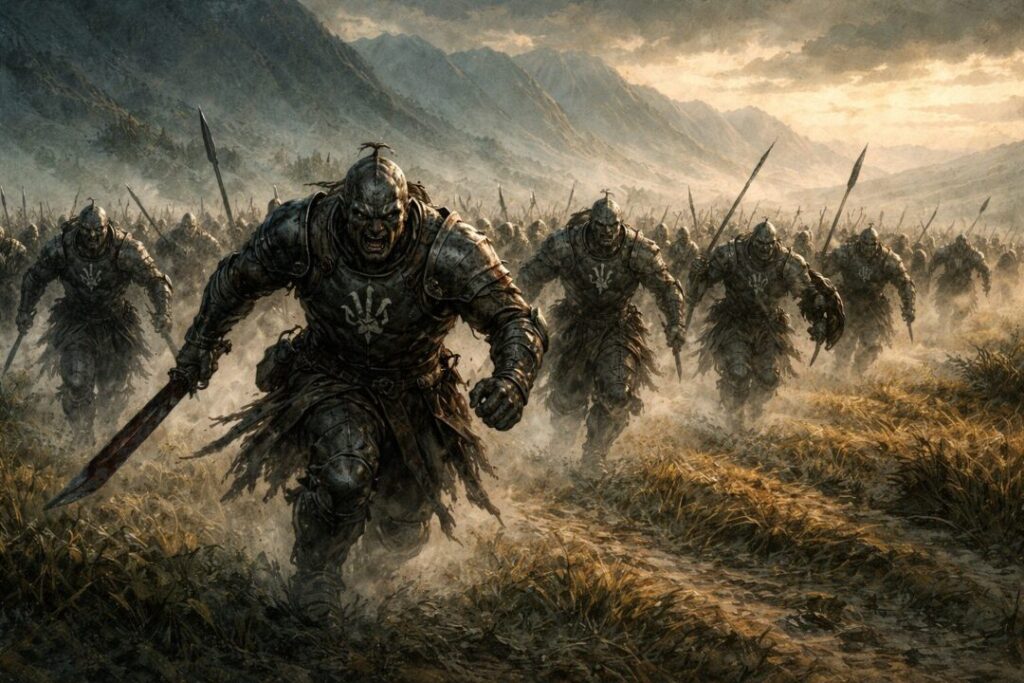
Nowhere is this difference more clearly illustrated than in the pursuit of Merry and Pippin after the fall of Amon Hen. The Uruk-hai crossed vast distances at a punishing pace, maintaining cohesion while carrying captives and engaging multiple enemies. They argued among themselves, certainly, but they did not scatter. Even when wounded or exhausted, they pressed on, driven by discipline and the certainty of purpose drilled into them.
This was not an isolated incident. Uruk-hai repeatedly demonstrated the ability to march for days with minimal rest, hold formation under pressure, and continue fighting even when leadership changed or casualties mounted. Their strength lay not in individual prowess, but in collective endurance.
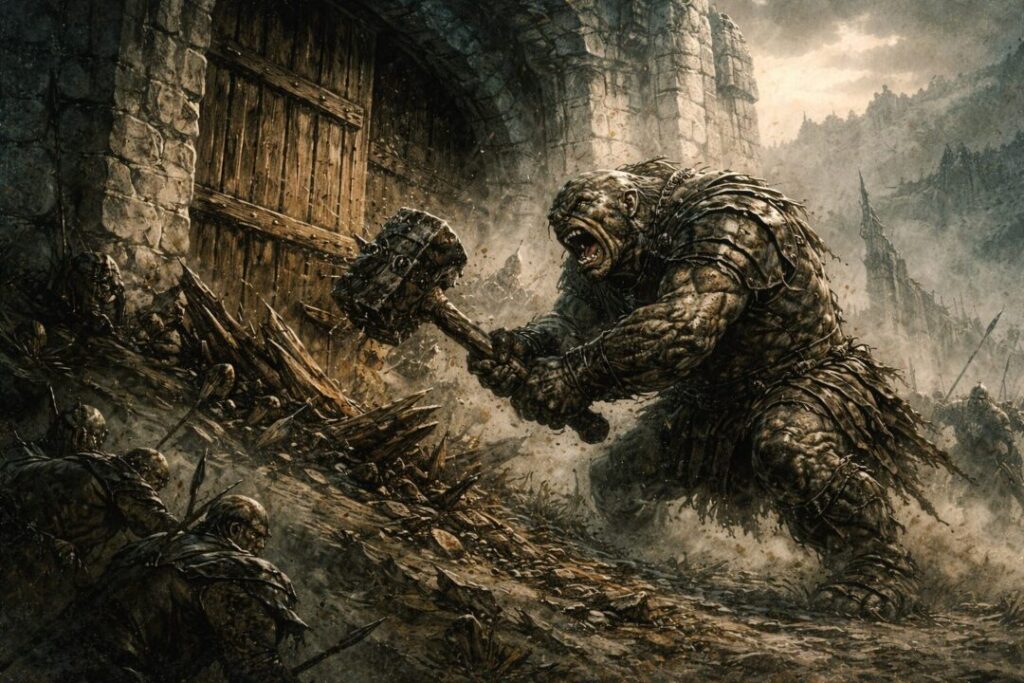
Trolls, by contrast, rarely operated independently or for extended campaigns. At the Pelennor Fields, Trolls smashed gates, hurled stones, and sowed terror among defenders. Yet they required constant direction. When command structures faltered or circumstances shifted, their effectiveness diminished rapidly. Trolls were devastating at the moment of impact, but ill-suited for sustained or adaptive warfare.
Uruk-hai could adapt. Trolls could not.
Psychological Warfare and Battlefield Presence
Trolls inspired fear through sheer size. Their towering forms and brutal strength struck directly at instinct, triggering panic and flight. Yet fear born solely of shock is often fleeting. Once defenders recovered, Trolls could be outmaneuvered, isolated, or neutralized with focused effort.
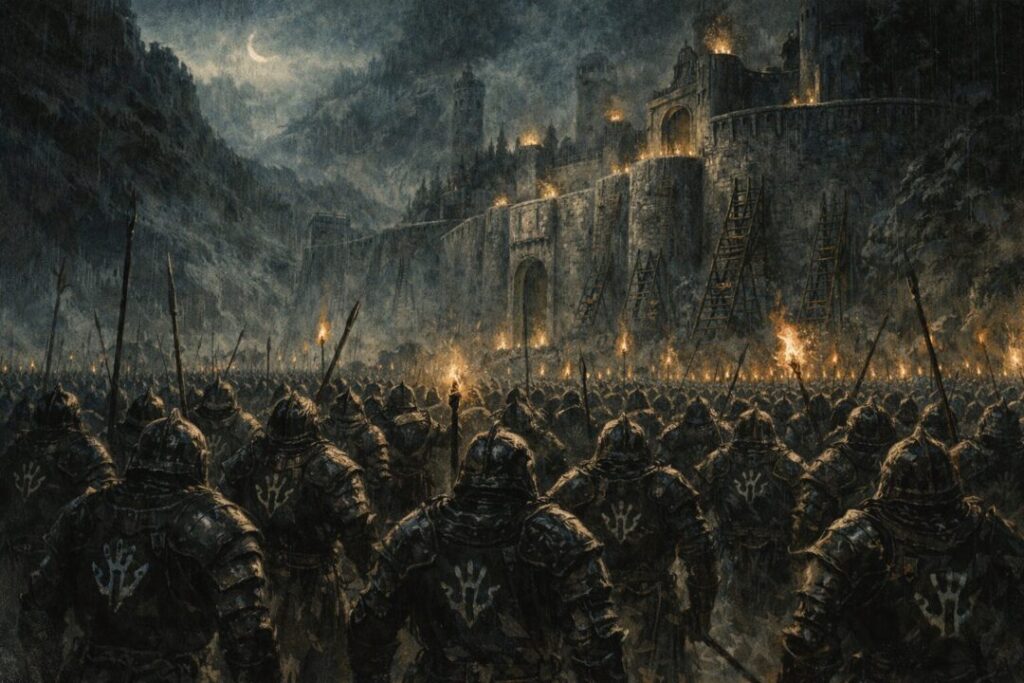
Uruk-hai inspired a different, deeper dread—one rooted in inevitability. Their black armor, white-hand insignia, and relentless movement conveyed discipline and intent. They did not charge blindly into battle. They advanced methodically, shields locked, weapons ready, responding to resistance with practiced brutality.
This distinction matters. Armies do not truly break when walls fall; they break when hope does. The sight of an organized force advancing without hesitation, indifferent to losses, erodes morale far more effectively than the roar of a single monster. The Uruk-hai were designed not merely to kill, but to grind resistance down over time.
Battlefield Roles Compared
Trolls functioned best as siege engines—living battering rams capable of smashing gates, tearing down fortifications, and scattering tightly packed defenders. When deployed correctly and supported by other forces, they were devastating. Their strength could accomplish in moments what conventional weapons might take hours to achieve.
Outside those narrow roles, however, Trolls struggled. They were poorly suited for pursuit, holding ground, or coordinated maneuvering. Their size made them obvious targets, and their lack of tactical awareness limited their usefulness once initial shock had passed.
Uruk-hai filled every role required of a true army. They served as heavy infantry, shock troops, pursuit units, guards, and executioners. They could hold ground, advance under fire, retreat in order, and regroup for renewed assaults. Individually, an Uruk-hai was not extraordinary. Collectively, they were terrifying.
This versatility made them indispensable. Where Trolls required careful placement and constant oversight, Uruk-hai could be trusted to execute broader strategic objectives with minimal intervention.
Leadership, Control, and Reliability
Another crucial difference lies in command. Trolls responded to authority, but only in the most direct sense. They obeyed orders when given clearly and enforced immediately, but they lacked initiative. Remove the guiding will, and their effectiveness plummeted.
Uruk-hai, while still bound to their masters, possessed enough autonomy to operate within broader objectives. They could pursue enemies, secure territory, and adapt tactics without constant oversight. This made them far more reliable in the chaos of large-scale war, where communication breaks down and plans rarely survive first contact with the enemy.
Reliability wins wars. Terror alone does not.
Why the Uruk-hai Ultimately Mattered More
Trolls were weapons—terrible, powerful, and limited. Uruk-hai were strategy made flesh.
Middle-earth was not nearly conquered by strength alone. It was threatened by endurance, coordination, and adaptation. These are the qualities that allow an enemy to press forward despite losses, setbacks, and resistance. Time and again, it was the Uruk-hai who embodied these traits most fully.
They marched by day. They fought in formation. They endured hardship without breaking. They did not need to be terrifying individually, because they were unstoppable together.
That is why the Uruk-hai left a deeper and more lasting mark on the War of the Ring than Trolls ever did. And that is why, when history looks back on the engines of war that nearly broke the Free Peoples, it is not the roar of monsters that echoes longest—but the sound of iron-shod boots at dawn, advancing without pause.