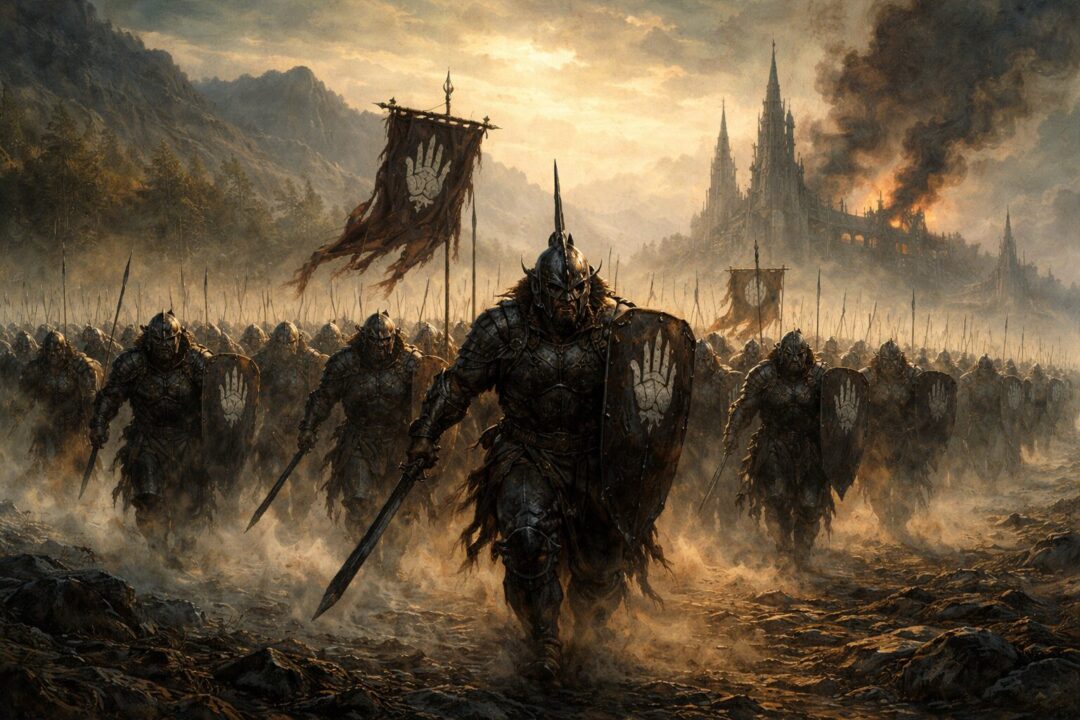
In the history of Middle-earth, Orcs are everywhere. From the black pits beneath the Misty Mountains to the ash-choked plains before the Black Gate, they form the backbone of the Shadow’s military strength. They raid villages, harry travelers, and overwhelm defenses through sheer numbers. Yet again and again, we are shown a crucial weakness in Orc-kind: most Orcs are unreliable soldiers.
They quarrel among themselves. They panic when the balance turns against them. They flee when fear outweighs cruelty, and they turn on one another the moment strong leadership falters.
The Uruk-hai were different.
They did not replace Orcs—but they solved Orc-kind’s greatest weaknesses. In doing so, they represented one of the most dangerous military innovations of the Third Age.
The Core Problem with Ordinary Orcs
To understand why the Uruk-hai were so effective, we must first understand why ordinary Orcs were not.
Across Middle-earth, Orcs share several consistent limitations:
- They fear sunlight and weaken under it, becoming sluggish, irritable, and prone to mistakes
- They lack discipline unless directly supervised, relying on threats rather than structure
- They are driven by fear rather than loyalty, obeying only while power looms close
- They collapse when leadership is removed, often descending into infighting
These traits make Orcs excellent tools for terror. They excel at ambushes, night raids, burning settlements, and overwhelming poorly defended targets. But they struggle in sustained, organized warfare—especially against trained defenders and fortified positions.
The Dark Lord compensated for this with scale. Mordor did not rely on Orc excellence; it relied on Orc abundance. Losses could be replaced. Disorder could be drowned in numbers.
Saruman chose another path.
The Origin of the Uruk-hai
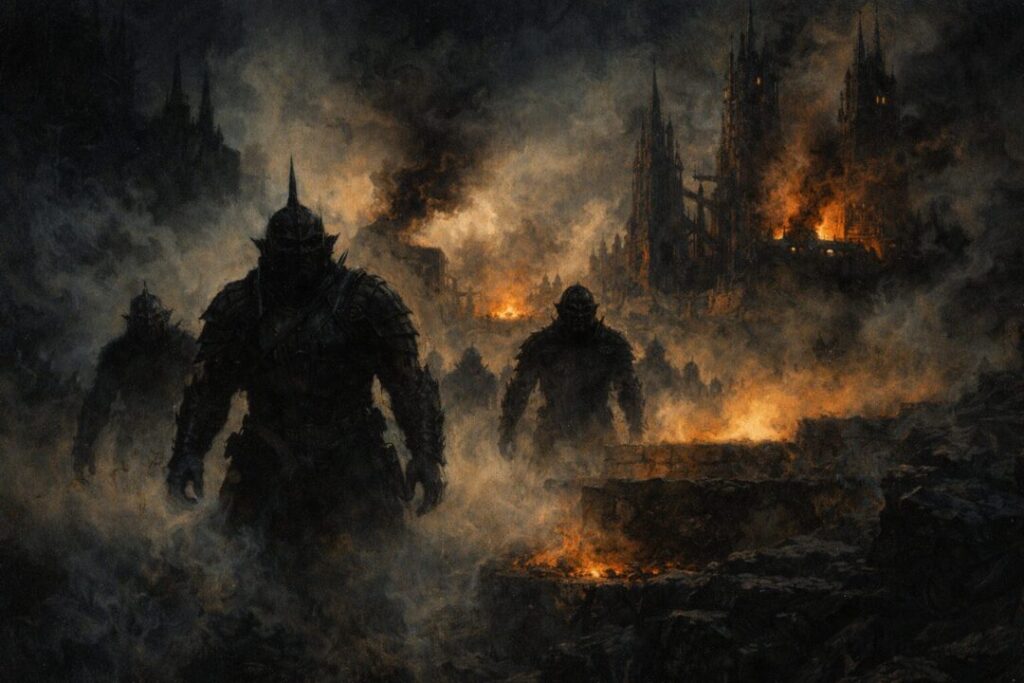
The Uruk-hai first appear openly during the rise of Saruman as a rival power in the West. Unlike the lesser Orcs, these warriors are described as taller, broader, stronger, and far more disciplined. They move with purpose. They speak with confidence. They obey without hesitation.
Most telling of all, they name themselves Uruk-hai—Orc-folk—claiming identity rather than shrinking from it. This is a subtle but important shift. Ordinary Orcs often resent their masters and fear punishment. The Uruk-hai show pride in their role.
They march under the White Hand, not the Eye.
Their exact origin is deliberately grim and left partially obscured. Hints are given, but no full accounting is offered. What matters is not the method—it is the result. Saruman did not merely breed strength. He bred obedience, endurance, and cohesion.
This was Orc-kind refined into a weapon.
Sunlight: The Critical Advantage
One of the most overlooked traits of the Uruk-hai is their ability to operate fully in daylight.
This alone reshapes warfare.
Ordinary Orcs are creatures of night. They raid at dusk, withdraw before dawn, and avoid prolonged exposure to the sun. Their campaigns are shaped by darkness, weather, and concealment.
Uruk-hai ignore these limits.
They march for days under open skies. They pursue enemies without pause. They attack fortresses at dawn rather than dusk, catching defenders exhausted rather than alert.
This allows for:
- Relentless pursuit, as seen in the long chase across the plains of Rohan
- Coordinated sieges that do not rely on nightfall
- Continuous pressure, with no natural pause in operations
They do not fight around the world’s rhythms.
They impose their own.
This single trait turns Orc warfare from opportunistic raiding into sustained military campaigning.
Discipline Over Ferocity
Orcs are vicious. Uruk-hai are professional.
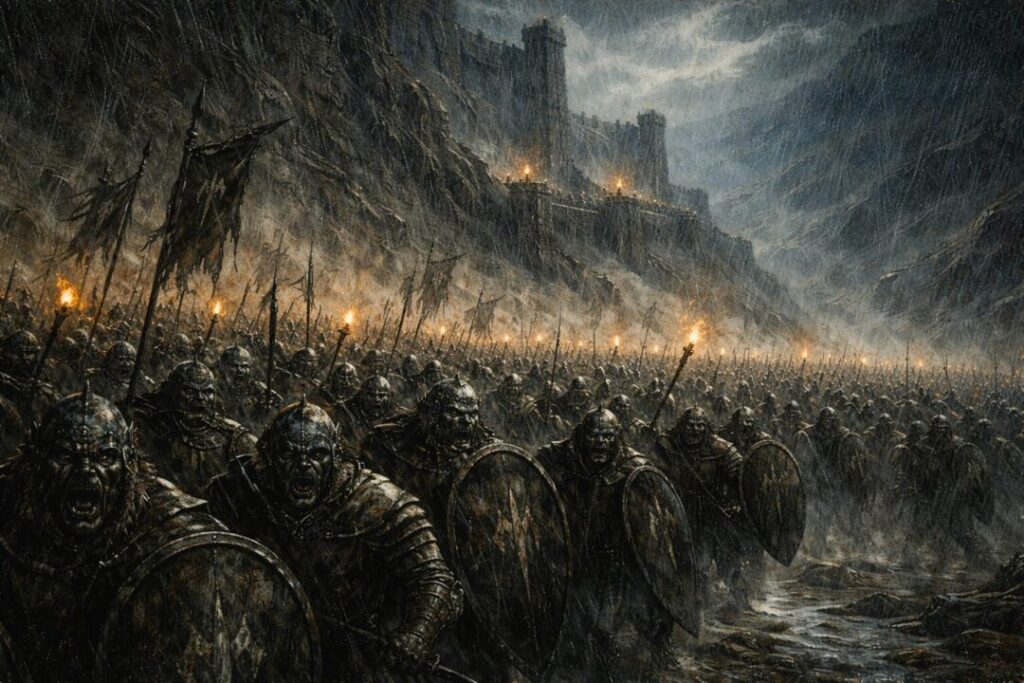
At Helm’s Deep, this difference becomes painfully clear. The defenders expect a horde. What they face instead is an army.
The Uruk-hai advance under arrow fire without breaking ranks. They carry ladders, shields, and siege equipment. They adapt when initial assaults fail. When ordered, they press forward even when the cost is certain death.
This is unprecedented.
No Orc army before them displays:
- Coordinated assault timing
- Prepared siege tactics
- Willingness to die for strategic objectives rather than personal survival
Saruman did not need his soldiers to love him. He needed them to function.
And they did.
Logistics, Not Brutality
Another quiet strength of the Uruk-hai lies in logistics.
They move quickly. They carry supplies. They march in formation rather than scattering to forage and loot. This allows Saruman’s forces to strike deep into enemy territory without losing cohesion.
Ordinary Orc armies tend to dissolve the farther they move from their strongholds. Uruk-hai do not.
This enables:
- Long-range operations
- Rapid redeployment
- Coordinated multi-front pressure
In short, they behave like a modern army rather than a roaming horde.
This is not accidental. It reflects Saruman’s mindset: war as a system, not a frenzy.
Why Saruman’s Army Nearly Won
The fall of Rohan was not averted because Saruman’s plan was flawed. It was averted because outside forces intervened.
The defenders of Rohan faced an enemy that:
- Could march when they rested
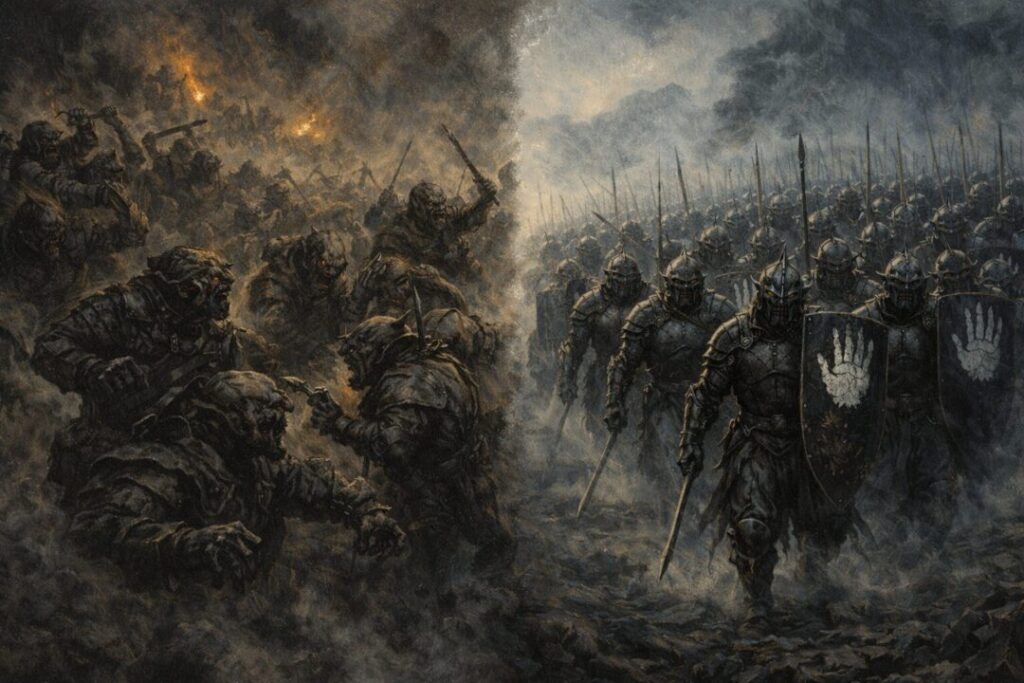
- Did not scatter under resistance
- Understood walls, gates, and weak points
Helm’s Deep nearly falls not because of superior strength—but because of superior planning.
The fortress holds only because help arrives that Saruman did not anticipate, breaking the closed system he had constructed.
Within its own logic, the Uruk-hai strategy works.
That is what makes it frightening.
The True Horror of the Uruk-hai
The Uruk-hai are not terrifying because they are monstrous.
They are terrifying because they are efficient.
They represent something new in Middle-earth: the industrialization of evil. War reduced to process. Soldiers reduced to output. Individual cruelty replaced with organized destruction.
They are not chaos.
They are control.
And that is why they were so dangerous.