Few scenes in modern fantasy are as visually striking as the Elves marching into Helm’s Deep. Their armor gleams in torchlight, their presence feels ancient and solemn, and their arrival carries the emotional weight of history itself—old alliances remembered, forgotten bonds reforged just in time.
On screen, it feels like salvation arriving at the brink of collapse.
But this moment creates a quiet misunderstanding.
Because in the original telling of the story, it never happens.
There is no Elven host at the Battle of Helm’s Deep. No company of the Galadhrim marches from the woods. No formal renewal of alliance between Elves and Men takes place beneath the walls of the Hornburg.
And yet—Helm’s Deep still stands.
So the real question is not whether the Elves helped.
It is whether Helm’s Deep ever needed them at all.
The Defense of Helm’s Deep in the Book
In the written account, the defense of Helm’s Deep is stripped of grandeur. What remains is exhaustion, fear, and grim resolve.
The fortress is not filled with elite warriors. It is defended largely by the remnants of Rohan’s people: men too old to ride, boys too young to have proven themselves, and farmers who have never held a shield in a real battle. Many of the able-bodied riders are scattered across the land or have already fallen.
Supplies are low. Sleep is nonexistent. Morale is brittle.
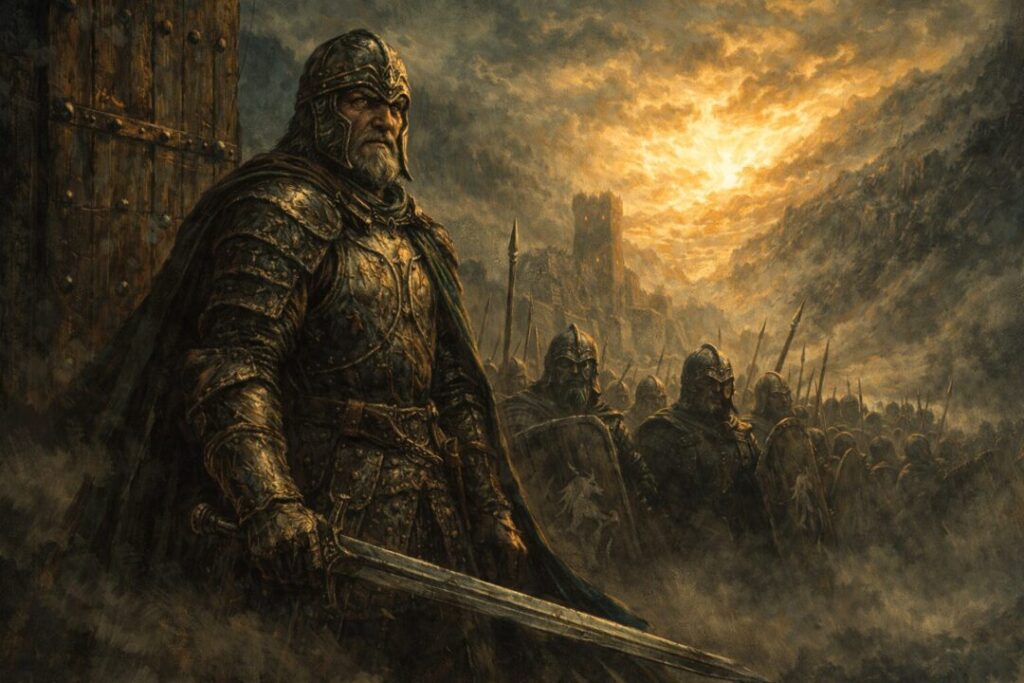
King Théoden does not enter the battle believing in victory. He expects to die. His goal is not triumph, but dignity—to meet the end standing rather than kneeling.
What follows is not a heroic spectacle, but a siege defined by pressure.
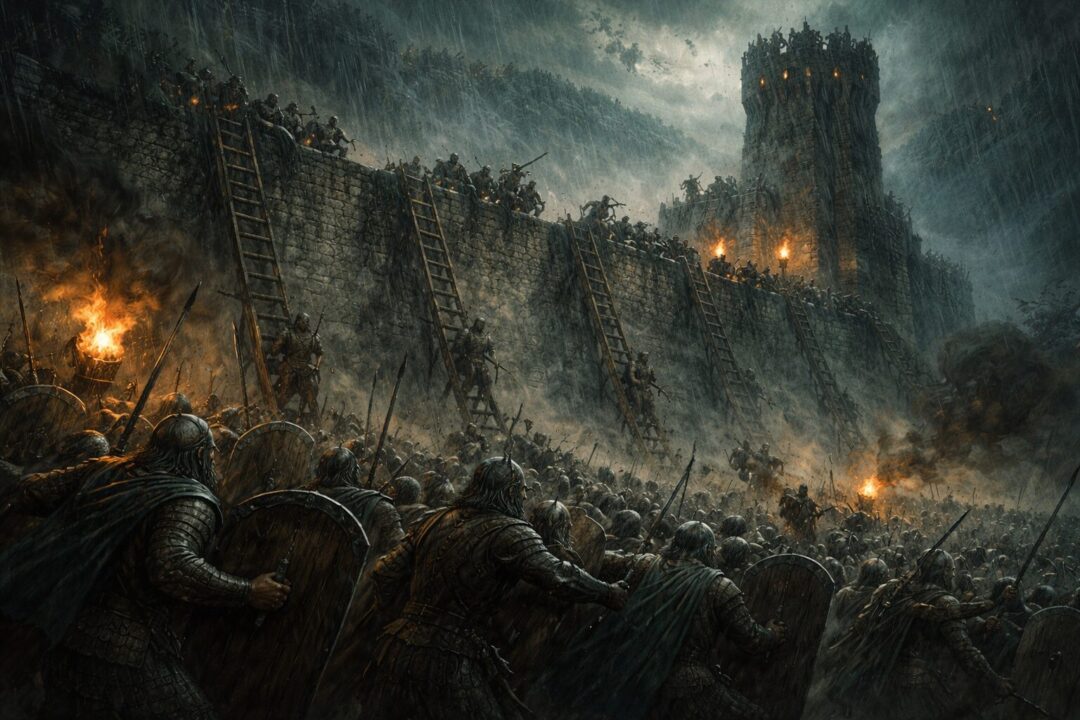
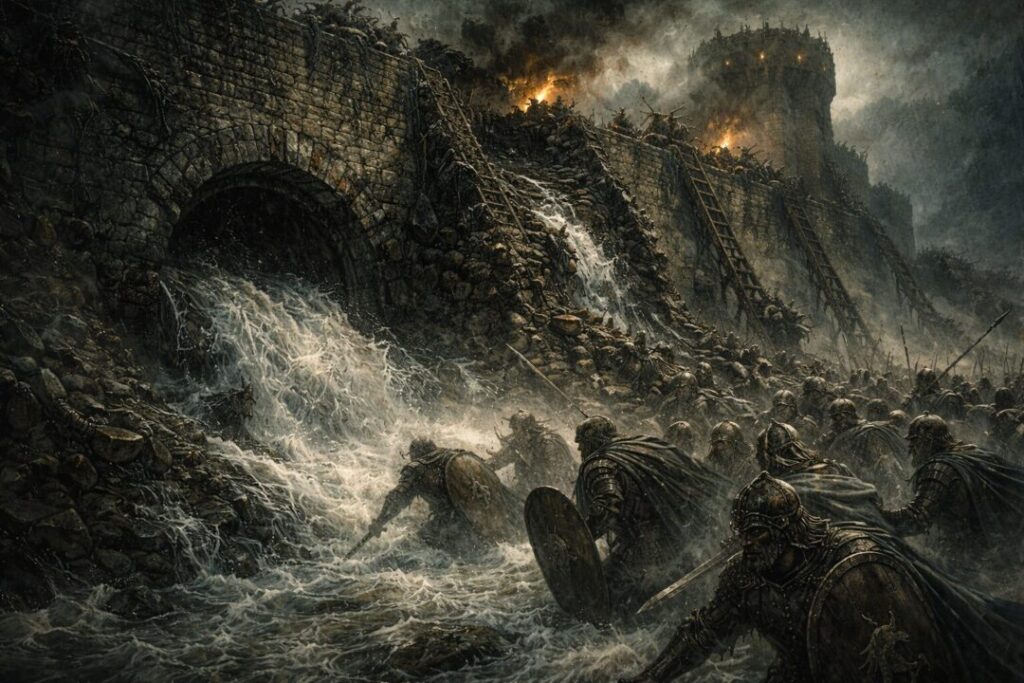
The enemy attacks without pause. Arrows darken the sky. Ladders rise against the walls. The Deeping Wall—long thought impregnable—is breached by a weapon no one expected. Water floods through the culvert. The defenders are forced back step by step, abandoning ground they believed could not be lost.
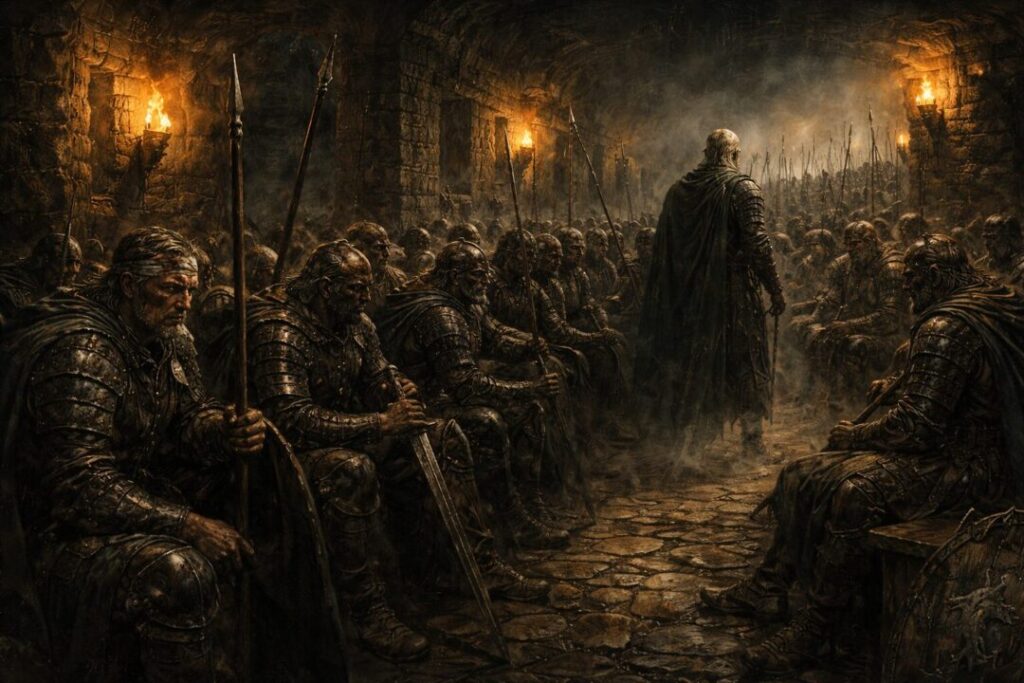
Eventually, the fight collapses inward, into the caves and the inner keep.
Legolas is present—but crucially, he stands alone. He fights as one warrior among many, not as the representative of an Elven host. There is no shining line of immortal soldiers absorbing the worst of the assault.
This matters.
Because it reveals what Helm’s Deep is actually testing.
What Helm’s Deep Is Really Meant to Prove
The battle is not about whether Rohan can match Saruman’s armies in strength.
It cannot.
The numbers are against them from the beginning, and everyone involved understands this. Helm’s Deep is never presented as a place where victory will come through superior force.
Instead, it tests something else entirely.
Can Men endure fear without certainty?
Can they hold a line knowing that help may never come?
Can leadership persist even when hope feels like a lie told for comfort?
Helm’s Deep is not a test of might.
It is a test of endurance.
Why the Fortress Holds
Helm’s Deep survives for three reasons—none of which involve Elven intervention.
1. Terrain
The Hornburg is designed to negate numerical superiority. The narrow causeway forces attackers into a confined approach. The walls are steep and sheer. The Deeping Wall channels the enemy into predictable lanes of advance.
Even when the wall is breached, the geography of the fortress slows the assault. The enemy cannot fully exploit its numbers. Every step forward costs time and lives.
This is not accidental. Helm’s Deep was built for exactly this kind of war.
2. Leadership Under Despair
Théoden does not flee.
He does not attempt negotiation. He does not bargain for mercy. When retreat is no longer possible, he prepares to ride out—not because he believes it will succeed, but because surrender is morally unacceptable.
This moment is crucial.
The defenders draw strength not from hope of survival, but from the refusal to abandon their duty. Théoden’s resolve anchors the line. Even when defeat seems inevitable, the Rohirrim do not dissolve into panic.
They follow their king.
3. Endurance Until Dawn
The battle is never won during the night.
It is survived.
The defenders hold long enough for time itself to turn against the attackers. When morning comes, the enemy is overextended, disordered, and exhausted. Allies arrive from the West—not as a miracle, but as the natural result of resistance bought with blood and time.
Helm’s Deep is not saved by a single heroic act.
It is saved by refusing to break.
What the Elves Represent in the Film
The film adaptation introduces the Galadhrim, led by Haldir, for reasons that are emotional rather than tactical.
They are not there because the battle cannot be won without them.
They are there because they represent something that is passing away.
Their presence reframes Helm’s Deep as the last echo of an older world—one where Elves and Men still fought side by side in open war. Their deaths are tragic precisely because they feel unnecessary. They are not the deciding factor. They are witnesses to a turning point.
This makes the scene deeply moving.
But it also softens a harsher truth.
In the book, Men are already alone.
And they still endure.
Would Helm’s Deep Have Fallen Without the Elves?
According to the internal logic of the world: no.
Because Helm’s Deep does stand without them.
The outcome is never dependent on overwhelming force or ancient power. It depends on restraint, resolve, and the willingness to endure terror without guarantees of reward.
That is the quiet lesson of the battle.
The Elves are not absent because they are unwilling to help.
They are absent because the age of solving such wars for others is ending.
The Larger Pattern in Middle-earth
Helm’s Deep is not an isolated case. Across the War of the Ring, the same pattern repeats.
Those with the greatest power increasingly step back from direct action. They advise, guard, and preserve—but they do not dominate the battlefield.
The burden of victory shifts steadily onto the shoulders of Men, and ultimately onto the smallest and least expected figures of all.
Helm’s Deep marks the moment when this transition becomes unmistakable.
Why This Distinction Matters
Helm’s Deep is not simply a famous battle.
It is a statement about the future of the world.
It is the moment when Men prove—to themselves more than anyone else—that they can hold the line without ancient guardians standing beside them.
Not through glory.
Not through inherited power.
But through persistence.
That makes the victory far more fragile.
And far more meaningful.
Because the world that follows will depend on that kind of courage alone.
And once you see Helm’s Deep this way, the question is no longer why the Elves were absent.
It is why their absence was necessary.