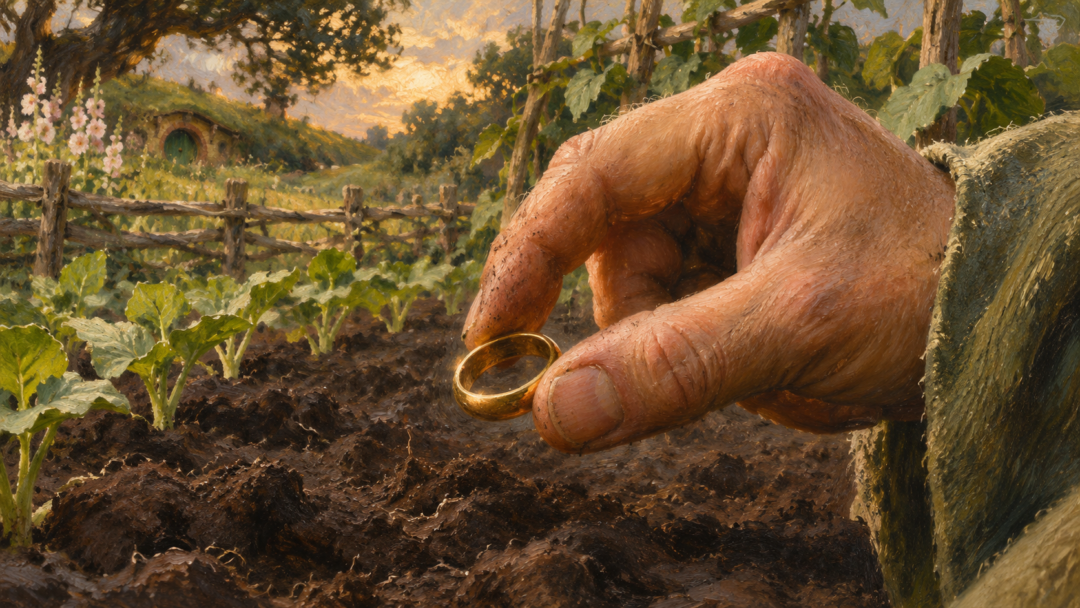
At the Crack of Doom, Frodo stands against the furnace-glow and announces that the Ring is his. Sam is only a few steps away. Then Gollum springs upon them, knocks Sam aside, and attacks the invisible Ring-bearer. Sam has no chance to respond to Frodo's refusal. But suppose Sméagol had stayed away. Would Sam have sacrificed his beloved master to save Middle-earth?
Nothing in the book suggests that he would. Sam can fight fiercely, but his decisions grow out of loyalty to Frodo, not a willingness to sacrifice him for victory. The question is tempting because Sam has already proved himself capable of taking over the quest. What he does with that responsibility, though, points toward a very different answer.
Sam had already faced a choice between Frodo and the quest
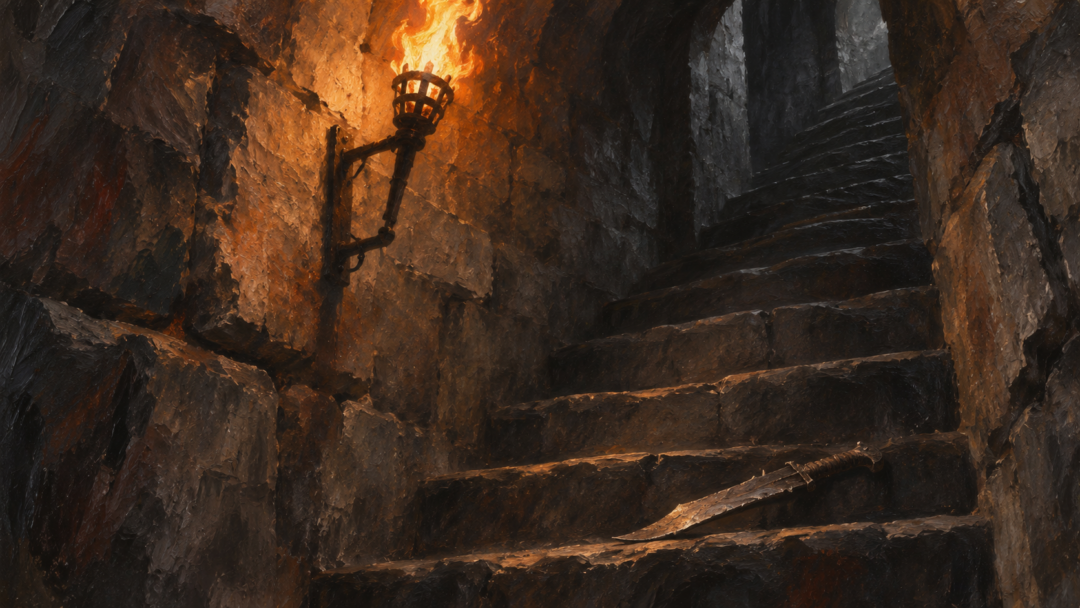
The clearest test comes before Mordor, at the end of The Two Towers. After Shelob stings Frodo, Sam attacks the monstrous spider with Sting and drives her away with Galadriel's phial. Returning to his master, he finds Frodo unresponsive and believes him dead. Sam is devastated, but the Ring is still there, and leaving it to be discovered would make the entire journey meaningless. He must decide alone.
In “The Choices of Master Samwise,” Sam takes the Ring and prepares to continue alone. That decision shows real courage. He accepts a burden he never sought. If Sam cared about nothing but staying physically close to Frodo, he could not have made this choice. His devotion is serious enough to include the duty Frodo accepted, even when that duty breaks his heart.
Yet the chapter does not end with Sam marching determinedly toward the Fire. Hearing Orcs approach, he cannot bear to leave Frodo exposed. He turns back, imagining himself dying in a last defence of his master's body, even though that could cost the quest. He discovers too late that the Orcs have carried Frodo away, and their conversation reveals that Shelob's victim is paralyzed, not dead. Sam's next purpose is unmistakable: get Frodo out of the tower.
Sam tries to honor love and duty together, and sometimes misjudges how. But when Frodo might still be saved, he does not treat his friend as expendable. This is Sam making a difficult choice, not an imaginary commander calculating losses.
The Ring offered Sam a garden big enough to be a kingdom
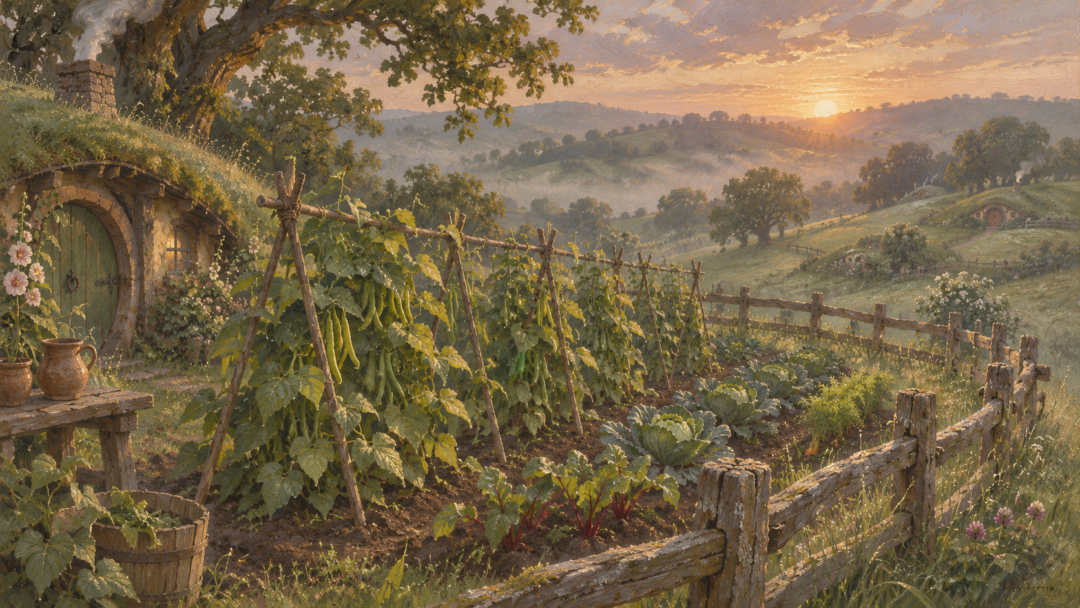
Sam's brief time as a Ring-bearer gives the question another edge. He is not immune to its power. In “The Tower of Cirith Ungol,” as he approaches the fortress with the Ring, he feels an extraordinary temptation: he imagines himself as a mighty hero, wielding a flaming sword, gathering armies, defeating Barad-dûr, and transforming the barren land into a flourishing garden. Even Sam's wish to make things grow can be enlarged into a fantasy of command.
That is how the Ring works. It does not have to invent a desire from nothing; it can take something recognizable and inflate it until the bearer mistakes domination for a noble achievement. In “The Shadow of the Past,” Gandalf refuses Frodo's offer of the Ring partly because his wish for strength to do good could become the road to tyranny. Sam's imagined gardens are gentler than Gandalf's possible ambitions, but the trap is related: a good end held out as an excuse for absolute power.
Sam resists for two connected reasons. The first is his love of Frodo, which the text explicitly gives as his strongest defence in that hour. The second is his ordinary hobbit sense of proportion. He knows that the grand visions might be deceit, and that he has neither the need nor the right to command an entire realm. He wants “one small garden of a free gardener,” not command over other people's hands.
This is not evidence that Sam could never be corrupted. He bears the Ring briefly, whereas Frodo endures it through a long, punishing journey to the place where its influence becomes greatest. Their tests are unequal. Still, the one temptation the story actually records for Sam leads him to reject rule, not to consider murdering a friend for the world's benefit. He refuses to turn gardening into conquest. The films largely omit this vision, making it easier to overlook that Sam has undergone a genuine test of the Ring's seductive power.
His love survives even when Frodo wounds him
When Sam finally finds Frodo in the tower, the reunion is not as simple as either hobbit wishes. Frodo has been stripped, tormented, and terrified that the Ring is lost. Sam explains that he took it for safekeeping. Rather than thanking him immediately, Frodo snatches it back and accuses him as though Sam were a thief. The Ring has made ordinary trust suddenly fragile at the very moment both hobbits most need it.
Sam is deeply hurt. He recognizes the Ring's influence on Frodo. Frodo soon regrets the outburst, and Sam returns to the practical business of helping him escape. This is the closest on-page parallel to the proposed crisis: Frodo behaves unjustly because of the Ring, and Sam's response is grief, patience, and continued care. He does not turn the insult into permission to seize control of the mission.
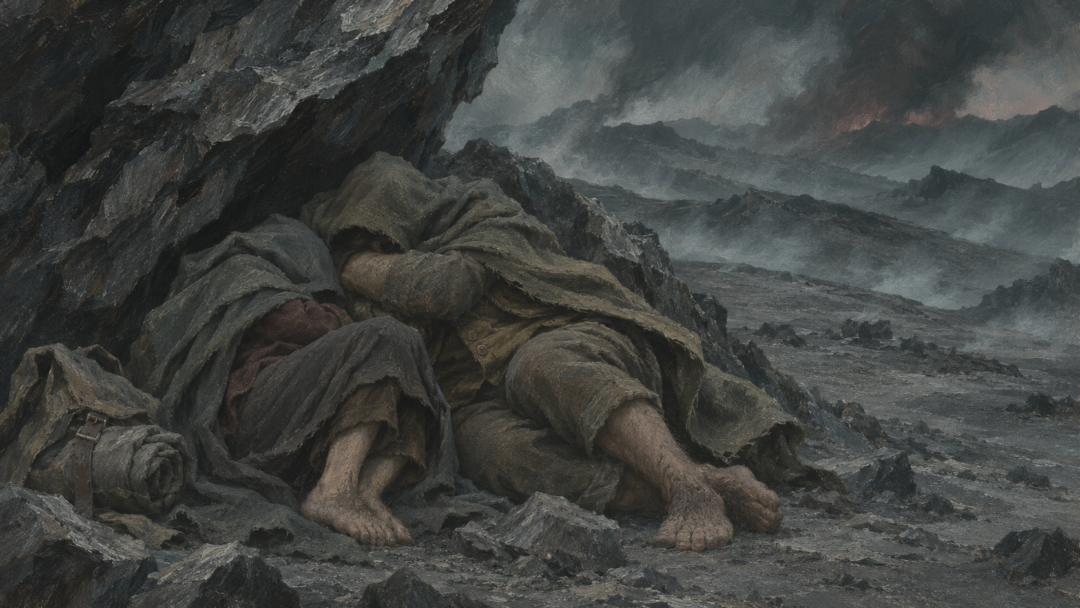
Across the plain of Gorgoroth, Sam watches Frodo weaken, rationing what little food and water remain and discarding possessions to lighten their load. Near the summit, Frodo can no longer manage the climb. Sam does not propose taking the Ring by force, even though he has borne it before and can see what it is doing to his master. Instead he lifts Frodo himself. The line “I can't carry it for you” names the limit; carrying Frodo is the help Sam can actually give.
Sam is not incapable of violence. He wounds Shelob, fights Orcs, and raises his sword against Gollum when the creature attacks them again on Mount Doom. But the decisive detail is what follows. Faced with Gollum grovelling in the ash, Sam stays his hand. His own brief experience of the Ring helps him dimly understand the ruin it has made of Gollum. If he cannot bring himself to kill this treacherous enemy when doing so seems safest, the text gives little basis for expecting him to kill Frodo.
Killing Frodo would not itself destroy the Ring
The last scene also needs to be read in its exact order. Sam has already spared Gollum when Frodo enters the Sammath Naur. Inside, Frodo refuses the task and claims the Ring. He puts it on and vanishes. Almost immediately Gollum knocks Sam down, reaches the invisible Frodo, and bites off the finger bearing the Ring. Gollum celebrates his recovered treasure, steps too far, and falls with it into the fire. In the book, Sam does not stand there considering a fatal blow against Frodo.
Without Gollum, the danger is immense. Frodo would still have the Ring, and merely killing its bearer would not unmake it. Someone would have to get the Ring into the fire, while resisting its power at the very place where it was forged. Frodo has already struggled to cast it into an ordinary hearth at Bag End, long before his ordeal. It is therefore no small assumption that Sam could simply wrest it away and complete the task himself.
Tolkien's discussion of Frodo's failure in Letter 246 reinforces this difficulty. He treats the final pressure on Frodo as beyond what could reasonably be resisted after such suffering, not as proof that Frodo lacks courage. He also considers alternatives in which Gollum's relationship with Frodo developed differently, and what might happen if Frodo kept the Ring after claiming it. His speculation includes the approach of the Ringwraiths, who might try to lure Frodo away from the Crack rather than attack him outright. None of this supplies an unwritten plan for Sam to kill Frodo.
In Letter 131, Tolkien calls Sam the chief hero and stresses the relationship between ordinary life, love, quests, and sacrifice. That is a different emphasis from treating him as someone ready to remove Frodo at any cost. The danger of the counterfactual is that it turns Sam into an all-knowing strategist with perfect access to the consequences of his actions. The actual hobbit is exhausted, frightened, devoted, and standing beside an invisible friend. He cannot know in advance whether violence would secure the Ring, doom them both, or hand victory to Sauron.
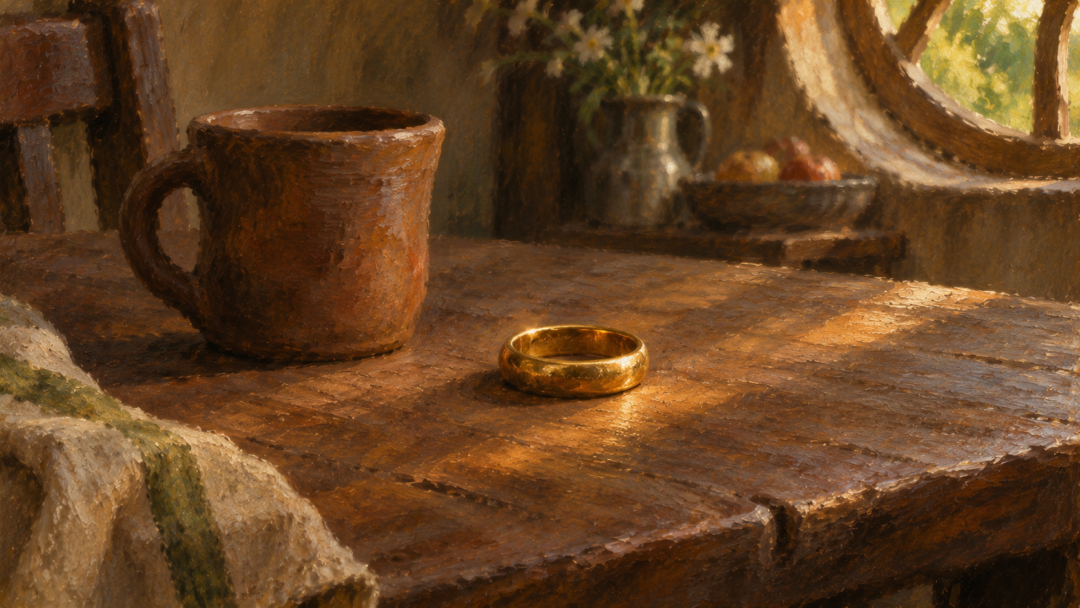
Sam's reward was a small, living place
The end of the story supplies a quieter measure of his desires. Back in the Shire, Sam uses the earth Galadriel gave him to restore ravaged trees and gardens. He plants the mallorn seed where the Party Tree had stood. He marries Rosie Cotton, raises a family, and helps Frodo live with wounds that victory has not healed. The Ring had tried to magnify such ordinary things into an empire.
“The Grey Havens” makes the cost of loving Frodo especially clear. Sam cannot follow his friend on the ship into the West, though Frodo acknowledges that Sam, too, was briefly a Ring-bearer. Sam returns to Bag End, to Rosie and their daughter Elanor, carrying both his grief and his responsibility for a life that continues. His hopes were never small because he failed to understand the stakes. They were small enough to leave room for other people.
So what if Sméagol had never made that last attack? The book leaves the outcome open, and the chances for the quest look grim. But it gives us no reason to imagine Sam raising his sword against Frodo. At the brink of the greatest fire in Middle-earth, his most characteristic act would still be to reach for his master, not to decide that his master must die.
Sources & Notes
- The Choices of Master Samwise - Tolkien Gateway — https://tolkiengateway.net/wiki/The_Choices_of_Master_Samwise
- Mount Doom (chapter) - Tolkien Gateway — https://tolkiengateway.net/wiki/Mount_Doom_(chapter)
- Letter 246 - Tolkien Gateway — https://tolkiengateway.net/wiki/Letter_246
Compare The Two Towers, ‘The Choices of Master Samwise’, with The Return of the King, ‘The Tower of Cirith Ungol’ and ‘Mount Doom’. Letter 246 discusses Frodo’s limits and alternative endings, not an intention by Sam to kill him; the hypothetical outcome remains unwritten.