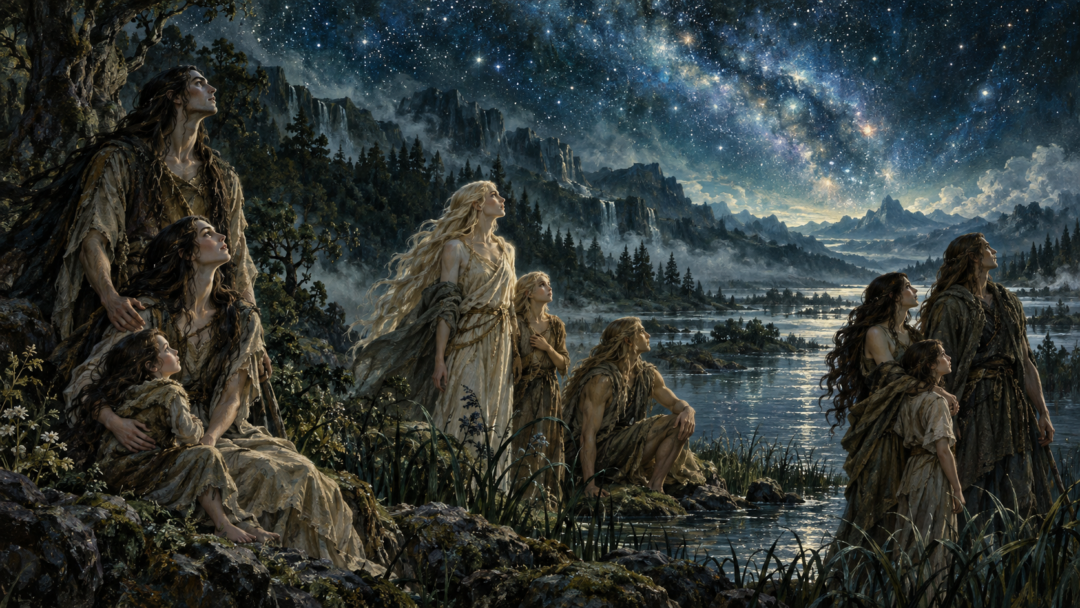
At Cuiviénen, before Tirion had white walls, before Menegroth had a thousand caves, and before any Elf had seen the light of the Two Trees, the first Elves knew themselves by simpler clan names. In one ancient tradition they were the Minyar, Tatyar, and Nelyar: the Firsts, Seconds, and Thirds. Much later, the familiar names Vanyar, Noldor, and Teleri appear around the great summons to Aman and the long journey west.
That makes the neat equation tempting: Minyar equals Vanyar, Tatyar equals Noldor, Nelyar equals Teleri. It is useful only if we remember what the two sets of names describe. The first belongs to an awakening-and-counting tradition. The later names belong to peoples shaped by descent and, crucially, by choices made when Oromë summoned the Quendi westward. One scheme describes original clan identity; the other records what happened to portions of those clans.
Three Names Before the Familiar Three
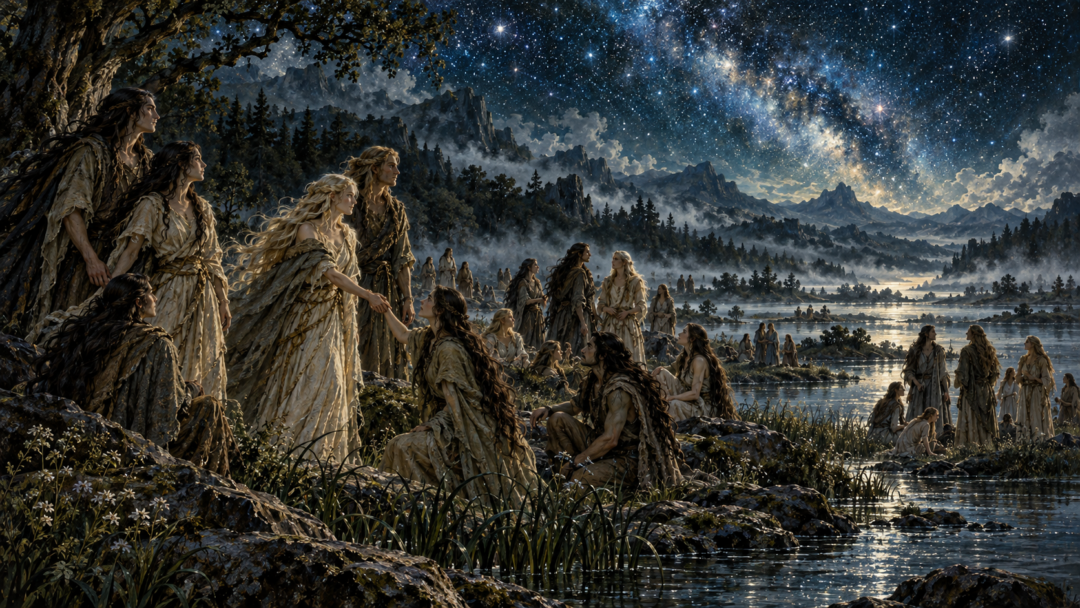
The early names are ordinal. Minyar means the Firsts, Tatyar the Seconds, and Nelyar the Thirds. In the Cuivienyarna, the legend of the awakening of the Quendi, those names are tied to Imin, Tata, and Enel, the first three Elf-fathers to awaken beside their spouses. Their names are connected with one, two, and three, and the three couples become the starting points for the three great divisions of the newly awakened Elves.
That can look like an early version of the later Vanyar-Noldor-Teleri arrangement. But the difference is not merely chronological, as though three labels were erased and three replacements written in. The older groups are parent populations. When the summons of the Valar later divides the Quendi, only some of those populations take the road that produces the familiar Eldarin kindreds. The Minyar are exceptional because their group does not split at that decision. The Tatyar and Nelyar do.
The Cuivienyarna Is Counting-Lore, Not a Census
The Cuivienyarna survives as an appendix to “Quendi and Eldar” in The War of the Jewels, with a manuscript form also published among the “Eldarin Traditions Concerning the Awakening” in The Nature of Middle-earth. Its frame matters. The story is presented as an old Elvish tale, a kind of traditional counting-lore, not as a modern demographic record assembled by witnesses checking names and totals against a register.
Its pattern is deliberately memorable. Imin, Tata, and Enel awaken with Iminyë, Tatië, and Enelyë. As the couples travel, they discover further groups of Elves. Imin makes the first choice of companions, Tata the second, and Enel the third. The discovered groups grow larger, and the repeated pattern explains why the clans end with different sizes while tying their names to the order of the first three fathers.
Within that legendary scheme, the total is 144 newly awakened Elves, divided into 14 Minyar, 56 Tatyar, and 74 Nelyar. Those figures help explain the proportions of the original clans, but they should not become a universal population chart for every Elf who would ever live. The tale gives an origin structure at Cuiviénen. Later births, separations, journeys, and histories belong to a much larger story.
Why the Minyar and Vanyar Look Almost Identical
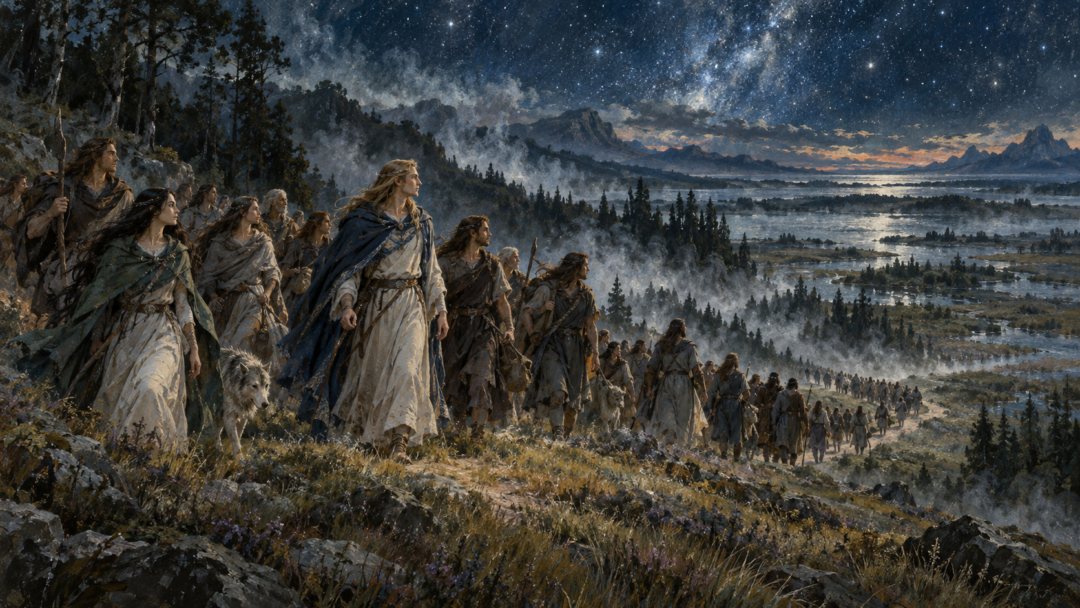
The Minyar produce the cleanest mapping because, when the invitation to Aman comes, all of them follow Ingwë. None of the Minyar remain behind as Avari. The entire first clan therefore enters the Eldarin migration, and the people descended from that first clan can be spoken of as the Vanyar without leaving an excluded Minyar branch on the shores of Cuiviénen.
Even here, two figures should not be collapsed merely to make the chart tidier. Imin belongs to the awakening legend as the first Elf-father and namesake of the Firsts. Ingwë belongs to the later history of the summons and Great Journey as the leader of the people who become the Vanyar. The traditions can connect the ancient clan to Ingwë’s people without making “Imin” and “Ingwë” interchangeable names for one character.
The Minyar therefore show why the simple equation seems convincing. In their case, clan of origin and later Eldarin kindred have almost the same membership. But that is the result of a unanimous later choice, not proof that the two naming systems always classify Elves in the same way. The second clan makes the difference impossible to miss.
The Tatyar Split, and the Noldor Are Only One Branch
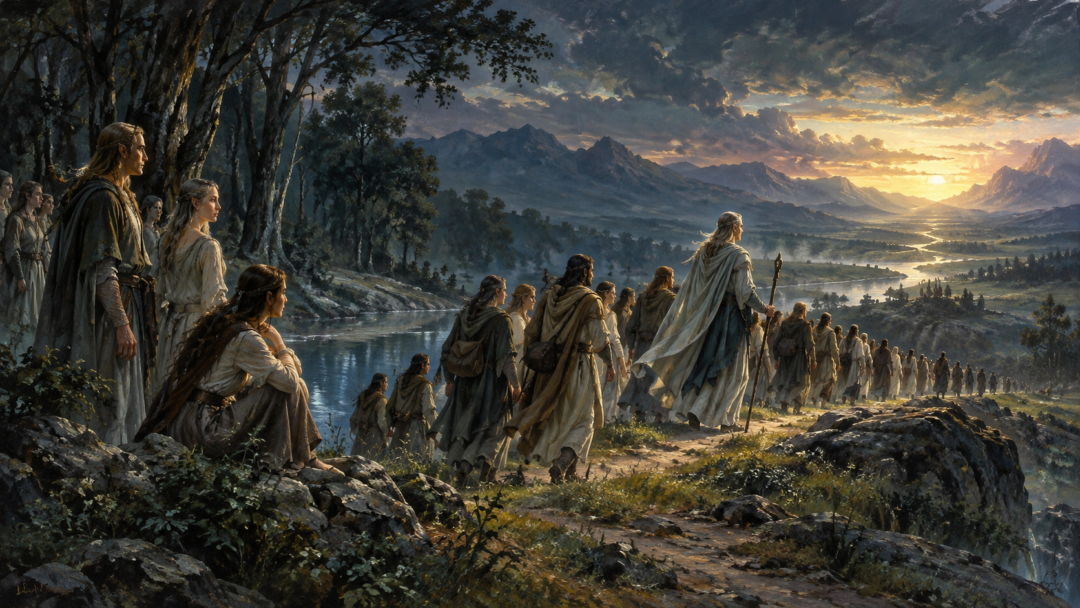
When Oromë’s summons divides the Quendi, the Tatyar do not move as one people. In the tradition summarized in “Quendi and Eldar,” half follow Finwë and take part in the westward migration. These become the Noldor. The other half refuse the summons and remain behind. They belong to the Avari, the Refusers.
So “Tatyar” cannot simply be replaced everywhere by “Noldor.” Every Noldo in this origin scheme belongs to the Tatyarin stock, but the Tatyarin stock is broader than the Noldor because it also includes Tatyarin Avari. The relationship is ancestry plus decision: Tatyar describes the old clan; Noldor describes the departing Eldarin portion associated with Finwë.
That distinction matters more than later reports about how some Avari of Tatyarin descent regarded the Noldor when their paths crossed again. Such traditions can tell us something about later relationships, but they do not justify inventing an innate “Tatyar personality” that mechanically produces Noldorin history. The firm point is simpler: one original clan divided, and a later kindred name belongs to one side of that division.
It also means an Elf can be described correctly in more than one way depending on the question. “Of Tatyarin origin” answers a question about ancient clan descent. “Noldo” answers a question about the Eldarin people formed from those who followed Finwë. “Avar” answers a different question again: whether that Elf or ancestral group refused the summons. These are overlapping categories, not rival spellings.
The Nelyar Make the Later Taxonomy Even Clearer
The Nelyar, the Thirds, were the largest of the three clans in the counting legend. When the summons came, most followed Elwë west and became the people later called the Teleri, while a substantial Nelyarin remainder refused and belonged to the Avari. Once again, the later kindred does not exhaust the earlier clan of origin.
The result is less like a family tree with labels swapped at each fork and more like two questions laid over the same history. What was the ancient clan of origin? Did this people accept the summons? Names such as Nelyar, Teleri, and Avari answer different questions. Treating them as one sequence of replacements erases the sundering those names preserve.
Why Elegant Maps Need Warning Labels
The same caution applies to diagrams. The Cuivienyarna’s 14, 56, and 74 are exact within the counting tale, and later proportions can be related to that scheme. They are not a license to calculate every later Elvish population as though no births, deaths, separations, or other changes intervened. A clean chart can clarify relationships while giving a false impression that every number belongs to one continuous census.
Maps of Cuiviénen raise a similar problem. Surviving early cartographic material and later textual descriptions do not fit together with modern precision. Reference maps sometimes reconstruct bays, rivers, or surrounding geography to reconcile different sources; responsible versions identify such additions as speculative. A stream drawn neatly on a modern map may help the eye without becoming a newly discovered fact about the awakening place.
A diagram saying “Minyar → Vanyar, Tatyar → Noldor, Nelyar → Teleri” is therefore a good memory aid if its arrows mean “the departing Eldarin portions developed into these later kindreds.” It becomes misleading if the arrows mean “every member of the first category was simply renamed as the second.” Only the Minyar make that stronger statement come close to working.
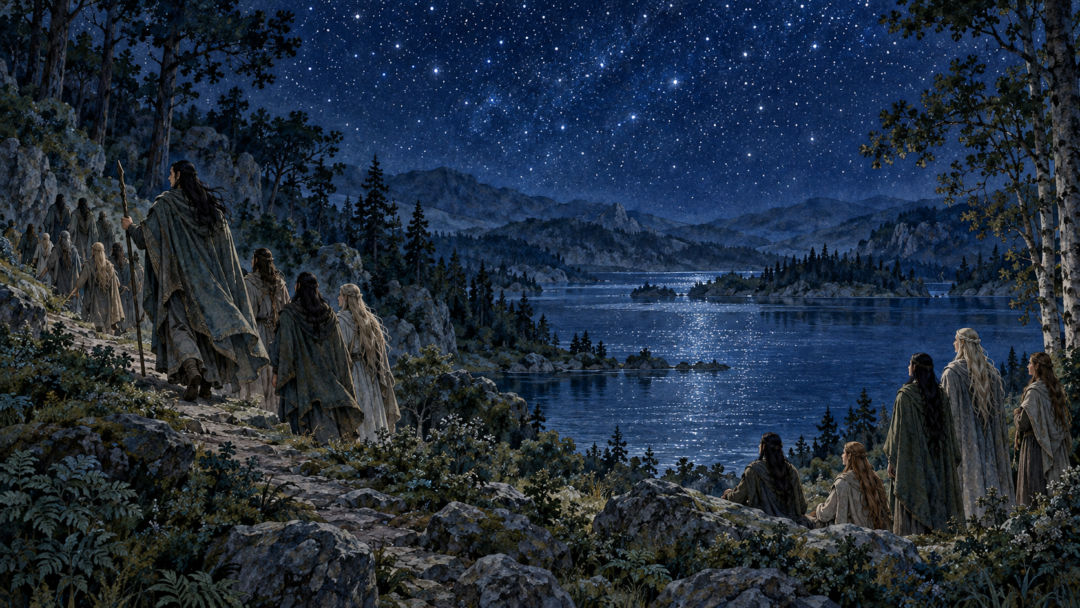
The safest vocabulary is also the richest. Minyar, Tatyar, and Nelyar preserve the remembered first ordering of the Quendi under the stars at Cuiviénen; Vanyar, Noldor, and Teleri belong to peoples shaped by the summons and the road west. The names are not clutter around one simple three-part system. They are layers of history, preserving the moment before one people became many.
Sources & Notes
- https://tolkiengateway.net/wiki/Minyar — Tolkien Gateway, Minyar: first-clan origins and the whole clan following Ingwë; references The War of the Jewels, “Quendi and Eldar,” pp. 380–381.
- https://tolkiengateway.net/wiki/Tatyar — Tolkien Gateway, Tatyar: the ancestral second clan divided between the Noldor and Avari; references “Quendi and Eldar,” pp. 380–381.
- https://tolkiengateway.net/wiki/Nelyar — Tolkien Gateway, Nelyar: the third clan and its division into departing Teleri and remaining Avari.
- https://tolkiengateway.net/wiki/Cuivienyarna — Tolkien Gateway, Cuivienyarna: the awakening legend and counting tradition behind the three original clans; identifies the published typescript and manuscript versions.
The clan distinctions follow “Quendi and Eldar” and its awakening tradition. Linked references are secondary guides to Tolkien’s texts; the legendary numbers are not a census of later populations.