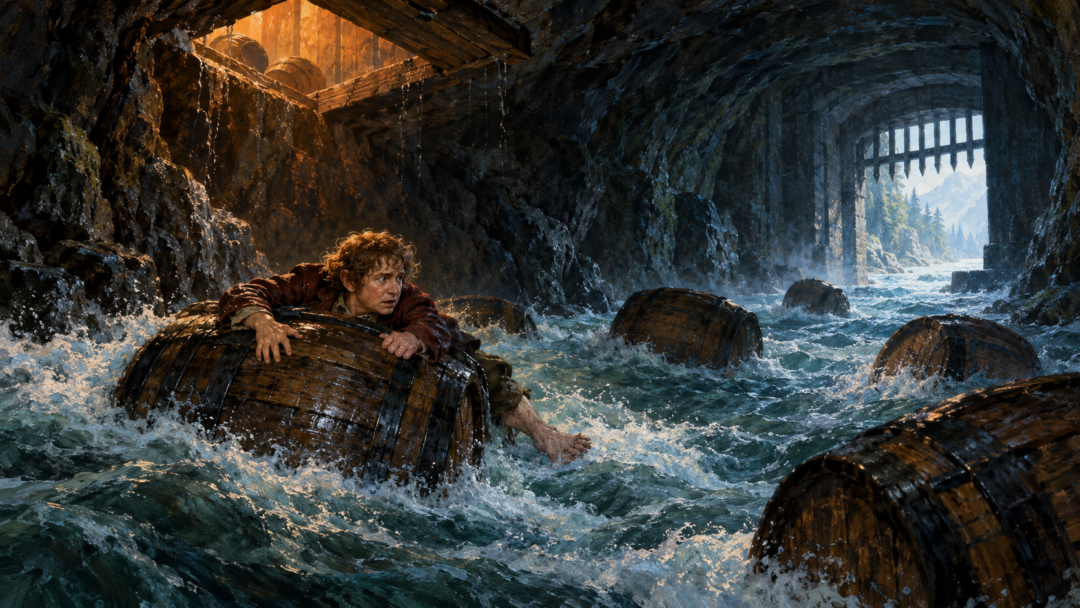
Beneath the Elvenking’s halls, water runs through the darkness. Bilbo discovers a way out through a trapdoor leading down into an underground stream. Above that unlikely escape route stand guarded stone gates, winding passages and a royal hall supported by pillars of rock. It is a defended royal seat within a working woodland realm.
Its older counterpart is Menegroth, the legendary underground stronghold of Thingol in Doriath. The comparison is explicit in accounts of Thranduil’s halls, not merely a likeness invented because both kings lived beneath stone. Yet the resemblance has limits. Thranduil’s dwelling follows the model of a cavern palace and fortress, on a smaller scale and beside a different river, without turning all the Wood-elves into inhabitants of an underground city.
A model, not a copied floor plan
Menegroth offers a recognizable architectural idea: a king’s dwelling sheltered within rock, with controlled access from the world outside and chambers deep enough to serve more than ceremonial purposes. The later Elvenking’s halls adopt that arrangement in northeastern Mirkwood. They are meant to house royal life and protect valuable things, while giving the surrounding people a place of safety when the forest becomes dangerous. The resemblance is practical, not just visual.
But a model is not a blueprint. Neither the account of Menegroth nor the scenes inside Thranduil’s halls supplies matching measurements, numbered chambers or a room-by-room correspondence. Even “the Thousand Caves” describes Menegroth’s exceptional extent, not a feature every later stronghold must reproduce. The comparison turns on which features travel between realms and which change with the landscape.
A palace for a people who live in the woods
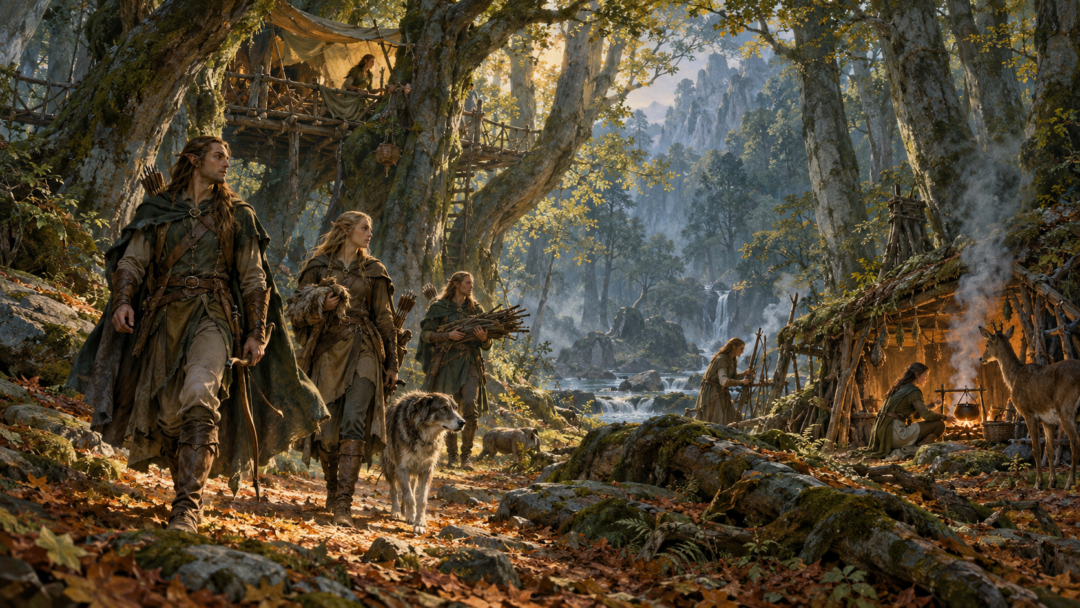
The most revealing distinction concerns the people outside the palace. The Elvenking’s subjects spend most of their time in the open woodlands, rather than making the underground halls their common home. The forest is where they live, not merely scenery around an underground settlement. The king’s cave serves as his palace, the secure place for his treasure and a fortress against enemies. The woodland population does not move permanently into the hill.
That gives the halls several roles at once. The royal seat provides a recognizable centre for a scattered community; the treasury gives valuable things a protected place; the stronghold offers shelter within the rock. Such functions suit people who normally inhabit the forest. The cave serves that woodland life rather than replacing it.
Its interior is nevertheless a working residence. The throne room, treasury and dungeons belong to the same stronghold, while the stream beneath it connects the halls to trade outside the forest. Thorin’s company experiences the halls as captives, making its locked doors memorable. Yet captivity is only one use of the building. A prison is one part of this royal stronghold, not its defining purpose; the same passages that frustrate the Dwarves also connect chambers required for daily life.
What Thingol’s Menegroth passes on
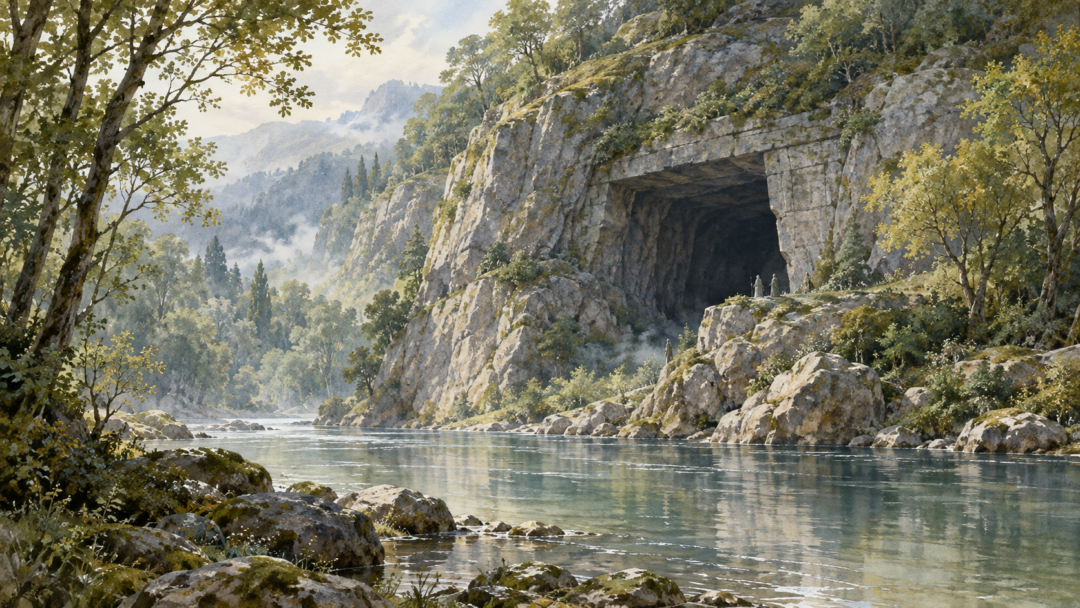
Menegroth lay in Beleriand, far to the west of the later Woodland Realm, on the Esgalduin in Doriath. Its name means the Thousand Caves. Long before the rising of the Sun and Moon, the Dwarves of the Blue Mountains delved the stronghold beside the river for Thingol. It became his great stronghold and citadel, a place associated with the larger history of Doriath rather than merely with one household’s shelter.
The Dwarves’ work is a substantial part of the architectural precedent. Menegroth’s name and its description as a stronghold establish the older cavern model, without supplying a detailed entrance plan. The Encyclopedia of Arda also explicitly credits Dwarven skill in the making of Thranduil’s later stronghold, while stressing that his halls were less grand. That is evidence for a repeated kind of craftsmanship, not for a shared construction crew or for identical techniques in every chamber. The later builders remain unnamed.
The connection does not make the realms interchangeable. Thingol ruled the Sindar of Doriath; Thranduil was a Sindarin king among the predominantly Silvan Elves of the Greenwood. The older cavern court could therefore serve as an inherited model even though the later king presided over a different community in a different age. Reading the resemblance as cultural memory is an interpretation grounded in that connection, not evidence that Doriath’s whole society moved east.
The bridge, the guarded door and the living rock
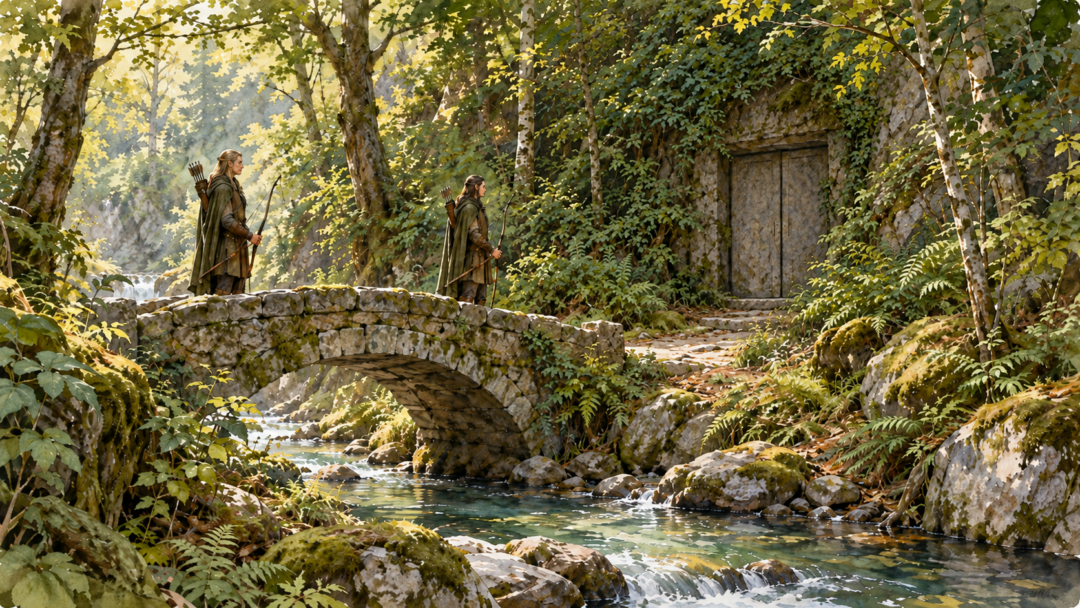
Both strongholds stand beside rivers, but the later halls have a more specifically described entrance. In Mirkwood, a bridge brings visitors across the Forest River to the Elvenking’s great stone doors. The later doors are magically secured, making entry difficult. River, crossing and gate combine to make arrival a controlled act rather than a casual walk into a hillside.
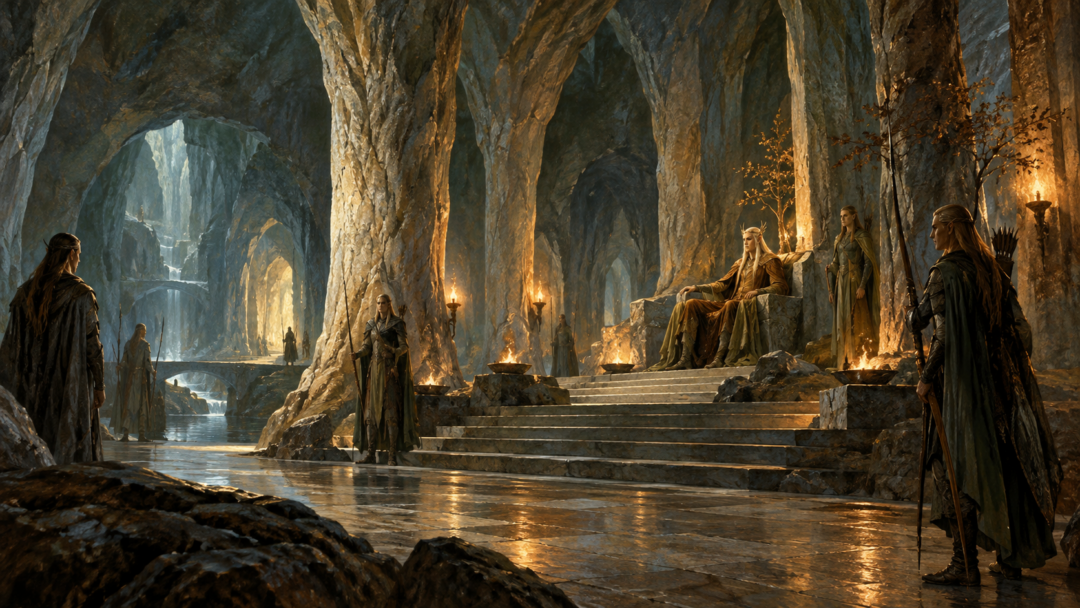
Inside Thranduil’s halls, numerous passages connect wider chambers, including the throne room, whose roof is borne on pillars cut from the living rock. The association with Menegroth is especially tangible here: royal space does not merely sit inside a natural hollow but is shaped out of the stone itself. The columns define a ceremonial hall; adjoining caverns serve other needs. It is architecture formed by excavation rather than buildings assembled beneath a roof.
The route also explains something about the stories set there. Thorin’s company is held in the dungeons, while Bilbo uses his ring to remain invisible as he devises their escape. The impassable stone doors make the other exit important to his plan. Later, Gollum too is held in the Elvenking’s custody. These episodes show control over movement without revealing the shape of every passage.
A second opening, and a river that carries goods
The feature that most clearly makes Thranduil’s halls their own place lies below the occupied chambers. A stream of the Forest River runs beneath the halls, reached by a trapdoor. The account identifies this as the only other exit apart from the impassable stone doors. It is a connection with the river quite different from the bridge at the main entrance.
The arrangement belongs to a trading network. The stream beneath the halls is used for trade with the nearby Men of the Long Lake. The river is therefore more than an obstacle outside the walls: it connects the enclosed stronghold with people beyond it. The main entrance explains how the halls are protected, while the working stream shows that protection does not mean isolation.
Bilbo’s escape plan makes use of this other opening. The same stream associated with trade becomes the Dwarves’ way out of captivity through the trapdoor. This links two uses of the halls without requiring an invented secret tunnel or a complete account of how supplies were handled. Menegroth also stood beside a river, but no equivalent trapdoor-to-stream system is established there. The later hall’s river passage is a concrete adaptation, not a detail to be copied backward into Doriath.
The uncertain date and the tempting map
The location can be described confidently in broad terms: the halls lie near the northeastern edge of Mirkwood, associated with the Forest River and the forest path approaching it from the south. Their exact relation to every branch of that river is less secure. The map in The Hobbit hints at a site between channels; one reconstruction places the gates across a southern branch and the underground stream along a northern one. That is a plausible reading of sparse clues, not a surveyed map of the hill.
The time of construction also resists a precise date. One account associates the Silvan Elves’ movement northward with the growing Shadow over Greenwood during the Third Age. Another places an earlier withdrawal under Thranduil’s father, Oropher, in the Second Age, responding to the rising power of Khazad-dûm. Those are alternative explanations for the people’s movement, not two relocations that can automatically be fitted into a neat sequence. Neither supplies a dated foundation stone for the halls.
Thranduil’s own history makes such certainty even less attractive. Accounts differ over the early leadership of the Woodland Realm, with the later history identifying Oropher as its former king and Thranduil as his successor. The halls are Thranduil’s stronghold in The Hobbit, but no definite building commission follows. The story gives us firm physical details at the moment the place is used, while leaving much of its original making beyond view.
What survives of Menegroth here is not a second Thousand Caves. It is the idea of a king’s hall protected by stone and water, made useful to Elves whose home remains the forest outside. The image that lingers is wonderfully particular: above, a guarded throne hall in the living rock; below, a trapdoor leading to the stream that gives the captive Dwarves their way out. Even a remembered architectural pattern must find its own river.
Sources & Notes
- The Encyclopedia of Arda, Elvenking's Halls — explicitly compares Thranduil's stronghold with Menegroth and discusses its woodland population, river trade, entrances and uncertain dating. https://www.encyclopedia-of-arda.com/e/elvenkingshalls.html
- The Encyclopedia of Arda, Menegroth — identifies Thingol's Thousand Caves beside Esgalduin and their construction by Dwarves of the Blue Mountains. https://www.encyclopedia-of-arda.com/m/menegroth.html
- Tolkien Gateway, Barrels Out of Bond — chapter guide to the magical gates, the dungeons, the river beneath the halls and Bilbo's barrel escape. https://tolkiengateway.net/wiki/Barrels_Out_of_Bond
Primary textual context: The Hobbit, Barrels Out of Bond; The Silmarillion, Of the Sindar; and Unfinished Tales, the history of Galadriel and Celeborn and the Silvan Elves. The linked reference account explicitly compares the halls with Menegroth, while identifying uncertainties in their construction date and reconstructed geography. Cultural memory is an interpretation, not a surviving building plan.