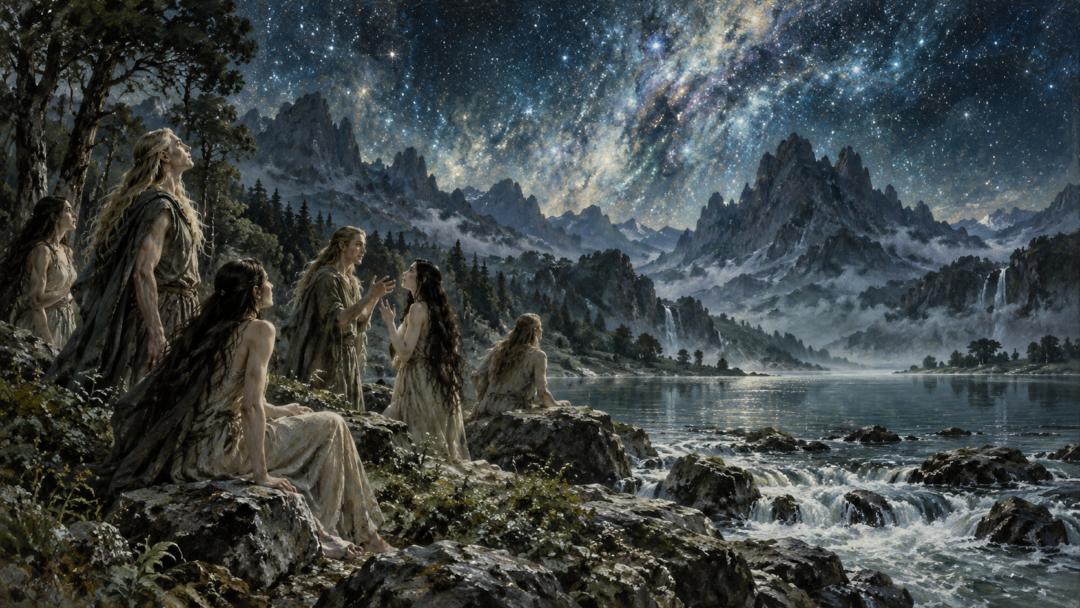
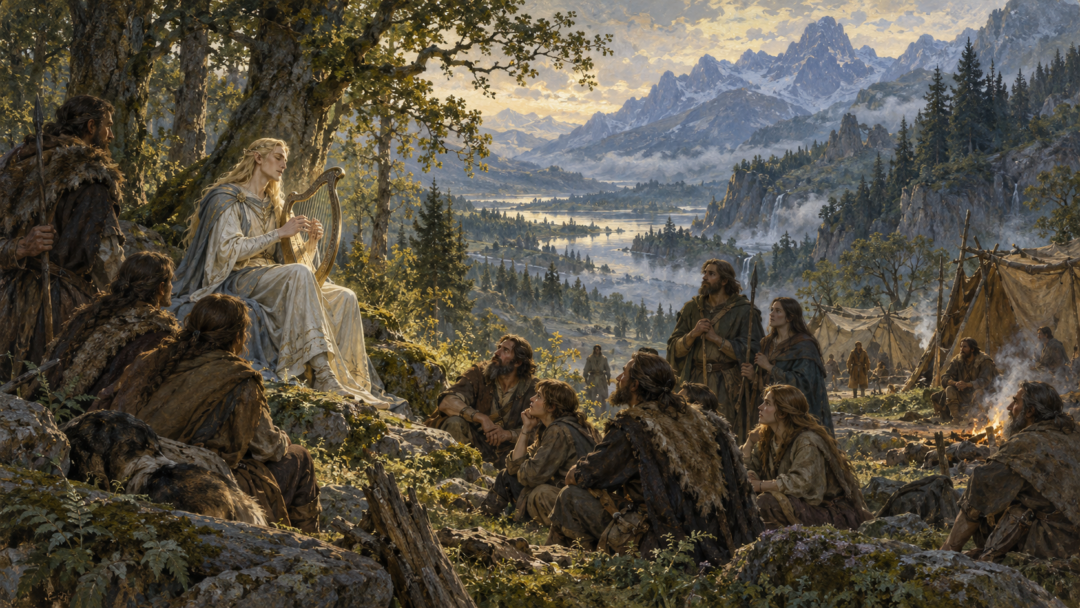
Long before Galadriel ruled in Lothlórien, before Elrond founded Rivendell, and before the first Elven kingdoms rose in Middle-earth, the Elves awakened beside the waters of Cuiviénen.
There was no Sun or Moon. The stars shone above them, and the sound of water flowing over stone was among their first experiences of the world.
In that ancient darkness, the Elves began to speak. They gave names to the things around them, and eventually they gave a name to themselves.
They called themselves the Quendi.
In The Silmarillion, the explanation seems beautifully simple: Quendi meant those who spoke with voices. The Elves had not yet encountered another living people who spoke or sang as they did.
But the linguistic essay Quendi and Eldar, published in The War of the Jewels, reveals something more complicated.
The oldest Elvish name was connected not merely with speaking, but with the idea of a person. And the linguistic notes reveal an unresolved question about how closely those two meanings were originally connected.
That distinction matters because Quendi was older than the division between the Eldar and the Avari. Before there were High Elves, Grey Elves, or Elves who refused the journey westward, there was one people identifying itself through the remarkable ability to communicate.
Their first name tells us how they understood themselves before history began separating them.
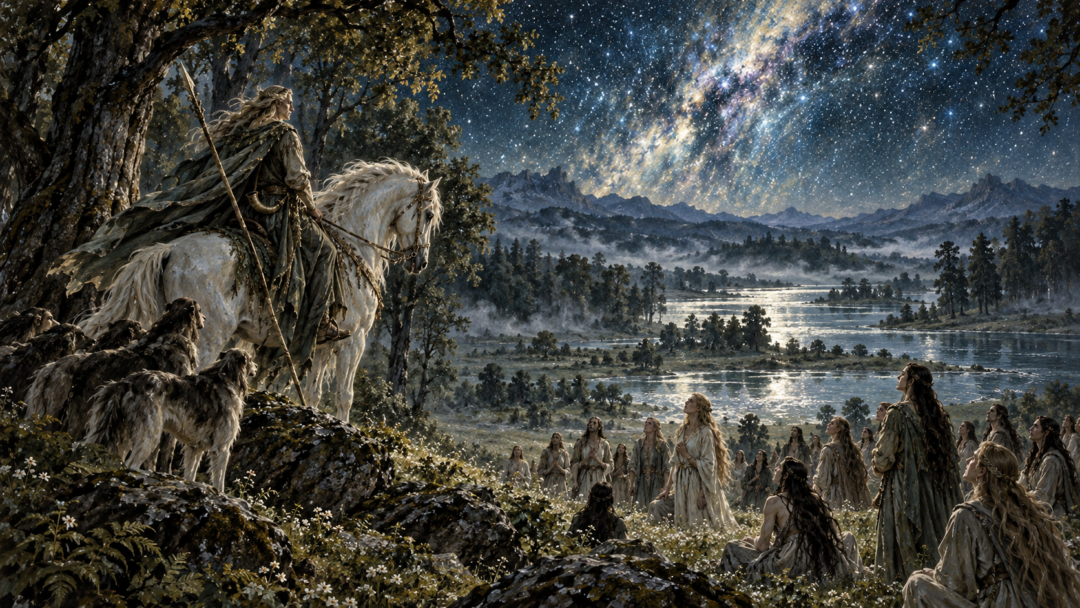
Why Quendi Means More Than Simply ‘Elves’
In later Quenya, Quendi was the plural of Quendë, meaning an Elf.
The older Primitive Quendian form is reconstructed as kwendē, with its plural represented as kwendī.
But Quendi and Eldar examines a family of related linguistic forms that makes the familiar translation more interesting.
Among them is the root KWEN, associated with speech and with the concept of a person, and its elaboration KWENED.
Another related root, KWET, is associated more directly with saying or uttering words.
These relationships matter because they connect three ideas that modern readers might instinctively separate: speech, an individual person, and the Elves themselves.
At the earliest stage of Elvish experience, those categories could overlap.
The Elves knew themselves as speakers. Their word identifying speakers became the name of their people.
In later usage, however, words from the same linguistic family did not all retain the restricted meaning of Elf.
The Quenya word quén could mean a person or individual, without necessarily identifying that individual as Elvish.
This distinction prevents a common misunderstanding.
Quendi was not simply the ordinary Quenya word for every person in every age. It became a name specifically identifying the Elves.
Yet the broader concept of personhood remained present in related vocabulary.
What began as the self-description of one people was linguistically connected to a category larger than that people.
The difference would become especially important after the Elves encountered others who could speak.
Oromë Gave the Elves a Second Identity
The name Eldar entered Elven history through an encounter with the Vala Oromë.
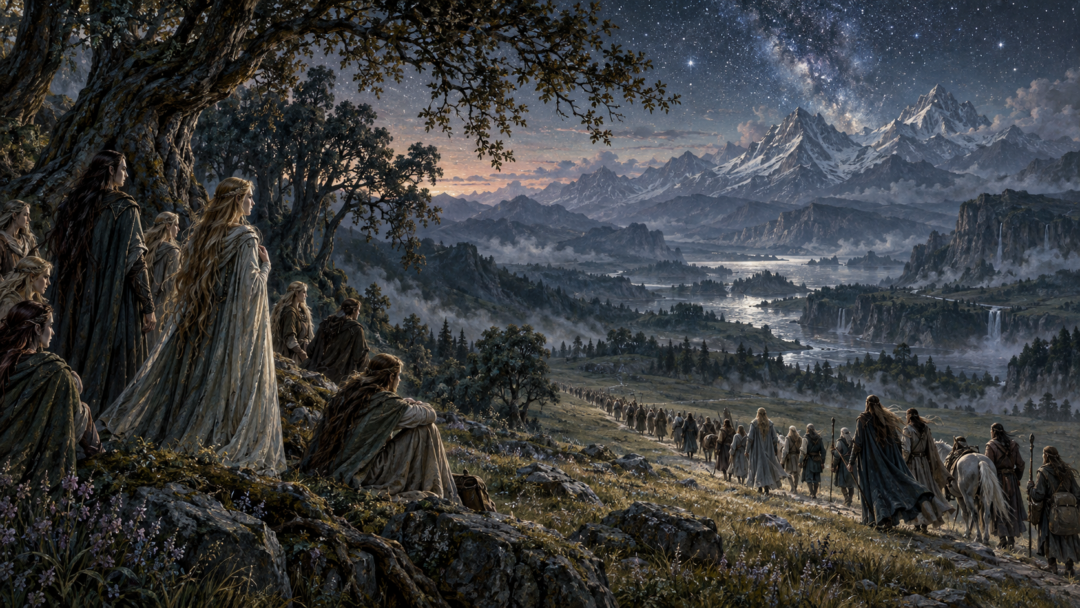
Oromë discovered the Elves while travelling through Middle-earth. In the ancient account, he heard their singing before coming upon them.
He called them Eldar, the People of the Stars.
At first, the name applied to the Elves generally.
It was appropriate to a people who had awakened beneath the stars and had long regarded their light with wonder.
But Eldar and Quendi did not originate in quite the same way.
Quendi was the Elves’ own ancient name for their kind, while Eldar was the designation given to them by Oromë.
The difference became more significant after the Valar invited the Elves to leave Middle-earth and dwell in Aman.
Not all accepted.
Some were willing to undertake the westward journey. Others refused the summons and remained in the lands where they had awakened.
From that division came a more restricted use of Eldar.
The name increasingly referred to the Elves who accepted the summons and began the Great Journey.
Those who refused became known as the Avari, the Unwilling or Refusers.
The original broad meaning of Eldar had narrowed.
And suddenly, the Elves possessed names that reflected different things about their identity.
Quendi identified their kind. Eldar identified a major historical division within that kind.
The Linguistic Mystery Hidden in Quendi and Eldar
The most intriguing part of the subject lies in the relationship between speech and personhood.
In The Silmarillion, the traditional explanation associates Quendi directly with the ability to speak.
Yet the more detailed linguistic evidence reveals that the history of the word was not always expressed in exactly the same terms.
In the earlier linguistic work known as The Etymologies, the root KWEN(ED) was identified with Elf, while KWET was associated with saying or speaking.
The connection between those roots was not made as explicit as it would become in later writings.
In Quendi and Eldar, composed around 1959–60, the relationship receives more developed treatment.
The essay connects KWEN and KWET with a still more basic element, KWE, associated with vocal speech.
This gives the traditional meaning a deeper linguistic explanation.
The Elves’ word for themselves could be understood within a family of forms relating articulate speech to the idea of an individual person.
But a difficulty remained.
Many derivatives associated with KWEN meant person, individual, or Elf rather than referring directly to the physical act of speaking.
The surviving vocabulary therefore raises a question: was the connection to speech the original meaning of the name, or was it an interpretation of an older word for a person?
Related late linguistic notes make that question especially interesting.
In material published in Parma Eldalamberon 19, a marginal note entertained the possibility that the connection between KWEN and speech reflected a conjecture by Elven loremasters, perhaps influenced by the separate root associated with saying.
That note was subsequently struck through.
It therefore cannot be treated as a definitive rejection of the traditional explanation.
Nevertheless, its existence shows that the relationship between the terms was subjected to further reconsideration.
This is the crucial distinction.
The narrative tradition explains why the Elves understood their self-name as referring to speakers.
The philological material explores whether that traditional understanding necessarily represents the earliest linguistic meaning of the underlying root.
Those are related questions, but they are not identical.
An ancient people may preserve a meaningful explanation of its name even when the full history of the word is more difficult to establish.
The surviving writings do not require us to discard the familiar translation.
They do require us to distinguish the traditional meaning from every detail of its proposed etymology.
What Happened When the Elves Met Other Speakers?
The broader use of quén becomes particularly revealing when other peoples enter Elven history.
The Dwarves had been created by Aulë, though their independent life depended upon Ilúvatar’s acceptance. Men, like the Elves, were Children of Ilúvatar.
Both peoples eventually became known to the Eldar.
In Quendi and Eldar, the word quén is described as applicable to other incarnate beings, including Men and Dwarves.
That detail changes the apparent implications of the ancient self-name.
The first Elves had called themselves speakers before encountering other peoples capable of articulate language.
Later generations had to reckon with the existence of persons outside their own kind.
But the broader vocabulary did not require that only Elves could count as persons.
Indeed, the distinction between Quendi and quén allowed Elvish language to preserve the ancestral name while recognizing individuals of other peoples.
This does not mean that every Elf treated Men and Dwarves fairly. The histories contain suspicion, misunderstanding, conflict, and occasional friendship between the kindreds.
Language alone cannot settle questions of prejudice or moral conduct.
Nevertheless, the linguistic distinction is important.
The name Quendi remained attached to the Elves, while a closely related word for an individual person could extend beyond them.
The idea of personhood was not permanently confined to the people who had first called themselves speakers.
The First Name of the Elves Reveals Their Shared Beginning
The most familiar Elven names in Middle-earth often tell us about a division: those who saw the Light of the Trees, those who remained in Middle-earth, those who followed a particular journey, or those who belonged to a particular kindred.
Quendi reaches further back.
It belongs to the age before those divisions, when the Elves first discovered the world and began expressing what they perceived through speech.
Quendi and Eldar deepens that story by showing how closely the ancient name was connected with words for a person, while also preserving questions about the original relationship between those meanings.
The traditional explanation remains powerful: the Elves called themselves speakers because speaking distinguished them within the world they knew.
But the linguistic evidence adds a subtle complication.
Their earliest identity was connected to the very concept of a speaking person, a concept that would eventually extend beyond the Elves themselves.
Long before there were Eldar and Avari, there were the Quendi.
And before their history became a story of sundering, exile, and fading kingdoms, their oldest name remembered something they had once shared.
They were the people who spoke.
Sources & Notes
This article is based on close reading and interpretation of Tolkien's published works and related source material where relevant.