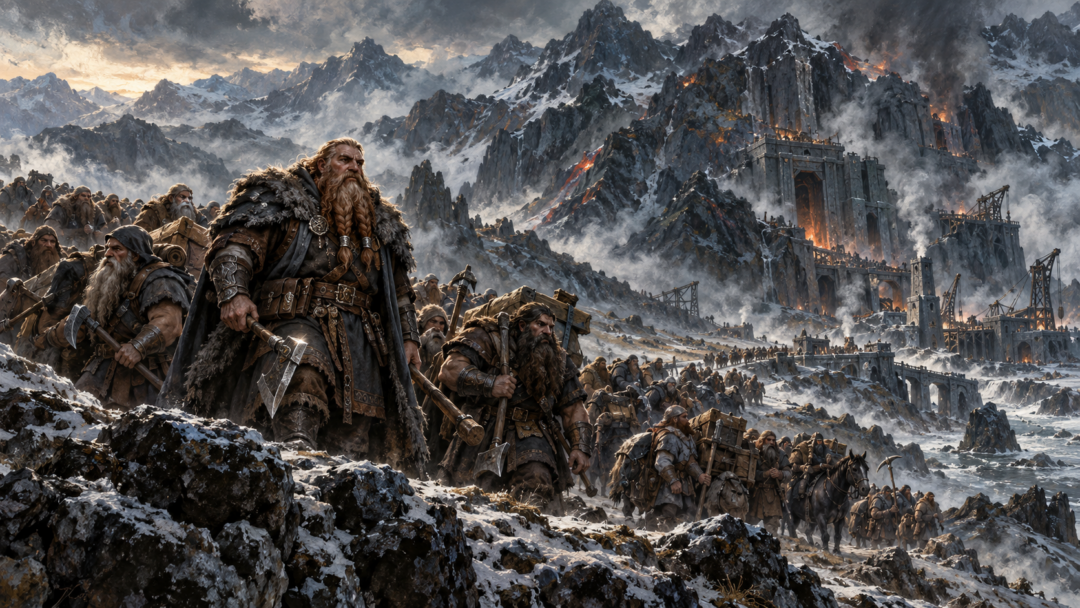
When Thorin Oakenshield is trapped inside the Lonely Mountain and armies gather outside his gate, he sends for one relative who can change the balance at once: Dáin Ironfoot of the Iron Hills. Dáin does not arrive as a wandering exile with a handful of companions. He comes at the head of 500 armed Dwarves, organized enough to cross the wild and strong enough that his arrival threatens to turn a treasure dispute into open war.
That raises an odd question. If the Iron Hills could sustain a powerful Dwarf settlement, maintain its own ruling line, and field a serious force, why was Dáin still a lord rather than a king?
The answer reveals something easy to miss about Durin’s Folk. Their highest legitimacy was not simply attached to whoever controlled the strongest surviving fortress. The kingship followed the senior royal line. The Iron Hills could therefore function for centuries under Grór’s branch without becoming a rival kingdom. Only when Thorin’s line ended in 2941 did political reality and royal title finally meet in the same person.
Two brothers, two different kinds of authority
The division began after disaster in the Grey Mountains. In 2589 of the Third Age, King Dáin I was killed by a cold-drake. The following year, his people abandoned those northern mansions.
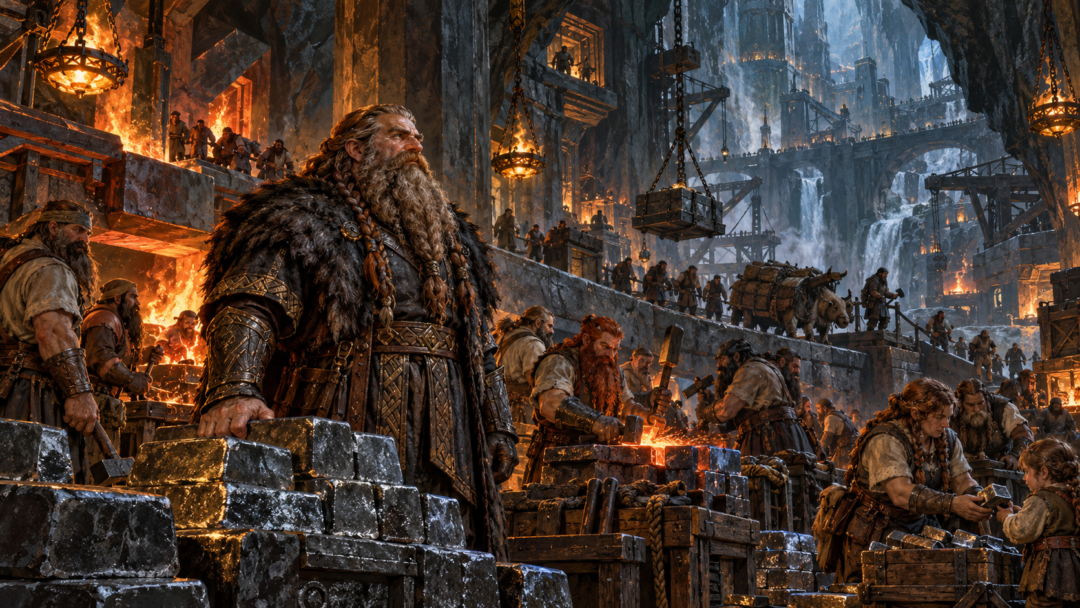
His two surviving sons did not lead everyone to the same place. Thrór, the elder son and heir, returned with part of Durin’s Folk to Erebor. Grór, his younger brother, went east with many followers to the Iron Hills. From that moment, the family had two major centers: the royal branch at the Lonely Mountain and a cadet branch in the Iron Hills.
The distinction matters. Thrór possessed the kingship because he was Dáin I’s heir. Grór possessed a substantial following and a durable settlement, but he did not become a second King of Durin’s Folk. The texts associate the Iron Hills with a lordship, while the kingship remains with Thrór’s line.
That is the constitutional oddity at the heart of the story. Durin’s Folk did not simply turn every successful Dwarf stronghold into an independent monarchy. At least in this case, lineage outranked geography.
The Iron Hills did not need a crown to endure
The Iron Hills were not a temporary refugee camp. Grór’s people settled there in 2590, and the settlement remained important all the way to the events of The Hobbit in 2941 — a span of 351 years.
Its location helps explain why it could matter so much. The hills lay east of Erebor, in a region associated with iron, with the River Carnen rising nearby and routes connecting the eastern Dwarves to the Lonely Mountain. The sources do not describe an Iron Hills council, bureaucracy, tax system, guild hierarchy, or any other machinery of state, so none should be imagined into the gap. What they do show is continuity: a settled Dwarf population, a recognized ruling family, military capacity, and long-standing ties with Erebor.
That is enough to make the title “lord” significant rather than small. It was not the label for a mere village headman. By the late Third Age, the lord of the Iron Hills could command a community capable of sending a formidable armed host far to the west.
The absence of a crown therefore tells us more about legitimacy than about power.
Smaug destroyed a kingdom but not the kingship
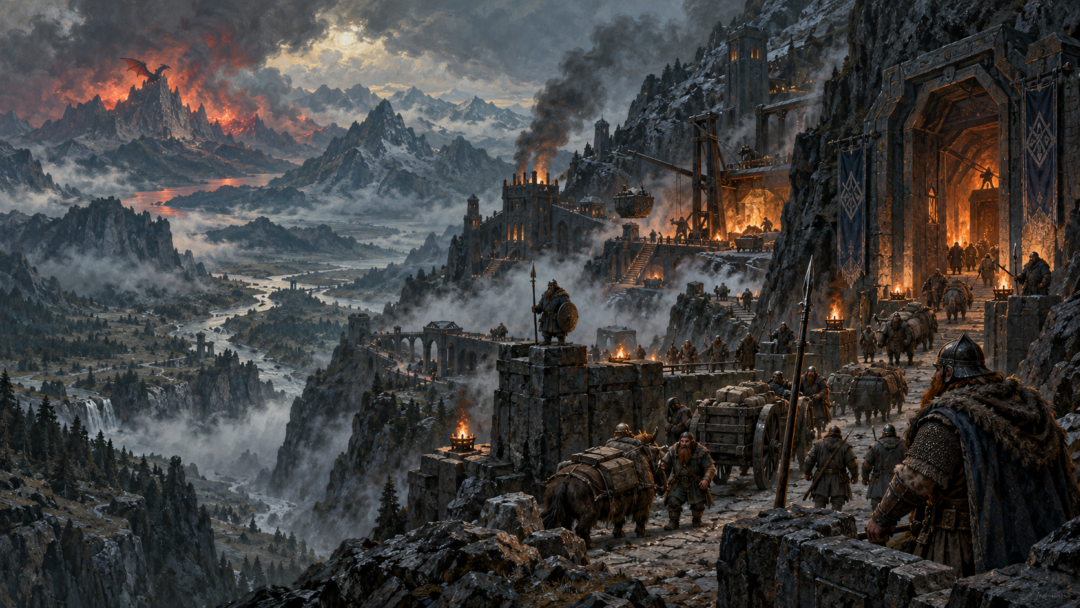
The strongest test came in 2770, when Smaug descended on Erebor. The Kingdom under the Mountain was shattered. Dale was ruined, and the surviving Dwarves were scattered.
Yet Thrór did not cease to be the head of Durin’s Folk simply because he had lost the Mountain. The royal claim continued through his line in exile: from Thrór to Thráin II and then to Thorin II Oakenshield.
This is where the Iron Hills become especially interesting. Erebor, the great royal seat, was occupied by a dragon. The royal house wandered and later established itself far to the west. The Iron Hills, meanwhile, remained an intact Longbeard settlement in the east.
If Dwarven kingship had been purely territorial — if the crown simply belonged to the ruler of the strongest surviving Dwarf center — Grór’s branch had a powerful practical claim. But that did not happen. Control of a functioning stronghold did not displace the senior line.
For 171 years, from Smaug’s capture of Erebor in 2770 until the Battle of Five Armies in 2941, there was no resident King under the Mountain in the old hall. But the royal line endured. The Iron Hills did not promote its own ruler into a competing king.
That separation is the key: power could be local; kingship remained dynastic.
Dáin’s title shows the system working
Dáin Ironfoot makes the distinction visible because he was unquestionably powerful long before he became king.
He was Grór’s grandson and the son of Náin. As a young Dwarf he fought at Azanulbizar in 2799, where Náin was slain by Azog and Dáin killed Azog before the East-gate of Moria. Grór himself lived until 2805. After Grór’s death, Dáin became the ruler associated with the Iron Hills lordship.
That means Dáin did not rule the Iron Hills for the entire 171-year exile of Erebor’s kings. His own lordship began later, in 2805, and lasted until 2941 — about 136 years. The longer 171-year span belongs to the political situation created by Smaug: an intact Iron Hills existing while the royal seat at Erebor remained lost.
The distinction actually strengthens the point. Dáin had decades upon decades in which to become something more than a local ruler if success alone created kingship. He had ancestry from the House of Durin, military fame, a secure base, and a substantial people. Yet he remained Dáin of the Iron Hills, a lord, while Thorin — landless for most of his life — remained the royal heir.
Authority and title were not the same thing.
Five hundred Dwarves reveal what “lord” could mean
The clearest evidence of the Iron Hills’ real strength comes not from a description of its government but from action.
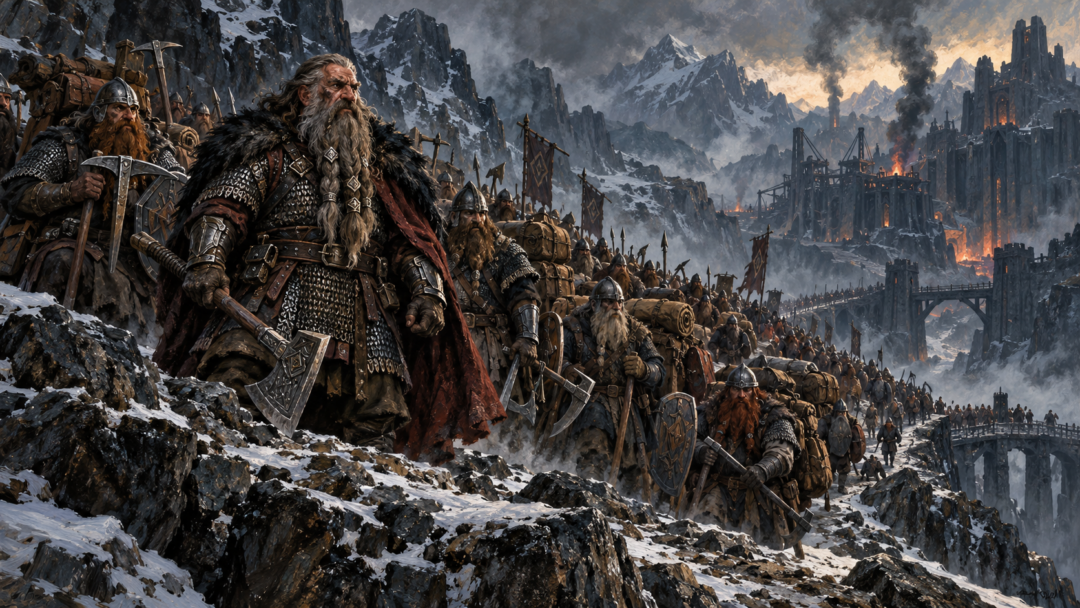
After Smaug’s death, Thorin reclaimed the Mountain and treasure but found himself confronted by Bard’s Men and the Elvenking’s host. He sent a message to Dáin asking for aid. Dáin answered by marching west with 500 Dwarves.
The Hobbit gives us no census for the Iron Hills and no way to calculate what proportion of its population those warriors represented. But the force itself tells us something concrete. Dáin could receive a summons from a kinsman, gather hundreds of armed Dwarves, and bring them across the distance to Erebor as a coherent host.
That is the political fact we are actually given.
It is tempting to fill in the invisible machinery behind such a feat: officers, councils, supply systems, mining levies, formal institutions. The texts do not provide them. What they provide is the result. The Iron Hills had enough social and military cohesion for its lord to act decisively beyond his own hills.
In other words, the settlement behaved like a serious polity without ever needing to be described as a separate kingdom.
Thorin’s death changed the title, not Dáin’s competence
The Battle of Five Armies transformed the succession in a way that Smaug’s conquest never had.
Thorin was mortally wounded. His nephews Fíli and Kíli also died. With Thorin’s branch ended, the kingship passed to Dáin, descended from Grór, the younger brother of Thrór.
This was not a promotion awarded because Dáin had brought the largest army. Nor does the text suggest that the Dwarves held an election after the battle. Dáin’s claim came through the royal genealogy. The cadet line became the surviving line entitled to inherit.
That is why his change in title is so revealing. The man who had already ruled the Iron Hills for more than a century did not become king by accumulating more territory or proving himself in battle. He became king when the senior line failed and his branch inherited its place.
The crown finally caught up with a ruler who already possessed power.
Dáin then became King under the Mountain, and Erebor once more became the chief royal center of Durin’s Folk. The lord of the Iron Hills and the kingship were no longer separated between two branches of the family.
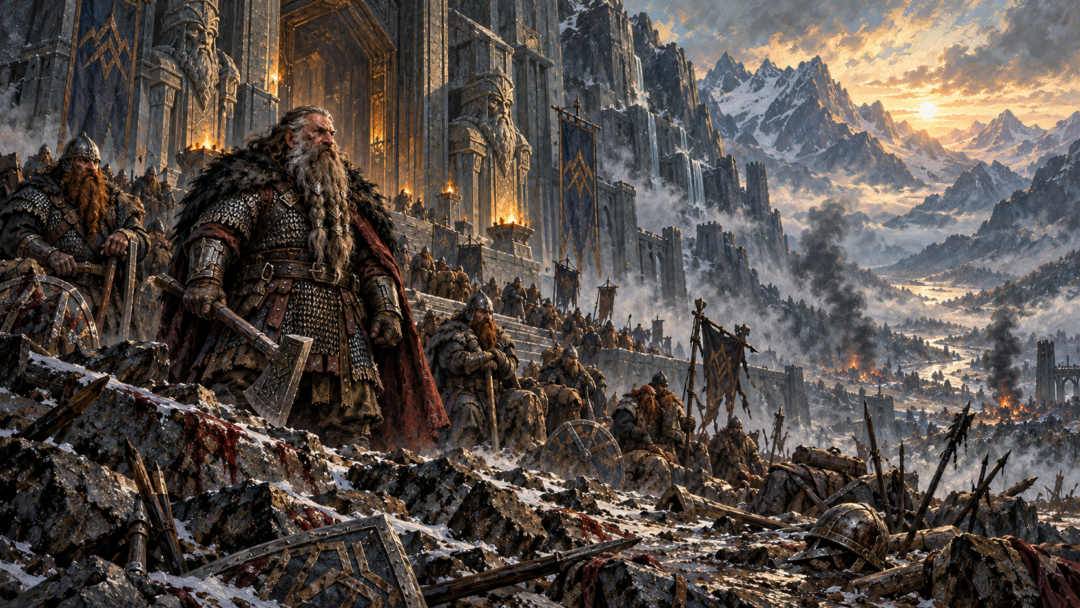
The Iron Hills complicate what a Dwarf “kingdom” means
Middle-earth often encourages us to think territorially. Gondor has a king; Rohan has a king; Erebor has a King under the Mountain. It is easy to assume that a prosperous people in a defensible homeland must therefore form a kingdom of their own.
The Iron Hills resist that assumption.
For 351 years, they supported a distinct and durable branch of Durin’s Folk. Their rulers could lead warriors, answer great summonses, and maintain a settlement far from the wandering royal household. Yet the texts never say that the Iron Hills declared itself a kingdom, and its most famous ruler is explicitly presented first as a lord.
That does not make the Iron Hills politically insignificant. It makes the structure of Dwarven legitimacy more interesting.
The senior kingship could survive the loss of its capital. A cadet lordship could survive beside it without becoming a rival crown. And when the senior line ended, the cadet line could inherit the kingship without needing to invent a new basis for authority.
The Iron Hills therefore offer one of the clearest examples of how Durin’s Folk could separate place from rank. Erebor could fall while its kingship survived. The Iron Hills could flourish without claiming that kingship. Dáin could be one of the most consequential Dwarf rulers of his age and still remain a lord until genealogy, not conquest, made him king.
After 2941, the story follows Dáin to Erebor, and the Iron Hills largely pass out of the narrative as an independent center. The texts do not establish that the hills were emptied, nor do they describe any later administration there. What matters for the earlier centuries is already clear.
The Iron Hills did not need to call itself a kingdom to possess continuity, strength, and a ruler of Durin’s house. For centuries, it stood as proof that among the Longbeards, a throne was more than a mountain — and ruling a people was not, by itself, the same thing as wearing their crown.
Sources & Notes
- https://tolkiengateway.net/wiki/Iron_Hills — Tolkien Gateway — Iron Hills: location, Grór’s settlement in 2590, and its relationship with Erebor; includes references to Appendix A.
- https://tolkiengateway.net/wiki/Gr%C3%B3r — Tolkien Gateway — Grór: the younger branch of Dáin I’s family, Iron Hills lordship, and succession through Dáin Ironfoot.
- https://tolkiengateway.net/wiki/D%C3%A1in_Ironfoot — Tolkien Gateway — Dáin Ironfoot: lordship from 2805, the host sent to Erebor, and inheritance of the kingship after Thorin’s death.
Textual anchors: The Lord of the Rings, Appendix A, Durin’s Folk, and The Hobbit, chapters 15–18. The distinction between lordship and kingship is an interpretation of the genealogy and narrative, not a surviving Dwarven constitution. Linked references provide supporting summaries and book citations.