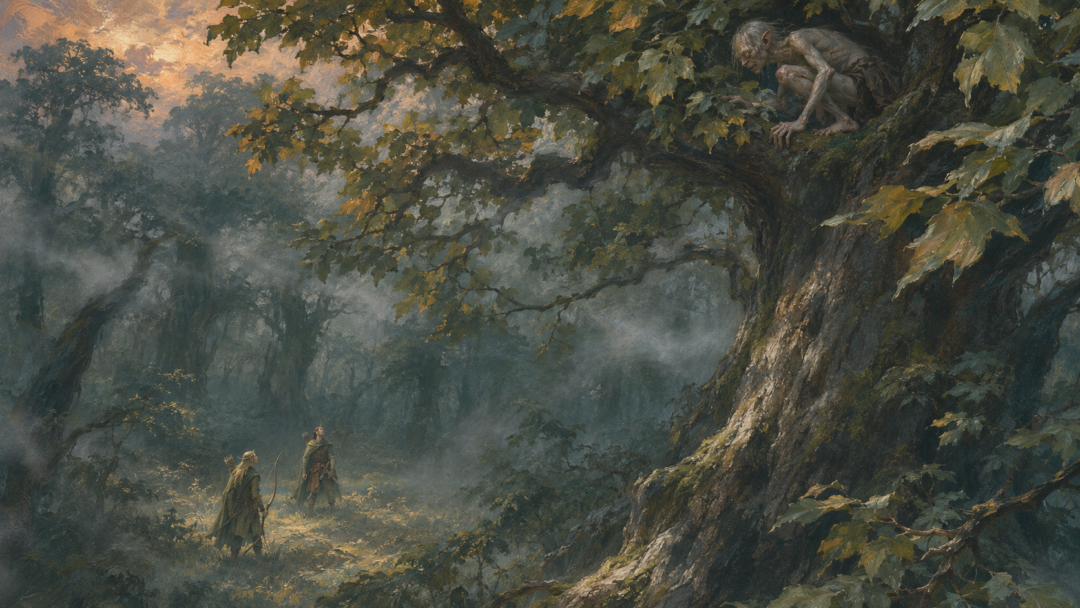
At the Council of Elrond, Aragorn speaks of Gollum as a prisoner safely held by the watchful Elves of Mirkwood. Legolas immediately corrects him: Gollum is gone. This is troubling news for those deciding the fate of the One Ring. Its former owner is loose again, and the Enemy has already forced dangerous secrets from him.
The escape began with a tree. Gollum had been allowed to climb it under guard, but one day he refused to come down. That night Orcs attacked the Elves. When the fighting ended, Gollum had disappeared and his guards had been killed or taken. Legolas believed it was a rescue, although he could not explain how it had been arranged. The account appears in The Fellowship of the Ring, Book II, Chapter 2, “The Council of Elrond.”
Why Gollum was in the Elves’ keeping
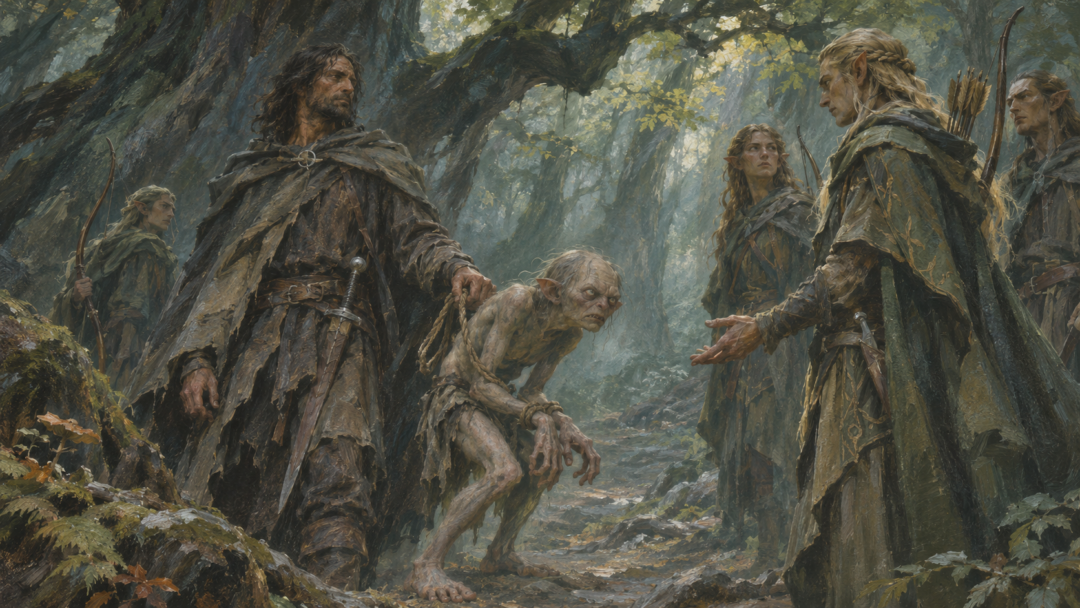
Gollum did not wander into Thranduil’s realm and get arrested. Aragorn had hunted him after Gandalf became convinced that the creature might hold answers about Bilbo’s ring. Near the Dead Marshes, Aragorn found tracks leading away from Mordor and caught Gollum beside a stagnant pool. Gollum bit him, and the Ranger had to force his unwilling prisoner north on a difficult journey to Mirkwood.
Aragorn delivered Gollum to the Wood-elves as previously agreed. Gandalf questioned him and learned about the Ring’s history, including its connection to the Great River near the Gladden Fields. More disturbingly, Gollum had been to Mordor, where information had been forced from him. Sauron now knew that the Ring had been found and had spent time in the Shire. Gollum was both a valuable source of knowledge and a danger if released.
The Elves watched Gollum day and night at Gandalf’s request. But Gandalf had also urged them to hope that he could be cured. They were reluctant to leave him permanently underground, where darkness and isolation might deepen his misery. That choice was not simple carelessness. They were trying to hold a dangerous prisoner without treating him as beyond hope.
The tree that gave Gollum his chance
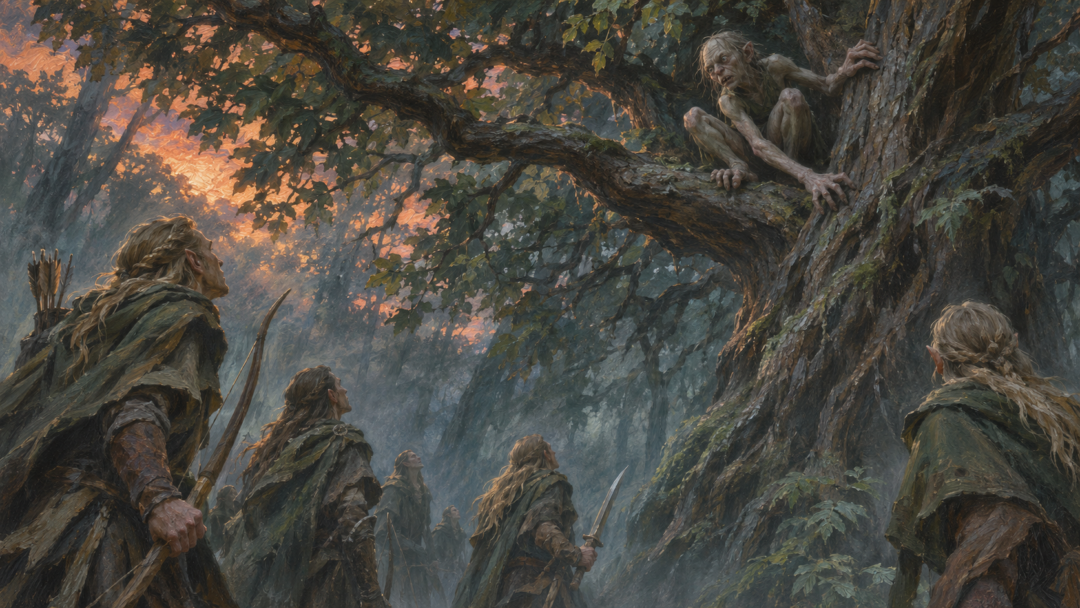
During fair weather, the Elves sometimes led Gollum through the woods. He liked to climb a tall tree standing apart from the others, and they let him reach its upper branches while a guard remained below. He was not free to wander unattended. The arrangement kept him at a known place while offering something an underground cell could not: open air and wind in the treetops.
Gollum was an extraordinary climber. He could cling to branches with his feet as well as his hands, using his whole body in ways a pursuer might struggle to copy. His wasted appearance was misleading; Aragorn had warned the Council about his surprising strength. From the ground, a guard could watch his descent, but reaching him high among the branches would be another matter.
Then, on a summer day, Gollum refused to come down. The guards did not want to climb after him, so they stayed at the tree into the night. The immediate problem was not a broken lock but a prisoner beyond easy reach. Gollum had chosen a position from which removing him would be difficult, and his keepers were waiting for him to descend.
The delay gave the events that followed their opening. It is tempting to imagine Gollum watching for a prearranged signal, but no such moment is recorded. We know that he refused to leave a tree he usually climbed willingly, on the very day of the attack. In hindsight the timing looks suspicious. To the guards, he remained a stubborn prisoner high above their post, not yet a fugitive disappearing through the forest.
The Orc attack on a moonless summer night
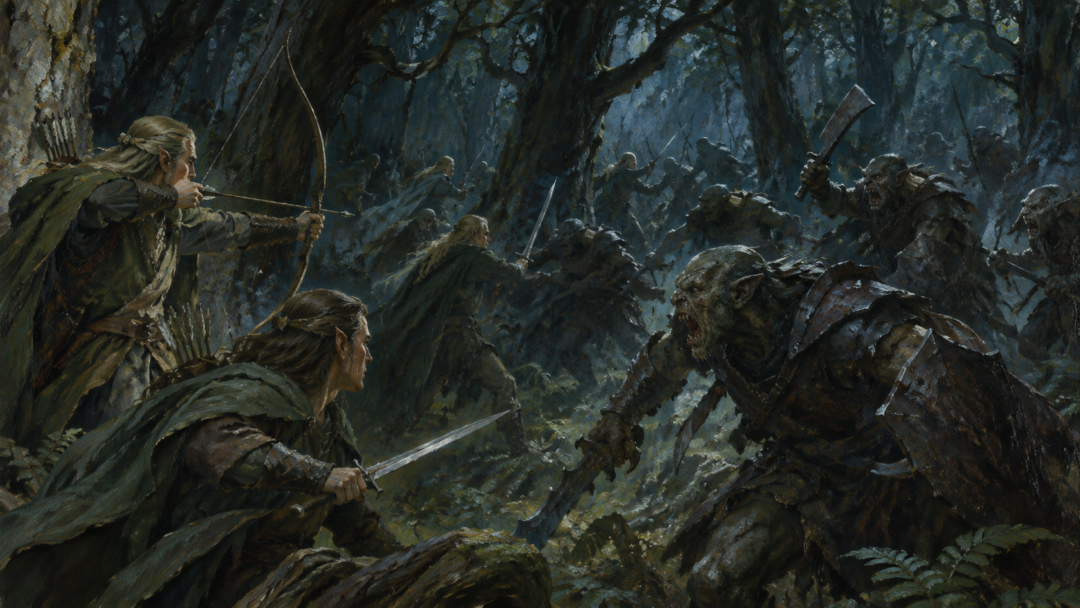
The attack came after darkness fell, on a summer night without moon or stars. A large, fierce force of Orcs from over the mountains surprised the Elves. The Orcs were unfamiliar with fighting in the woods, and the defenders eventually drove them away. Their victory, however, did not prevent the loss that made the battle consequential.
Once the fighting ended, Gollum had vanished. The guards assigned to him had been slain or captured. Legolas gives no moment-by-moment account, and reports no eyewitness seeing Orcs take Gollum from the tree. The battle explains how his watch could be disrupted, but not exactly how he got from the branches into the forest. That missing detail is why the story remains more mysterious than a simple prison break.
The Elves repelled the attackers but still lost their prisoner. An assault need not conquer an entire realm to achieve a narrower purpose. If Gollum’s freedom was the objective, the confusion of the fighting could have been enough. The cost was real: the guards did not return safely to their posts, even though the Orcs were beaten back. The distinction between winning the battle and preventing the escape is central to what Legolas reports.
Did Gollum arrange the rescue with the Orcs?
Legolas believed the attack was intended to rescue Gollum and that Gollum knew of it beforehand. This was his interpretation, not a witnessed conversation or confirmed record of orders. The reasoning is persuasive: Gollum stayed in the tree, Orcs struck that night, and he vanished during the assault. Those facts look more like coordination than an ordinary refusal to descend followed by an unrelated raid.
Yet Legolas admits the Elves cannot guess how any arrangement was made. He mentions Gollum’s cunning and the Enemy’s many spies, but names no intermediary. The story provides no code, messenger, secret signal, agreed meeting, or conversation between Gollum and the Orcs. It never shows him contacting them from captivity. A detailed account of how he sent word would fill a gap with speculation rather than evidence.
The Enemy’s involvement is plausible for reasons beyond the timing. Gollum had endured torment in Mordor, and Aragorn suspected that he had been allowed to leave on an evil errand. Legolas also reports that hostile creatures had returned to Mirkwood in strength. Together, these details suggest outside help could reach into the woodland realm. They do not establish what Gollum knew, whom he contacted, or whether he himself initiated a plan.
Nor must we assume Gollum could command Orcs. Others might have organized a rescue serving Sauron’s interests, with Gollum knowing only part of it. That is a possibility, not a confirmed event. His loyalties are hardly straightforward: longing for the Ring, fear of Sauron, and the desire to survive all influence him. Legolas identifies a convincing pattern without being able to describe the machinery behind it.
The trail south toward Dol Guldur
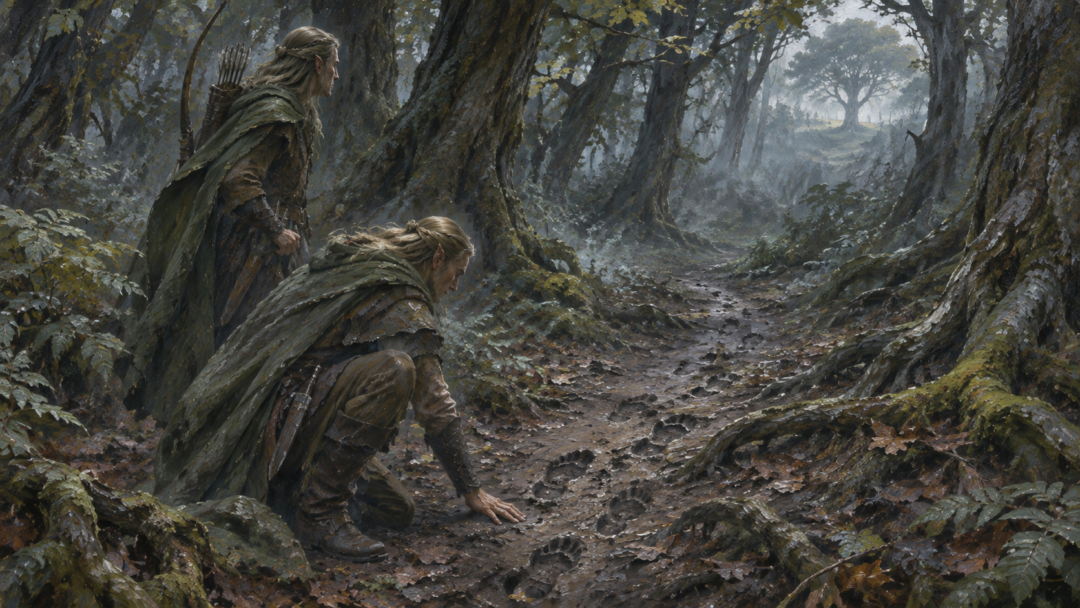
The Wood-elves searched after the Orcs withdrew. They found Gollum’s trail among the tracks of many Orcs, leading deeper into the forest toward the south. That association strengthens the idea that his disappearance was connected with the attackers, rather than merely an unnoticed climb down the tree. Yet tracks are not a captive recovered. Eventually the trail escaped even the skill of the Elven trackers.
The pursuit led toward Dol Guldur, the dreadful stronghold in southern Mirkwood. Legolas says the Elves did not dare continue. The region remained perilous although Sauron had departed from the fortress earlier, and evil creatures had returned to the forest beyond the areas the Elves maintained. Following one fugitive into that territory might expose the searchers to dangers far beyond those of the first attack.
This does not prove Gollum entered Dol Guldur, or that the Orcs delivered him to any particular master. Legolas gives a direction, a lost trail, and a limit the pursuers refused to cross. The forest contained places beyond the reach of Thranduil’s people. Once Gollum vanished toward them, knowing roughly which way he had gone did not mean the Elves could bring him back.
Why the news troubled the Council
Legolas reveals the escape just after Aragorn has expressed relief at Gollum’s secure imprisonment. Aragorn is alarmed: he knows how difficult Gollum was to capture and how much harm he might do free. The Council has also heard how the Ring passed through Gollum’s hands and how Sauron learned of its stay in the Shire. His escape adds a dangerous uncertainty to the decisions being made at Rivendell.
Gandalf does not propose another hunt. There is no time, and the Council has a greater task. Instead, he allows that Gollum may play a part neither he nor Sauron expects. He is not predicting the details of Gollum’s future. Readers who know the ending can recognize the significance: at Mount Doom, Gollum’s final seizure of the Ring leads to its destruction. At Rivendell, nobody can plan for that outcome.
The scene leaves a haunting image: a solitary tree in Mirkwood, with a miserable prisoner clinging high above his guards as daylight fades. The Elves let him feel the wind because they had not entirely given up on him. They could not protect him from the darkness gathering outside their realm, or know what his escape would eventually mean. A small act of mercy had become part of a future nobody could yet see.
Sources & Notes
- Tolkien Gateway, The Council of Elrond — Legolas's report of the tree, Orc attack, missing prisoner, and southward trail — https://tolkiengateway.net/wiki/The_Council_of_Elrond
- The Encyclopedia of Arda, Gollum — capture, imprisonment in Mirkwood, and escape — https://www.encyclopedia-of-arda.com/g/gollum.php
- Tolkien Gateway, The Hunt for the Ring — supplementary accounts of Gollum and the Enemy's pursuit — https://tolkiengateway.net/wiki/The_Hunt_for_the_Ring
Reading references: The Fellowship of the Ring, The Council of Elrond; Unfinished Tales, The Hunt for the Ring. Legolas's belief that a rescue was arranged is distinguished from a witnessed agreement; the report establishes the attack, missing guards, escape, and direction of the trail.