
Imagine a sheet of parchment in Tirion, the Elven city in the Blessed Realm, and Fëanor bending over it with a pen. His work with letters would eventually reach far beyond that city, appearing in inscriptions familiar to readers of The Lord of the Rings. It is easy to mistake such a celebrated maker for the inventor of Elvish language itself. But did he give Arda its first language?
No. Fëanor devised the influential letters known as the Tengwar, a writing system, not the first spoken language. Elves had been speaking long before his birth, and another scholar had already invented signs to record their words. To understand his achievement, we need to begin not at a writing desk, but beside a lake under the stars.

The first Elves already had words
In The Silmarillion, the chapter “Of the Coming of the Elves” takes us to Cuiviénen, the Water of Awakening, in the far east of Middle-earth. There the first Elves awoke before the rising of the Sun and Moon. They heard water running over stone, wandered in wonder, and began to make speech and name the things they perceived. Language belonged to their earliest experience of Arda, not a later invention in Valinor.
They called themselves the Quendi, meaning those who speak with voices. That name is especially revealing: speech was so central to their sense of themselves that they used it to distinguish their people. They had not yet encountered other living creatures that spoke or sang. They needed no written letters to name their surroundings or share discoveries.
This happened before the Great Journey westward, when some of the Elves followed the summons of the Valar and others remained in Middle-earth. That separation would matter enormously for their tongues. Their speech developed along different paths. Quenya, associated with the High Elves of Aman, and Sindarin, the language of the Grey-elves of Beleriand, belong to that wider history of divergence. Neither language sprang from Fëanor’s pen; both have roots reaching back toward the speech of the first Elves.
Rúmil made letters before Fëanor
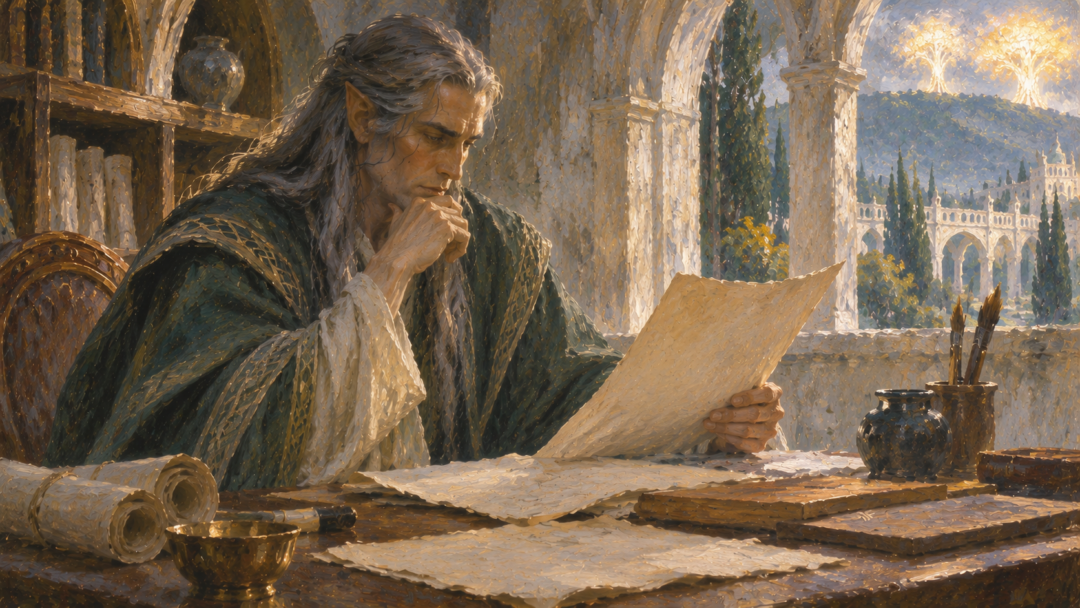
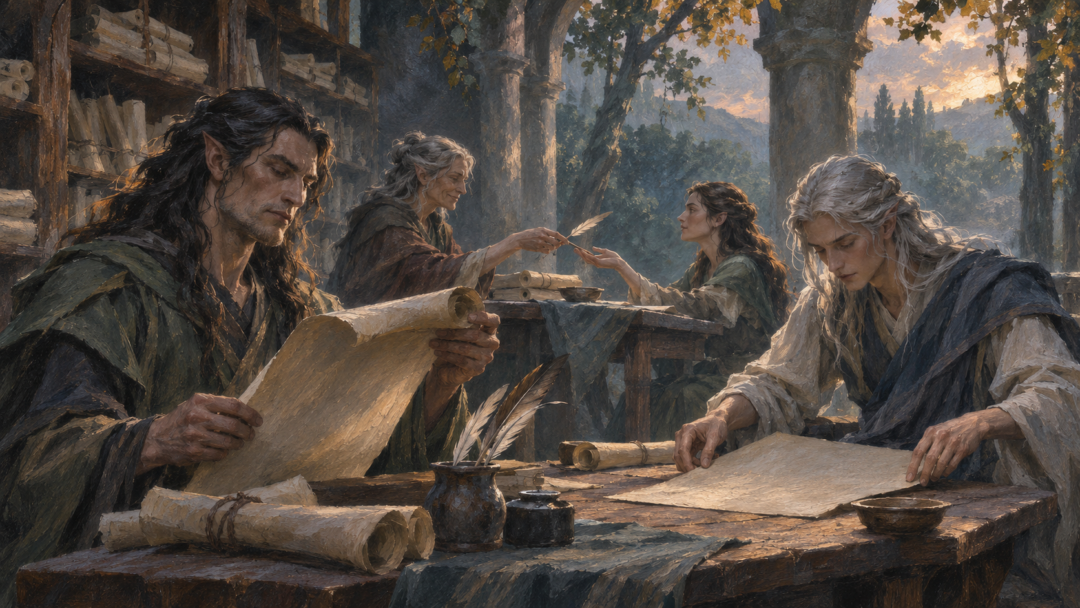
In Tirion, the name to remember is Rúmil. In “Of Fëanor and the Unchaining of Melkor,” The Silmarillion describes a period of extraordinary learning among the Noldor in Aman. They delighted in learning and refining words. Rúmil of Tirion, a loremaster, was the first to devise suitable signs for recording speech and song. Some could be cut into hard materials; others could be drawn with a pen or brush.
Only after this account does the narrative introduce Fëanor’s birth. The sequence is plain: the Eldar spoke first; Rúmil developed an early system for writing their speech; Fëanor came later. Rúmil’s achievement was preserving words beyond the moment of utterance, so songs and accounts need not depend entirely on memory.
Rúmil’s letters, often called the Sarati, have their own forms and conventions. They are not merely an early draft of the script on the One Ring. In Appendix E of The Lord of the Rings, the oldest Eldarin letters are attributed to Rúmil, while his system is said not to have been used in Middle-earth. Fëanor’s later letters would have a different reach. Rúmil’s place in Elvish history is secure, though his script is less familiar to readers.
What Fëanor actually invented
Fëanor inherited the Noldor’s curiosity about language and craft. The Silmarillion says that in his youth he improved upon Rúmil’s work and devised the letters that bear his name. Appendix E adds a useful qualification: the Fëanorian letters owed something to Rúmil but were largely a new invention. He was not copying an older alphabet in a prettier hand; he created a flexible new system.
The word tengwar simply means “letters” in Quenya; a single letter is a tengwa. The system is more than a collection of elegant marks. Its primary letters use combinations of stems and bows, with related shapes reflecting relationships among the sounds they can represent. That order explains why certain letters belong together, rather than being isolated signs to memorize.
The Tengwar were first used for Quenya, but a writing system does not own the language it records. English can be written in the Latin alphabet, as can many other languages, without those languages becoming Latin. Likewise, the Tengwar could serve tongues beyond Quenya. Inventing a script means devising visible signs and rules for using them; inventing a language would involve its sounds, words, and grammar. They are distinct crafts.
That fascination suits Fëanor. Best remembered for the Silmarils, Fëanor also worked on a more shareable kind of creation. The jewels are unique objects, inseparable from the fate of their maker and his house. A script is useful precisely because it need not remain in its maker’s hands. Once others learn it, they can use it to record their own words, including words Fëanor never heard. It could spread without his authority.
Why the writing changes with the language
Appendix E calls the different applications of the Tengwar modes. That is essential to reading them. A letter’s sound value is not always fixed across every language and arrangement. The system can be fitted to the sounds that a particular community needs to represent. Some modes write vowels with separate letters; others use smaller marks called tehtar. Seeing Tengwar does not tell you which language they record.
Two of the best-known inscriptions make the point without any complicated chart. The writing around the One Ring is in the Black Speech, though its visible letters are Tengwar. The inscription on the West-gate of Moria uses Tengwar for Sindarin. Both look Elvish, yet neither records Quenya. If someone asks for a universal translation of one Tengwa into one sound, the answer can depend on the mode being used.
This versatility also explains why recognizing the shapes is not the same as being able to read a text. A reader might know an alphabet’s forms but still need to identify its language and spelling conventions. Knowing Roman letters does not make anyone fluent in every language printed with them. Fëanor’s achievement gave scribes adaptable tools. Interpreting the words remained another skill.

How the letters reached Middle-earth
Fëanor made his letters in Aman, but the Tengwar became widely known in Middle-earth after the return of the exiled Noldor. Appendix E says that the letters spread to the Edain and Númenóreans and were used broadly by the Third Age. Their history crosses Elvish boundaries. Human scribes used letters devised by an Elf in a distant land.
That spread was not inevitable for every Elvish invention. Rúmil’s older letters did not make the same journey into the writing traditions of Middle-earth. That helps explain why readers associate Elvish writing with Fëanor. We see the surviving and widely transmitted system more often than its predecessor. Famous surviving examples can make his script seem older than it was.
Nor were all the scripts of Middle-earth Fëanor’s. The Cirth, angular letters suited to carving on wood or stone, were first developed by the Sindar in Beleriand. The Dwarves later adopted and adapted them. Appendix E treats them separately from the flowing letter forms better suited to pen or brush. Not every alphabet in Middle-earth was his.
Was there speech even before the Elves?
There is a deeper complication if the question really means the first language anywhere in Arda. The Valar and Maiar have a language of their own, usually called Valarin, known to us through limited Elvish records. Its existence rules out treating early Elvish speech as the only language worth considering. But the surviving material does not give us a simple, securely dated contest in which we can crown the first spoken language of all beings.
The opening Ainulindalë reaches still farther back. Ilúvatar speaks to the Ainur, and the Ainur sing the Great Music before the world is made. That establishes communication, voice, and song before the awakening of the Elves. It does not, by itself, establish that the Music was a spoken language with a vocabulary and grammar, or place a particular language first within Arda’s physical history. The Timeless Halls are not an earlier age of Middle-earth.
One history inside the world, another outside it
There is also their history outside the story. Tolkien developed languages, scripts, and their fictional pasts over many years, repeatedly revising their relationships. The Rúmilian alphabet was created in his own work before the familiar Fëanorian system took shape. Dates in notebooks are not dates in the Years of the Trees. Fëanor and Rúmil are inventors within the story; Tolkien is the creator of the linguistic world in which either invention makes sense.
So picture those first Elves again, listening to water at Cuiviénen and finding words for what they see. No ink or carved sign lies behind their first names. Much later, Rúmil finds a way to preserve such speech, and Fëanor makes letters that will travel across ages and peoples. His lasting marvel is not that he gave the world a voice, but that he helped its voices leave marks that others could still read.
Sources & Notes
- Arden R. Smith, Writing Systems (The Tolkien Estate) — Rúmil's sarati, Fëanor's tengwar, and the distinction between scripts and languages — https://www.tolkienestate.com/scholarship/arden-smith-writing-systems/
- The Encyclopedia of Arda, Quendi — the Elves as speakers before their westward journey — https://www.encyclopedia-of-arda.com/q/quendi.php
- Tolkien Gateway, Valarin — the Valar's speech and its distinction from the Elvish languages — https://tolkiengateway.net/wiki/Valarin
Reading references: The Silmarillion, Of the Coming of the Elves and Of Fëanor and the Unchaining of Melkor; The Lord of the Rings, Appendix E. Fëanor's innovation concerns writing, not the first existence of speech. Within-world chronology is distinguished from Tolkien's real-world development of scripts.