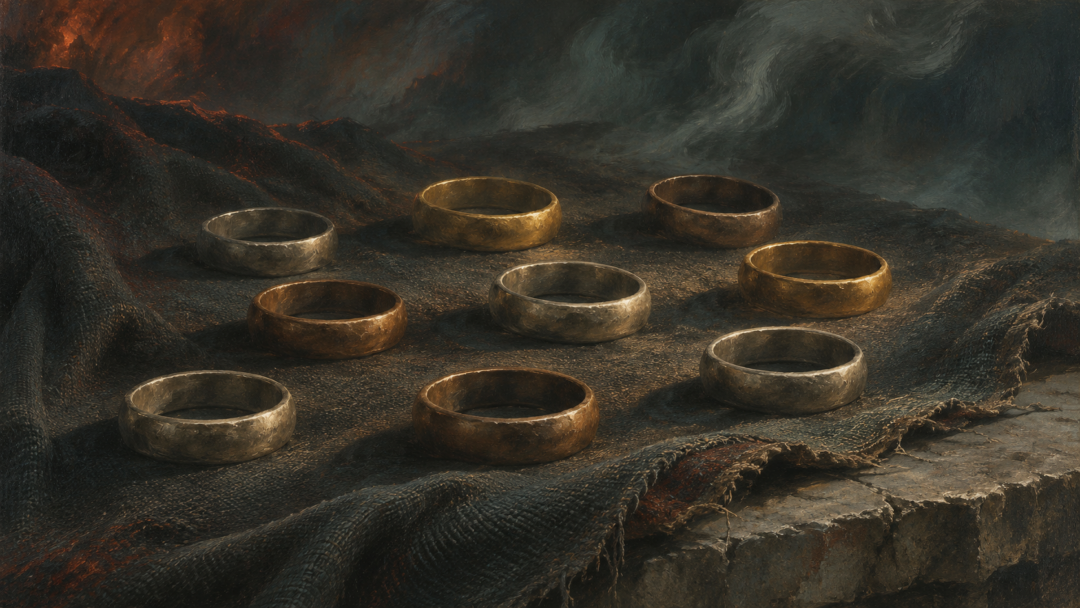
At Weathertop, when Frodo puts on the One Ring, the Black Riders become something more dreadful than cloaked figures in the night. He sees pale faces, ancient weapons, and a crowned figure advancing toward him. They are the Nazgûl, but they did not begin as shadows. Once, they were mortal Men who could accept a ring, wear it, and imagine a future greater than the one allotted to them.
Sauron gave the Nine Rings to Men after his war against the Elven-smiths of Eregion, as part of a plan to gain power over other peoples of Middle-earth. The recipients became the Nazgûl only later, through their use of the rings and their growing subjection to the One. The broad history is clear. The exact occasions on which the rings changed hands—and Sauron’s words to their recipients—are not recorded.
The Gifts Came After the Ruin of Eregion
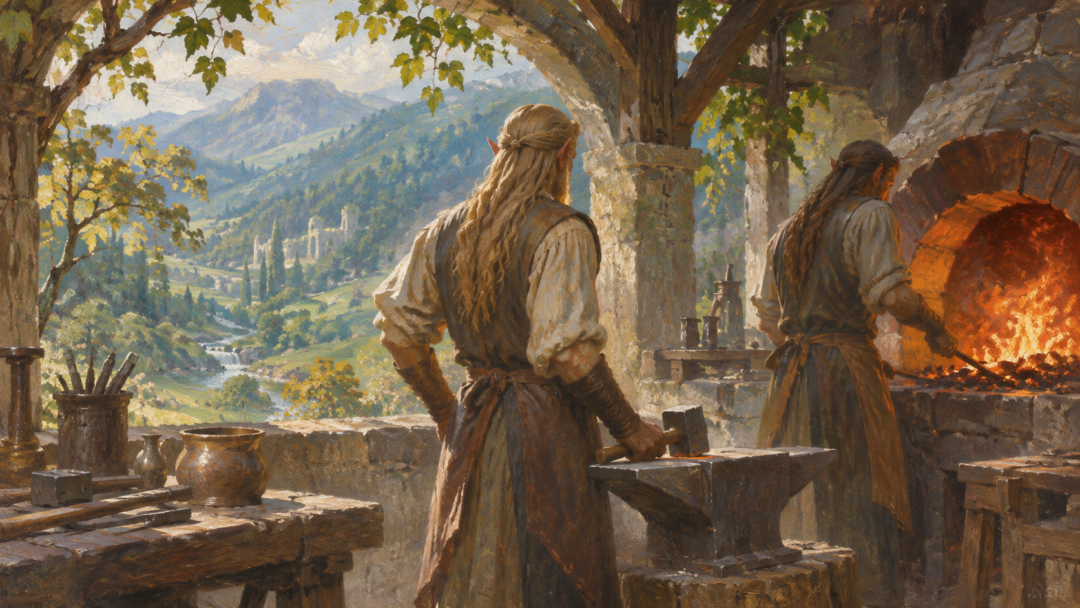
The Nine began in an Elven story, not a gathering of human kings. In the Second Age, the smiths of Eregion developed the Rings of Power with knowledge and counsel from Sauron, whose purpose they did not understand. The Elves loved Middle-earth and wanted to preserve what was beautiful against weariness and decay. Their extraordinary craft made that hope seem achievable. Sauron saw in the same craft a means of bringing its users under his control.
He secretly forged the One Ring to govern the others. When he first wore it, the Elves perceived his design and removed their rings rather than submit. They saved and concealed the Three, which Celebrimbor had made without Sauron’s touch. Those Three remained unsullied, but they were still subject to the One’s power; their concealment was protection from Sauron’s rule, not proof that they stood outside the ring-system altogether. The original attempt to master the Elves had failed.
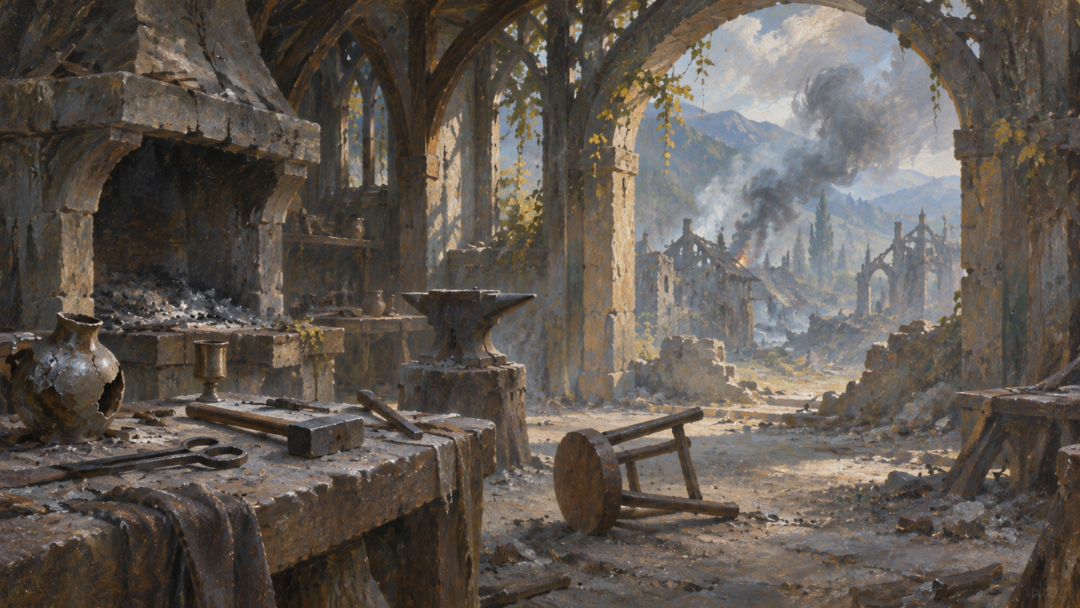
Sauron answered with open war. The account in Of the Rings of Power and the Third Age places his seizure and distribution of the other rings after Eregion was laid waste and Celebrimbor slain. The doors of Moria were shut, and Elrond founded the refuge of Imladris, later called Rivendell, amid the conflict. These details set the circumstances: the rings were no longer treasures resting with their makers, but instruments Sauron had acquired through the destruction of their world.
Why Sauron Turned to Mortal Men
Having failed to catch the Elves unawares, Sauron turned rings fashioned with Elven skill against other peoples. The history states his purpose plainly: he dealt them out hoping to bring under his sway those who desired extraordinary, secret power. This was not simple generosity, nor was it an attempt to create heroic champions to reward faithful service. He wanted the desire for power to lead its possessors toward dependence on him.
The division is given in a compact sentence: “Seven Rings he gave to the Dwarves; but to Men he gave nine”. The distinction matters because the two peoples reacted differently. Dwarves were difficult to dominate and could not be turned into shadows. Their rings stirred greed and anger, and they amassed wealth, but they resisted the intended submission. Men, the account says, proved more readily subject to Sauron’s will. The Nine were therefore terribly effective in a way the Seven were not.
Nor does the text say the nine rings had always been earmarked for nine human thrones. They belonged to the wider undertaking of the Elven-smiths before Sauron seized them. Their eventual distribution to Men was a choice made within his campaign of domination. That is why a story sometimes imagined as a ceremony of royal investiture is better understood as the aftermath of a failed deception and a war: Sauron was exploiting captured works of power to seek a different set of victims.
What Were the Men Offered?
There is no surviving scene in which Sauron approaches one of the nine Men and spells out the bargain. We have no recorded speech, formal oath, agreed price, or individual negotiation. What we do have is the narrator’s account of what the bearers obtained. That distinction matters when asking what Sauron promised: a benefit described in the history is not automatically a promise he is known to have spoken aloud.
The rewards were formidable. Of the Rings of Power and the Third Age says, “Those who used the Nine Rings became mighty in their day, kings, sorcerers, and warriors of old.” They gained glory and great wealth. Such results help explain why a mortal lord or ambitious warrior might treasure a ring, without requiring us to invent the words used to persuade him. Power was not merely suggested by the object; the wearers’ lives demonstrated it.
The rings also gave their users what seemed to be unending life. To mortal Men, whose lives have a limit even at their most splendid, that appearance carried an extraordinary attraction. Yet the account is careful: they had life without apparent end, and eventually that life became unendurable. The rings did not provide the uncomplicated gift of immortality. They prolonged existence in a form that would finally work against the people who accepted them.
There were stranger abilities as well. A bearer could choose to go unseen by ordinary eyes and could perceive things invisible to other mortals. Such powers might look like advantages to someone seeking influence or secret knowledge. But the hidden world was not a safe kingdom suddenly opened to him. The wearers too often encountered phantoms and delusions associated with Sauron. What first expanded their reach also exposed them to a reality in which his power was already at work.
Who Received the Nine?
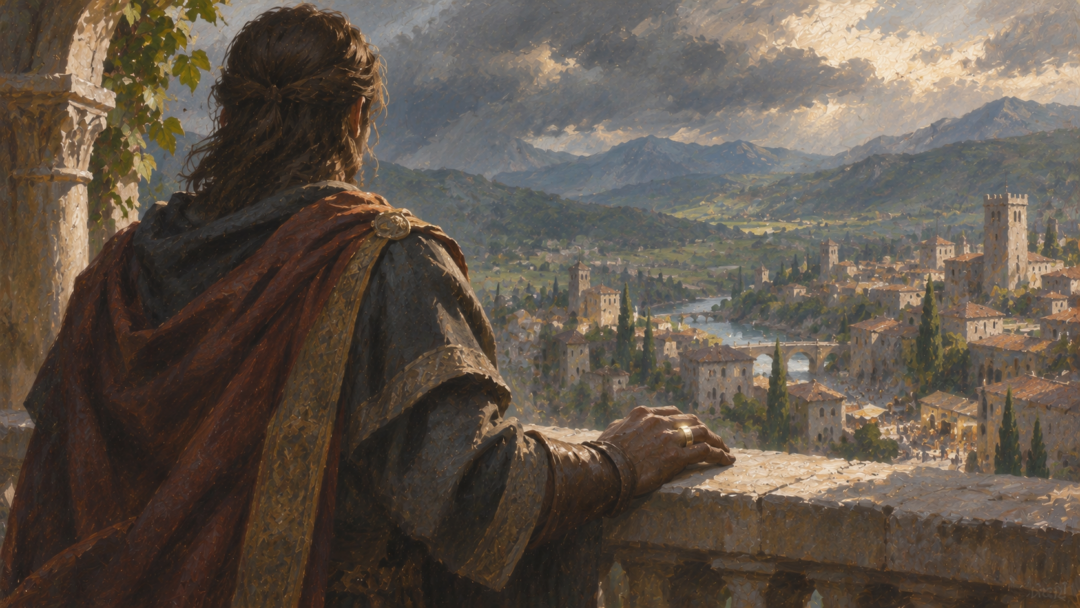
The names, offices, and former homes of the nine recipients are largely left in darkness. The clearest additional identification comes from Akallabêth, which says that among those ensnared “three were great lords of Númenórean race”. That is a significant clue. Númenor was a mighty realm of Men, and its great lords belonged to a world of prestige and power far beyond the lives of ordinary inhabitants of Middle-earth.
But three is not nine. The passage does not make all the recipients Númenóreans, place them at a single court, or tell us the political positions held by the other six. Nor should the later description of the wearers as kings, sorcerers, and warriors be read as a list of qualifications each man already possessed before receiving a ring. The history tells us what they became or how they were remembered in their days of power, not that Sauron selected nine reigning kings.
The available evidence also leaves open the practical arrangements. It does not name a hall where Sauron presented the rings, explain whether he met each recipient personally, or describe a common moment of acceptance. The act of giving is explicit; the choreography is not. We can infer that the rings had to reach their human bearers, but building a scene around that fact would turn an unknown detail into fictional history.
How the Wearers Became the Nazgûl
The transformation was neither immediate nor uniform. The same rings that brought power and wealth gradually placed their users in bondage. The history says the Men fell “one by one, sooner or later”, according to their native strength and the good or evil in their wills at the beginning. This makes the nine individual fates distinct even though their destination was the same. Some could hold out longer than others; no precise schedule of each decline is given.
The sequence also shows why the initial greatness of the bearers should not be mistaken for independence from Sauron. Their rings could make them powerful figures in the visible world while drawing them toward a condition they could not control. A ruler might possess impressive worldly authority and still lose command of himself. In the account, their subjection is first to the rings they bore and then to the One Ring, Sauron’s instrument of mastery.
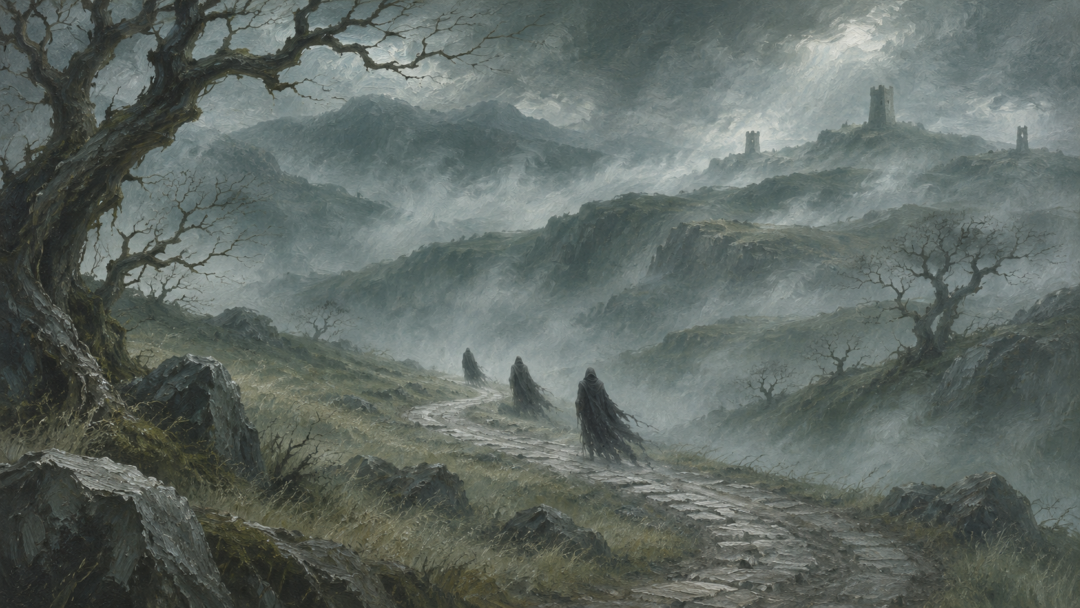
Their invisibility changed character as that bondage deepened. At first they could walk unseen if they wished. Ultimately they became invisible permanently, except to the one who wore the Ruling Ring, and entered the realm of shadows. This is the arrival of the Nazgûl proper: not nine Men who simply owned dangerous jewels, but Ringwraiths whose prolonged existence had been overtaken by Sauron’s dominion. Their earlier achievements had not protected them from the power behind the gifts.
The account never tells us whether each man understood the danger early, suspected it only later, or mistook every warning for another cost of greatness. We know the outcome, not their private thoughts. Even the differences in their original wills are acknowledged without being turned into nine character studies. That restraint leaves room for a chilling possibility grounded in the narrative: the path to becoming a wraith could look, for a considerable time, like a successful human life.
We cannot watch the first of these Men accept his ring; no account puts us beside him when the metal passes into his hand. What survives is the long distance between that unknown moment and the pale figure Frodo saw at Weathertop. The first belongs to the unrecorded lives of mortal people. The second reveals the price of the gift: a man once visible in the affairs of his age, now scarcely visible in the world at all.
Sources & Notes
- Tolkien Gateway — Nine Rings; forging in Eregion, capture by Sauron, distribution to Men, and corruption of the bearers (with references to The Silmarillion and Unfinished Tales). https://tolkiengateway.net/wiki/Nine_Rings
- Tolkien Gateway — Nazgûl, Origins; the recipients' Númenórean connections, acquired power, extended lives, and gradual enslavement (citing Of the Rings of Power and the Third Age and Akallabêth). https://tolkiengateway.net/wiki/Nazg%C3%BBl
- The Encyclopedia of Arda — Nine Rings; the War of the Elves and Sauron, the limited identities known for the human recipients, and their transformation into Ringwraiths. https://www.encyclopedia-of-arda.com/n/ninerings.html
Sources checked for relevance and availability.