Most people imagine the Rings of Power as a simple bargain.
Sauron appears.
He offers Rings.
Elves, Dwarves, and Men accept them.
Then everything goes wrong.
But the actual story is far more subtle than that.
In the texts, Sauron does not begin by appearing as the Dark Lord of Mordor with a crown of terror and a hand full of cursed jewels. He comes in fair form. He uses another name. He presents himself not as a conqueror, but as a giver.
And that changes everything.
Because the great deception of the Rings was not that Sauron offered evil and everyone chose it.
It was that he offered something that looked, at first, like wisdom.
The Rings Were Not Originally a Public Gift to Everyone
The first important correction is this:
The Rings of Power were not originally made as separate gifts for Elves, Dwarves, and Men in the way the Ring-verse later presents them.
The verse tells us the final distribution:
Three for the Elven-kings.
Seven for the Dwarf-lords.
Nine for Mortal Men.
One for the Dark Lord.
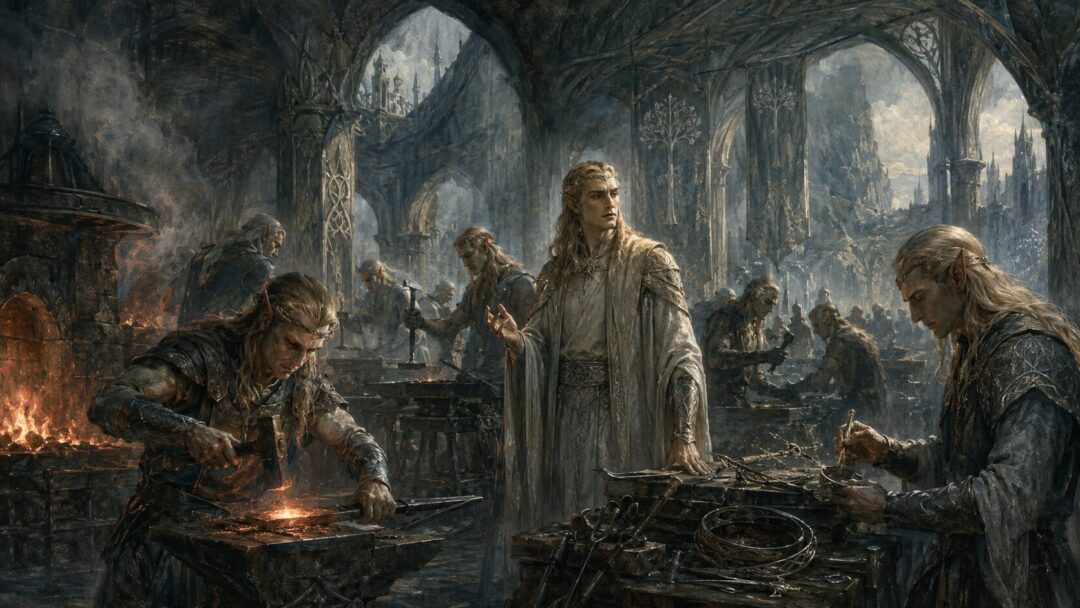
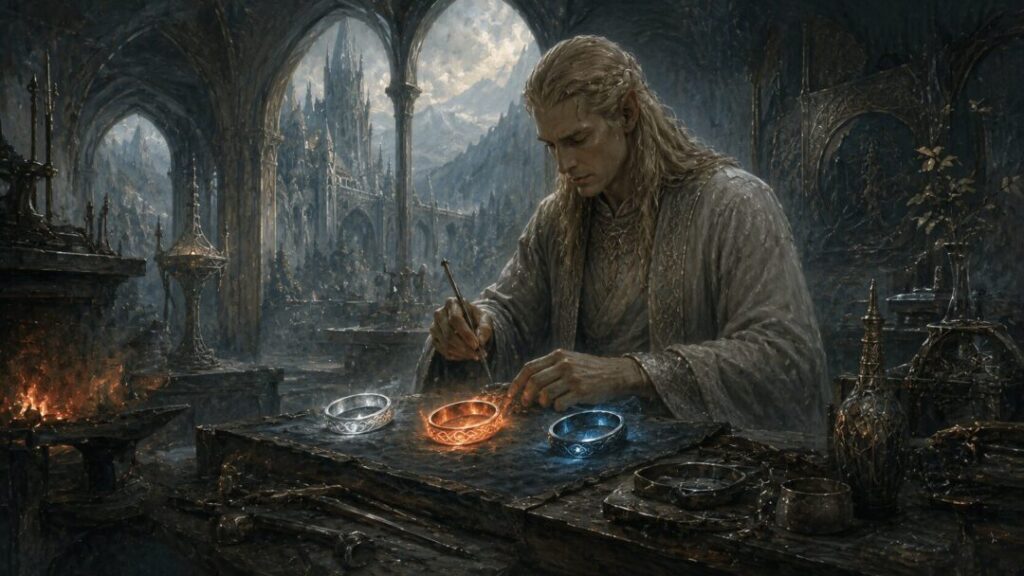
But the making of the Rings begins in Eregion, among the Elven-smiths, especially the Gwaith-i-Mírdain, the brotherhood of jewel-smiths associated with Celebrimbor.
Sauron comes to them in disguise. Under the name Annatar, “Lord of Gifts,” he offers teaching. He claims to be an emissary of the Valar. The texts are careful here: Gil-galad and Elrond do not trust him, though they do not know his true identity. In another tradition, Galadriel also distrusts him.
So the deception is not universal.
Some of the Wise sense that something is wrong.
But in Eregion, Annatar finds an audience.
That does not mean the smiths knowingly serve evil. It means they are tempted by knowledge that speaks directly to their deepest desire.
What the Elves Wanted
The Elves of Eregion were not merely greedy for power.
That matters.
The central temptation of the Rings was preservation. The Rings had the power to slow decay, preserve what was loved, and enhance the natural powers of their bearers. For the Elves remaining in Middle-earth, this was profoundly tempting.
They loved Middle-earth.
But Middle-earth was changing.
The beauty of the Elder Days was passing. Time wounded even things that seemed strong. The Elves could remember what had been lost, and that memory was both a gift and a grief.
So when Annatar offered craft that could make Middle-earth fairer, more enduring, more like the Undying Lands in beauty and memory, the offer did not look like corruption.
It looked like healing.
This is why the deception works. Sauron does not begin by asking the Elves to worship him. He does not ask them to surrender their kingdoms. He teaches them a craft that appears to answer a real sorrow.
The hook is not ugliness.
The hook is beauty.
Annatar’s Mask Was Designed for Eregion
Sauron’s disguise was not random.
He came as Annatar, a figure of wisdom and gifts, because that is exactly the form most likely to appeal to the smiths of Eregion. They were craftsmen. Makers. Healers of matter through art. They were not looking for a warlord.
So Sauron did not present himself as one.
He offered improvement. Skill. Secret knowledge.
This is one of the most frightening things about the Rings. Their danger is not obvious at the beginning. The Elves are not tricked because they are foolish. They are tricked because Sauron understands how to clothe domination in the language of restoration.
And yet the texts also show limits to his deception.
Gil-galad and Elrond reject him. They are not taken in by his fair-seeming. They do not know exactly who he is, but they mistrust him enough to refuse him.
That detail is essential.
Middle-earth did not simply accept Sauron’s gifts.
Some refused. Some doubted. Some listened.
And that division shaped the entire Second Age.
The Three Were Different — But Not Untouched by the Danger
The Three Elven Rings are often misunderstood.
Sauron did not make them. He did not touch them. Celebrimbor made them alone.
That is why the Three are described as unsullied in a way the others are not. Their purpose was not domination. They were associated with preservation, healing, and resistance against decay.
But that does not make them completely independent of Sauron’s scheme.
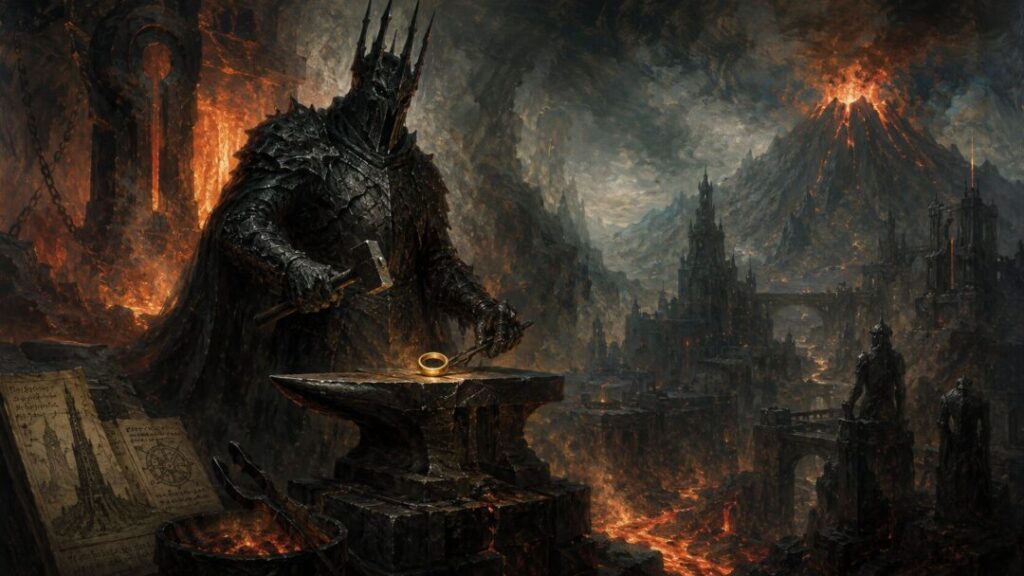
The Three were still made using the craft that had developed through Annatar’s teaching. When Sauron forged the One Ring in Orodruin, the other Rings were subject to it. The Three were not corrupted by his hand, but they were still caught in the larger design.
This is the tragedy of Celebrimbor’s work.
He tried to make something beautiful apart from Sauron.
But Sauron had already shaped the method.
So when the One Ring was made, the Elves became aware of him. They perceived his purpose. They took off their Rings and hid them. Sauron’s plan to dominate the Elves through the Rings failed at the very moment he revealed himself.
That failure is crucial.
The Elves did not continue wearing the Rings under Sauron’s rule. They resisted. They concealed the Three. And Sauron, enraged, made war on Eregion.
Sauron Did Not Politely Hand Out All the Rings
This is where the common version becomes misleading.
Sauron did not simply distribute all the Rings like ceremonial gifts at the beginning.
After the Elves resisted him, Sauron attacked Eregion. Celebrimbor was captured and slain. Sauron seized the Rings he could find, though the Three remained hidden from him.
Only after this disaster do the Seven and the Nine enter their later histories as Rings given to Dwarves and Men.
Even here, the details require care.
The texts say Sauron gave seven Rings to Dwarves and nine to Men. Yet Dwarvish tradition held that the Ring of Durin’s House was not given by Sauron, but by the Elven-smiths themselves. The texts do not present that tradition as something Sauron would have agreed with, and it remains a point where the records preserve more than one perspective.
So the safest answer is this:
Sauron distributed most or all of the Seven and Nine after seizing the Rings from Eregion, but at least one Dwarvish tradition claimed a different origin for Durin’s Ring.
That distinction matters, because the story is not a neat fairy tale of everyone accepting a cursed object from an obvious villain.
It is a history of deception, war, stolen craft, and repurposed gifts.
Why the Dwarves Took Them
The Dwarves did not respond to the Rings the way Sauron intended.
This is one of the great surprises of the Ring-lore.
Sauron wanted domination. But the Dwarves were difficult to enslave through the Rings. Their wills were not easily turned into shadows under his command. They did not become wraiths. They did not become Nazgûl.
Instead, the Rings inflamed their desire for treasure.
The Seven became associated with the founding of great hoards. In Dwarvish history, these hoards often ended in ruin, especially through dragon-fire and disaster. But the Dwarves themselves did not become servants of Sauron in the same way Men did.
Why did they accept them?
The texts do not give us a private scene of each Dwarf-lord receiving a Ring. So we should not invent one.
But the broad answer is clear enough: the Rings enhanced power, wealth, and possession. For Dwarf-lords, such a Ring could appear as a mighty treasure and a tool of increase. It did not need to be accepted as a pledge to Sauron in order to become dangerous.
That is the pattern again.
The Ring does not need to look evil to begin its work.
Why Men Fell Most Completely
Men were the most vulnerable to the Nine.
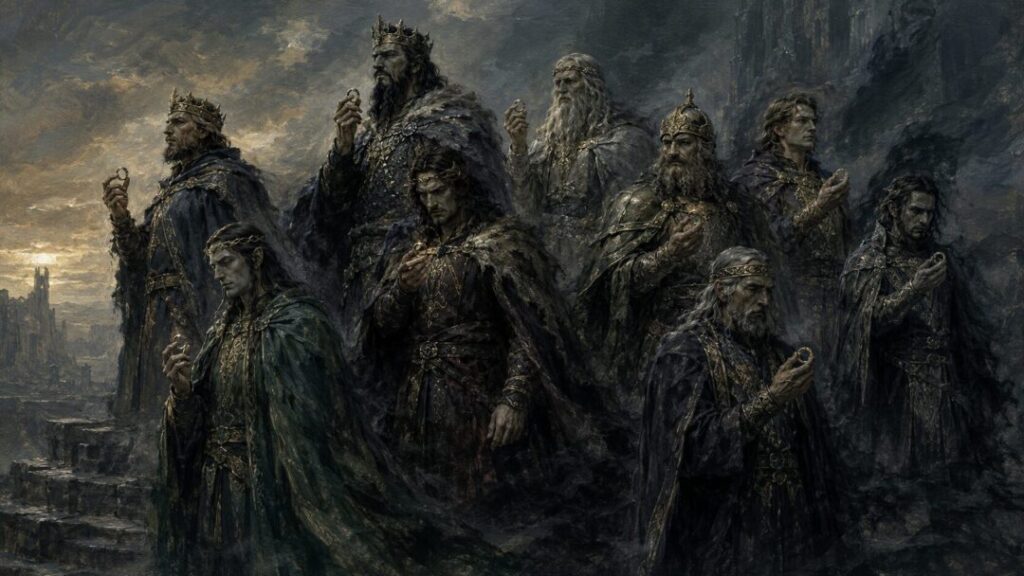
The bearers of the Nine became mighty in their day: kings, sorcerers, and warriors. The texts do not name all of them. They do tell us that three were great lords of Númenórean race. Over time, they faded, became invisible to mortal eyes, and entered the wraith-world. Eventually they became the Nazgûl, enslaved to Sauron.
Here the temptation is different from the Elves’ temptation.
Elves wanted preservation of beauty and memory.
Dwarves were drawn toward wealth and hoarding.
Men were vulnerable to power, fear of death, and the hunger to extend their lives and authority.
The Nine worked terribly well because they offered Men something Men were not meant to possess indefinitely: a lengthening of life under the shadow of domination.
This is not true immortality. It is a counterfeit.
The Nazgûl do not become deathless in glory. They become stretched, diminished, and bound. Their lives are prolonged, but their selves are consumed.
That is Sauron’s gift in its purest form.
He gives more time, more power, more command.
And then he takes the person.
The Real Answer
So why did everyone accept Rings from Sauron?
They didn’t.
That is the first answer.
Gil-galad and Elrond distrusted Annatar. The Elves removed their Rings when Sauron made the One. The Three were hidden from him. The Dwarves did not become the servants he intended. Even the final distribution of the Seven carries a Dwarvish tradition that complicates the idea that every Ring came directly from Sauron’s hand.
But the deeper answer is that the Rings were never presented as “evil Rings.”
They were presented as answers.
To the Elves, they answered the sorrow of decay.
To the Dwarves, they answered the desire for increase and treasure.
To Men, they answered the hunger for power and the fear of death.
Sauron’s genius was not merely making objects of power.
It was understanding what each people already wanted.
He did not create every desire from nothing. He found existing longings and bent them toward himself.
That is why the Rings are so dangerous.
They do not begin by making someone love evil.
They begin by offering a person exactly what they already wish could be true.
The Trap That Failed — and Then Succeeded
Sauron’s first and highest aim was to dominate the Elves.
In that, he failed.
The Elves perceived him when he put on the One Ring. They resisted. They hid the Three. Eregion was destroyed, but Sauron did not gain the Elven wills as he intended.
Yet from that failure came another strategy.
The seized Rings became snares for Dwarves and Men. Among the Dwarves, they caused ruin but not full enslavement. Among Men, they produced Sauron’s most terrible servants.
So the story of the Rings is not a story of one perfect plan unfolding smoothly.
It is the story of a failed deception becoming a wider disaster.
Sauron could not master the Elves as he wished. But he could still corrupt the works made in Eregion. He could still turn beauty into bondage. He could still place gifts into the hands of those who would not see the chain until it had closed.
And that is why the question matters.
The frightening part is not that everyone in Middle-earth was foolish enough to take gifts from the Dark Lord.
The frightening part is that the gifts did not look like they came from the Dark Lord at all.
They looked like preservation.
They looked like wealth.
They looked like strength.
They looked like more time.
And by the time their bearers understood the full cost, for some of them, there was no self left strong enough to refuse.
Sources & Notes
- J.R.R. Tolkien, The Silmarillion, “Of the Rings of Power and the Third Age” — Sauron comes in fair guise to Eregion, the Elven-smiths make the Rings, and the Elves perceive him when he forges the One.
- J.R.R. Tolkien, The Lord of the Rings, “The Shadow of the Past” — Gandalf summarizes the Ring-verse tradition and the peril of the Rings under Sauron’s ruling Ring.
- J.R.R. Tolkien, The Lord of the Rings, Appendix A, “Durin’s Folk” — Dwarvish tradition that Durin’s Ring came from the Elven-smiths, plus the Seven’s link to treasure-hoards and ruin.
- J.R.R. Tolkien, Unfinished Tales, “The History of Galadriel and Celeborn” — fuller Second Age traditions around Annatar, Eregion, Celebrimbor, and the distrust shown by Gil-galad, Elrond, and Galadriel.
- J.R.R. Tolkien, Letter 131 — Tolkien’s own summary of the Rings as a device of Sauron’s domination, set against Elvish desires for preservation and arresting change.