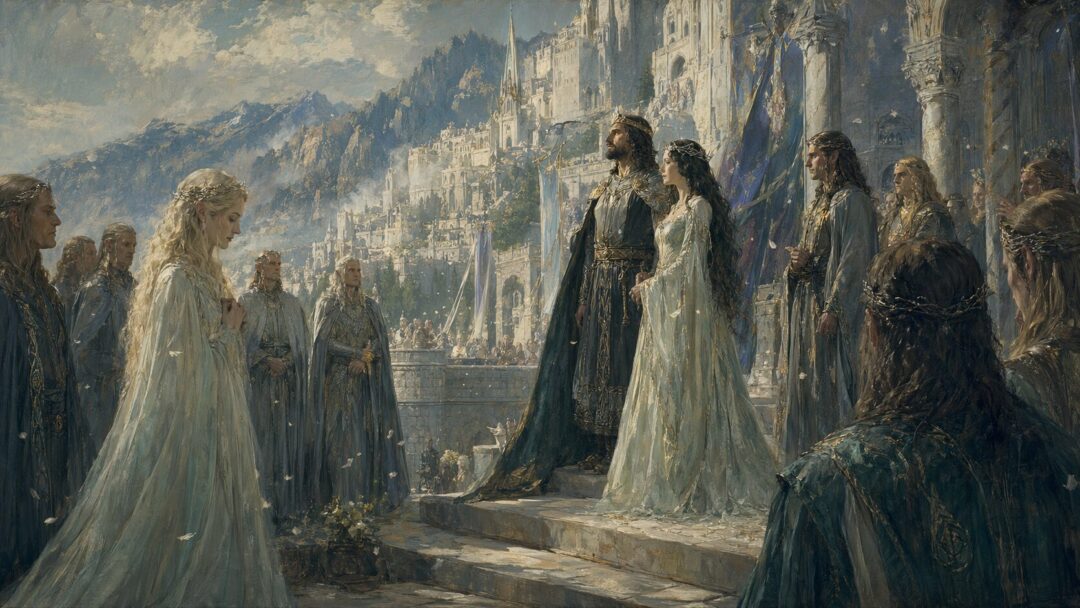
At first, the question seems simple.
Why doesn’t Galadriel go to Arwen’s wedding?
Arwen is her granddaughter. Aragorn is the heir of the ancient kings. Their marriage is one of the great turning points at the end of the Third Age. It unites the line of Elrond with the restored kingship of Gondor and Arnor. It echoes the ancient tale of Beren and Lúthien. It marks the beginning of a new age.
Surely Galadriel should be there.
And here is the surprise:
She is.
The real mystery is not Galadriel’s absence.
The real mystery is how quietly the story treats her presence.
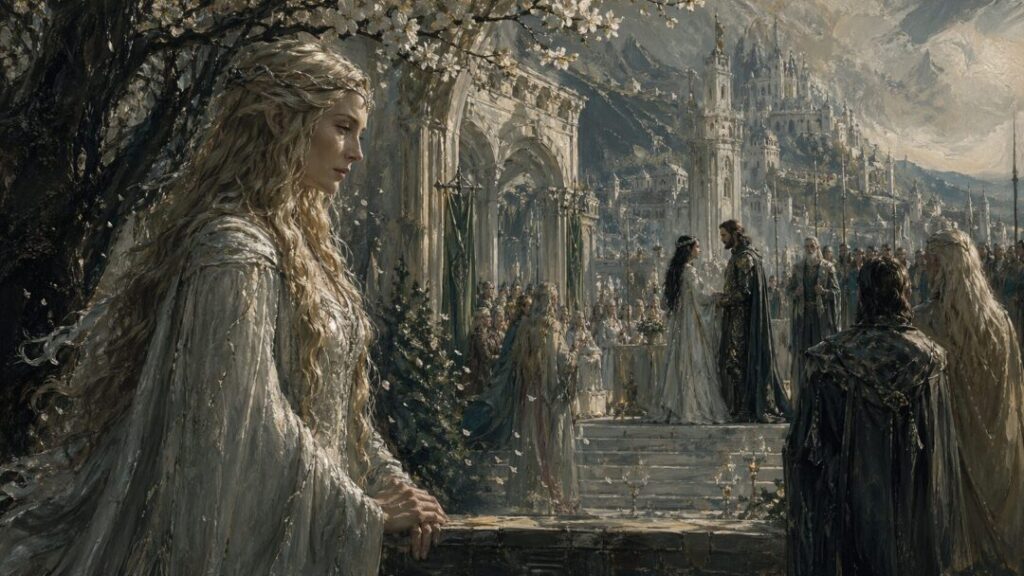
Galadriel Was There
The idea that Galadriel missed Arwen’s wedding is a misunderstanding.
After the fall of Sauron and the crowning of Aragorn, Arwen comes to Minas Tirith with Elrond. On Mid-year’s Day, Aragorn and Arwen are married in the City of the Kings.
Galadriel and Celeborn are also present in the great company gathered in Gondor after the War of the Ring. The later chapter of partings shows them leaving Minas Tirith with the others, joining the funeral journey that bears Théoden back to Rohan.
So the answer is not that Galadriel stayed in Lórien.
She did not refuse to attend.
She did not miss the wedding.
She was there.
But the text does not pause to give us a private scene between Galadriel and Arwen. There is no long conversation between grandmother and granddaughter. No tearful blessing is recorded. No description lingers on Galadriel watching Arwen stand beside Aragorn.
That silence is where the deeper meaning begins.
This Wedding Was Not Just a Wedding
Aragorn and Arwen’s marriage is easy to read as the final reward after victory.
Sauron is overthrown. The Ring is destroyed. The king has returned. The White Tree has been found. Gondor is restored. Then Arwen arrives, and the long-delayed promise between her and Aragorn is fulfilled.
On the surface, it is one of the most joyful moments in the entire story.
But beneath that joy is a much older sorrow.
Arwen is not simply marrying a king. She is making a choice that changes her fate. As one of the Half-elven, she belongs to the house in which the choice between Elven immortality and mortal destiny still matters. By choosing Aragorn, she chooses the fate of Men.
That means she will not sail West with Elrond.
She will not share the immortal road of her people.
Her marriage is also a farewell.
And Galadriel, standing at the edge of the fading Elven age, would understand that better than almost anyone.
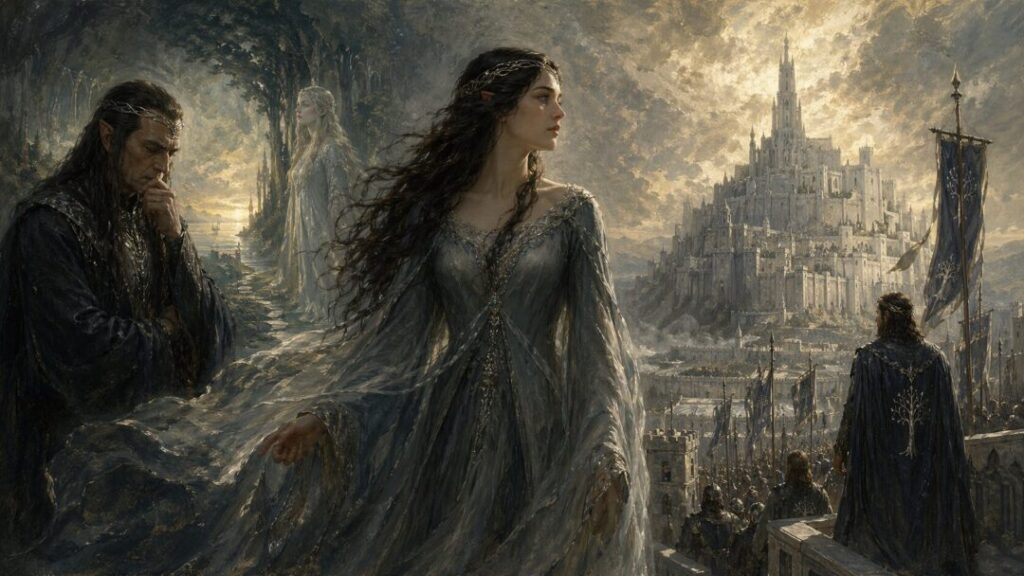
Arwen Was Galadriel’s Granddaughter
Arwen’s connection to Galadriel is not distant or symbolic.
Arwen is the daughter of Elrond and Celebrían. Celebrían is the daughter of Galadriel and Celeborn. That makes Galadriel Arwen’s grandmother.
This matters.
Arwen is often associated most strongly with Elrond, because the emotional cost of her choice falls heavily on him. He must watch his daughter remain in Middle-earth while he eventually departs over the Sea. Their separation becomes one of the quiet tragedies behind the victory.
But Galadriel is part of that same family wound.
She, too, belongs to the older world Arwen is leaving behind. She, too, is tied to the Elven fate from which Arwen turns. And she, too, will soon depart Middle-earth.
The story does not tell us exactly what Galadriel felt at the wedding.
So we should not invent a private scene as fact.
But the situation itself is clear. Galadriel is witnessing the marriage of her granddaughter to a mortal king, knowing that this joy will end in a permanent sundering from the Elven road.
That is not fan fiction.
That is the emotional weight already built into the event.
The Echo of Lúthien
Arwen’s choice is not isolated.
The text repeatedly links her to Lúthien, the greatest Elf-woman of the Elder Days, who loved the mortal Beren and chose a mortal fate.
This echo matters because Arwen’s marriage to Aragorn is not merely political. It is mythic. It brings the pattern of Beren and Lúthien into the final days of the Third Age.
But there is an important difference.
Lúthien’s story belongs to the ancient world of the Silmarils, Morgoth, and the first great wars. Arwen’s story happens at the end of the Elven age in Middle-earth, when the power and beauty of the Eldar are already passing away.
So when Arwen chooses Aragorn, the act feels both beautiful and final.
It is not just another love story.
It is one of the last great moments in which the Elder Days seem to touch the world of Men.
Galadriel’s presence at that moment is therefore deeply fitting. She is one of the last living links to the ancient histories. She has seen kingdoms rise and fall. She has preserved Lórien through the power of Nenya. She has resisted the temptation of the One Ring. She has chosen to diminish and go into the West.
And now she sees Arwen choose differently.
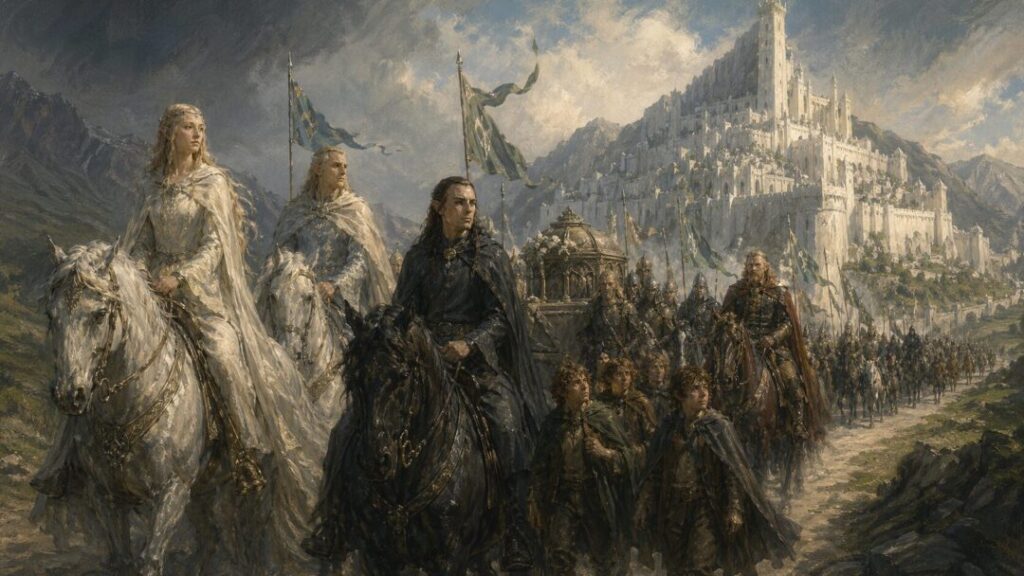
Why the Text Does Not Dwell on Galadriel
If Galadriel was there, why does the story not make more of it?
The most likely answer is that the wedding is being shown from a broader narrative distance. The end of The Lord of the Rings moves quickly through restoration, celebration, farewells, and departures. Many enormous events are described with restraint.
Aragorn’s reign begins.
Arwen becomes queen.
The companions prepare to part.
The dead are honored.
The Elves begin their last withdrawal.
The story does not stop to give every character a full emotional scene.
But there may be another reason the silence feels right.
Galadriel’s role at this point is no longer to shape events. Her great test has already come in Lórien, when Frodo offered her the Ring. She refused it. She accepted diminishment. She accepted the passing of her realm as it had been.
By the time of Arwen’s wedding, Galadriel is not acting as a ruler trying to preserve the old order.
She is witnessing its transformation.
That is why her quietness matters.
She does not need to object.
She does not need to explain.
She does not need to bless what the story has already made inevitable.
Her presence is enough.
Arwen’s Joy Contains Elrond’s Loss
The emotional center of Arwen’s choice is often Elrond.
That is understandable.
Elrond has already experienced the long grief of division in his family line. His brother Elros chose the fate of Men and became the first king of Númenor. Elrond chose the fate of the Elves. Now, at the end of the Third Age, his daughter repeats the pattern in another form.
Arwen’s marriage brings joy to Aragorn and Gondor.
But for Elrond, it means separation beyond the circles of the world.
He will leave Middle-earth. Arwen will remain. Their roads will not meet again in the same way.
Galadriel’s grief is less directly described, but it belongs to the same pattern. She is not only losing the world she helped preserve. She is also watching her own descendant bind herself to the mortal future of that world.
That is what makes the wedding so powerful.
It is not happiness untouched by sorrow.
It is happiness paid for by farewell.
Galadriel and the Passing of the Elves
Galadriel’s attendance also comes at a turning point in her own story.
The One Ring has been destroyed. Because the One was destroyed, the Three Rings of the Elves lose their power. That means Nenya, Galadriel’s ring, can no longer preserve Lórien as before.
The Golden Wood may remain beautiful for a time, but its deeper enchantment is passing.
The world Galadriel knew cannot continue unchanged.
This gives Arwen’s wedding another layer of meaning. Minas Tirith is full of renewal. The king has returned. The White Tree flowers again. The future belongs to Men.
For Aragorn, the wedding is the beginning of his life as king with the woman he has long loved.
For Arwen, it is the beginning of mortal queenship.
For Galadriel, it is a sign that the world has truly turned.
The Elves are not the center of the story anymore.
They are becoming memory.
Why This Misunderstanding Happens
So why do so many people think Galadriel did not attend?
Part of the reason is simple: the wedding itself is not described in great detail.
The story gives us the fact of Aragorn and Arwen’s marriage, but it does not present the ceremony as a long dramatic scene. Readers remember Arwen arriving. They remember the joy of the city. They remember the restoration of the king.
But Galadriel’s presence is easier to miss because it is folded into the larger movement of the company.
Another reason is that adaptations and visual retellings often rearrange, compress, or omit parts of the ending. Many people remember the emotional shape of the story more than the exact sequence of the book.
And emotionally, Galadriel feels absent because the text gives us no intimate moment between her and Arwen.
But absence from the page is not the same as absence from the event.
The canon is clear enough: Galadriel was in the company present in Minas Tirith and departed afterward with the others.
The silence is not about whether she went.
It is about what the story chooses not to dramatize.
The Wedding as a Beautiful Ending and a Hidden Farewell
Aragorn and Arwen’s wedding is one of the great happy endings of Middle-earth.
But it is not simple happiness.
It is the beginning of a reign.
It is the fulfillment of a promise.
It is the renewal of ancient kingship.
It is also the moment when Arwen’s separation from the Elven fate becomes complete.
That is why Galadriel’s quiet presence matters so much.
She is not absent.
She is standing at the edge of two ages.
Behind her lies Lórien, the fading power of the Elven Rings, and the long memory of the Elder Days.
Before her stands Arwen, choosing love, mortality, queenship, and the future of Men.
Galadriel does go to her granddaughter’s wedding.
But the story does not turn it into a sentimental family scene.
It makes it something more restrained and more painful.
A grandmother is there.
A queen is there.
One of the last great powers of the Elves is there.
And she watches as the world she has known gives way to another.
The Real Answer
So the question should not be:
Why doesn’t Galadriel go to Arwen’s wedding?
She does.
The better question is:
Why does her presence feel so quiet?
Because the wedding is not only a celebration. It is one of the final signs that the Third Age is ending. Arwen’s joy belongs to the new world of Men, but her choice carries the sorrow of the Elves with it.
Galadriel is there to witness both.
The crown and the farewell.
The hope and the loss.
The beginning of Aragorn and Arwen’s life together, and the ending of the world that made such a love feel ancient, perilous, and rare.
That is why the scene lingers in the imagination even though the text says so little.
Because sometimes the deepest grief in Middle-earth is not spoken aloud.
Sometimes it stands quietly at the wedding.
Sources & Notes
- J.R.R. Tolkien, The Lord of the Rings, Book VI, Chapter 5, “The Steward and the King” — places Galadriel and Celeborn in the northern company that comes to Minas Tirith before Aragorn and Arwen are married on Mid-year’s Day.
- J.R.R. Tolkien, The Lord of the Rings, Book VI, Chapter 6, “Many Partings” — shows Galadriel and Celeborn leaving Minas Tirith with the returning company, confirming their presence in Gondor after the wedding.
- J.R.R. Tolkien, The Lord of the Rings, Appendix A, “The Tale of Aragorn and Arwen” — gives the deeper frame of Arwen’s choice, her kinship with Elrond’s house, and the mortal fate she accepts with Aragorn.
- J.R.R. Tolkien, The Silmarillion, “Of the Rings of Power and the Third Age” — explains the passing of the Three Rings after the One is destroyed, the background to Galadriel’s fading Lórien and departure.
- J.R.R. Tolkien, The Lord of the Rings, Book II, Chapter 7, “The Mirror of Galadriel” — establishes Galadriel’s acceptance that her own power and realm must diminish if the Ring is destroyed.