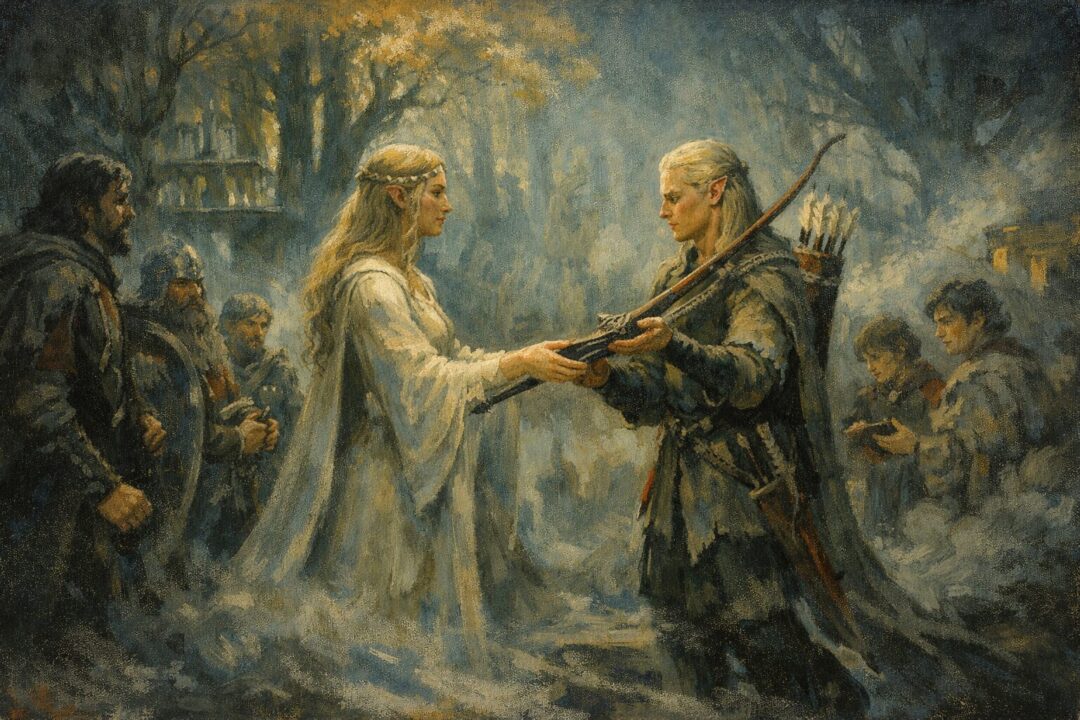
When the Fellowship leaves Lórien, Galadriel gives each member a parting gift.
Some of them are immediately memorable. Aragorn receives the Elfstone. Sam receives earth from Galadriel’s orchard. Gimli receives something far more personal than he dared ask for.
Legolas, meanwhile, receives a bow.
At first glance, that choice seems almost too obvious to need explanation.
Legolas is the archer of the Company. Of course he is given a bow.
But the scene is not written like a simple distribution of supplies. Galadriel’s gifts are careful. They match character, role, burden, and future. Each one feels chosen rather than convenient.
That is why Legolas’s gift deserves a closer look.
Galadriel does not merely hand him ammunition for the road. She gives him a bow “such as the Galadhrim used,” and the text immediately adds that it is “longer and stouter than the bows of Mirkwood.”
That detail matters.
The gift is not just a replacement. It is a marked transfer from one Elven realm to another.
And once that becomes visible, the question changes.
The real question is not simply why Galadriel gave Legolas a bow.
It is why she gave Thranduil’s son the bow of Lórien.
The Gift Is Practical, but Not Merely Practical
The first layer of the answer is the safest and most direct.
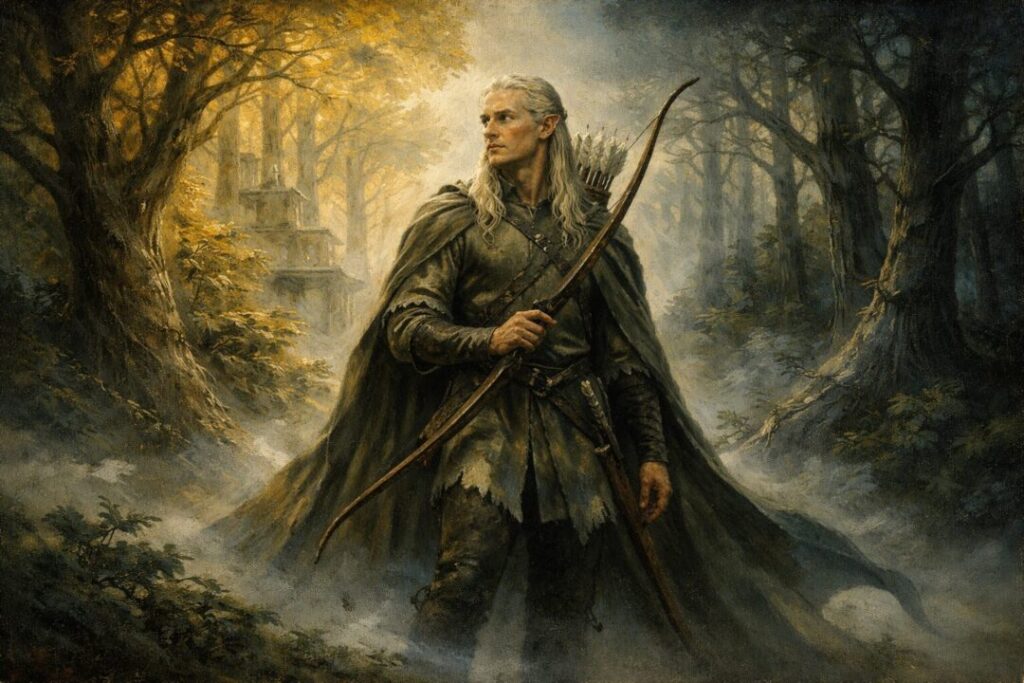
Legolas is the Company’s archer, and Galadriel equips him accordingly.
This fits the pattern of the farewell in Lórien. Galadriel’s gifts are not random luxuries. They are fitted to the road ahead. Sam receives something tied to growth and restoration. Aragorn receives a token bound up with his lineage and future kingship. Even the more modest gifts reflect the nature of the person receiving them.
So yes, there is a practical answer here.
Legolas is the one member of the Fellowship whose fighting style depends most clearly on distance, sight, speed, and precision. A stronger bow from the Galadhrim is therefore exactly the kind of thing he would best use.
The text even emphasizes its superiority in a specific way. It is not merely beautiful. It is “longer and stouter than the bows of Mirkwood.” In other words, Galadriel is not only honouring Legolas. She is strengthening him.
That matters because the Fellowship is leaving the last great refuge they will know together. Once they depart, no further shelter is promised. The world opens into pursuit, ambush, river-travel, division, war, and loss.
A better bow is, in that sense, a very serious gift.
But if that were the whole explanation, Tolkien could simply have written that Galadriel replenished the Company’s gear.
He does not.
He pauses long enough to tell us what kind of bow it is, and how it compares to the bows of Legolas’s own land.
That is where the deeper meaning begins.
Legolas Is Not Just an Archer
Legolas enters the story in a politically meaningful role.
At the Council of Elrond, he is introduced not merely as an Elf, but as “a messenger from his father, Thranduil, the King of the Elves of Northern Mirkwood.”
That description matters because it frames him as more than a skilled companion.
He is the son of another woodland ruler.
He is a representative of another Elven realm.
He stands, in effect, between courts as well as between companions.
This does not mean Legolas is acting as a diplomat throughout the Quest. The text never says that. But it does mean his identity carries more weight than “the Elf with the bow.”
And that changes how Galadriel’s gift can be read.
Because Lórien and the Woodland Realm are not unrelated places.
They are distinct, certainly. Their histories are different. Their rulers are different. Their dangers are different. Lórien is guarded by Galadriel and preserved in unusual beauty. Mirkwood has endured the long pressure of Dol Guldur and the darkness spread through Greenwood.
But both belong to the wider story of the Wood-elves.
That shared background does not erase their differences. Still, it makes the gift feel less like a simple handoff of equipment and more like an act of recognition from one woodland power to another.
Galadriel is not arming a stranger.
She is placing the craft of her people into the hands of a prince from the other great forest.
A Gift from One Woodland Realm to Another
This is where careful interpretation is needed.
The text does not explicitly say, “Galadriel gave Legolas this bow as a symbol of unity between Lórien and Mirkwood.”
That would go beyond the evidence.
But the text does give us enough to say something more restrained and still meaningful.
Lórien and the Woodland Realm are both major Silvan-Elvish centers in the later Third Age, though each is shaped by Sindarin leadership and its own long history. Legolas belongs to one. Galadriel rules the other. In that context, the gift of a Lórien bow to Legolas can reasonably be read as more than practical.
It is fitting.
It acknowledges who he is.
It acknowledges where he comes from.
And it places no barrier between the two realms.
That matters because Middle-earth is full of borders, estrangements, and long memories. Elves and Dwarves carry old griefs. Gondor and Rohan are bound by oaths and need. Even among the free peoples, trust is never automatic.
Yet here, at one of the last peaceful partings before the story breaks apart, Galadriel gives Legolas not a neutral token but something proper to her own people.
That feels intimate in a quiet, Elvish way.
Not intimate in the romantic sense.
Not intimate in the modern sentimental sense.
But intimate in the sense of trust, welcome, and shared standing.
She gives him the weapon of her own realm because he is the sort of person who can rightly bear it.
The Bow Also Fits the Story That Follows
One reason this gift can be overlooked is that it does not draw attention to itself in a dramatic speech.
But the bow does not remain decorative.
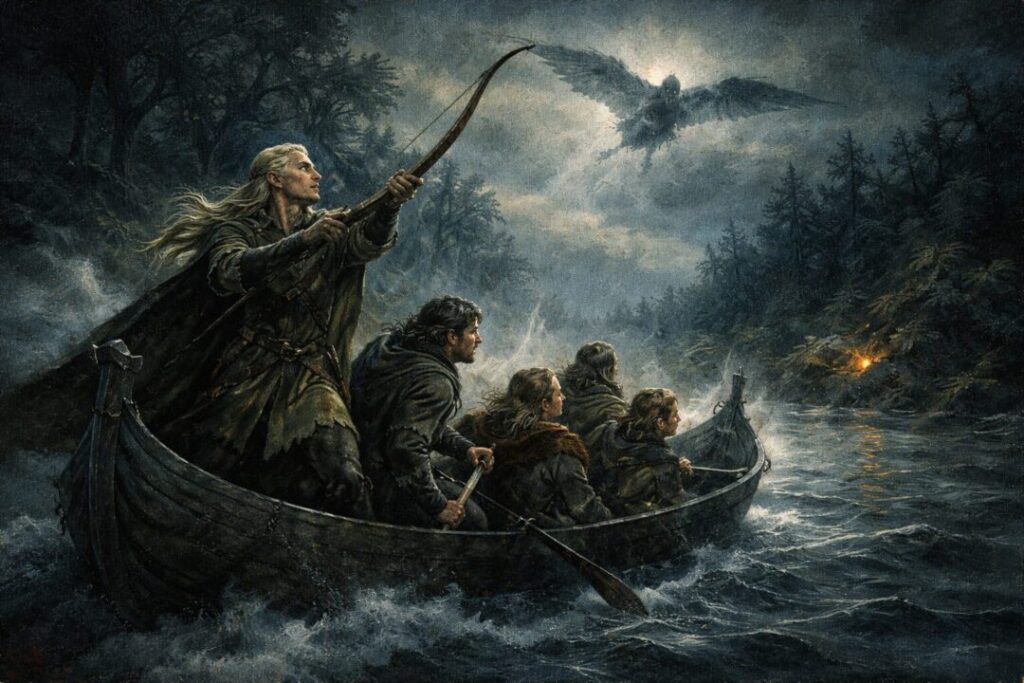
Soon after the Fellowship leaves Lórien and travels the Great River, Legolas uses the Galadhrim bow against a dark winged threat descending from above. The scene is deliberately shadowed and uncertain. Aragorn identifies it only cautiously afterward. The text does not make a grand display of the moment.
Still, the point is clear enough.
The new bow is not ceremonial.
It enters the action almost at once.
That matters because it confirms something important about Galadriel’s gifts as a whole. They are not museum pieces from a fading Elven age. They go with the Fellowship into danger and prove their worth there.
So the practical layer of Legolas’s gift is real and should not be pushed aside in favour of symbolism alone.
Galadriel gives him the bow because he can use it, and because he will need it.
The deeper meaning does not replace that.
It rests on it.
What the Later History Quietly Suggests
There is one later detail that makes the gift even more interesting in retrospect.
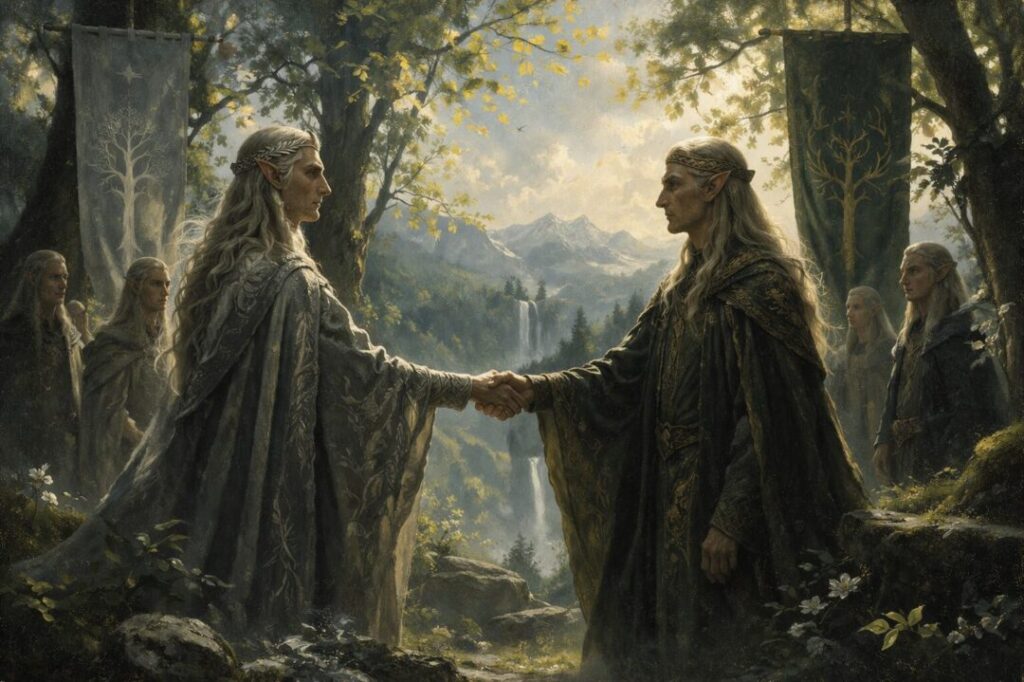
After the fall of Sauron, Celeborn and Thranduil meet in the healed forest and divide its regions in peace. Mirkwood is renamed Eryn Lasgalen, the Wood of Greenleaves.
This does not prove that Galadriel’s gift to Legolas was meant as a formal political symbol months earlier.
But it does show that the relationship between these woodland powers is not one of rivalry or separation in any final sense. They stand on the same side of the long struggle, and after victory they help shape the same restored world.
That later harmony casts a backward light.
Legolas’s bow from Lórien begins to look like part of the same pattern: not a treaty, not a proclamation, but an ease of kinship between realms that the war will only make more visible.
And Legolas himself becomes a fitting bridge for that pattern.
He is Thranduil’s son.
He bears the bow of the Galadhrim.
Later he will go on with Gimli into Ithilien, helping to shape yet another woodland renewal in the Fourth Age.
He moves, in other words, through exactly the parts of Middle-earth where healing after war matters most.
Why Galadriel Did Not Give Him Something Else
There is also a subtler point here.
Galadriel could have given Legolas a token of rank, beauty, memory, or prestige.
Instead, she gives him something active.
Something meant to be carried, drawn, bent, and used under pressure.
That fits Legolas’s place in the story.
He is graceful, but never ornamental.
Ancient, but never remote.
He sees clearly, moves lightly, and acts quickly.
A courtly jewel would have said less about him than this bow does.
The gift honors not only his identity, but his function.
Galadriel sees him as he truly is: a woodland prince, yes, but also a watchful fighter in a darkening world.
And so she gives him neither decoration nor prophecy.
She gives him readiness.
The Real Meaning of the Bow
So why does Galadriel gift a bow to Legolas?
At the most direct level, because it is the right gift for the Company’s archer.
At the deeper level, because it is not just any bow. It is a bow of Lórien, placed in the hands of the prince of the Woodland Realm. That makes the gift more than useful. It makes it personal to his people, his skill, and his place in the wider story of the Elves under the trees.
The text does not force the symbolism.
That is exactly why it works.
Galadriel’s greatest moments often come this way: not with blunt explanation, but with perfectly chosen acts whose meaning grows clearer the longer you stay with them.
Legolas’s gift is one of those acts.
It equips him for the danger ahead.
It honors what he already is.
And it quietly links two woodland realms that stand, despite distance and history, within the same fading but still-living world.
What looks at first like the simplest gift in the scene may actually be one of the most precise.
Because Galadriel does not merely give Legolas a weapon.
She gives him the craft, trust, and recognition of Lórien itself.
Sources & Notes
- J.R.R. Tolkien, The Lord of the Rings, Book II, Chapter 8, “Farewell to Lórien” — gives the primary scene: Galadriel presents Legolas with a Galadhrim bow, “longer and stouter than the bows of Mirkwood.”
- J.R.R. Tolkien, The Lord of the Rings, Book II, Chapter 2, “The Council of Elrond” — introduces Legolas as Thranduil’s messenger from the Elves of Northern Mirkwood, giving his presence a Woodland Realm context.
- J.R.R. Tolkien, The Lord of the Rings, Book II, Chapter 9, “The Great River” — shows the Lórien bow immediately proving its worth when Legolas shoots the dark winged creature above the Company.
- J.R.R. Tolkien, The Lord of the Rings, Appendix B, “The Tale of Years” — records Celeborn and Thranduil’s post-war ordering of the renamed Eryn Lasgalen, supporting the wider woodland-realm connection.
- J.R.R. Tolkien, The Lord of the Rings, Appendix B, “The Tale of Years” — notes Legolas later bringing Elves to Ithilien, fitting the article’s point about his role in woodland renewal after the War.