
Many readers remember the world beyond Mordor as if it were almost empty of detail.
A dark horizon.
A direction armies come from.
A vague idea of “the East.”
But that is not quite how Middle-earth presents it.
The lands east of Mordor are mentioned.
Not fully.
Not in the dense, lived-in way that Gondor, Rohan, or the Shire are described.
But they are there.
And what is most revealing is not simply that the East exists on the map.
It is the way the legendarium handles it: with names, hints, movements of peoples, traces of deep history—and then a striking refusal to say more than it needs to.
That pattern matters.
Because the farther east the eye moves, the more Middle-earth seems to shift from narrated world into remembered distance.
The East Is Named More Than Many People Realize
The first thing to establish is simple:
Yes, there are named lands east of Mordor.
Rhûn is the clearest and most important of them. In practice, “Rhûn” can refer broadly to the East, and especially to the lands around the great inland Sea of Rhûn. It is associated with Easterlings, peoples who repeatedly enter the history of the West as allies or servants of dark powers.
That alone is significant.
The East is not merely an unmapped void. It has geography, peoples, and political weight.
Khand is also named. It lies to the south-east of Mordor and is associated with the Variags of Khand, who appear among Sauron’s forces in the War of the Ring.
And then there is Nurn.
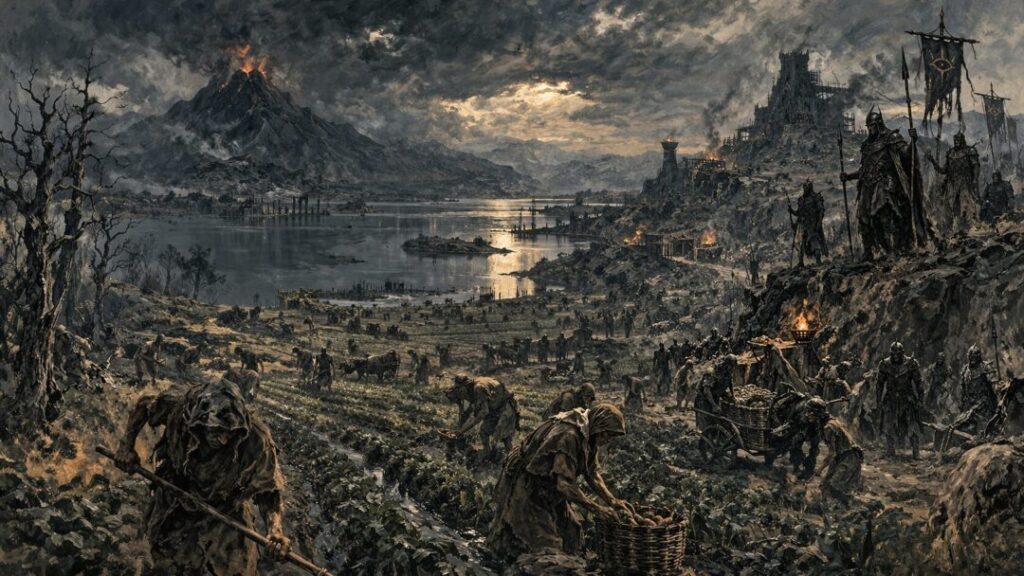
This is not beyond Mordor, but within its southern reaches, and it matters because it shows that even Mordor is not just one uniform wasteland. Around Lake Núrnen there are lands worked to sustain Sauron’s power. The text briefly opens a grim window there: fields, labor, supply, endurance, and domination made practical.
That detail is easy to pass over.
But once it is noticed, the world around Mordor becomes less abstract. Sauron’s realm is not only towers and ash. It is also infrastructure. Food. Servitude. A system.
So the lands east and south-east of Mordor are not absent from the story.
They are partially visible.
Why the East Feels More Mysterious Than the South or North
If Rhûn and Khand are named, why do so many readers still feel that the lands east of Mordor are almost unknown?
Because in a sense, they are.
Middle-earth often gives place-names without giving full narrative intimacy. There is a difference between a region being acknowledged and a region being opened.
The Shire is opened.
Gondor is opened.
Rohan is opened.
Even Mordor, though terrible and hostile, is experienced directly through movement, fear, terrain, labor, and war.
The East usually is not.
Instead, it enters the story through consequence.
Peoples come from there.
Threats rise there.
Pressure moves westward from there.
Old memories point there.
But the narrative seldom settles in those lands long enough for them to become familiar.
That distance is not an accident of carelessness. It appears to be part of the design.
The story is centered in the north-west of Middle-earth. That is where most of the memory, record, and perspective lie. What is east of Mordor is often known the way border civilizations know distant interiors: as rumor, trade-route knowledge, hostile incursion, and fragments of older lore.
So when readers feel that the East is both present and withheld, they are reading the text correctly.
Rhûn Matters Because It Keeps Returning
Rhûn is not important only because it is named on a map.
It matters because it keeps pressing into the history of the West.
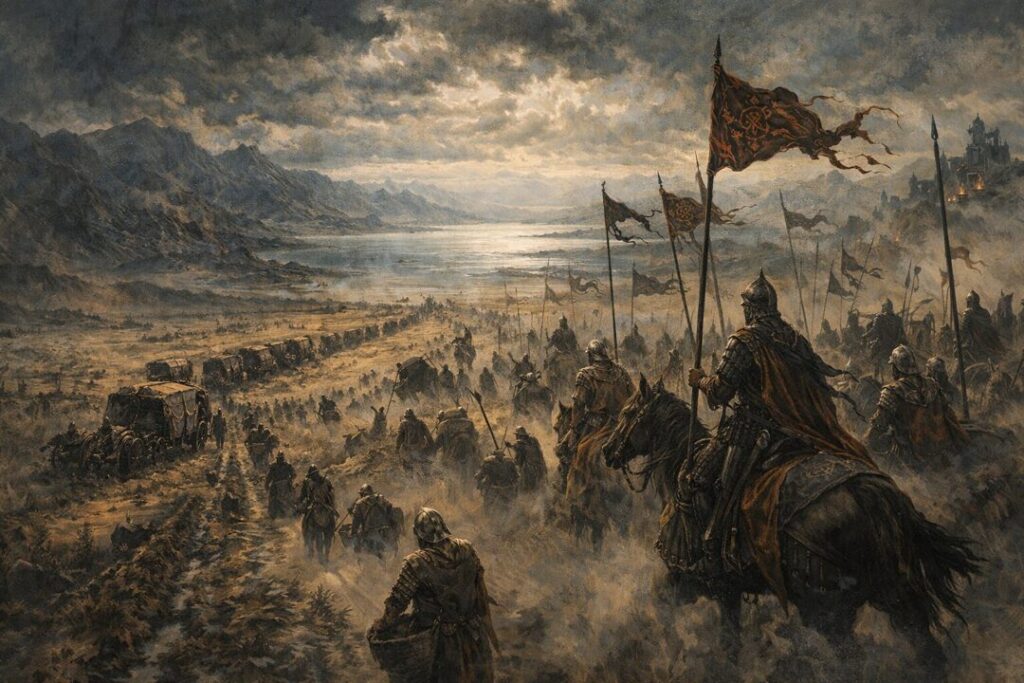
Easterlings appear in multiple ages of the legendarium. They are not a single people with one fixed identity, but a recurring reality: peoples of the East moving into the great struggles of Middle-earth, sometimes under Morgoth, later under Sauron, and often in war against Gondor and its allies.
This matters for one reason above all:
The East is not decorative.
It is historically active.
When Gondor fights waves of invaders from the East, when northern wars are shaped by Easterling pressure, when Sauron draws strength from eastern and southern alliances, the East becomes one of the major reservoirs of military and political force in the legendarium.
And yet, even then, the texts remain restrained.
We usually learn what these peoples do in western history.
We learn far less about what their own societies look like from within.
That imbalance is part of what gives the East its peculiar weight. It is not a blank. It is a frontier of incomplete knowledge.
Mordor’s Eastern Horizon Is Larger Than Mordor Itself
One easy mistake is to think of Mordor as the end of the map.
It is not.
Mordor is a fortress-region, but beyond and around it lie broader human worlds. Sauron does not emerge from nowhere. Nor does he draw support from nowhere. His influence spreads into existing lands and peoples.
That is why Khand matters.
That is why Rhûn matters.
That is why references to men “from the East and South” matter.
They remind us that the War of the Ring is not a conflict between one dark land and one free land. It is a continent-wide struggle shaped by enormous regions mostly left outside the main narrative lens.
This also helps explain why the East can feel so haunting.
It is not empty space behind the villain.
It is a wider human world, only partly seen, some of it under shadow, some of it resisting in ways the main story barely records, and much of it simply unknown from the western point of view.
That last point is important.
The texts do not authorize us to fill the East with confident invention. They authorize only caution.
We know there are lands.
We know there are peoples.
We know they matter.
Beyond that, the story becomes selective.
The Far East Touches the Deepest Past
This is where the subject becomes more surprising.
The lands east of Mordor are not only tied to war in the Third Age.
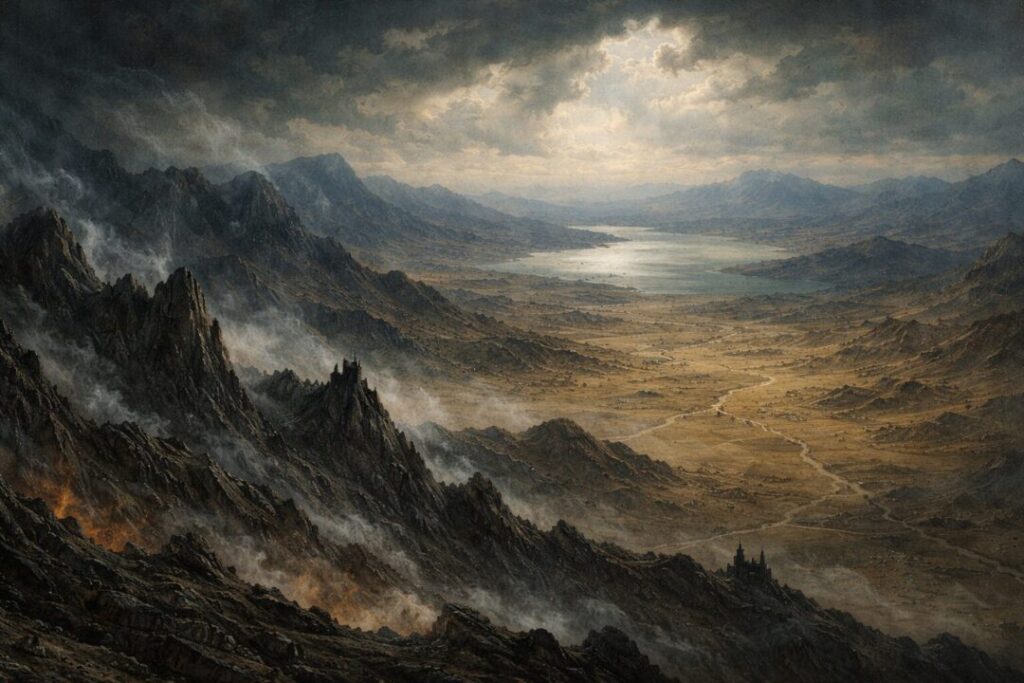
In the deep background of the legendarium, the distant East is connected with the earliest awakenings of the Children of Ilúvatar. Cuiviénen, where the Elves first awoke, lies in the far East in the ancient tradition. Hildórien, associated with the awakening of Men, is also placed in the East.
That changes the emotional shape of the question.
Because the East is not merely where danger comes from.
It is also where memory begins.
In other words, when Middle-earth looks eastward, it is looking not only toward hostile armies, but toward origins that have become unreachable.
That helps explain why the East can feel both foundational and remote at once. It stands at the edge of history and before history. It is part of the world’s structure, but not part of the familiar stage on which most of the later drama unfolds.
This is one reason the East feels older than its page-count suggests.
The Blue Wizards Complicate the Picture
There is another thread that makes the East more important than many readers realize.
In later writings, the Blue Wizards are associated with the East and South.
That does not solve the mystery of those lands. It deepens it.
Some texts leave their fate uncertain and even suggest failure. Later conceptions make their mission more active in resisting Sauron by stirring opposition in lands beyond the north-western focus of the main narrative.
This must be handled carefully, because the tradition is not perfectly consistent.
But even taken conservatively, one point stands:
The East was important enough to imagine as a major field of unseen struggle.
That is a remarkable idea.
It implies that the defeat of Sauron may have depended not only on the famous deeds in the West, but also on pressures, resistances, and disruptions in lands the reader scarcely sees.
Not because the texts fully narrate that story.
They do not.
But because they leave room for the possibility that Middle-earth was broader in conflict than the principal narrative could follow directly.
Why So Little Is Said
So why are the lands east of Mordor mentioned, but never fully unfolded?
Partly because the legendarium is shaped by perspective. The surviving histories are western. They do not pretend to omniscience.
Partly because mystery is one of the ways Middle-earth creates scale. A fully described world can become smaller than a partly veiled one. The East remains large because it remains incomplete.
And partly because the story is not trying to become a total atlas of every people and kingdom.
It is telling a particular history from a particular edge of the world.
That restraint gives the East its power.
Rhûn is more evocative because it is not exhausted.
Khand is more memorable because it is barely opened.
Even Mordor becomes larger once we realize it stands before regions that the story acknowledges but does not master.
So, Is There Mention of the Lands East of Mordor?
Yes.
Absolutely.
There is mention of Rhûn.
There is mention of Khand.
There are references to Easterlings, to wars out of the East, to Nurn and Lake Núrnen in the south of Mordor, and in the deeper legendarium to ancient eastern lands tied to first beginnings.
But the truer answer is this:
Middle-earth mentions those lands in a way designed to keep them half beyond reach.
They are real.
They are important.
They affect the fate of the West.
And still they are never fully brought near.
That is why the question lingers.
Not because the East is absent.
But because it is present as distance.
And in a world as carefully made as Middle-earth, that kind of distance is rarely accidental.
Sources & Notes
- J.R.R. Tolkien, The Lord of the Rings, map and Appendix A, ‘Gondor and the Heirs of Anárion’ — Rhûn, Khand, Easterlings, Wainriders, and other eastern pressures on Gondor place lands and peoples beyond Mordor in the story’s political geography.
- J.R.R. Tolkien, The Lord of the Rings, Book V, Chapter 10, ‘The Black Gate Opens’ — Sauron’s armies include Easterlings, Southrons, Variags of Khand, and forces drawn from beyond the main western viewpoint.
- J.R.R. Tolkien, The Lord of the Rings, Book VI, Chapter 5, ‘The Steward and the King’ — Aragorn frees the slaves of Mordor and grants them the lands about Lake Núrnen, showing Mordor’s southern agricultural and servile infrastructure.
- J.R.R. Tolkien, The Silmarillion, ‘Of the Coming of the Elves and the Captivity of Melkor’ and ‘Of Men’ — Cuiviénen and Hildórien locate the awakenings of Elves and Men in the far East of the ancient world.
- J.R.R. Tolkien, Unfinished Tales, ‘The Istari’, together with The Peoples of Middle-earth, ‘Last Writings’ — the Blue Wizards are associated with journeys into the East and South, with Tolkien’s later notes allowing for unseen resistance to Sauron there.