Most people remember Eärendil as the bright star of the West.
That is true.
But it is not the beginning of the story, and it is not even the most important part of what his voyage accomplishes.
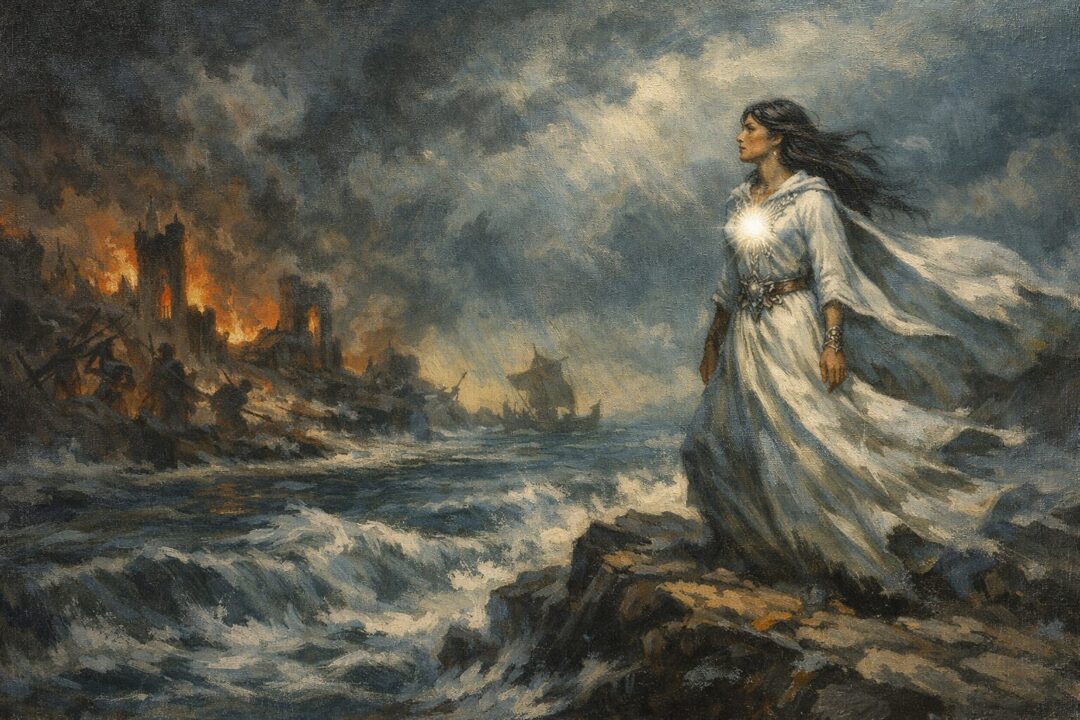
By the time Eärendil and Elwing sail into the West, the First Age is already collapsing under the weight of long defeats. The great hidden cities are gone. The Sindarin and Noldorin realms have been shattered. The surviving peoples of Beleriand are reduced to scattered refuges and remnants. Morgoth still sits in the North, and no power in Middle-earth seems capable of overthrowing him.
It is in that setting that one voyage changes everything.
The story begins in ruin, not triumph
The Havens of Sirion are not a kingdom in glory.
They are a refuge at the edge of disaster.
There the survivors of Doriath and Gondolin are gathered, and there dwell Eärendil and Elwing. Elwing carries the Silmaril that came down from Beren and Lúthien through Dior. That jewel matters not only because of its holiness, but because it keeps the old oath of Fëanor alive. The sons of Fëanor, still bound by their oath, attack the Havens to seize it.
This is one of the darkest details in the whole chain.
The last refuge of the survivors is broken not by Morgoth, but by those who should have been his enemies.
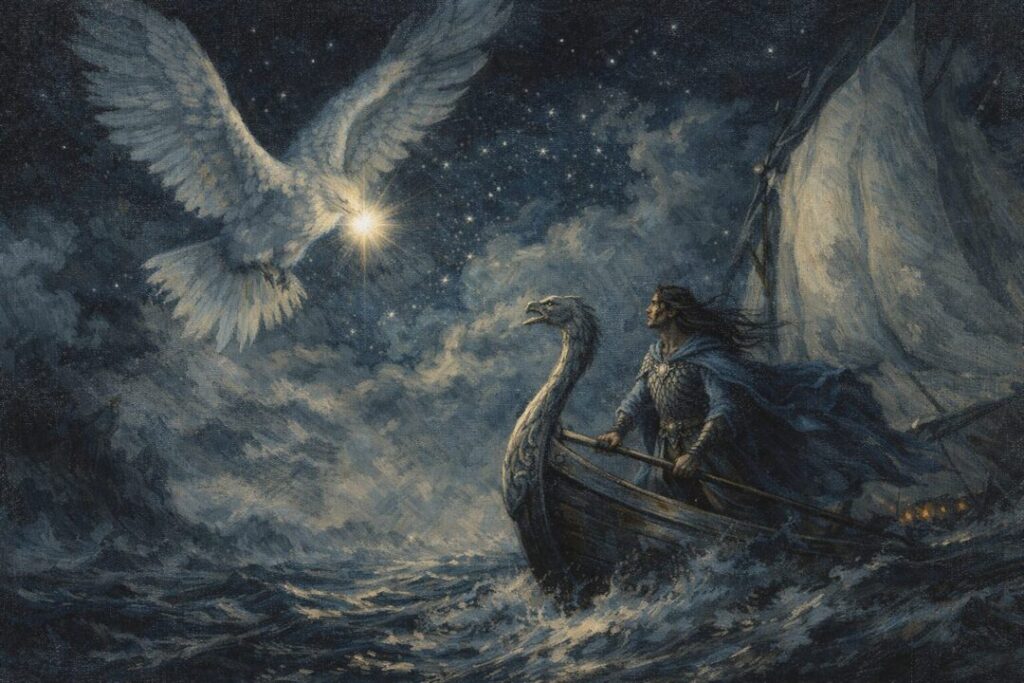
Elwing refuses to yield the Silmaril. Instead she casts herself into the Sea. Yet she is not lost. Ulmo bears her up, and she comes to Eärendil in the form of a great white bird, with the Silmaril still upon her breast. That reunion is one of the decisive moments in the legendarium, because from that point the voyage changes from a mariner’s long search into an appeal that can actually reach the West.
Without Elwing, the voyage looks different.
Without the Silmaril, it may never succeed at all.
Why the voyage matters more than the star
It is easy to remember Eärendil only as a figure of wonder: a mariner in a shining ship, carrying the Silmaril across the heavens.
But before he becomes a sign, he is a messenger.
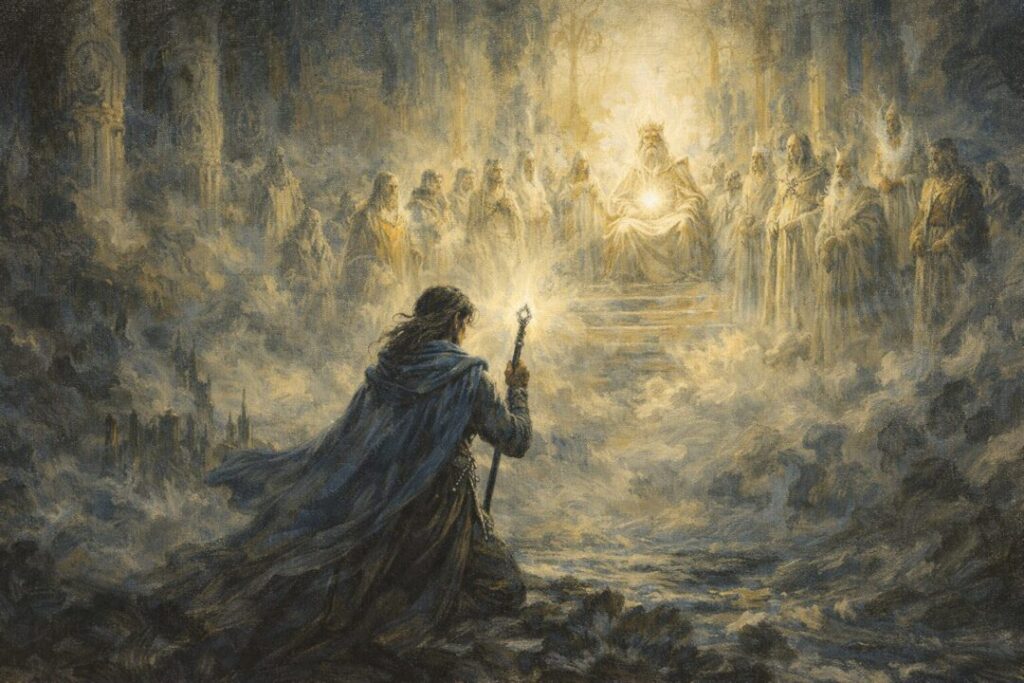
The tradition is explicit that Eärendil comes before the Valar and delivers the “errand of the Two Kindreds,” asking pardon for the Noldor, pity for their sorrows, and mercy and aid for both Elves and Men in Middle-earth. His journey is not private. It is representative. He goes because the peoples left in Middle-earth cannot save themselves.
That point is easy to miss.
Eärendil does not merely achieve an impossible voyage.
He brings the crisis of the whole world to the Valar.
And his prayer is granted.
That is the hinge.
Before the voyage, Morgoth’s dominion appears effectively unanswerable within Middle-earth. After the voyage, the Valar move in force. The Host of the West is assembled. The War of Wrath begins. Morgoth is overthrown.
So when people say Eärendil’s voyage changed the world, that is not poetic exaggeration.
It is structurally true.
Elwing is not secondary to the turning
There is a common tendency to tell this story as if Eärendil acts and Elwing simply accompanies.
The texts do not support reducing her like that.
Elwing preserves the Silmaril through catastrophe. Elwing refuses the sons of Fëanor. Elwing survives by grace out of the Sea. Elwing reaches Eärendil with the jewel that becomes central to what follows. Even Manwë’s judgment distinguishes their acts: Eärendil took peril upon himself for love of the Two Kindreds, and Elwing entered into peril for love of Eärendil.
That distinction matters.
Eärendil’s part is public and representative.
Elwing’s part is preservative and catalytic.
She carries forward what would otherwise have been lost.
And that means the voyage is theirs together, even if Eärendil is the one most visibly remembered afterward.
The world is saved, but not preserved
One of the most important things about this story is that victory does not restore what was already destroyed.
The Valar intervene. Morgoth is defeated. Yet the war that follows is so immense that Beleriand itself is broken and mostly drowned beneath the sea. Only remnants remain, including Lindon in the west beyond the Blue Mountains.
That is why the voyage does not simply “save Beleriand.”
It ends Beleriand.
This is one of the deepest patterns in the legendarium: deliverance can come, but the old world is not simply handed back untouched. Evil can be defeated, yet the cost remains written into the land itself. Eärendil and Elwing help bring the answer to Morgoth, but the answer arrives on a scale that closes the First Age and remakes the map of Middle-earth.
So the voyage does not return the world to what it was.
It carries the world into what comes next.
The judgment on their house changes later ages too
The consequences do not stop with the war.
After Eärendil’s plea is heard, a doom is spoken over him and Elwing. Because they are of mixed descent, they are given the choice to be reckoned among Elves or Men. They choose to be numbered among the Eldar, and the same choice passes to their line.
This is not a small genealogical footnote.
It becomes one of the defining lines of later history.
Their sons Elrond and Elros choose different fates. Elrond remains with the Elves. Elros chooses the fate of Men and becomes the first king of Númenor. From that divided line come two of the greatest later histories in the legendarium: the long Elvish memory preserved in Elrond’s house, and the royal line of Númenor that eventually leads, through many ages, to Aragorn.
So this voyage does not only bring about the fall of Morgoth.
It also establishes the shape of the Half-elven destiny that runs forward into the Second and Third Ages.
In that sense, the voyage rewrites not only the present crisis, but the structure of the future.
Eärendil’s star is a consequence, not the whole meaning
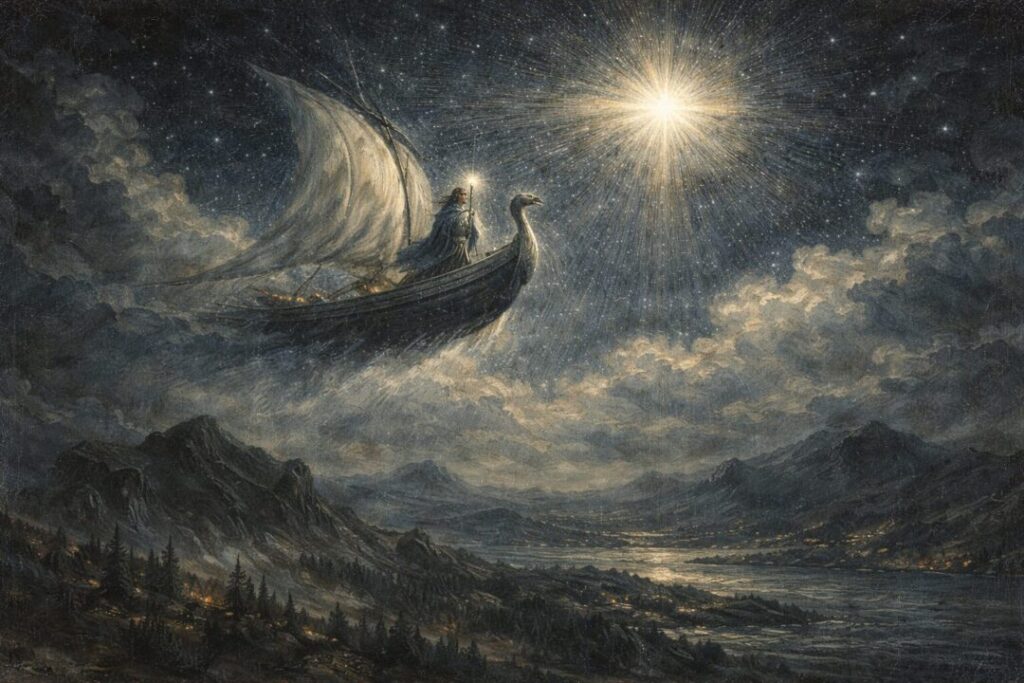
After the war, Eärendil’s vessel is hallowed, and he sails with the Silmaril upon his brow. In Middle-earth he is seen as a star and called Gil-Estel, the Star of High Hope.
This is the image people remember.
And rightly so.
But the star is not merely decorative myth.
It is the visible memory of the entire turning that came before it.
The star marks that someone reached the West.
The star marks that the Valar answered.
The star marks that Morgoth fell.
The star marks that hope survived the ruin of the Elder Days.
Its significance also does not end in the First Age. The Edain later follow the Star of Eärendil to Númenor, and in The Lord of the Rings the light of Eärendil still appears as a sign of help against darkness through Galadriel’s phial. That does not mean Eärendil is acting directly in every later event; the safer reading is that his light endures as a sign and token of hope across ages.
That long afterlife is exactly why the voyage matters so much.
It does not end when the ship reaches shore.
Why this single voyage feels larger than one hero’s deed
Eärendil and Elwing’s story sits at the meeting point of several great currents at once.
It gathers the Silmaril out of the ruin of Beren and Lúthien’s line.
It gathers the fall of Gondolin through Eärendil’s own descent from Tuor and Idril.
It gathers the sorrow of Elves and Men into one appeal.
And it sends forward consequences that shape Elrond, Elros, Númenor, Aragorn, and Arwen.
That is why one voyage can seem to rewrite the world.
Because it does.
Not by erasing what came before, but by carrying all of it into judgment, mercy, war, loss, and a new age.
The deeper beauty of the story is that the turning does not begin in strength.
It begins with survivors.
A shattered refuge.
A jewel rescued from repeated ruin.
A leap into the Sea.
A ship going where it should not be able to go.
And from that, the whole history of Middle-earth bends.
Sources & Notes
- J.R.R. Tolkien, The Silmarillion, ‘Of the Voyage of Eärendil and the War of Wrath’ — the Havens of Sirion, Elwing’s rescue with the Silmaril, Eärendil’s plea before the Valar, and the War of Wrath.
- J.R.R. Tolkien, The Silmarillion, ‘Of the Voyage of Eärendil and the War of Wrath’ — Manwë’s judgment on Eärendil and Elwing and the choice of the Half-elven.
- J.R.R. Tolkien, The Silmarillion, ‘Akallabêth’ — Elros, Númenor, and the later inheritance of the Half-elven line.
- J.R.R. Tolkien, The Lord of the Rings, Appendix A, ‘Annals of the Kings and Rulers’ — the descent from Elros through Númenórean kings to Aragorn.
- J.R.R. Tolkien, The Lord of the Rings, Book II, Chapter 8, ‘Farewell to Lórien’ — Galadriel’s phial holding the light of Eärendil’s star.