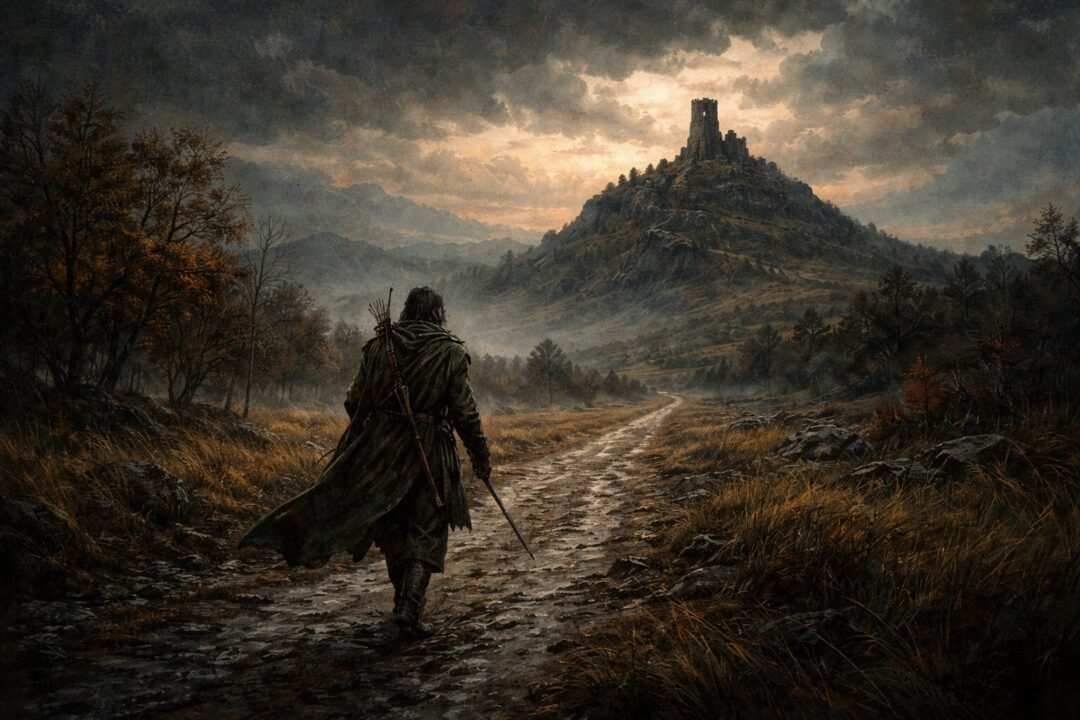
Most people think of Middle-earth as a place of vast distances and sudden arrivals.
Characters leave one kingdom, suffer a few hardships, and then seem to emerge in another world entirely. The map feels enormous, but the movement across it can feel strangely easy in memory.
The texts tell a different story.
Middle-earth is large in a way that often resists modern instinct. Roads matter. Rivers matter. Weather matters. Terrain matters. A trained Ranger can do what an ordinary traveller cannot. A mounted host can cover ground that a group on foot would never match. And once travellers leave roads altogether, time stretches very quickly.
That is why the question is more revealing than it first appears:
How far could you really travel in Middle-earth in one week?
The answer is not “very far.”
But it is also not simple.
A Week Is Shorter Than Middle-earth Makes It Feel
The cleanest way to begin is with one of the few places where the text gives a direct estimate.
After the attack at Weathertop, Aragorn tells the hobbits that from there to the Ford of Bruinen would take him twelve days on his own feet in fair weather, and longer for their party if they must stay off the Road.
That matters more than it first seems.
Weathertop is not some remote edge of the world. It is roughly on the eastward road toward Rivendell. Yet even there, a skilled traveller is still looking at nearly two weeks to reach the Ford under good conditions. In other words, one week does not get you from Bree to Rivendell. It does not even get a burdened and cautious company from Weathertop to safety.
This is one of the clearest reminders that Middle-earth does not shrink itself for convenience. Even well-known destinations are often farther apart in lived experience than fans remember.
A week can move you meaningfully.
But it often cannot finish the journey.
Roads Change Everything
Travel in Middle-earth is never just about distance in the abstract. It is about what lies under your feet.
A maintained road is one thing. Trackless country is another.
Earlier in the same part of the journey, Strider says the Forsaken Inn lies about a day’s journey east of Bree. That small detail is easy to overlook, but it establishes an important scale. Even in Eriador, where the old East Road still exists, movement is not casual. A day’s journey is a serious unit of travel, and the old road beyond Bree is already entering the kind of country where certainty starts to thin.
This is why “one week” cannot be answered as though Middle-earth were flat ground with modern assumptions built into it.
On a road, a traveller can make steady progress.
Off a road, the same traveller slows dramatically.
And if secrecy matters, as it so often does in the War of the Ring, speed is purchased at the cost of exposure.
The map is not just made of miles. It is made of conditions.
On Foot, One Week Is Enough to Matter but Not Enough to Roam Freely
For ordinary people on foot, one week in Middle-earth is best understood as a limited, local journey.
You might get from one settled region to the next.
You might cross a portion of open country.
You might reach a refuge if you begin close enough.
But you are not casually spanning half a kingdom.
The books repeatedly suggest that walking parties are constrained not only by stamina, but by baggage, food, fear, and the need to stop before darkness in dangerous lands. Hobbits move more slowly than Rangers. A mixed company moves more slowly than a single hardened traveller. Wounded companions or poor weather change everything.
That is why the scale of Aragorn’s estimate is so valuable. If even he treats the road from Weathertop to the Ford as a journey measured in many days, then ordinary foot-travel must be imagined more conservatively still.
A week on foot in Middle-earth is real distance.
It is not map-breaking distance.
Desperate Pursuit Is Not Normal Travel
There is, however, another model in the text.
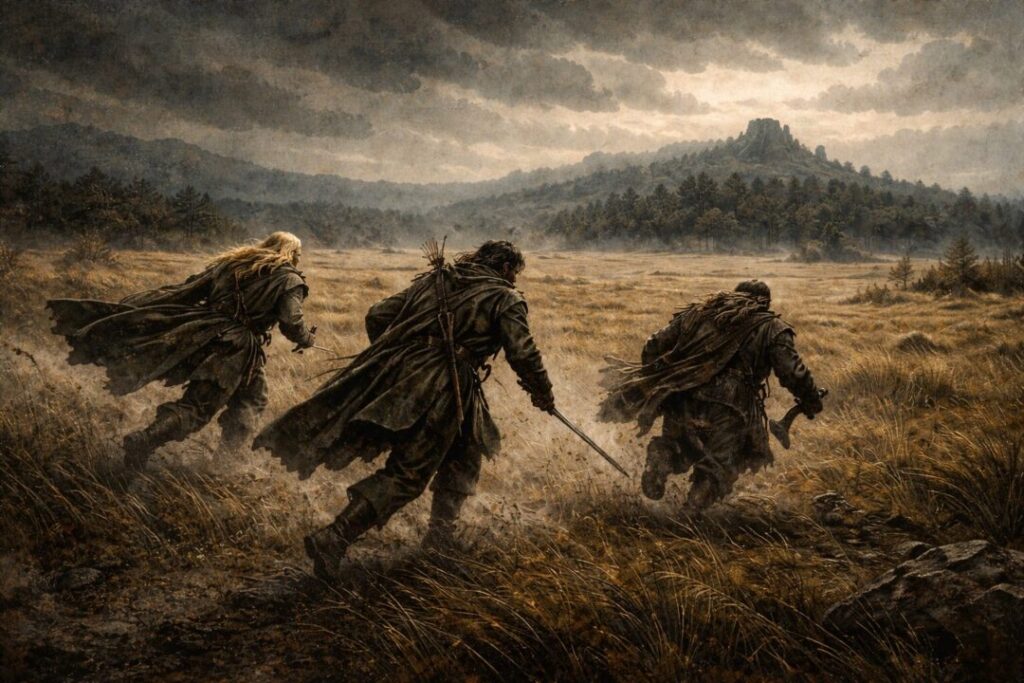
The Three Hunters give us one of the most extreme examples of forced movement on foot in the entire narrative. The Fellowship breaks on 26 February. Aragorn, Legolas, and Gimli pursue the Orcs at once. By 30 February they meet Éomer near the edge of Fangorn.
That is a remarkable pace.
But it is not ordinary travel, and the text does not present it as ordinary. It is an exhausting pursuit driven by urgency, stripped sleep, and unusual endurance. Aragorn is no common man. Legolas is an Elf. Even Gimli’s stubbornness is treated as exceptional.
This is crucial for judging what “one week” means.
Yes, Middle-earth contains astonishing overland movement.
But when it does, the narrative marks it as extraordinary.
So if someone asks how far you could really travel in a week, the honest answer is not to use the Three Hunters as the baseline. They are closer to the outer limit of what a desperate and unusually gifted group can do.
They show what is possible under pressure.
They do not show what is normal.
Rivers Compress the Map
If roads change travel, rivers can transform it.
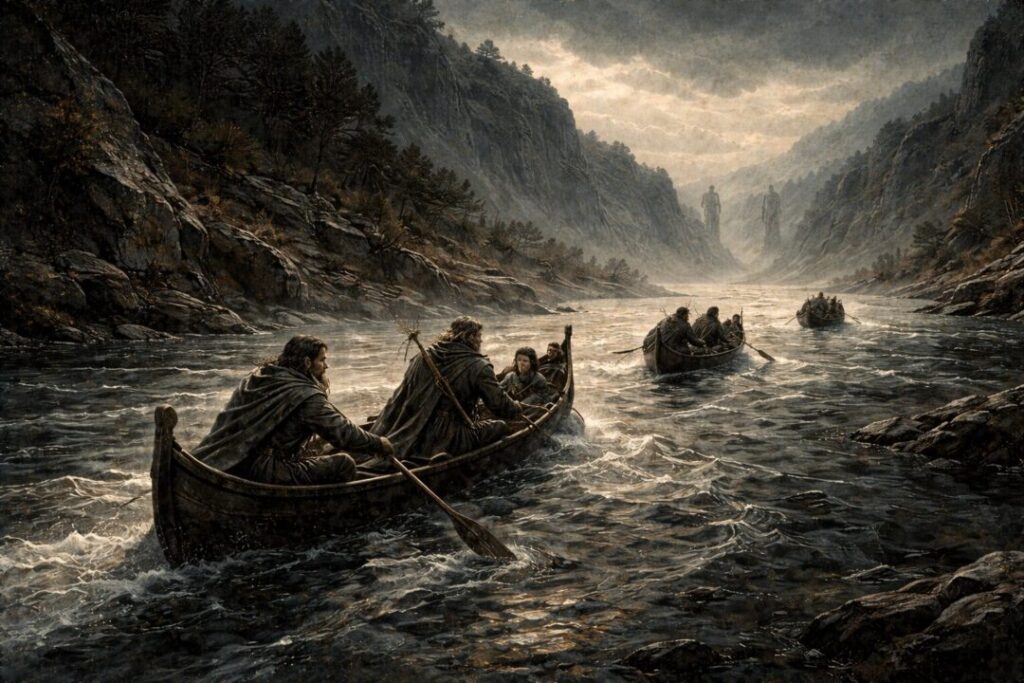
The Fellowship’s journey down the Anduin is one of the clearest examples. They depart Lórien on 16 February and pass the Argonath on 25 February. That does not mean the river is effortless or safe. It is not. But it does show that water travel can carry a company much farther in a given span than overland movement through difficult terrain.
This matters because fans often imagine Middle-earth primarily in terms of marching.
The books do not.
Where navigable water exists, it creates a different scale of movement. The Great River links spaces that would feel much more distant if approached on foot through broken country. That does not eliminate danger. It changes the geometry of effort.
So in one week, a traveller in Middle-earth might cover far more ground by boat than by road, and certainly more than by cautious travel through the wild.
A river does not make the world small.
It makes some journeys possible that would otherwise be punishingly slow.
Horseback Expands the World, but Not Without Limits
Mounted travel is the point where many readers begin to overestimate what Middle-earth allows.
Horses are faster. Rohan proves that clearly. But the texts still keep speed tied to realism, especially when large numbers are involved.
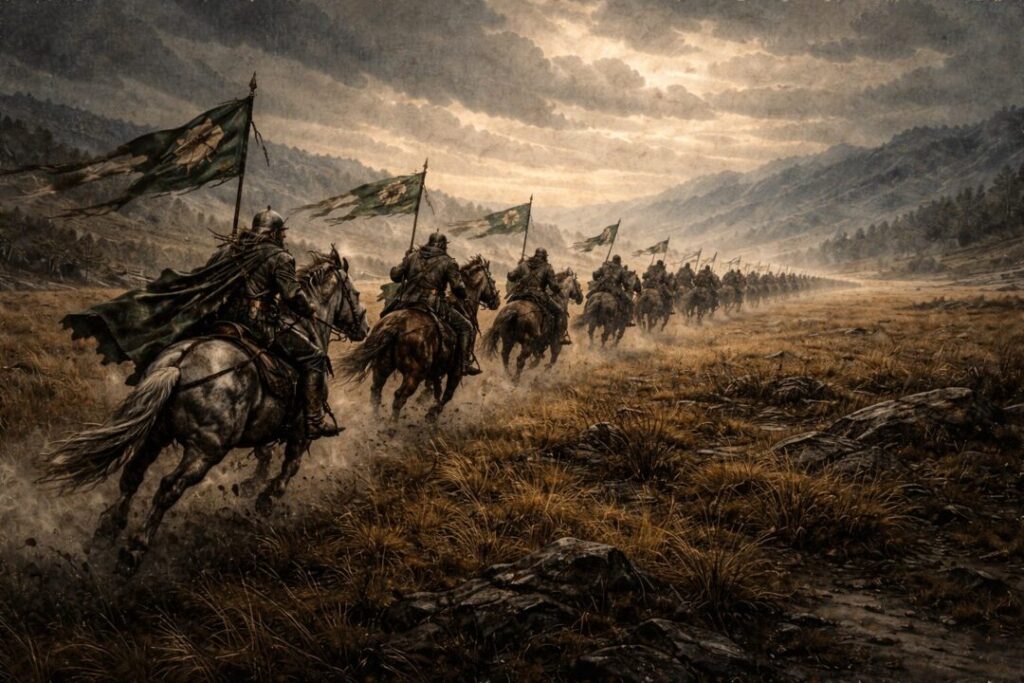
When Théoden prepares to ride to the aid of Gondor, he says they will not reach Minas Tirith for a week. That is not the estimate of a hesitant king. It is the estimate of a people who understand horses, roads, burdens, and war.
And that is with riders, purpose, and organized movement.
So yes, in one week on horseback, you can do much more than a traveller on foot. You can cross a substantial part of a kingdom. You can answer a summons that would be hopeless for walkers. You can make distance feel suddenly strategic.
But even then, Middle-earth does not become small.
A week on horseback is powerful.
It is not limitless.
The Real Shock Is Which Journeys Are Actually Unrealistic
Once you put these examples side by side, the biggest surprise is not simply that Middle-earth is large.
It is that many routes people casually imagine turn out to be unrealistic within a week.
Bree to Rivendell in seven days? Not by the evidence we are given.
A comfortable week’s wandering from one famous realm to another? Usually not.
A crossing of dangerous country while staying hidden, eating well, and arriving fresh? Even less likely.
By contrast, some routes become more believable once the mode of travel changes. A road can rescue a journey. A river can compress distance. A horse can turn a strategic impossibility into a hard but manageable ride.
That is the pattern.
The question is never only “how far?”
It is always “by what way, under what pressure, and at what cost?”
Why This Makes Middle-earth Better
This restraint is part of what gives Middle-earth its weight.
Journeys do not exist merely to connect scenes. They create consequence. Distance delays help. Terrain isolates peoples. Roads preserve kingdoms. Rivers bind regions together. Fatigue changes choices. The world feels historical because movement through it is difficult in a believable way.
That is why seven days matters so much in the books.
A week can save a city.
A week can lose a trail.
A week can place a traveller on the edge of safety without getting them there.
A week can feel swift in one part of Middle-earth and painfully insufficient in another.
So how far could you really travel in Middle-earth in one week?
Far enough to matter.
Not far enough to ignore the map.
And once you start reading the journeys that way, the world becomes larger, harsher, and much more convincing than it first appears.
That is the real answer hiding inside the question.
It is not just about distance.
It is about the fact that in Middle-earth, the road itself is always part of the story.
Sources & Notes
- J.R.R. Tolkien, The Lord of the Rings, Book I, Chapter 12, “Flight to the Ford” — gives Aragorn’s estimate of roughly twelve days from Weathertop to the Ford of Bruinen, longer for a wounded and cautious party.
- J.R.R. Tolkien, The Lord of the Rings, Book I, Chapter 11, “A Knife in the Dark” — uses the Forsaken Inn and the East Road east of Bree to show how even familiar Eriador travel is measured in hard day-stages.
- J.R.R. Tolkien, The Lord of the Rings, Book III, Chapter 2, “The Riders of Rohan” — shows Aragorn, Legolas, and Gimli making exceptional speed on foot across Rohan, underlining that such pace is heroic rather than ordinary.
- J.R.R. Tolkien, The Lord of the Rings, Book V, Chapter 3, “The Muster of Rohan” — frames Théoden’s ride to Gondor as a multi-day mounted military movement, not an effortless crossing of the map.
- J.R.R. Tolkien, The Lord of the Rings, Appendix B, “The Tale of Years” — anchors the War of the Ring itinerary by dates, including the Rohirrim’s muster and arrival at the Pelennor after several days of riding.