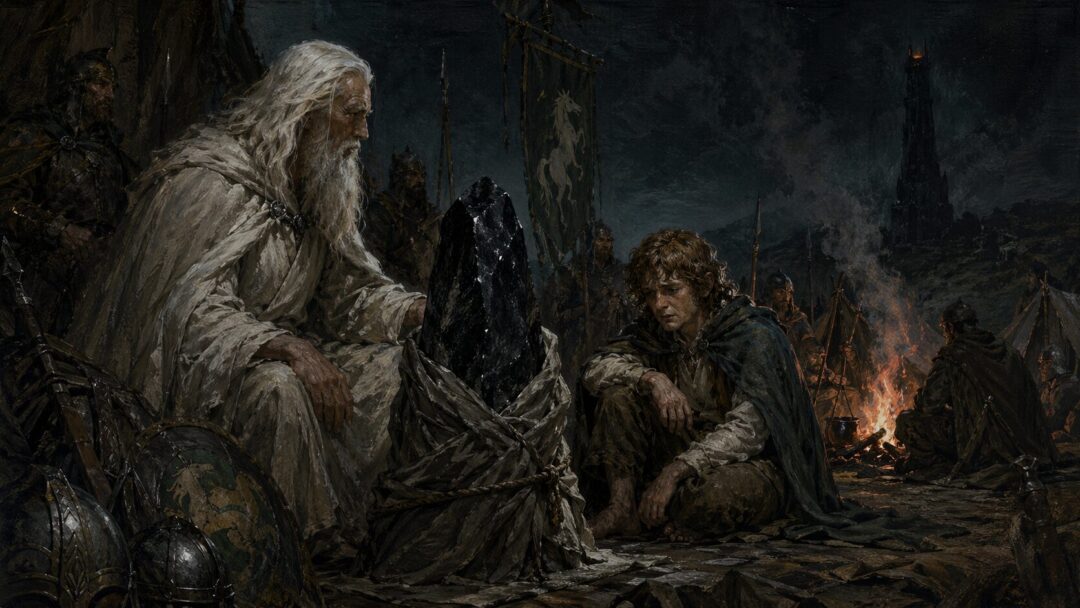
When Pippin looks into the Orthanc-stone, the danger seems obvious.
Sauron is on the other side.
The Enemy sees too much. The Stone is already entangled in his will. And for one terrible moment, a hobbit is dragged into the attention of the Dark Lord himself.
But once that danger passes, Gandalf says something even more revealing.
He admits that he had considered probing the Stone himself.
And then he says he may have been saved from a grave blunder.
That is the part readers often pass over too quickly.
Because Gandalf is not merely warning that the palantír is dangerous in a general sense. He says that if he had used it, he would have been revealed to Sauron. He says he is “not yet ready for such a trial, if indeed I shall ever be so.” And then he adds something stranger still: even if he could have withdrawn, it would have been disastrous for Sauron to see him — yet, he says, not until the hour comes when secrecy no longer avails.
That line raises the real question.
Why would Gandalf, returned as the White and greater than before, still refuse to show himself through the palantír?
This Was Never Just About Looking
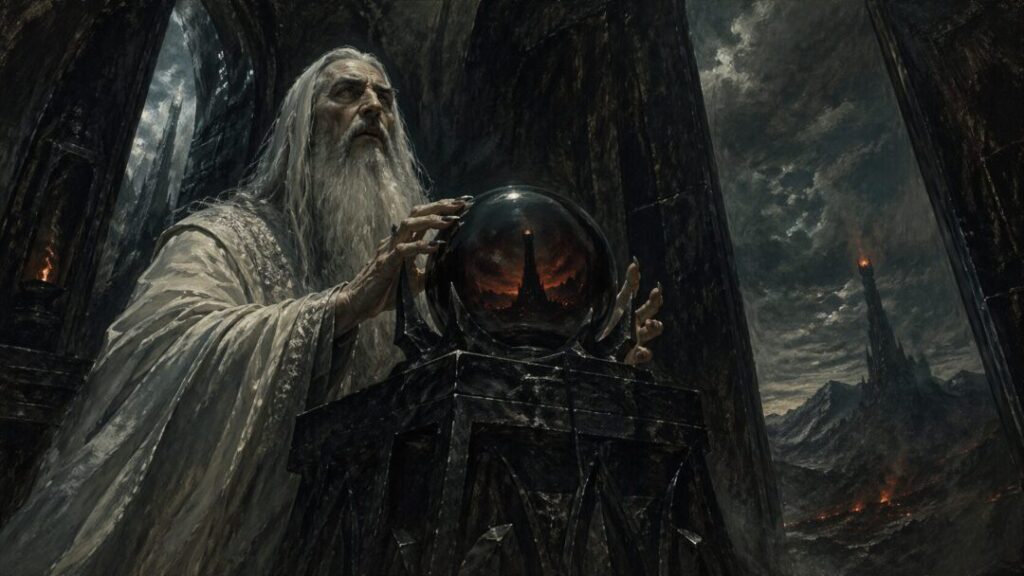
The first thing to understand is that a palantír is not simply a passive viewing device.
The stones can be used to see far away, and in some cases to communicate with another stone. But they are also dangerous because the stronger will can exert control over what is shown, how a viewer is drawn, and how minds meet across that contact. Sauron, using the Ithil-stone in Barad-dûr, had already become the dominant power in this network of surviving stones.
That matters enormously.
Gandalf is not talking about casually glancing into a magical object.
He is talking about entering a contested space in which Sauron is already present.
And the text gives two very clear examples of what that can cost.
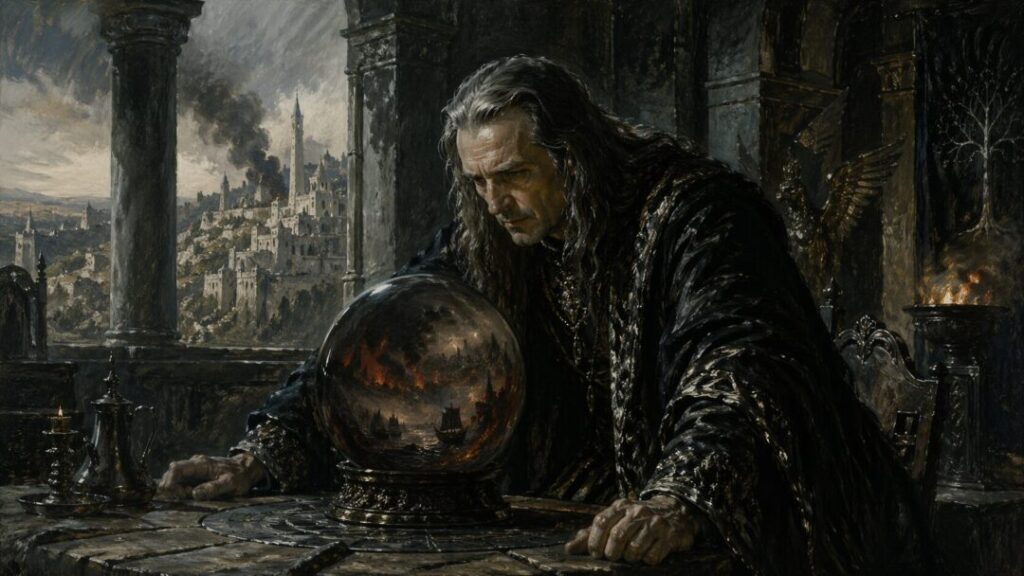
Saruman, for all his power and pride, was ensnared through the Orthanc-stone. He did not begin as Sauron’s servant, but his use of the palantír brought him into contact with a mind greater, darker, and more experienced in domination than his own. Denethor was stronger in a different way: he was not corrupted into allegiance, and Sauron could not simply force the Anor-stone to lie to him. Yet the struggle still exhausted him, isolated him, and helped drive him into despair by showing him truths in a ruinous frame.
So Gandalf’s caution is not surprising.
If Saruman could be overawed, and Denethor could be worn down, then entering into direct contact with Sauron through a stone was no small thing, even for Gandalf.
Gandalf’s “Not Yet” Is the Important Part
Still, Gandalf does not simply say, “I am too weak.”
He says, “not yet.”
That small word changes the meaning.
It suggests that the problem is not only whether he possesses enough power in some abstract sense. It is also whether this is the right moment to be known.
And that fits the wider shape of the war.
Gandalf’s task in Middle-earth is not to overthrow Sauron by openly matching him in unveiled spiritual force. The Istari were sent to advise, hearten, and unite the peoples of Middle-earth against the Shadow, not to dominate by displays of their own power. Even long before the War of the Ring, Olórin was described as fearing Sauron and feeling too weak for that mission, which already tells us something important about his character: Gandalf is powerful, but never careless about power, especially Sauron’s.
That humility matters here.
Gandalf understands what kind of being Sauron is.
He understands what a direct contest of attention and will might cost.
And he also understands that secrecy is still protecting the true hope of the West.
At this stage of the story, the Quest still depends on Sauron misunderstanding his enemies. He must not clearly grasp where the decisive danger lies. He must not be pushed too soon toward the right suspicion. Gandalf says exactly this in compressed form: it would be disastrous for Sauron to see him, but not yet — because secrecy still has value.
In other words, Gandalf is not merely asking, “Could I endure this encounter?”
He is also asking, “What would Sauron learn from it?”
What Sauron Might Have Understood
The text does not spell out every detail Sauron would have inferred, so caution is needed here.
But the broad implication is clear.
If Gandalf the White openly entered Sauron’s sight through the stone too early, Sauron would know that a major power had reappeared in the West, active, aware, and willing to confront him directly. He would know more than he should about the presence and movement of one of his greatest enemies. And because Sauron constantly interprets events through the logic of power, he would begin re-reading the situation around that revelation.
That is what makes Gandalf’s line so interesting.
He does not say that it would be disastrous for himself to be seen.
He says it would be disastrous for Sauron to see him.
At first that sounds paradoxical.
But in Middle-earth, “disastrous” does not always mean immediate destruction. It can mean forcing a move too early, exposing a truth at the wrong time, or driving the enemy into an action that harms the larger plan.
If Sauron had seen Gandalf too soon, he might have reacted more sharply, more warily, or in a less useful direction. The exact counterfactual cannot be proved, but Gandalf’s own wording strongly implies that such a revelation would have changed the shape of the war before the Free Peoples were ready.
Why Aragorn Could Do What Gandalf Would Not
This becomes much clearer when Aragorn later uses the same stone.
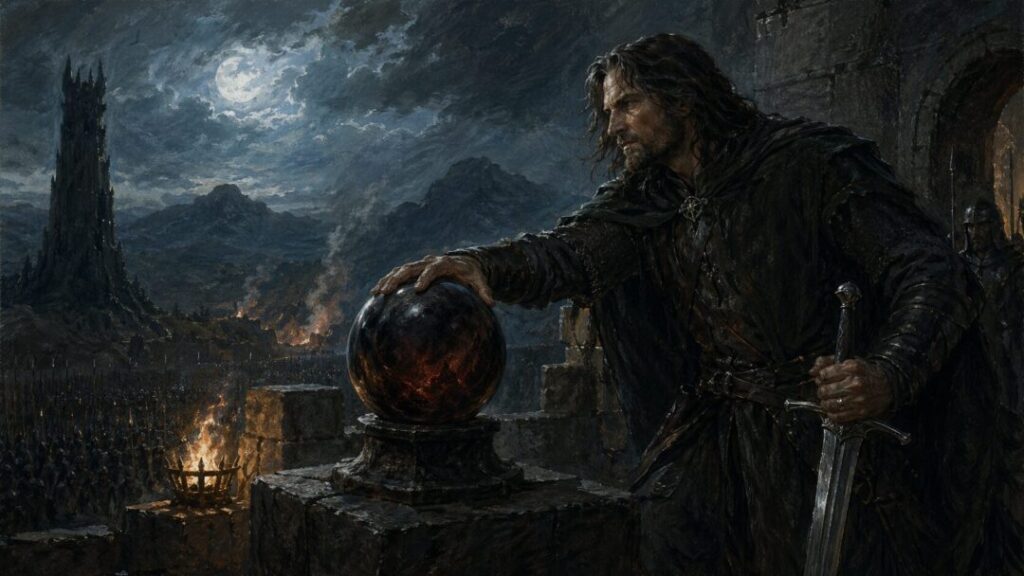
After Helm’s Deep, Aragorn takes the Orthanc-stone and confronts Sauron. When he describes the encounter, he says he had both the right and the strength to use it, though the strength was “enough — barely.” He deliberately lets Sauron see the heir of Isildur and the reforged sword of Elendil. And he judges that this revelation strikes fear and doubt into the Dark Lord at exactly the right moment.
That contrast is decisive.
Aragorn does reveal himself.
Gandalf does not.
Why?
Because the strategic situation has changed.
By then, being seen is no longer a grave blunder. It is bait.
Aragorn wants Sauron to believe that a claimant of ancient kingship has arisen openly against him. He wants Sauron’s eye turned westward. He wants him to imagine a rival lord moving toward open challenge. Since Sauron expects great opponents to seek mastery, he is naturally pushed toward the false conclusion that the Ring may be in the hands of one who intends to wield it. That misreading serves the Quest.
Gandalf, earlier, is still protecting the stage before that move.
Aragorn, later, is making the move.
So the difference is not that Aragorn is simply stronger than Gandalf, nor that Gandalf is secretly weaker than readers expect.
The difference is timing, authority, and purpose.
Gandalf’s Refusal Is a Sign of Wisdom, Not Limitation Alone
It is tempting to turn this into a simple hierarchy question.
Was Sauron stronger than Gandalf the White?
Could Gandalf have won a palantír struggle?
Was he admitting inferiority?
The text never gives a neat numerical answer, and it is better not to pretend it does.
What it does show is that Gandalf treats direct exposure to Sauron as a serious peril, not because he lacks courage, but because he sees more clearly what is at stake. He knows the history of the stones. He knows how Saruman fell. He knows what Denethor suffered. He knows that entering Sauron’s attention is not just a duel but a revelation.
That restraint is deeply characteristic of him.
Gandalf again and again refuses the kind of action that looks decisive but would actually serve the logic of domination. He does not seize the Ring. He does not claim kingship. He does not rush into contests merely because he is mighty enough to attempt them.
And here he does not use the palantír simply because it is available.
He waits.
That waiting is not hesitation in the lesser sense.
It is discipline.
The Real Answer
So why does Gandalf think he is not strong enough to reveal himself to Sauron through the palantír?
Because “strong enough” is only part of the question.
Yes, the encounter would have been a real trial of will against a being who had already mastered one stone, ensnared Saruman, and worn down Denethor. Gandalf had every reason to treat that danger seriously.
But more importantly, he was not yet willing to let Sauron see what he should still be denied.
The danger was not only that Gandalf might lose something in the encounter.
It was that Sauron might learn something too soon.
And in the war against Sauron, timing is often the difference between wisdom and ruin.
That is why Gandalf holds back.
Not because he is merely afraid to be seen.
But because, for a little while longer, the victory of the West still depends on Sauron looking the wrong way.
Sources & Notes
- J.R.R. Tolkien, The Lord of the Rings, Book III, Chapter 11, “The Palantír” — Pippin’s encounter with Sauron and Gandalf’s warning that using the stone himself would have revealed him too soon.
- J.R.R. Tolkien, Unfinished Tales, “The Palantíri” — explains how the Seeing-stones were used, how wills could contest them, and why Sauron’s possession of the Ithil-stone made contact perilous.
- J.R.R. Tolkien, The Lord of the Rings, Book V, Chapter 4, “The Siege of Gondor” — Gandalf’s explanation of Denethor’s use of the Anor-stone and Sauron’s ability to bend true visions toward despair.
- J.R.R. Tolkien, The Lord of the Rings, Book V, Chapter 2, “The Passing of the Grey Company” — Aragorn’s later deliberate confrontation with Sauron through the Orthanc-stone, with the strength “enough — barely.”
- J.R.R. Tolkien, Unfinished Tales, “The Istari” — frames Gandalf’s mission as guidance and resistance rather than domination, and notes Olórin’s fear of Sauron before accepting the task.