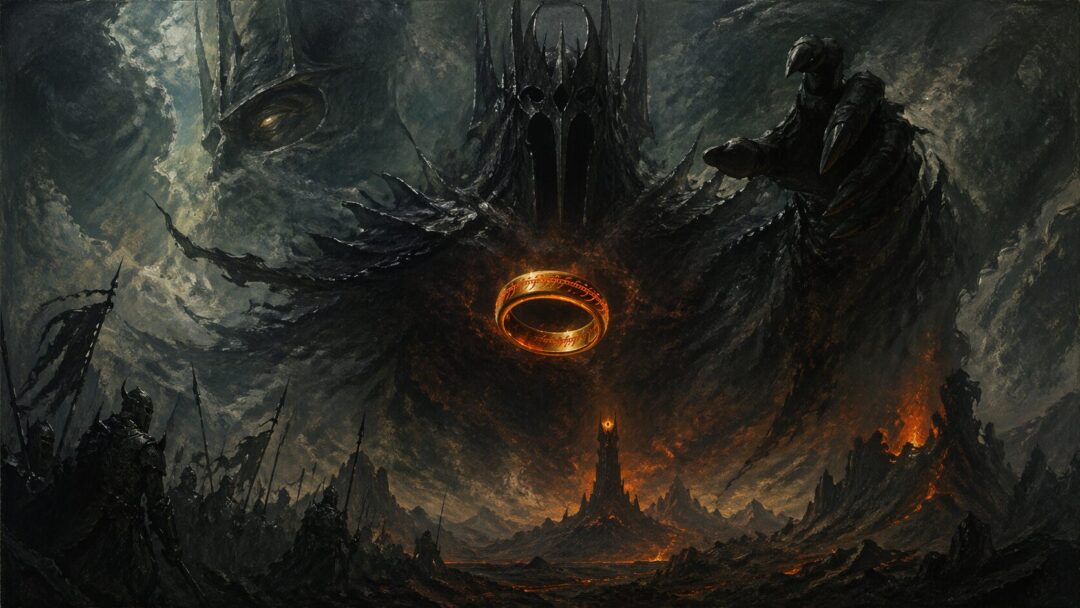
Most people remember the image in the simplest possible way.
Isildur cuts the Ring from Sauron’s finger.
Sauron falls.
The Dark Lord is defeated.
At a glance, it almost looks like a single cause and effect, as though the act worked like a hidden weak point in a myth: sever the finger, remove the Ring, end the Dark Lord.
But that is not quite what the texts describe.
The deeper lore makes the moment both more precise and more disturbing.
Sauron was not defeated because his finger was somehow magically vulnerable. He was defeated because in his final combat he was physically overthrown, and in that same moment the One Ring—the object into which much of his own strength and will had passed—was taken from him.
That difference matters.
Because once you see it, the scene stops being a clever finishing blow and becomes something far more central to the whole legendarium: a revelation of what the Ring actually was, how Sauron had bound himself to it, and why losing it broke his victory without ending him completely.
Sauron Was Already Thrown Down Before Isildur Took the Ring
One of the most important details is also one of the most commonly blurred in popular retellings.
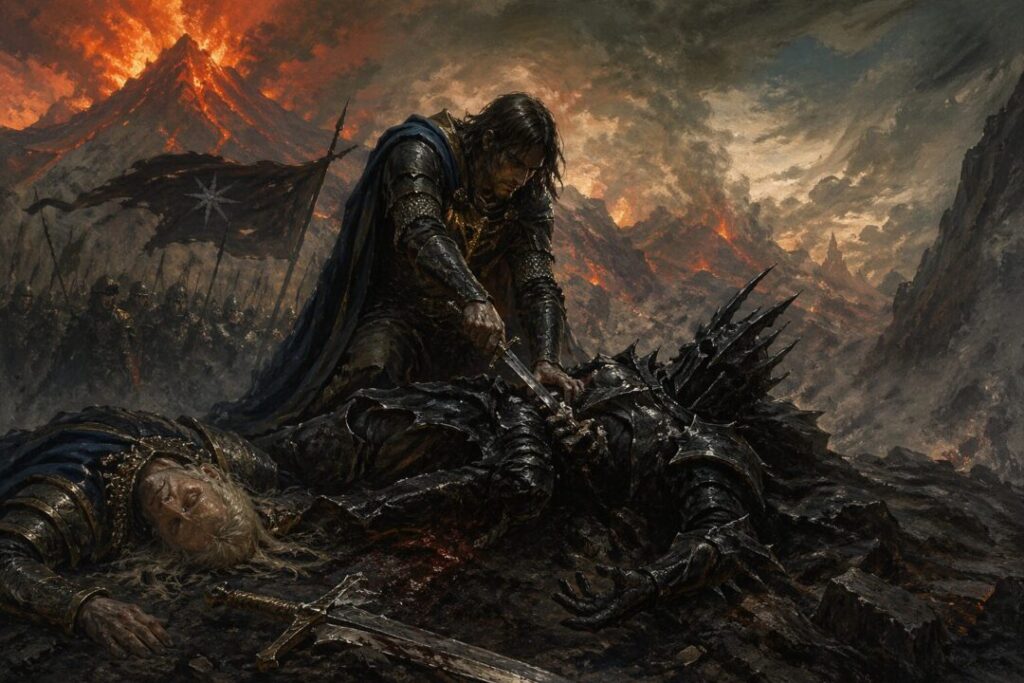
At the end of the Siege of Barad-dûr, Sauron himself came forth and fought Gil-galad and Elendil. In that combat, both of those leaders were slain—but Sauron was also overthrown. Only after that did Isildur take the hilt-shard of Narsil and cut the One Ring from Sauron’s hand.
That means the Ring-cutting is not the whole battle.
It is the final act that follows the overthrow.
This is why careful phrasing matters here. It is not quite right to say that Isildur alone defeated Sauron by striking off the Ring. The texts place the decisive combat in the struggle with Elendil and Gil-galad. Isildur’s act comes immediately after, and its importance lies in what he removes.
The difference is easy to miss, but it changes the meaning of the whole event.
The last alliance of Elves and Men broke Sauron in war.
Isildur then took from him the thing that made that defeat catastrophic rather than temporary.
The Ring Was Not Just Something Sauron Owned
To understand why losing the Ring mattered so much, we have to leave behind the idea that it was merely a powerful weapon or royal insignia.
The lore is much harsher than that.
The One Ring was made as the Ruling Ring, and much of Sauron’s own native power, strength, and will were bound up in it. That is why wearing it enhanced him, and why the Ring was so dangerous to anyone else who claimed it. It was not only under his control. In an important sense, it was an extension of himself.
This is the point many summaries flatten.
Sauron did not simply lose a tool.
He lost hold of something into which he had poured himself.
That is why the moment is not comparable to a king losing a crown or a warrior dropping a sword. The Ring had become bound to the structure of his power. So when Sauron was overthrown in bodily form and the Ring was cut from him instead of remaining with him, the loss was not symbolic. It was deeply metaphysical, though the texts describe it in restrained terms.
And that explains why the act had consequences far beyond the battlefield itself.
Why the Finger Itself Was Not the Source of Sauron’s Fall
There is a tempting but misleading way to picture the scene.
It makes the finger special.
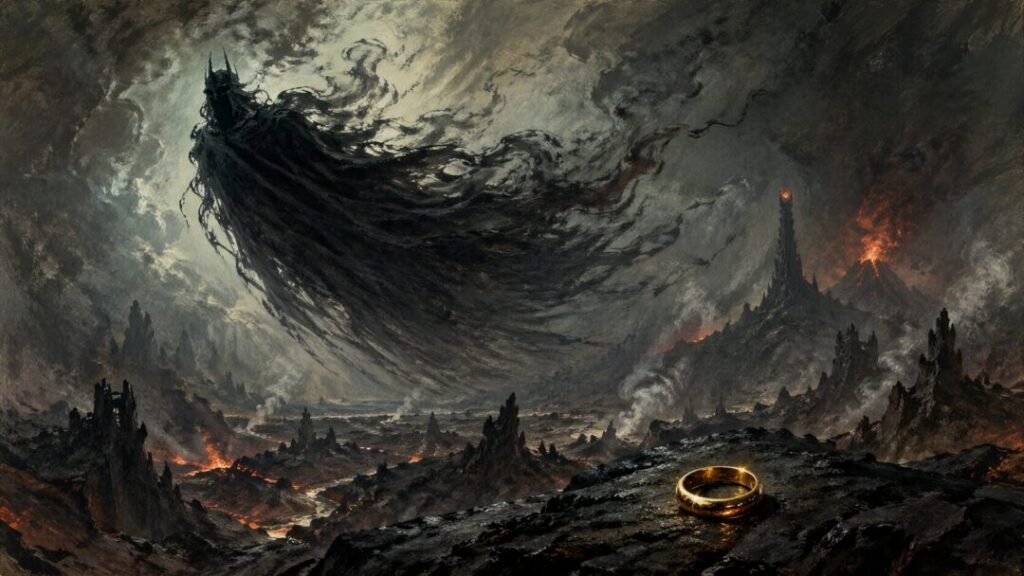
As though Sauron’s body had one literal point of failure, and once it was severed, the whole Dark Lord collapsed. But the texts do not suggest that the finger itself had any unique magical status. The Ring happened to be on Sauron’s hand, and Isildur cut it free from there. The importance lies in the Ring being removed from Sauron after his overthrow, not in the anatomy of the wound by itself.
That is why the common phrasing can distort the event.
“Cutting off Sauron’s finger defeated him” is memorable, but it pushes the eye to the wrong place.
The finger is the visible detail.
The Ring is the real center.
What Isildur severs is not simply flesh. He severs possession.
And because Sauron had allowed so much of himself to pass into that object, losing possession of it at the moment of bodily ruin left him unable to continue in power as before. He endured as a spirit, but no longer as the same active embodied tyrant who had come forth from Barad-dûr.
Why Sauron Was Defeated, But Not Destroyed
This is where the story becomes more unsettling.
If taking the Ring from Sauron broke him so decisively, why did that not end him forever?
Because the Ring still existed.
That is the crucial limit on Isildur’s victory.
Elrond later makes the point plainly: because the Ring was not destroyed, Sauron was not wholly destroyed either. The war ended his dominion in that age, but it did not erase the deeper bond between Sauron and the Ring. So long as the Ring endured, the possibility of Sauron’s return endured with it.
This matches the broader explanation preserved in Letter 131: if the Ring were actually unmade, Sauron would be largely diminished. Not merely disarmed. Not merely exiled. Diminished in his very being.
That had not yet happened.
So after the Last Alliance, Sauron was reduced, maimed in power, and deprived of bodily form for a long while, but not annihilated. Later traditions within the lore remember this clearly: he was defeated, his body destroyed, his spirit passed away, yet he was still able in time to gather himself again.
This is one of the central tragedies of Isildur’s choice.
He took the very thing that should have been unmade.
Why Isildur’s Choice Matters So Much
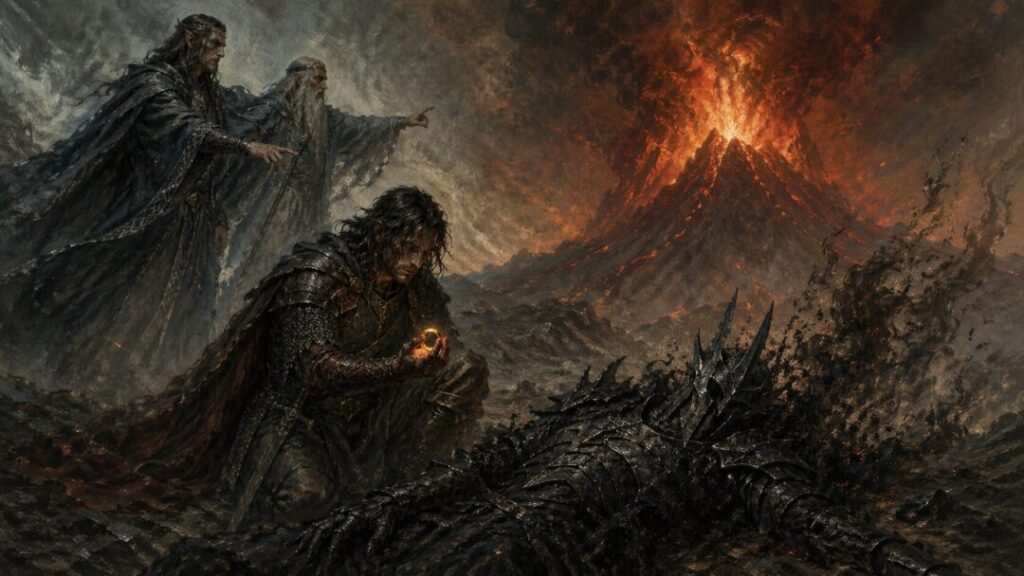
After the battle, Isildur did not cast the Ring into the fire.
He claimed it.
The tradition remembered in The Council of Elrond is that Elrond and Círdan urged him to destroy it in Orodruin, where it had been made, but he refused and kept it as weregild for his father and brother.
That detail is morally important.
Isildur is not portrayed in this moment as ignorant of the Ring’s evil in the fullest later sense, but he is already acting as someone who has begun to think of it as something due to him. And that is exactly the kind of claim the Ring was made to provoke.
The tragedy is almost immediate.
The Wise had the one chance to end Sauron’s threat at its root, and the Ring’s own hold helped prevent that ending.
So the moment on the slopes of Orodruin is double-edged.
It is a victory great enough to end the Second Age.
And it is a failure deep enough to doom the Third.
The Deeper Pattern: Sauron Had Bound His Fate to the Ring
The reason Isildur’s act mattered so much is not just that Sauron lost a powerful object.
It is that Sauron had arranged things so that his own fate was entangled with it.
This is why the Ring could preserve the possibility of his return while also making him vulnerable to catastrophic reduction if it were lost or destroyed. The more of himself he invested in it, the greater his domination while he wielded it—but also the more terrible the consequences if it was taken from him or unmade.
There is a revealing contrast elsewhere in the lore.
Sauron had already suffered bodily destruction before, most notably in the Downfall of Númenor, and yet he returned. What changed after the Last Alliance was not simply that he lost another body. It was that after being overthrown, he no longer had the Ring in hand. The texts treat the loss of the Ring as a great weakening of his power and the reason he could not maintain or quickly rebuild his physical presence as before.
That is why Isildur’s cut matters so much.
Not because a finger was enchanted.
But because the Ring was the place where Sauron had made himself vulnerable without ever meaning to admit it.
Why This Moment Still Feels So Powerful
The scene endures because it is so visually simple.
A broken sword.
A fallen Dark Lord.
A hand.
A Ring.
But the simplicity hides the real mechanism.
Sauron falls in battle.
The Ring that contains much of his own power is taken from him.
He is defeated for an age, but because the Ring survives, so does the root of his return.
That is why Isildur’s act was enough to bring Sauron down, and also why it was not enough to finish him.
The victory was real.
The ending was postponed.
And that is what makes the moment so haunting.
Middle-earth did not fail because Sauron survived a lost finger.
It failed because the one thing that could have turned defeat into final ruin was taken as a prize instead of cast into the fire.
Once you see that, the whole scene changes.
It is no longer a story about finding the Dark Lord’s weak spot.
It is a story about a power so bound to its maker that removing it could break him—yet not free the world from him until that power itself was destroyed.
Sources & Notes
- J.R.R. Tolkien, The Silmarillion, “Of the Rings of Power and the Third Age” — recounts Sauron coming forth at the end of the siege, Gil-galad and Elendil overthrowing him, and Isildur cutting the Ruling Ring from his hand.
- J.R.R. Tolkien, The Lord of the Rings, Book II, Chapter 2, “The Council of Elrond” — Elrond’s account of Isildur taking the Ring as weregild and refusing the chance to cast it into Orodruin.
- J.R.R. Tolkien, The Lord of the Rings, Book I, Chapter 2, “The Shadow of the Past” — Gandalf explains that Sauron let a great part of his former power pass into the Ring, so its survival preserved his threat.
- J.R.R. Tolkien, Letter 131 — Tolkien’s summary of the Ring as Sauron’s concentrated power, with its destruction meaning a permanent reduction of Sauron himself.
- J.R.R. Tolkien, The Silmarillion, “Akallabêth” — useful background for Sauron surviving bodily ruin before the Last Alliance, showing why losing the Ring was more decisive than losing a body alone.