Most people remember Rohan’s stand at Helm’s Deep as a moment of impossible courage.
A king rides out. A horn sounds in the deep. The dawn comes. Gandalf appears, and the strength of Saruman is broken.
But the deeper question comes before any of that.
Why does Gandalf think Rohan should stand and fight at all?
On the surface, it seems almost reckless. Rohan is weakened. Théoden has only just been freed from the influence of Gríma Wormtongue. Éomer has been cast into prison. Saruman has already struck hard at the Fords of Isen. The Westfold is in ruin, and the armies of Isengard are moving.
This does not look like the moment to risk everything.
And yet Gandalf pushes Théoden toward action.
Not because courage alone can win the war.
Not because he thinks Rohan can simply overpower Saruman.
But because if Rohan does not stand now, it may never stand again.
Gandalf Is Not Calling for Recklessness
There is an important distinction that often gets blurred.
In the book, Gandalf does not urge Théoden to charge blindly into open battle against Isengard. His counsel changes according to what is known.
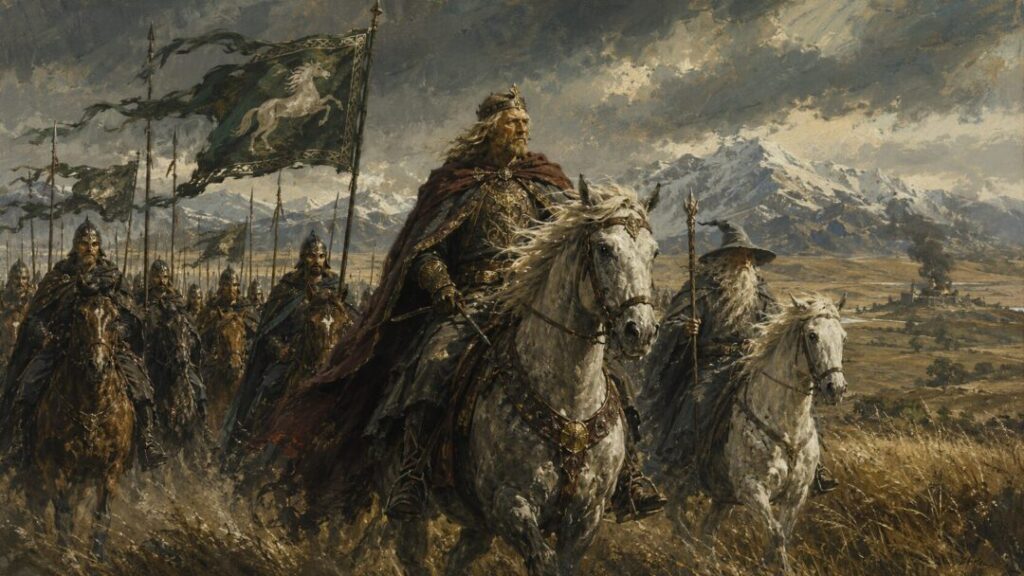
At first, after Théoden is restored in Meduseld, the king chooses to ride west. His purpose is to aid his people and confront the threat that has already fallen upon the Westfold. This is not a flight from responsibility. It is the return of a king who has been absent too long.
But on the road, news reaches them.
The defence at the Fords of Isen has failed. Erkenbrand’s forces have been scattered. Some have withdrawn toward Helm’s Deep.
At that point, Gandalf’s counsel becomes specific.
Go to Helm’s Deep.
This matters.
Gandalf is not choosing glory over survival. He is choosing the strongest available place where Rohan can still gather, endure, and resist.
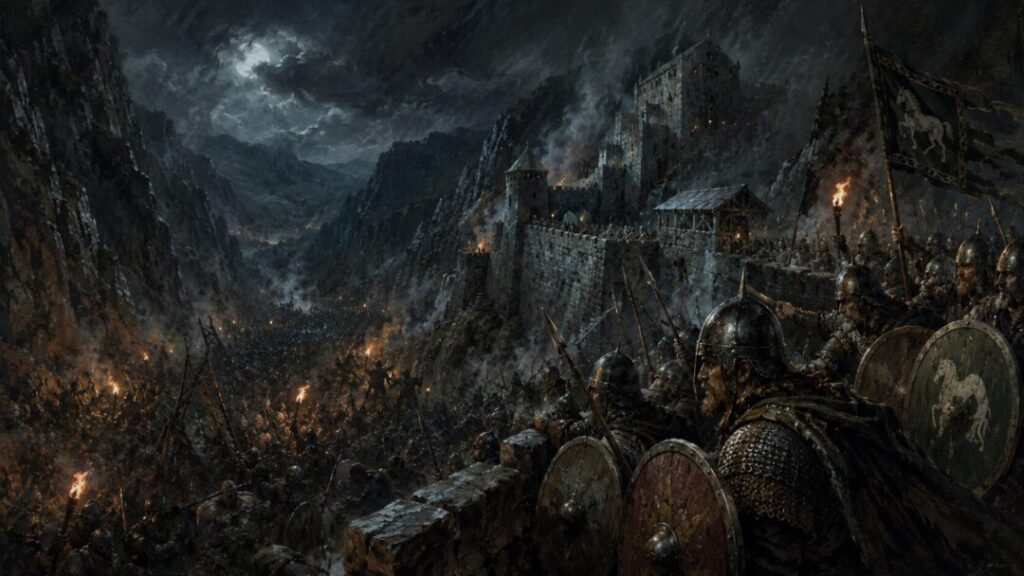
Helm’s Deep is not merely a cave to hide in. It is a fortress of the Westfold, guarded by the Hornburg, with walls, gates, and the Deeping-coomb behind it. It is exactly the kind of place where a smaller force might hold against a larger one.
So when Gandalf urges Rohan to stand, he is not rejecting strategy.
He is finding the only strategy left.
Rohan Has Already Been Attacked From Within
The military situation is only part of the answer.
Rohan’s deeper wound is spiritual and political.
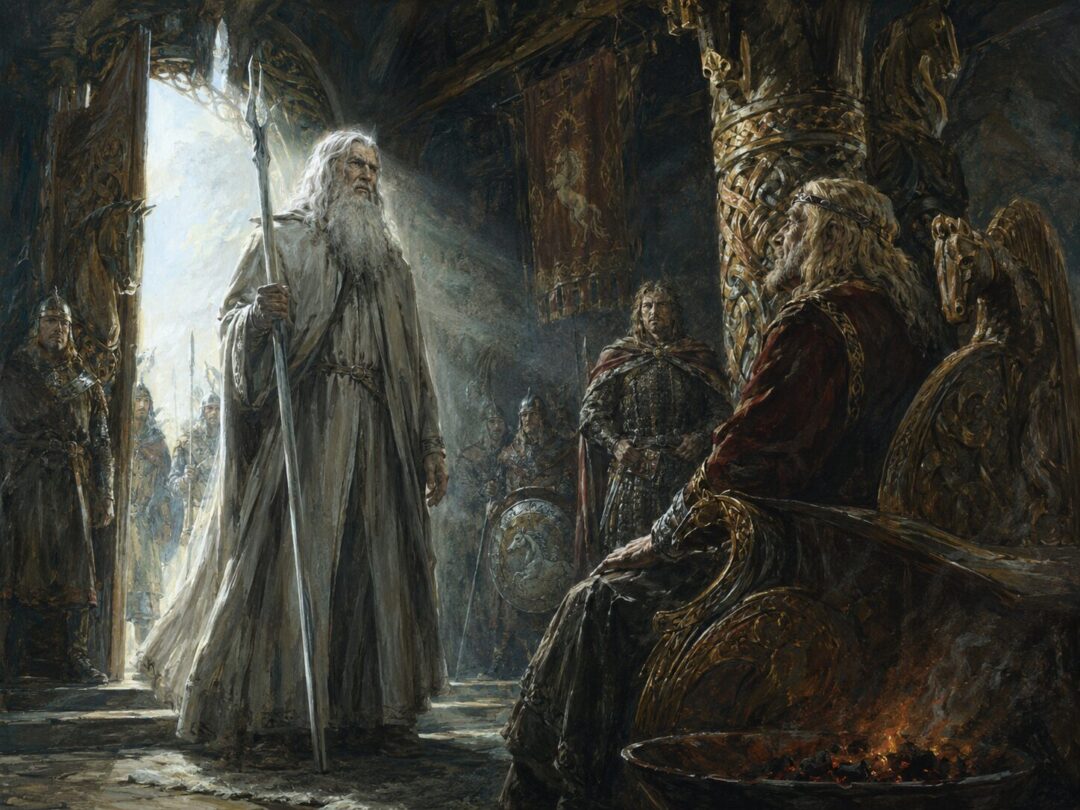
Before Gandalf arrives, Théoden is not ruling in the full strength of his will. Gríma Wormtongue has become the voice at his side, whispering caution, delay, suspicion, and despair. Éomer, one of Rohan’s strongest captains, has been imprisoned. The king’s hall has become a place of paralysis.
This is exactly what Saruman needs.
He does not have to destroy Rohan immediately if he can make Rohan unable to act. A kingdom can be conquered by swords, but it can also be softened first by fear, division, and hopeless counsel.
That is why Gandalf’s first victory in Rohan is not on a battlefield.
It is in Meduseld.
He confronts the lie that Théoden is too old, too weak, too late, too trapped by evil days. He restores the king not merely to physical action, but to responsibility.
From that moment, Théoden must choose.
He can remain in the hall, surrounded by the memory of his decline.
Or he can ride out as king.
Gandalf knows the second choice is dangerous.
But the first may already be defeat.
Théoden’s Presence Changes Everything
Rohan is a kingdom built around loyalty, oath, and the presence of its lord.
The Rohirrim are not an abstract nation with distant institutions holding everything together. They are a people of riders, households, marshals, and kings. Théoden’s public return matters because it gives shape to scattered courage.
If the king rides, others can gather around him.
If the king hides, the realm continues to fracture.
This is one reason Helm’s Deep matters so much. It is not only a defensible place. It becomes a visible center.
Men from the Westfold are already there. The Hornburg is a known refuge. The old and the young are among its defenders. The arrival of Théoden does not merely add soldiers. It adds legitimacy, command, and hope.
That may sound less dramatic than swords against Orcs.
But in Middle-earth, despair is never a small thing.
Again and again, the great servants of evil try to make resistance seem pointless before the final blow lands. Gandalf understands that war is fought in the will before it is fought at the wall.
So Théoden must be seen standing with his people.
Not because he can guarantee victory.
Because without that stand, Rohan’s defeat begins inside its own heart.
Helm’s Deep Is a Delay — and Delay Matters
Gandalf’s plan also depends on time.
Saruman’s army is powerful, but it is moving into a situation where geography matters. Helm’s Deep narrows the battle. The Deeping Wall and Hornburg force the attackers into a difficult assault. The defenders cannot match Isengard’s numbers in open country, but behind fortifications they can make the enemy pay for every step.
That does not mean Gandalf knows every detail of what will happen.
The texts do not present him as omniscient. He acts with wisdom, urgency, and insight, but he still moves within uncertainty.
What can be said safely is this: Gandalf sees that Rohan must hold long enough for other forces to matter.
Erkenbrand is not gone from the story. Scattered men from the Westfold may still be found. And beyond the ordinary movements of armies, Fangorn itself has begun to stir.
The Ents have marched on Isengard. The Huorns will come to Helm’s Deep. Saruman has awakened powers he does not understand.
But Théoden does not know the full shape of this when he rides.
That is essential.
His stand is not based on a complete guarantee. It is based on faithfulness in the face of incomplete knowledge.
Gandalf gives him a road.
Théoden still has to ride it.
Saruman Misunderstands Rohan
Saruman’s great mistake is that he treats Rohan as something that can be managed, weakened, and then crushed.
For a long time, that nearly works.
Through Gríma, he dulls the king’s judgment. Through war, he strikes the Westfold. Through force, he tries to overwhelm the Hornburg. His strategy depends on pressure from every side.
But Saruman misunderstands what happens when a people who seemed broken suddenly recover their center.
The return of Théoden changes the meaning of the battlefield.
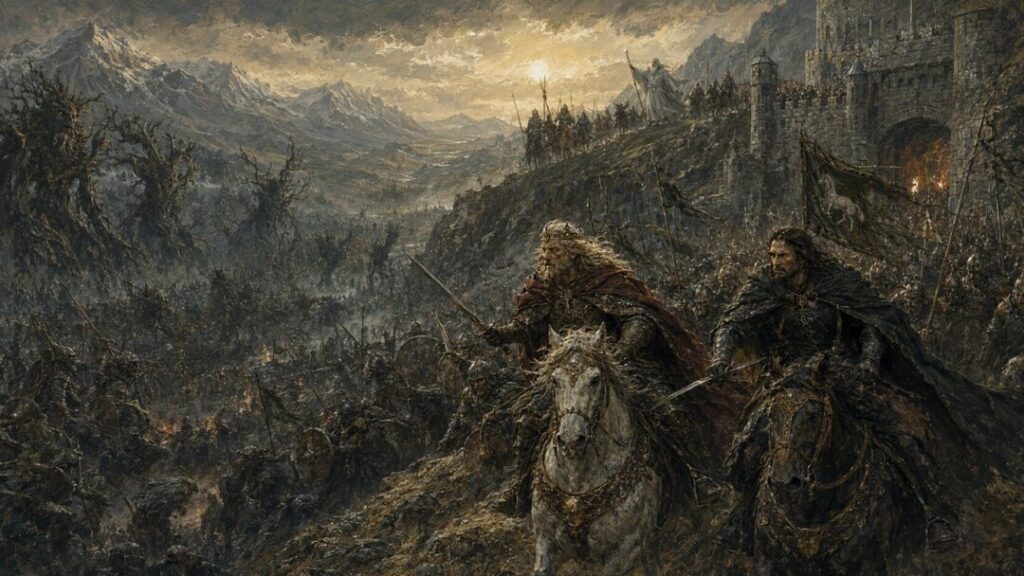
The defenders of Helm’s Deep are not merely trying to survive the night. They are witnessing the rebirth of their king’s courage. When Théoden resolves not to be trapped and to ride out at dawn, the act is not tactically sensible in a narrow way. It is almost certainly desperate.
But it is not meaningless.
It refuses the final shape Saruman wants to impose on the story.
Théoden will not end as a hidden, diminished old man waiting for the doors to break.
He will ride out as king.
And that is exactly the kind of thing Gandalf has been trying to awaken since Edoras.
Gandalf’s Hope Is Not Naive
It is easy to mistake Gandalf’s hope for optimism.
But Gandalf is not cheerful because the odds look good. He knows more than most how grave the war has become. He knows Sauron is rising. He knows Saruman has betrayed his order. He knows Rohan and Gondor stand under shadows larger than any single battle.
His hope is different.
It is the belief that evil is not as complete as it thinks it is.
Saruman counts armies, weapons, walls, and treachery. Gandalf counts those things too, but he also sees the hidden forces Saruman neglects: loyalty, mercy, timing, endurance, and the strange help that comes when free peoples choose to resist rather than submit.
This is not vague inspiration.
It is one of the central patterns of the War of the Ring.
Victory often comes through choices that look too small to matter at first. A hobbit spares Gollum. An heir refuses the Ring. A king rises from his chair. A fortress holds until dawn.
Gandalf understands that such moments are not separate from the war.
They are the war.
What Gandalf Is Really Asking of Théoden
Gandalf is not asking Théoden to win by strength.
He is asking him to stop surrendering before the battle is fought.
That is the crucial difference.
Under Gríma’s influence, Théoden has been taught to think like a man already defeated. His body is old. His son is dead. His realm is threatened. His enemies are too strong. His choices are too late.
Gandalf breaks that spell.
But freedom from despair is not complete until Théoden acts.
That is why the ride to Helm’s Deep matters so much. It is the first great outward sign that Théoden has returned to himself. He does not become young again. He does not become invincible. He does not suddenly possess perfect knowledge.
He simply chooses to do what a king must do.
He goes where his people are in danger.
He stands where the blow is falling.
Without Rohan, Gondor Stands Alone
There is also a wider reason Gandalf cannot allow Rohan to collapse.
The war against Sauron is approaching its decisive stage. Gondor will soon face the strength of Mordor. If Rohan is destroyed or broken by Saruman before that moment, Gondor loses its greatest ally in the North.
The later Ride of the Rohirrim depends on Rohan surviving Helm’s Deep.
This does not mean every event is mechanically planned in advance. But narratively and strategically, the connection is clear. If Théoden does not recover, if Rohan does not endure, if Saruman succeeds in pinning or destroying the Riders, then Minas Tirith faces the storm with far less hope.
So Gandalf’s counsel at Rohan is not only about Rohan.
It is about the whole war.
The stand at Helm’s Deep preserves the people who will later ride to the Pelennor Fields. It keeps alive a realm that Sauron and Saruman both need weakened. It proves that the Free Peoples can still answer one another.
Rohan’s stand becomes Gondor’s hope before Gondor even sees it.
The Strange Mercy of the Stand
The Battle of the Hornburg is terrifying because it is not presented as an easy triumph.
The wall is breached. The defenders are pressed back. Háma is killed. Théoden doubts whether any tower can withstand such hatred. The night grows darker before it breaks.
And yet the stand is still mercy.
Not soft mercy.
Hard mercy.
The kind that gives a people one last place to gather, one last king to follow, one last dawn to reach.
If Rohan had scattered completely, many might have died alone, hunted across the plains and valleys. At Helm’s Deep, they at least become a people again. They endure together. They resist together. And when help comes, it finds them still standing.
That is why Gandalf’s counsel matters.
He does not promise Théoden safety.
He gives him a chance to be faithful.
Why Gandalf Believes Rohan Must Fight
So why does Gandalf think Rohan should stand and fight?
Because flight has already been tried in another form.
It wore the face of delay.
It spoke with Gríma’s voice.
It called itself caution.
It left the king diminished and the realm exposed.
Gandalf does not reject prudence. Helm’s Deep itself proves that. He chooses a fortress, not an empty field. He seeks scattered allies, not a glorious death. He returns with aid, not merely with speeches.
But he knows that survival without courage can become another kind of surrender.
Rohan must fight because Théoden must become king again.
Rohan must fight because Saruman must not be allowed to break its will before Sauron’s war reaches Gondor.
Rohan must fight because hope, in Middle-earth, is not the certainty that things will end well.
It is the refusal to let evil decide the ending before dawn.
And at Helm’s Deep, that is exactly what Gandalf gives Théoden.
Not a guarantee.
A dawn worth riding toward.
Sources & Notes
- J.R.R. Tolkien, The Lord of the Rings, Book III, Chapter 6, “The King of the Golden Hall” — Gandalf frees Théoden from Wormtongue’s counsel and urges the king to act rather than remain in despair.
- J.R.R. Tolkien, The Lord of the Rings, Book III, Chapter 7, “Helm’s Deep” — the retreat to the Hornburg, the defensive strength of Helm’s Deep, Théoden’s stand, and Gandalf’s return at dawn.
- J.R.R. Tolkien, The Lord of the Rings, Book III, Chapter 8, “The Road to Isengard” — the aftermath of Helm’s Deep, the Huorns, Erkenbrand’s men, and Saruman’s defeat in Rohan.
- J.R.R. Tolkien, Unfinished Tales, “The Battles of the Fords of Isen” — gives the wider military background: Saruman’s attacks on the Westfold, Théodred’s fall, and the scattered Rohirrim before Helm’s Deep.
- J.R.R. Tolkien, The Lord of the Rings, Book V, Chapter 5, “The Ride of the Rohirrim” — shows why Rohan’s survival matters for the larger war, as Théoden later brings the Riders to Gondor’s aid.