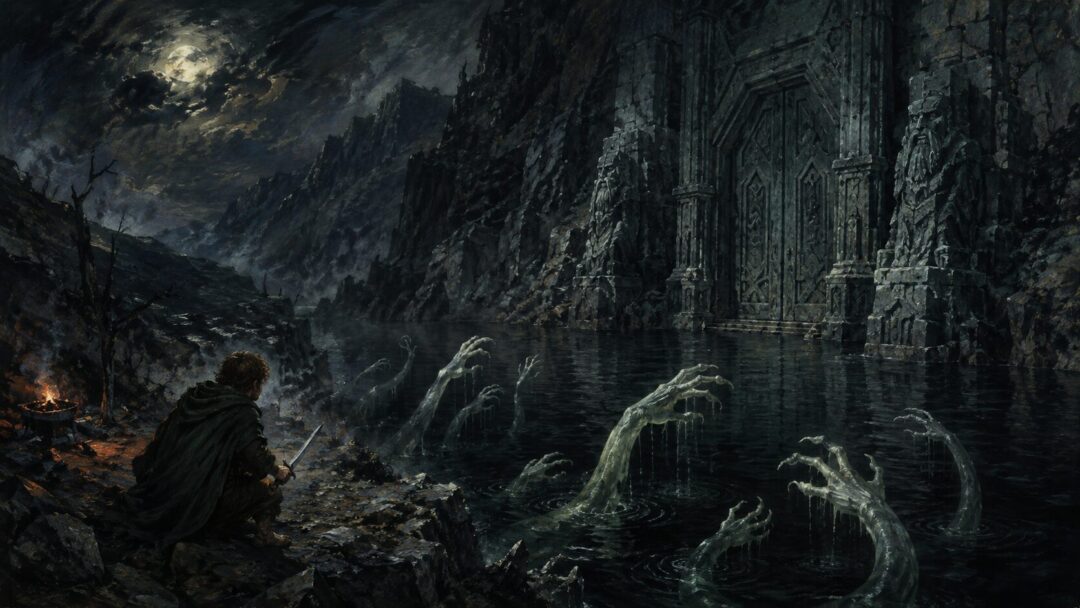
The scene outside the West-gate of Moria is easy to remember as a monster attack.
The Fellowship arrives at a dark, stagnant pool. The old road is gone. The stream of Sirannon has been dammed or blocked, and the water now lies against the Doors of Durin. Then, as the Company struggles to enter Moria, something rises from the lake.
A pale, luminous tentacle seizes Frodo.
Sam cuts it away.
Then many more arms come reaching out of the water.
The Company escapes through the doors, but the Watcher tears down trees and rocks behind them, sealing the entrance from the outside. The Fellowship survives only by going forward into the dark.
But the scene contains one detail that is easy to pass over.
The Watcher takes Frodo first.
Not Aragorn.
Not Gandalf.
Not Boromir.
Not Gimli, who has a personal connection to Moria.
Frodo.
The Ring-bearer.
The text never explains exactly why. Gandalf later admits he does not know what the creature was. But he does notice that it seized Frodo first, and that observation turns the entire scene into something more disturbing than a random encounter.
Because if the Watcher had succeeded, the War of the Ring may have ended before the Fellowship ever reached Moria.
Not with Sauron triumphant at once.
Not with the Watcher crowned as some new lord of darkness.
But with the Ring lost in black water, beneath the mountains, in the grasp of something no one understood.
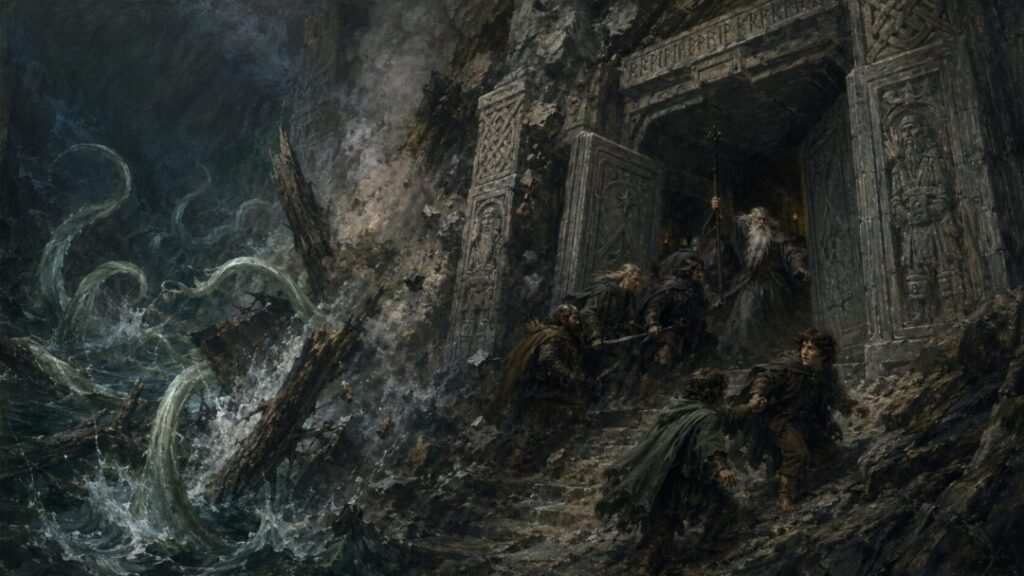
The Watcher Is Not Explained
The first thing to say clearly is this:
The Watcher in the Water is never fully identified.
The texts do not tell us its race, origin, allegiance, age, or purpose. It is not named as a servant of Sauron. It is not called a creature of Morgoth. It is not described as a dragon, demon, Maia, or corrupted beast.
All we are given is what the Company sees.
Tentacles.
Dark water.
A foul presence.
A sudden, intelligent attack.
A creature strong enough to shut the West-gate behind them.
Gandalf’s words are deliberately cautious. He says that something had “crept, or been driven” out of dark waters under the mountains. That phrasing matters. Even Gandalf does not claim certainty.
It may have come upward by its own movement.
Or something may have driven it.
The distinction is never settled.
That makes the Watcher one of the strangest beings in The Lord of the Rings. It is not important because we understand it. It is important because we do not.
And this uncertainty becomes crucial when we ask what would have happened if it had taken the Ring.
Did the Watcher Sense the Ring?
The Watcher’s first target is Frodo.
That is the strongest reason readers suspect the Ring drew its attention. Frodo is not the obvious physical target. He is small, quiet, and not leading the Company. Yet the first arm reaches for him.
Gandalf notices this afterward.
Still, the text never directly says, “The Watcher sensed the Ring.” That would be too strong. The safer reading is that the scene implies something strange about the attack, but does not explain it.
There are several possibilities.
The Watcher may have sensed the Ring.
It may have sensed Frodo as the one carrying some burden.
It may simply have reached for the nearest vulnerable figure.
Or it may have been guided by some instinct or malice that the story does not define.
Only the first of these is the dramatic answer. But it is not the only possible answer.
That restraint matters.
Middle-earth has many creatures that are evil, dangerous, ancient, or hostile without being direct servants of Sauron. The Watcher may belong to that category. It may have had no loyalty to Mordor at all.
But even if it did not understand the Ring, taking Frodo would still have changed everything.
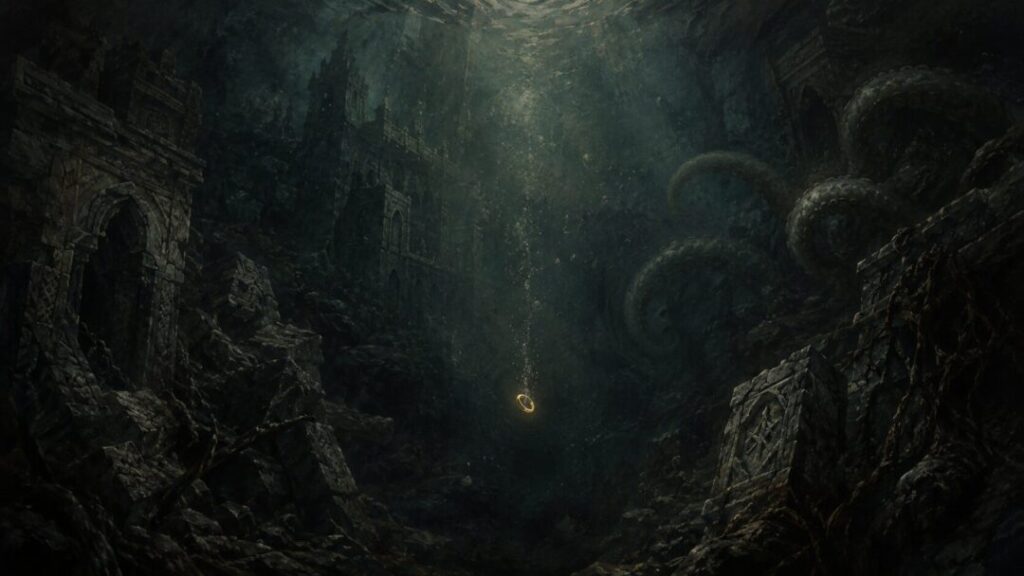
The Ring Would Not Be Destroyed
If the Watcher had dragged Frodo into the lake, the Ring would have remained intact.
This is the first certain consequence.
The Council of Elrond is clear that the Ring cannot simply be hidden, abandoned, or thrown away as a final solution. It must be destroyed in the fire where it was made: Orodruin, the Cracks of Doom.
Deep water would not unmake it.
The Ring had already survived long ages lost from Sauron’s hand. It had passed from Isildur into the Anduin, remained hidden, and eventually came to Déagol and Sméagol. Its disappearance did not end Sauron’s threat.
So if the Watcher had taken it, the Quest would not have been completed.
At best, the Ring would have been lost again.
At worst, it would have begun another long and terrible path back into the world.
And this is where Gandalf’s warning at the Council becomes important. When the idea of casting the Ring into the Sea is raised, Gandalf rejects it. Not because it would be useless for a few years, or even for a few lives of Men, but because it would not be safe forever.
There are things in deep waters.
Lands and seas change.
A hidden Ring is not the same as a destroyed Ring.
The Watcher’s pool beside Moria is not the Sea, but the principle is similar. Water is not an ending. It is only a delay.
Could the Watcher Use the Ring?
This is the question that changes the whole shape of the scenario.
Could the Watcher actually wield the One Ring?
The most conservative answer is: we do not know, and the texts give us no reason to say yes with confidence.
The Ring is not merely a magical object that makes anything powerful in a simple way. Its effects depend on the bearer. It tempts through desire, ambition, fear, and the will to possess or command.
With Isildur, it becomes a treasure and a claim.
With Gollum, it becomes obsession.
With Boromir, it awakens dreams of using power against the Enemy.
With Frodo, it becomes an increasing burden that presses on the will.
But the Watcher is never shown speaking, reasoning, desiring rule, or seeking mastery. It may be intelligent in some dark way; Gandalf says the arms seemed guided by one purpose. But purpose is not the same as political ambition, spiritual domination, or conscious use of the Ring.
The creature also may not have been able to wear it in any meaningful sense, despite the finger-like ends of its tentacles. The Ring can change size, but the story never suggests that every being can use it simply by touching it.
So the image of the Watcher becoming a new Dark Lord beneath the lake is dramatic—but it is speculative.
Possible as fan imagination?
Yes.
Supported directly by the text?
No.
The more lore-accurate horror is subtler: the Watcher may not use the Ring at all. It may merely keep it, hide it, bury it, or carry it into depths where no one else can retrieve it.
And that would still be disastrous.
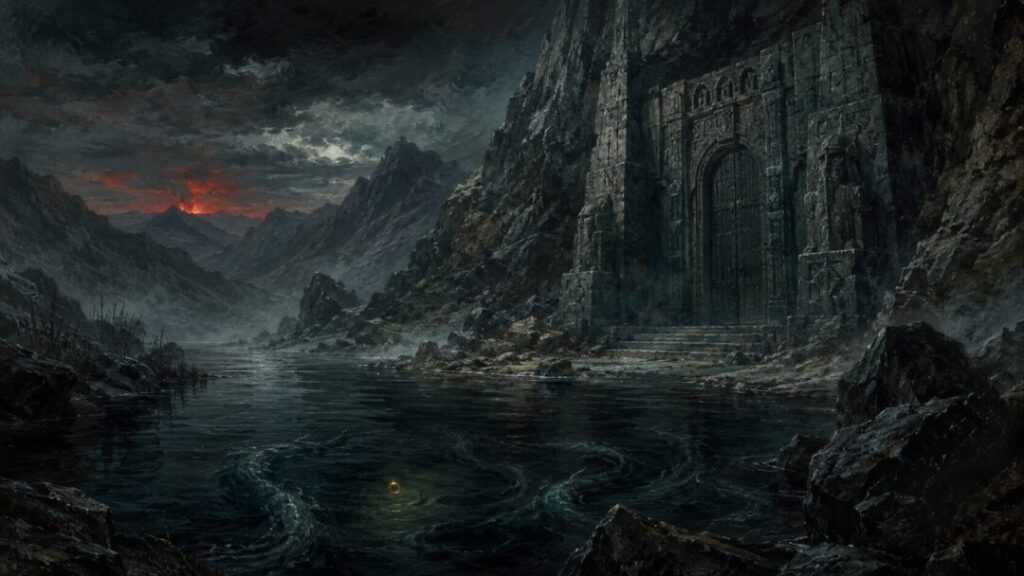
Sauron Would Not Need the Ring Immediately
One of the most important truths about the War of the Ring is that Sauron does not need to recover the Ring in order to remain dangerous.
He wants it.
He fears another might use it.
Its destruction would ruin him.
But while it exists, his power remains anchored. He has already rebuilt himself in the Third Age without possessing it. His armies are moving. Mordor is strong. Gondor is under pressure. The Free Peoples are divided and fading.
If Frodo died at the West-gate and the Ring vanished into the lake, Sauron might not instantly win.
But the only known path to his final defeat would be gone.
That is the true disaster.
The Fellowship could not simply continue the Quest. The Ring-bearer would be dead. The Ring would be beneath the water, in the domain of the Watcher, beside a sealed gate, under the shadow of Moria.
Could Gandalf retrieve it?
Perhaps he would try. But the story gives no reason to think such an attempt would be simple or safe. Gandalf himself does not know what the creature is. The Watcher is in its own element. The Company is trapped between the lake and the Mines. And even if they killed the creature, finding the Ring in dark water could be nearly impossible.
The delay alone might be fatal.
The Nine would return.
Sauron would learn more.
The roads would close.
The war would continue.
And the Ring would still exist.
The Watcher Might Become a Prison, Not a Bearer
This may be the most frightening possibility.
The Watcher does not have to become a Ring-lord to destroy hope. It only has to become the Ring’s prison.
Imagine the Ring sinking into the mud beneath the West-gate. Imagine it caught among roots, stones, bones, and drowned remnants of the old road. Imagine the Watcher resting over it, not as a servant of Sauron, but as a living barrier no one can pass.
In that case, the Ring would be close enough to matter and unreachable enough to doom the Quest.
This fits the logic of the story better than a monster suddenly becoming a ruler. The Watcher is not presented as a character with plans. It is presented as a threshold horror. It blocks the way. It closes the door. It forces the Fellowship into darkness.
If it took the Ring, it would become the ultimate closed door.
Not a new Sauron.
A sealed fate.
Would Sauron Eventually Find It?
This is where we must be careful.
The texts do not tell us what Sauron would know if the Ring were taken by the Watcher. They do not say whether he could sense its exact location. In fact, much of the plot depends on Sauron not knowing precisely where the Ring is until information reaches him through other means.
So we should not imagine Sauron instantly turning his eye to the lake and sending an army to collect it.
But over time, the danger would grow.
Moria was not empty. Orcs were there. The Balrog was there until its fall. The region was not beyond the reach of evil things. If the Fellowship vanished, Sauron’s servants might eventually learn where the trail ended.
And even if they did not, the Ring has a long history of returning from impossible hiding places.
This should not be overstated as if the Ring has unlimited independent movement. But the story strongly presents it as a thing that betrays, slips away, and works toward return. It left Isildur. It abandoned Gollum when the time came. It came into Bilbo’s hand by a chance that is treated as more than mere chance.
A Ring lost in the Watcher’s pool might remain hidden for years.
Or centuries.
But “hidden” is not “ended.”
That is exactly why the Wise reject half-measures.
What Happens to the Fellowship?
If Frodo is taken, the Fellowship likely breaks at once.
Sam would almost certainly try to save him. Aragorn and Boromir would act. Gandalf would be forced to choose between a rescue attempt and the survival of the Company. But the scene as written shows how quickly the Watcher’s attack escalates. Once the arms emerge, the Company barely escapes.
Without Frodo, there is no simple next step.
They cannot enter Mordor without the Ring.
They cannot destroy what they no longer possess.
They cannot safely leave the Ring where it is.
They cannot trust that Sauron will never find it.
The entire mission collapses into an impossible rescue.
And this is why the Watcher’s attack is more important than it first appears. The Quest nearly fails before Moria, before Lothlórien, before Amon Hen, before Gollum returns to the story, before Shelob, before Mordor.
The world is saved from disaster by a sword-stroke from Sam and the speed of the Company’s escape.
Why This Scenario Is So Dark
The darkest version of this “what if” is not the loudest one.
It is not the Watcher wearing the Ring like a crown.
It is not tentacles rising from the lake to rule Middle-earth.
It is not a new Dark Lord beneath the mountains.
Those ideas can be fascinating, but they go beyond what the texts support.
The more faithful answer is quieter and more hopeless.
If the Watcher had taken the Ring, the Ring would probably have been lost in deep water near Moria. The Watcher may not have understood it. It may not have used it. It may not have served Sauron at all.
But the Quest would have failed.
The Ring would still endure.
Sauron would remain undefeated.
And the Free Peoples would lose the one path that could bring a final end to him.
That is the horror of the Watcher in the Water.
It does not need a name.
It does not need a motive.
It does not need to be explained.
For one moment outside the Doors of Durin, an unnamed thing from the dark nearly removed the Ring from the story.
And if it had done so, Middle-earth might not have fallen in fire.
It might have fallen because hope sank beneath black water, and no one could reach it again.
Sources & Notes
- J.R.R. Tolkien, The Lord of the Rings, Book II, Chapter 4, “A Journey in the Dark” — the Watcher seizes Frodo first, Gandalf admits he does not know what it was, and he notes it may have crept or been driven from dark waters under the mountains.
- J.R.R. Tolkien, The Lord of the Rings, Book II, Chapter 2, “The Council of Elrond” — the Wise reject hiding or casting away the Ring as a final answer; it must be destroyed in Orodruin, not merely lost in water or wilderness.
- J.R.R. Tolkien, The Lord of the Rings, Book I, Chapter 2, “The Shadow of the Past” — the Ring’s history with Isildur, Déagol, Sméagol, and Bilbo supports the article’s point that “lost” is not the same as “ended.”
- J.R.R. Tolkien, The Lord of the Rings, Book II, Chapter 7, “The Mirror of Galadriel” — Galadriel’s refusal shows that the Ring tempts through will, desire, and imagined mastery, which makes any claim about the Watcher wielding it necessarily speculative.
- J.R.R. Tolkien, Letter 131 — Tolkien describes the One Ring as Sauron’s instrument of domination and the condition of his final defeat, clarifying why the Quest would fail if the Ring remained intact but unreachable.