At first glance, Aragorn’s life seems almost impossible to explain.
He is the heir of Isildur.
He is descended from the kings of old.
He carries the bloodline that links him to both Arnor in the North and Gondor in the South.
And yet when we first meet him, he is not sitting in a white tower.
He is not leading armies from Minas Tirith.
He is not demanding recognition from the Steward.
He is not even using his true name.
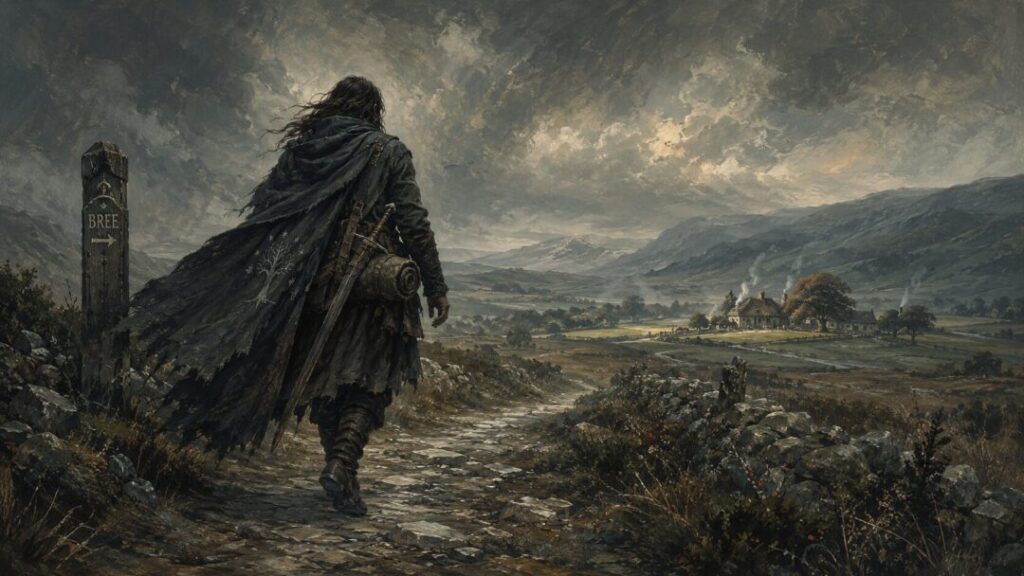
He is sitting in the corner of an inn in Bree, weather-stained, mistrusted, and called Strider by people who know almost nothing about him.
That contrast raises one of the quietest but most important questions in his story:
Why did Aragorn become a Ranger instead of going to Gondor?
The answer is not that he lacked courage.
And it is not that he did not know who he was.
The deeper answer is that Aragorn’s road to the throne was never meant to begin with a claim.
It had to begin with service.
Aragorn Was Not Ignorant of His Identity
The first point matters because it removes a common misunderstanding.
Aragorn did not spend his whole youth unaware of his heritage.
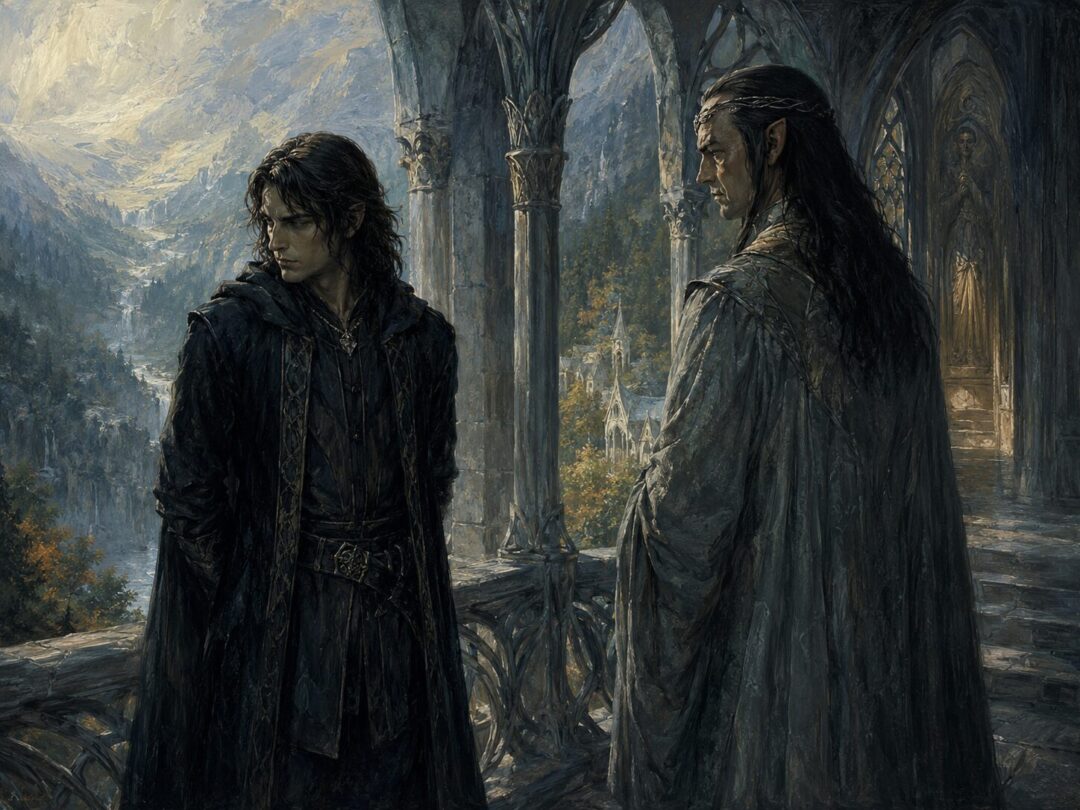
As a child, he was hidden in Rivendell under the name Estel, meaning “hope.” This secrecy was not random. His father, Arathorn, had been killed when Aragorn was very young, and the line of Isildur was vulnerable. His true name and ancestry were concealed for his protection.
But that concealment did not last forever.
When Aragorn reached manhood, Elrond revealed his lineage to him. He was told who he was. He received the heirlooms of his house, including the shards of Narsil and the Ring of Barahir.
So the question becomes sharper.
Once Aragorn knew he was Isildur’s heir, why did he not go south immediately?
Why not ride to Minas Tirith, display the tokens of his house, and demand the crown?
Because in Middle-earth, a rightful claim is not the same thing as an easy claim.
And Gondor’s history made that painfully clear.
Gondor Had Already Rejected the Northern Line Once
Aragorn’s claim was not appearing in a political vacuum.
Long before him, Arvedui, the last king of Arthedain, had claimed the crown of Gondor after the death of King Ondoher and his sons. Arvedui had arguments in his favor. He was descended from Isildur, and he had married Fíriel, the daughter of Ondoher.
But Gondor rejected the claim.
The crown went instead to Eärnil, a victorious captain of Gondor’s royal house. The decision was shaped by Gondor’s own lords and its Steward, Pelendur.
This matters because it shows that Gondor had not always accepted the northern heir as its king simply because the bloodline existed.
The South had its own memory.
Its own politics.
Its own pride.
Its own understanding of kingship.
By Aragorn’s lifetime, the situation was even more complicated. Gondor had not had a king for many generations. It was ruled by Stewards, and that rule was not treated as a temporary inconvenience by the people who lived under it. It had become the structure of their world.
Aragorn could not simply appear and expect Gondor to bend.
If he had tried, the result might not have been restoration.
It might have been division.
The Rangers Were Not a Lesser Calling
To understand Aragorn’s choice, we also have to understand what the Rangers were.
They were not merely wanderers.
The Rangers of the North were the surviving remnant of the Dúnedain of Arnor. Their kingdom had fallen long before, but their duty had not disappeared. They guarded the lands of Eriador, including places whose people barely understood who protected them.
Bree feared and mocked them.
The Shire was largely unaware of how much danger was kept from its borders.
The old kingdom was gone, but the watch remained.
This is where Aragorn’s kingship begins.
Not in a palace.
In the wild.
The title “Ranger” can make Aragorn seem diminished, as if he has fallen from royal destiny into obscurity. But in the North, that obscurity is part of the duty. The heirs of Isildur no longer rule from Annúminas or Fornost. They lead a scattered people and keep watch over roads, borders, ruins, and quiet settlements.
Aragorn becoming a Ranger is not an abandonment of kingship.
It is kingship stripped of ceremony.
No throne.
No crown.
No songs.
Only protection.
That is why the disguise matters. Before Aragorn can rule people who know his name, he serves people who never thank him.
He Did Go to Gondor — But Not as a Claimant
The most revealing part of the answer is that Aragorn actually did go to Gondor.
He just did not go as Aragorn.
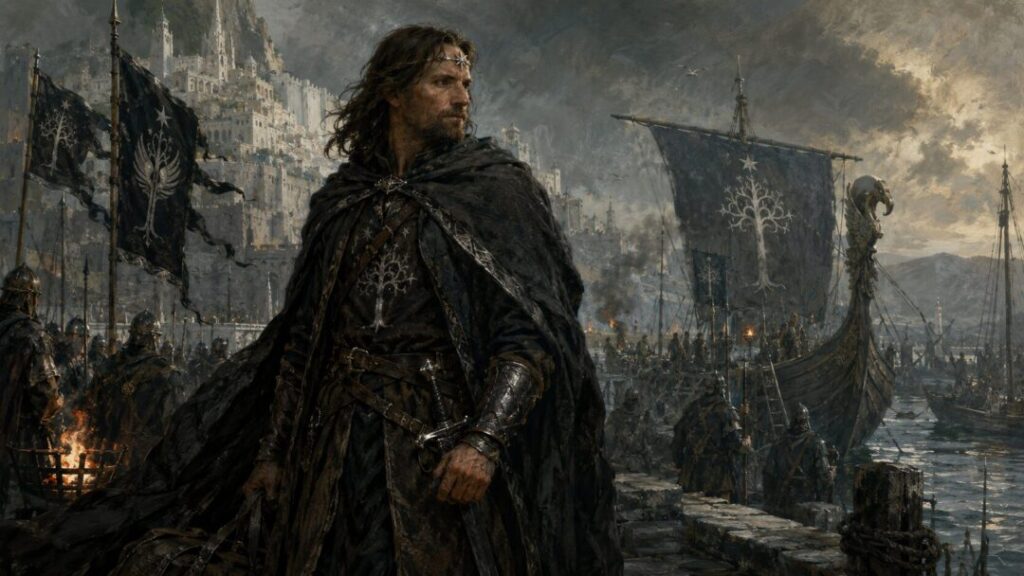
Under the name Thorongil, he served in Rohan under King Thengel and later in Gondor under Steward Ecthelion II. In Gondor, he became a figure of honor and military usefulness. He warned of the danger posed by Umbar, and with Ecthelion’s permission he led a successful attack against the Corsairs’ fleet.
This is one of the most important episodes in Aragorn’s life.
Because it shows that he was not avoiding Gondor.
He was learning it.
He served its Steward.
He fought its enemies.
He earned its respect.
But he did not reveal his royal identity.
That restraint is crucial.
Thorongil could have returned from victory and used his popularity to press a claim. The texts say great honor awaited him in Minas Tirith after the raid on Umbar. Instead, he left. He sent a message that other tasks called him, and he did not know whether fate would bring him back to Gondor.
This is not the behavior of a man hungry for power.
It is the behavior of someone who understands timing, legitimacy, and the danger of seizing what must be freely recognized.
Denethor’s Shadow Was Already There
There is another reason Aragorn’s open arrival in Gondor would have been dangerous.
Denethor was alive.
During the years when Aragorn served as Thorongil, Denethor was the son of Steward Ecthelion. The texts imply that Denethor perceived Thorongil as a rival, especially because Ecthelion favored him.
This does not mean Denethor knew exactly who Thorongil was. The texts do not clearly state that. But they do show tension between them.
That tension matters.
If Aragorn had revealed himself in Gondor during that period, he would not have been walking into a peaceful court ready to crown him. He would have entered a city with powerful internal loyalties, a Steward’s house, a proud heir in Denethor, and a long tradition of rule without a king.
Even if Aragorn’s claim was true, its announcement could have caused conflict inside the very realm he hoped to save.
And Aragorn’s pattern throughout the story is the opposite of that.
He does not grasp.
He waits until his return can heal rather than fracture.
The Sword Was Not Enough
It is tempting to imagine that Aragorn only needed the shards of Narsil to prove himself.
But symbols in Middle-earth are powerful only when they are joined to reality.
Narsil matters because it is the sword of Elendil, broken in the struggle against Sauron. When it is reforged as Andúril, it becomes a visible sign that the old war has reached its final hour.
But Aragorn does not have it reforged when he is twenty.
He does not ride south with it as a young man.
He does not use it to force Gondor’s hand.
He waits until the War of the Ring has begun.
That timing is not accidental.
The sword returns when the need is no longer personal ambition, but the survival of the West.
Aragorn’s claim becomes inseparable from his service in the war against Sauron. He does not come to Gondor merely saying, “I am the heir.” He comes having guarded the North, aided the Fellowship, passed through the Paths of the Dead, brought aid to the Battle of the Pelennor Fields, and healed the wounded in Minas Tirith.
By then, his kingship is not just inherited.
It is revealed.
Aragorn’s Humility Is Political Wisdom
Aragorn’s humility is often treated as a personal virtue, and it is.
But it is also political wisdom.
He knows that a king who must force recognition is already in danger. The restored kingdom cannot begin as a power struggle between North and South, Ranger and Steward, old claim and living custom.
So Aragorn allows his identity to unfold slowly.
In Bree, he is Strider.
In Rohan and Gondor, he is Thorongil.
Among the Dúnedain, he is their Chieftain.
In the Fellowship, he is a guide and companion before he is a king.
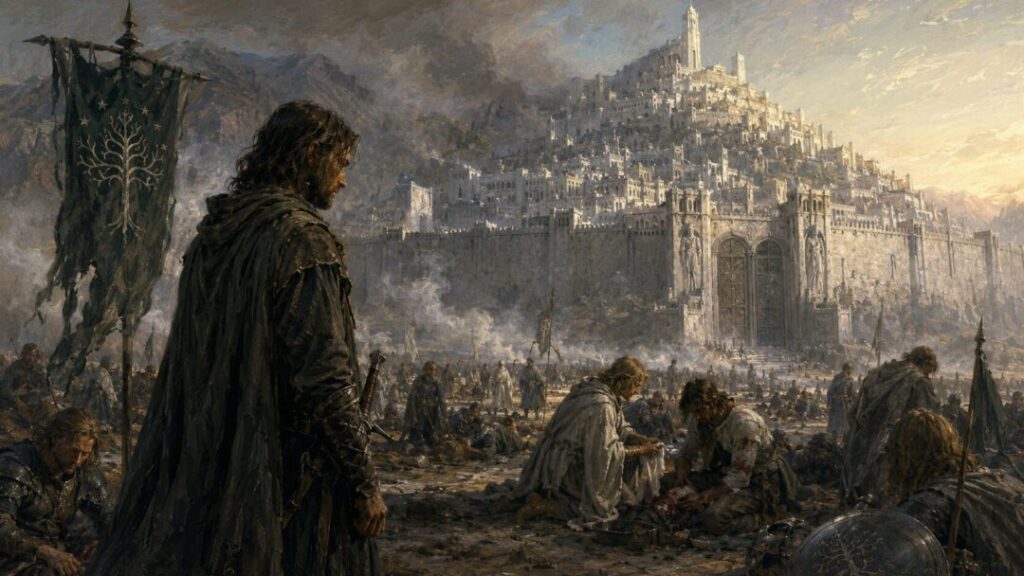
At Minas Tirith, he waits outside the city after the battle rather than entering immediately as ruler.
That last detail captures the whole pattern.
Even after victory on the Pelennor Fields, Aragorn does not simply crown himself. He enters the city first as a healer. The old saying that “the hands of the king are the hands of a healer” becomes part of how his identity is recognized.
Again, the pattern is service before rule.
Healing before enthronement.
Elrond’s Condition and the Shape of Aragorn’s Destiny
There is also the matter of Arwen.
Elrond does not permit Aragorn to marry Arwen unless Aragorn becomes king of both Gondor and Arnor. This is not the reason Aragorn becomes a Ranger, but it gives shape to the burden placed before him.
His destiny is not simply to sit on Gondor’s throne.
It is to reunite what has been broken.
That means the North matters as much as the South.
If Aragorn had abandoned the Dúnedain and gone straight to Minas Tirith, he would not have fulfilled the full meaning of his inheritance. He was not merely the potential king of Gondor. He was the heir of the North as well, the last Chieftain of a people who had endured in silence for centuries.
The Ranger years are therefore not a delay before the “real” story.
They are part of the restoration itself.
Aragorn cannot reunite the realms if he has not first lived the hidden grief of the fallen one.
Why He Had to Be Strider First
The name Strider is meant as an insult in Bree.
It makes Aragorn sound suspicious, shabby, and rootless. A man with long legs and no settled place. Someone to be watched, not honored.
But by the end of the story, that name becomes part of his royal house: Telcontar, meaning Strider.
This transformation is not accidental.
Aragorn does not erase the Ranger when he becomes king. He carries the Ranger into the kingship.
That is the point.
The king who returns to Gondor is not a sheltered prince. He is a man who has slept in the wild, guarded thankless borders, fought under borrowed names, learned the hearts of many peoples, and refused to claim power before its hour.
He becomes king because he first learned how to serve without being seen.
The Real Reason Aragorn Waited
So why did Aragorn become a Ranger rather than go straight to Gondor?
Because Gondor was not ready.
Because the North still needed him.
Because his claim required more than blood.
Because the old history between Arnor and Gondor could not be ignored.
Because revealing himself too early might have caused rivalry instead of renewal.
Because he had to become the kind of king who would not seize a throne merely because it was his.
Aragorn’s road is long because restoration in Middle-earth is never simple.
Broken kingdoms are not healed by one dramatic announcement.
Old wounds are not closed by ancestry alone.
A crown is not enough to make a king.
That is why Aragorn spends so much of his life in shadow.
Not because he is less than a king.
Because he is learning the one thing a true king must know before all else:
The throne is not the beginning of duty.
It is the last form duty takes.
Sources & Notes
- J.R.R. Tolkien, The Lord of the Rings, Appendix A, ‘The North-kingdom and the Dúnedain’ — Aragorn’s childhood as Estel in Rivendell, Elrond’s revelation of his lineage, and the heirlooms of Isildur’s house.
- J.R.R. Tolkien, The Lord of the Rings, Appendix A, ‘Gondor and the Heirs of Anárion’ — Arvedui’s rejected claim to Gondor and the choice of Eärnil show why a northern heir could not simply demand acceptance.
- J.R.R. Tolkien, The Lord of the Rings, Appendix A, ‘The Tale of Aragorn and Arwen’ — Aragorn’s long service in the wild and in disguise as Thorongil under Thengel and Ecthelion before openly claiming the kingship.
- J.R.R. Tolkien, The Fellowship of the Ring, Book II, Chapter 2, ‘The Council of Elrond’ — Elrond and Boromir’s exchange frames the Sword that was Broken, the heirs of Isildur, and Gondor’s guarded attitude toward the northern line.
- J.R.R. Tolkien, The Return of the King, Book V, Chapter 8, ‘The Houses of Healing’, and Book VI, Chapter 5, ‘The Steward and the King’ — Aragorn’s return is shown through healing, humility, and accepted kingship rather than a naked political demand.