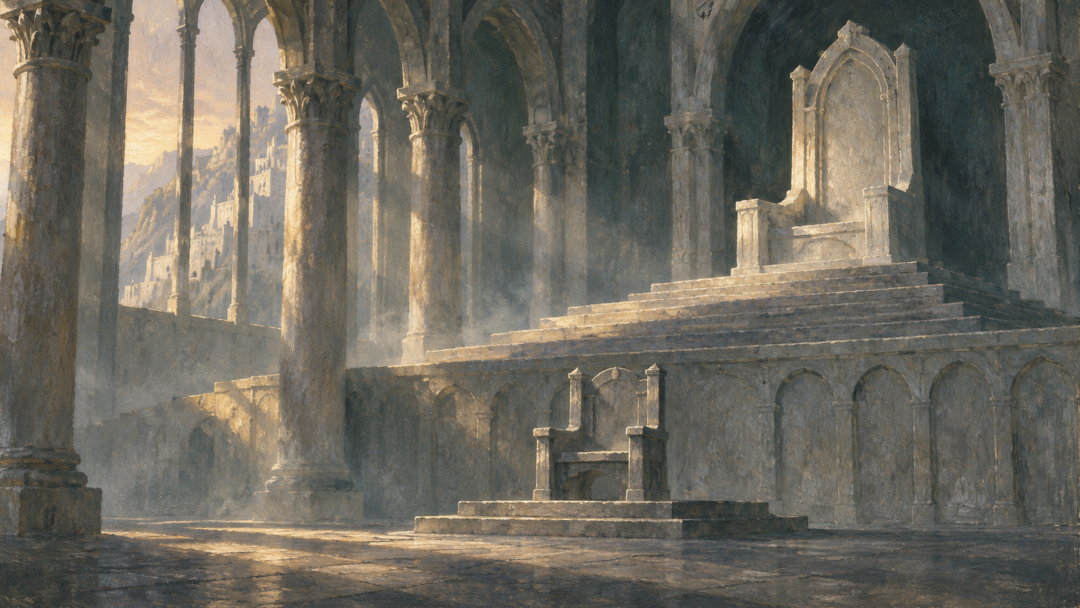
In Minas Tirith, the old crown of Gondor had been kept for centuries while no king sat upon its throne. When Aragorn finally came to the city after the War of the Ring, he was not greeted as the missing son of its last monarch. He came from the North, bearing a name associated with a different kingdom. So how could he inherit a throne whose last king, Eärnur, had left no heir?
The answer lies in the difference between a king having no successor and a royal family having no surviving branches. Eärnur left no child to take his place, and Gondor accepted no other claimant. But Aragorn descended from Isildur, whose family had ruled in the North, and also from Anárion’s royal line in Gondor through a marriage generations earlier. His ancestry gave him a serious claim. The history of Gondor explains why that claim still needed acceptance.

Two royal houses from one family
The story begins with Elendil and his two sons, Isildur and Anárion, who established the realms of the Dúnedain in Middle-earth after the fall of Númenor. Elendil ruled in the North, in Arnor, while his sons governed Gondor in the South. After the war against Sauron at the end of the Second Age, Isildur inherited his father’s position and eventually set out northward. Gondor’s kingship continued through Anárion’s son Meneldil.
That division created two related but distinct lines of rulers. The kings of Gondor traced their succession through Anárion, while the northern kings descended from Isildur. Isildur’s senior position as Elendil’s heir would later become central to a dispute: did his departure leave Gondor permanently to Anárion’s descendants, or did his wider claim as Elendil’s heir survive? Gondor’s own practice favored the southern line, whatever a northern claimant might argue.
Eärnur belonged to that southern line. He became king in the Third Age after his father, Eärnil II, and had no children. In 2050, the Witch-king challenged him to come to Minas Morgul. Eärnur rode out with a small company and was never seen again. The account does not describe anyone witnessing his death; it records his disappearance. For Gondor, that was enough to create a crisis, but not enough to produce an obvious new king.
There were still people with royal ancestry. The difficulty was finding someone whose right to rule would be recognized, rather than contested. Gondor remembered the Kin-strife, a devastating civil war fought over its crown, and had little appetite for another. Mardil, Eärnur’s Steward, therefore governed in the king’s name. His successors inherited the stewardship, not the crown. The throne remained vacant because no acceptable succession had been settled, not because Elendil’s descendants had all died.
The northern claim Gondor had already rejected
The most revealing episode actually happened before Eärnur became king. In 1944 of the Third Age, King Ondoher of Gondor and his two sons were killed in war. His daughter Fíriel survived, and she was married to Arvedui, heir to the northern kingdom of Arthedain. At that moment the succession became a question of two royal houses, two understandings of inheritance, and one throne.
Arvedui put forward a claim on more than one ground. As a descendant of Isildur, he argued that Elendil’s senior royal line retained a right over Gondor. Through his marriage to Fíriel, he also invoked Ondoher’s surviving child. The ancient inheritance custom of Númenor had allowed the eldest child to succeed regardless of sex. If that principle applied, Fíriel’s position could not simply be dismissed because her brothers were dead.
Gondor disagreed. Its answer was blunt: “In Gondor this heritage is reckoned through the sons only”. Its council maintained that the crown belonged to the descendants of Anárion, through Meneldil, and did not recognize Arvedui’s interpretation of Isildur’s rights. Arvedui countered that Isildur had inherited Elendil’s high kingship and had not permanently surrendered the South. This was a real argument about precedent and legitimacy, not a case where everyone knew the answer and merely overlooked a relative.
Gondor ultimately chose Eärnil II, a descendant of Anárion who had won important victories against its enemies. His son was Eärnur, the king who would later disappear. That order of events matters. Arvedui’s claim was rejected at an earlier succession crisis; Eärnur’s heirless end came decades afterward. The rejection showed how strongly Gondor guarded its own succession, but it did not make Arvedui’s descendants vanish or settle every possible future claim forever.
A royal line survived the fall of its kingdom
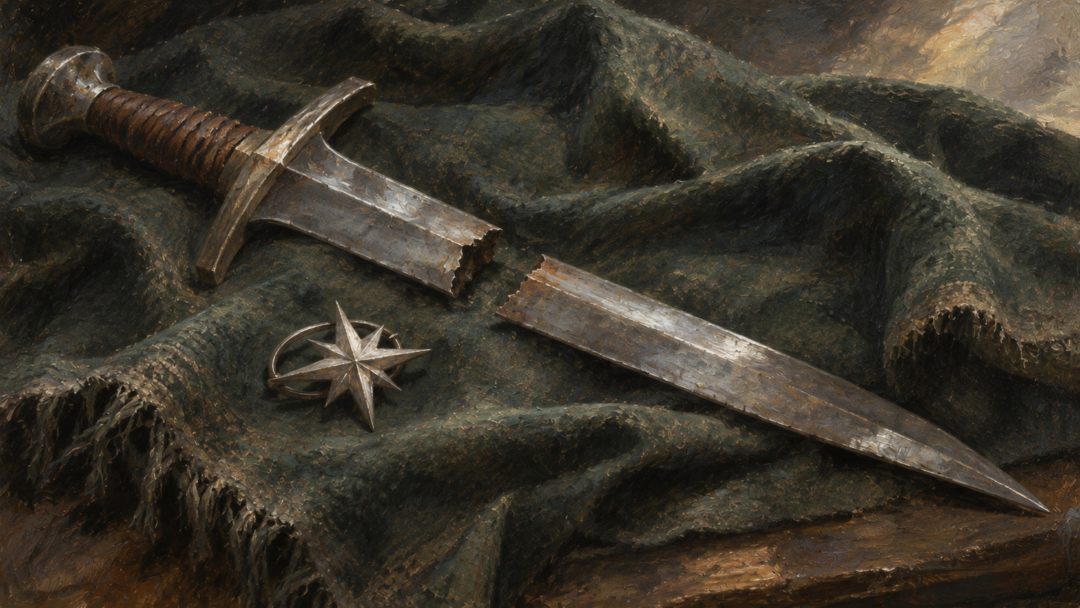
Arvedui’s kingdom did not endure. Arthedain fell under the assault of Angmar, and Arvedui himself perished in the far North. Yet his son Aranarth survived. Instead of becoming a king with a throne and court, Aranarth became the first Chieftain of the Dúnedain of the North. Appendix A states that “Yet the line of the kings was continued by the Chieftains of the Dúnedain”. The institution changed; the family line did not end.
Those chieftains passed down their leadership through generations of diminished northern power. The royal heirlooms were preserved, and Rivendell became a place of refuge and guardianship for the heirs of Isildur. There was no continuously reigning king of Arnor during this period: its scattered people had chieftains, while its ancient realm remained broken. It is precisely this distinction that makes Aragorn’s title meaningful. He inherited a royal ancestry, not an operating northern government.
Aragorn was the son of Arathorn II and Gilraen, and followed the line of chieftains back through Aranarth to Arvedui and Isildur. But Aranarth was also Fíriel’s son. Through her, Aragorn belonged to the line of Ondoher and thus to the descendants of Anárion. The northern and southern families had joined long before he was born. His descent did not run through Eärnur, nor did it require a secret child of that last Gondorian king.
This is why describing Aragorn simply as “Isildur’s heir” gives only half the picture. It names his most prominent title and the senior northern line, but the marriage of Arvedui and Fíriel also joined the line of Anárion to his ancestry. The appendices eventually describe the return of “the heir of Isildur and Anárion” when the kingship is renewed. That wording is deliberate about both sides of the family, without implying Gondor had accepted Arvedui’s case when he first presented it.
Why a bloodline alone did not put Aragorn on the throne
By the end of the Third Age, Gondor had lived under ruling Stewards for nearly a thousand years. Their government was not an interruption lasting a season or two; generations had been born, fought, and died without seeing a king. Denethor, the Steward during the War of the Ring, wielded real authority, and people knew the institutions that served him. A distant genealogical claim, however substantial, could not by itself make those institutions and memories irrelevant.
Aragorn’s actions during the war supplied the missing public dimension. He led forces to the aid of Minas Tirith, fought in the struggle against Sauron, and became a figure around whom Gondor’s allies could gather. He also entered the city to heal the wounded, including Faramir. Those acts did not create a new legal rule that victory or healing entitled anyone to a crown. They gave the people of Gondor reasons to recognize this particular claimant as a leader rather than merely a name in an ancient pedigree.
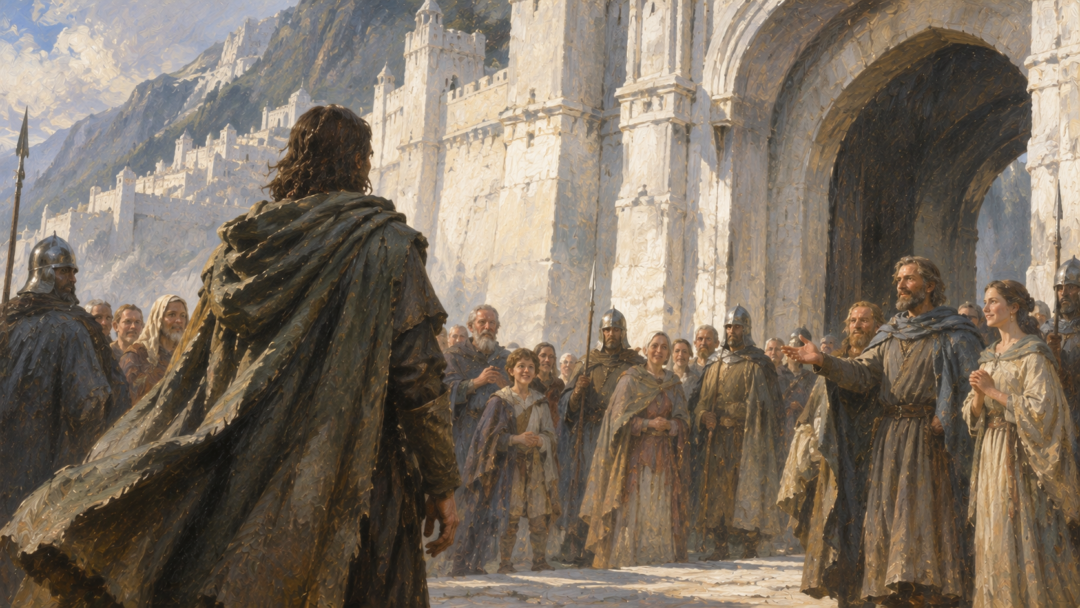
Significantly, Aragorn did not simply take up residence in the Citadel as soon as the battle outside Minas Tirith was won. The question of his entry as king was resolved openly after the war. At the coronation, Faramir met him before the city and offered to surrender his office as Steward. Aragorn returned the white rod to him and confirmed that the stewardship would continue under Faramir and his heirs. The return of a king did not require the erasure of the house that had guarded Gondor during his absence.
Faramir then presented Aragorn to the assembled people by name and descent: son of Arathorn, of the line of Valandil, Isildur and Elendil. He also named his leadership, his victory, and his healing hands. The proclamation held ancestry and deeds together. Finally Faramir asked, “Shall he be king and enter into the City and dwell there?” The gathered host and people answered yes. This was public recognition of the claim, not proof that Gondor had always agreed with the North about succession.
There is a telling difference between this scene and the dispute over Arvedui. In the earlier crisis, Gondor had a southern candidate it was prepared to support and a council unwilling to accept the northern argument. At the end of the War of the Ring, the surviving Steward himself presented Aragorn, and the people acclaimed him. His descent mattered, but so did the circumstances in which that descent was finally acknowledged. Aragorn became king of a reunited realm, not merely the latest occupant of an unchanged Gondorian succession.
The old crown could therefore be brought out without pretending that Eärnur had left a son. It had remained in Gondor while the northern heirs lived far from its walls, carrying a claim that had once been refused. When Faramir handed it forward, the ancient family line and the consent of the living realm finally met at the city gate. The empty throne had waited for a king, not necessarily for the last king’s child.
Sources & Notes
- The Encyclopedia of Arda, Eärnur — Gondor's last king and the end of the accepted royal succession — https://www.encyclopedia-of-arda.com/e/earnur.php
- The Encyclopedia of Arda, Arvedui — the last northern king, Fíriel, and the surviving line of chieftains — https://www.encyclopedia-of-arda.com/a/arvedui.php
- The Encyclopedia of Arda, Fíriel — Ondoher's daughter, Arvedui's wife, and the ancestral link to Anárion's line — https://www.encyclopedia-of-arda.com/f/firiel.php
- Tolkien Gateway, The Steward and the King — Faramir's presentation of Aragorn and the people's acceptance — https://tolkiengateway.net/wiki/The_Steward_and_the_King
Reading references: The Return of the King, Appendix A, Gondor and the Heirs of Anárion and The North-kingdom and the Dúnedain; The Steward and the King. Dynastic descent, Gondor's earlier succession ruling, and the later public acceptance are distinct parts of Aragorn's claim.