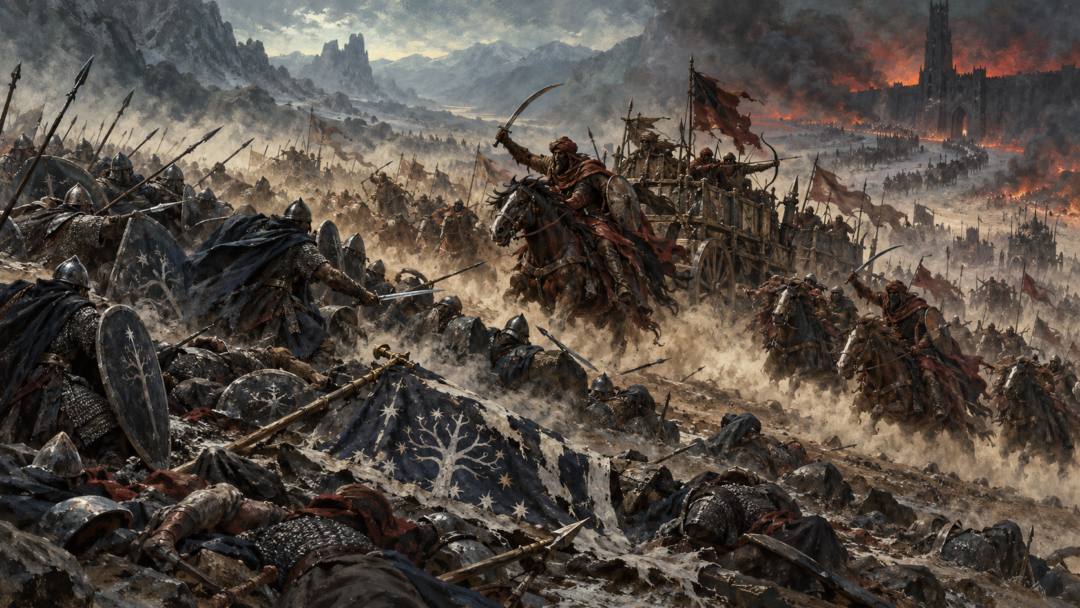
At the Morannon, Gondor lost more than a battle. In Third Age 1944, King Ondoher fell fighting the Wainriders, and his two sons died in the same disastrous campaign. Far to the north, the prince Arvedui of Arthedain had an extraordinary connection to the vacant throne: he descended from Isildur, while his wife, Fíriel, was Ondoher’s surviving child. For a moment, the divided royal houses of the Dúnedain seemed capable of meeting in one succession.
Yet Gondor crowned neither Arvedui nor Fíriel. Its Council, with Steward Pelendur playing a leading part, chose Eärnil, a victorious commander descended from Gondor’s own royal house. Arvedui had advanced two serious grounds for kingship, but the men empowered to recognize a successor accepted neither. The puzzle is not why bloodlines suddenly ceased to matter. It is why those particular lines did not win the argument.
The defeat that left Gondor without its expected heirs
The crisis began with enemies pressing Gondor from two directions. Wainriders threatened from the east, while forces from Harad gathered in the south. Ondoher divided his army accordingly, taking command of the larger northern force and entrusting the smaller southern army to Eärnil. His elder son Artamir accompanied him. The arrangement was dangerous, but it retained an essential safeguard: the king’s younger son, Faramir, was to remain behind as an undisputed heir.
That safeguard failed in a painfully specific way. Faramir went to war disguised among the Éothéod, rather than staying safely away from the fighting. The Wainriders struck Ondoher’s army before it could establish its intended battle positions. Ondoher and Artamir were killed, and in the retreat Faramir’s body was brought to the king’s nephew Minohtar, who was himself later slain. This Faramir was a prince of Gondor, not the much later son of Denethor familiar from the War of the Ring.
The northern defeat therefore became a dynastic disaster. It was not simply that Ondoher had died before arrangements could be made for his successor; both sons who might have carried his immediate male line forward were gone as well. His daughter Fíriel remained, but her place in the succession was disputed. And even as the royal house faced that uncertainty, Gondor still had armies to save and enemies to drive back. The man who accomplished that task would soon become a candidate for the crown.
Arvedui’s claim came by two different routes
Arvedui was not yet king of Arthedain. His father Araphant still ruled there when the southern throne fell vacant, and Arvedui would not succeed him until 1964. But as a prince of the northern royal line, Arvedui was a direct descendant of Isildur, the elder son of Elendil. That ancestry gave him an argument extending back beyond the long separation between Arnor and Gondor.
His first argument rested on descent from Isildur. Arvedui maintained that Isildur had never relinquished his royalty in Gondor, so the northern line still had a claim to the southern crown. This was more than an appeal to shared ancestry: it asserted that Isildur’s descendant retained a royal right in a realm now facing a vacant throne. The argument belonged to Arvedui’s own line, independently of his marriage.
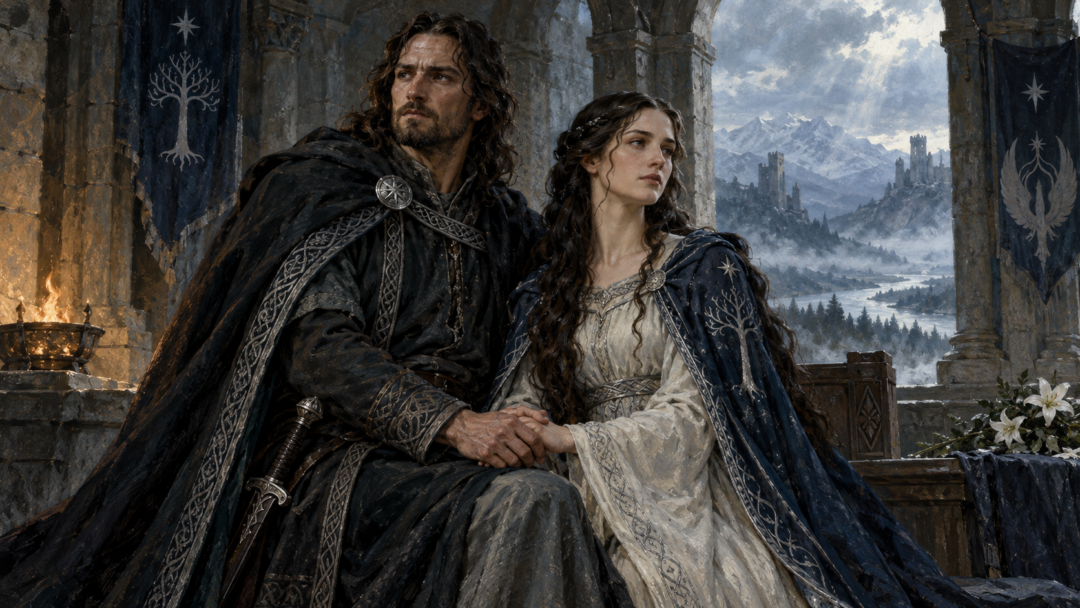
The second route was nearer in time and more personal. In 1940, Arvedui had married Fíriel as the two threatened northern and southern kingdoms renewed their ties. She was not merely a distant descendant of a past monarch: she was the daughter of the king whose death had opened the vacancy, and the surviving sibling after her brothers’ deaths. If the older Númenórean custom of inheritance were applied, Fíriel herself stood to inherit the sceptre.
These arguments were related, but they cannot be collapsed into the idea that Arvedui personally descended from both brothers, Isildur and Anárion. His own ancestry furnished the northern claim; marriage to Fíriel connected him with the immediate southern succession. Their children would unite both lines by descent, but that was not the same as giving their father an automatically superior title. It was Arvedui who advanced the claim, invoking both his descent and his wife’s position.
Which inheritance tradition should govern?
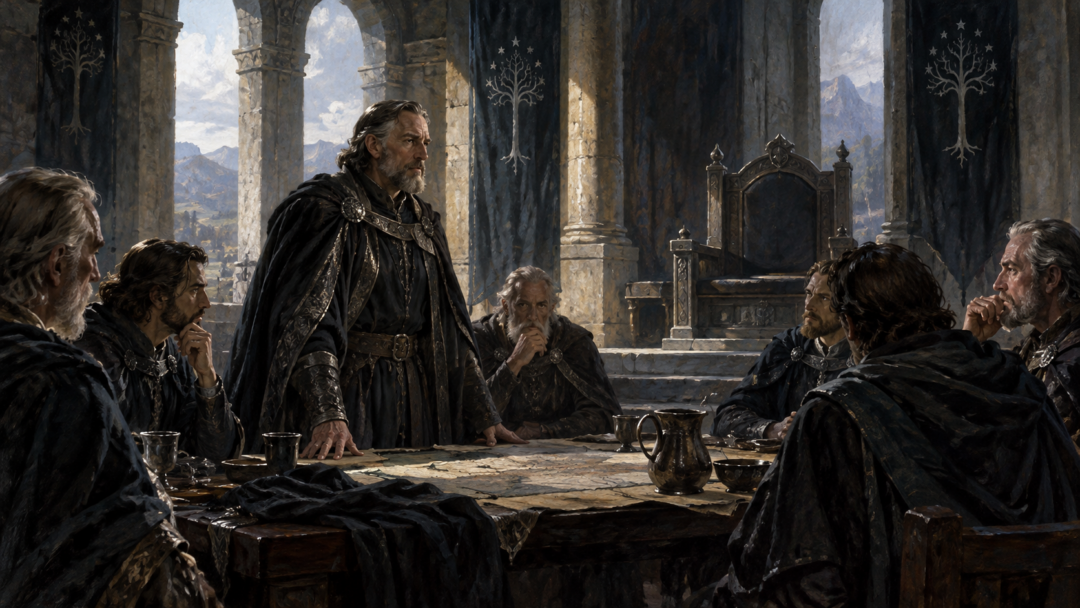
Arvedui’s appeal to Númenor gave the dispute a history older than either kingdom in exile. He invoked the ancient Númenórean law under which Fíriel should have received the sceptre after her father and brothers died. The point was not merely that his wife belonged to Gondor’s royal family: it was that she stood to inherit. That argument challenged any assumption that the loss of Ondoher’s sons had necessarily ended his children’s claim to the crown.
The Council did not accept Arvedui’s claim on those two grounds. Pelendur and the councillors rejected his request, and Gondor’s crown went instead to Eärnil. That decision establishes the failure of Arvedui’s appeal; it does not by itself supply a universal rule governing every woman’s inheritance in Gondor. Fíriel’s position under the older tradition was part of the claim being pressed, not a right the Council recognized in this succession.
The Council had taken authority over Gondor when Ondoher’s death left the realm kingless. Arvedui was therefore asking a body already governing the South to recognize his right to rule it. Its refusal did not break his descent from Isildur or his marriage to Fíriel. It meant those connections had failed to secure the assent of the institution handling this vacancy.
Eärnil offered more than a battlefield victory
That candidate was no outsider promoted in place of all hereditary right. Eärnil belonged to the House of Anárion. His family descended from King Telumehtar, through a branch separate from Ondoher’s immediate household. He was therefore a genuine royal alternative when the direct male heirs of the dead king were gone. Gondor did not abandon dynastic kingship; it selected a dynast from within the southern house.
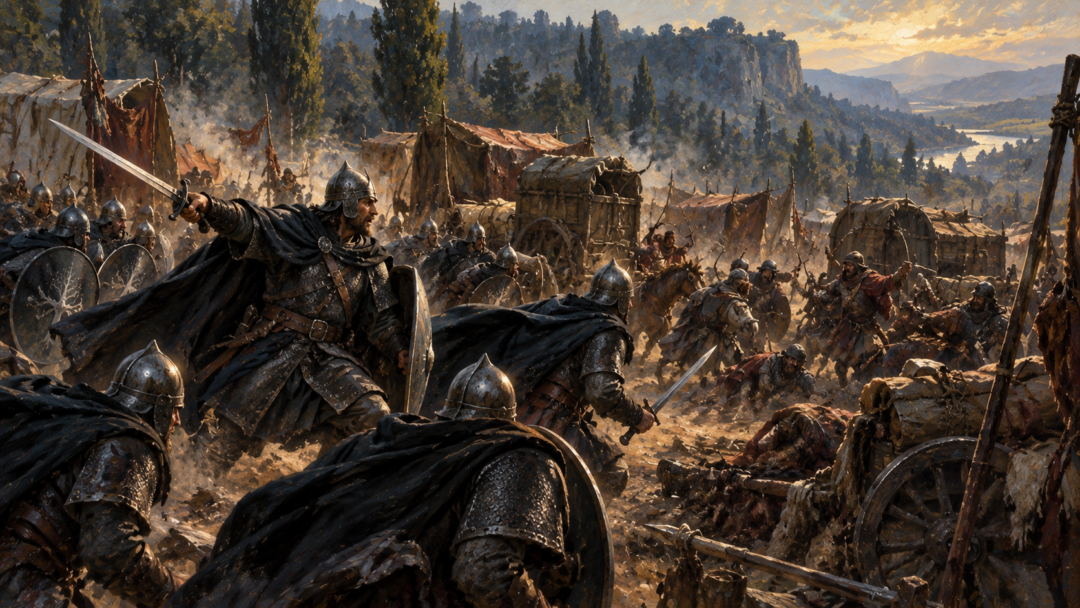
His military record made the choice unusually compelling. Eärnil had first defeated the attackers from Harad. Learning of the disaster suffered by Ondoher, he then moved north, gathered what he could of Gondor’s surviving forces, and surprised the Wainriders at their camp. His victory broke the invasion and drove the enemy from Ithilien. When Gondor needed a new ruler, the captain under consideration had just rescued the realm from a campaign that had killed its king.
Pelendur, Ondoher’s Steward, led the Council in rejecting Arvedui’s request. The Council chose Eärnil, who became king in 1945. That choice is the decisive political event in the story. A lineage could make someone eligible to argue for a throne; it could not, by itself, compel Gondor’s governing authorities to enthrone him when they recognized another claimant.
It is tempting to turn the choice into a neat contest between hereditary entitlement and the rewards of military success. But Eärnil had both southern royal descent and a spectacular victory. Conversely, Arvedui possessed substantial ancestral arguments without obtaining the Council’s assent. The known facts explain why the alternative was credible without requiring invented private motives for Pelendur, a fabricated tally of votes, or a theory that Gondor invariably crowned whichever warrior had most recently won a battle.
A refusal that did not sever the royal families
Arvedui’s claim failed to win Gondor’s crown, but the family connection on which it rested endured. Fíriel remained with her husband in the North, and their son Aranarth continued the line of both Isildur and Anárion. The rejected bid did not erase that inheritance. It would pass through their descendants even after the northern kingdom itself had fallen.
Eärnil’s accession also did not turn the North into an enemy. He acknowledged the kinship between the realms and expressed his intention to help Arthedain as far as he was able. The message did not reverse his selection as king of Gondor; it separated the rejection of Arvedui’s claim from any denial that the northern Dúnedain belonged to the same historic people. The two royal lines could remain connected without being reunited under one ruler.
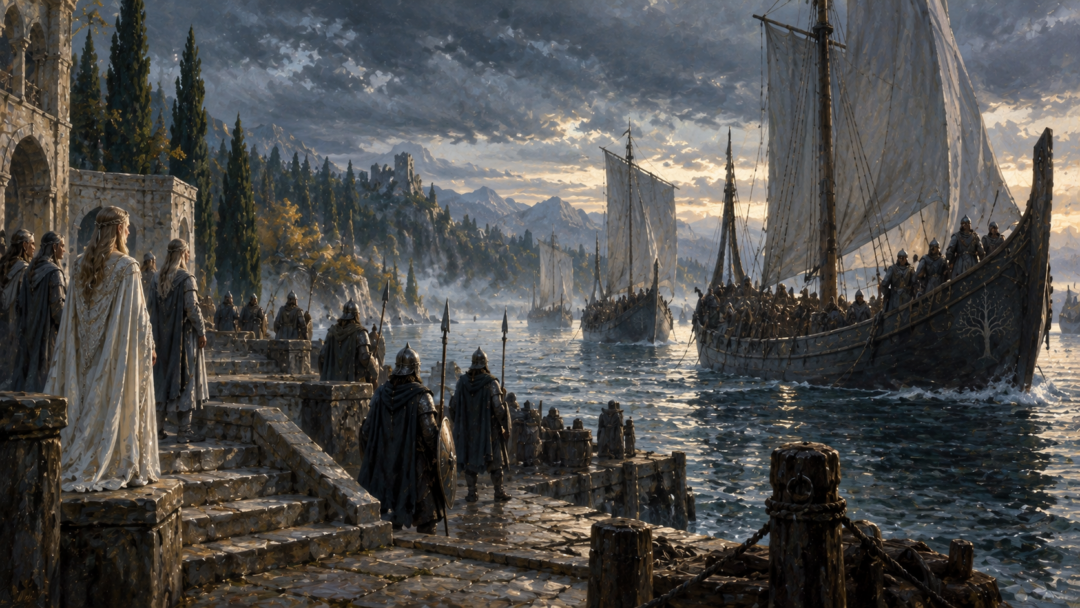
Years later, when Arthedain faced the final assault of Angmar, Eärnil sent a force north under his son Eärnur. The expedition arrived too late to save the kingdom or Arvedui, who had by then succeeded his father and become Arthedain’s last king. Gondor’s soldiers nevertheless helped defeat Angmar’s forces. The missed rescue casts a long shadow over the earlier promise, but it does not prove the promise insincere or supply an unrecorded explanation for the timing of the aid.
The claim survived the kingdom that made it
Fíriel and Arvedui’s son Aranarth continued the northern line after the collapse of Arthedain, although he bore the title of Chieftain rather than king. Through Fíriel, his descendants also carried the blood of Anárion. That inheritance eventually reached Aragorn, whose claim and acceptance came in the very different circumstances following the War of the Ring. His kingship reunited the realms, but it did not retroactively overturn the Council’s decision centuries earlier.
The outcome gives Arvedui’s failed claim an unusual place in Middle-earth’s history. The family connection endured after the proposed political union was refused; it travelled through people who no longer wore northern crowns. The marriage of Arvedui and Fíriel did not put him on Gondor’s throne. It did, however, leave a thread of both royal houses running through the long years toward the day when a king could be welcomed back.
Sources & Notes
- Tolkien Gateway, “Arvedui” — the two grounds for his claim, its rejection, and the later northern succession. https://tolkiengateway.net/wiki/Arvedui
- Tolkien Gateway, “Pelendur” — the Steward’s objections concerning Meneldil’s heirs and male-line succession, and the Council’s choice. https://tolkiengateway.net/wiki/Pelendur
- Tolkien Gateway, “Fíriel” — Ondoher’s surviving daughter, the Númenórean inheritance argument, and descent through Aranarth. https://tolkiengateway.net/wiki/F%C3%ADriel
- Tolkien Gateway, “Disaster of the Morannon” — Ondoher’s campaign, the deaths of his sons, and Faramir’s disguise among the Éothéod. https://tolkiengateway.net/wiki/Disaster_of_the_Morannon
- The Encyclopedia of Arda, “Eärnil II” — his descent from Telumehtar, victory at the Battle of the Camp, and accession in Third Age 1945. https://www.encyclopedia-of-arda.com/e/earnilii.html
Primary-text references: J.R.R. Tolkien, The Lord of the Rings, Appendix A, “Gondor and the Heirs of Anárion” and “Eriador, Arnor, and the Heirs of Isildur”; Unfinished Tales, “Cirion and Eorl and the Friendship of Gondor and Rohan”, part (i), “The Northmen and the Wainriders”. The linked reference entries identify these passages. Discussion of why the Council’s assent mattered is interpretation, not a claim to know unrecorded motives.