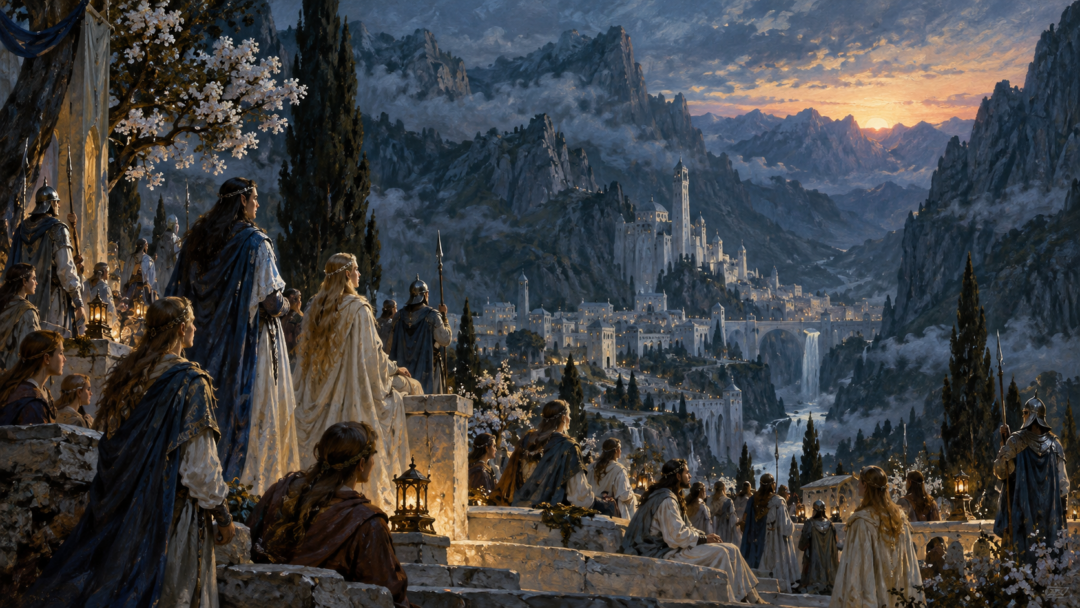
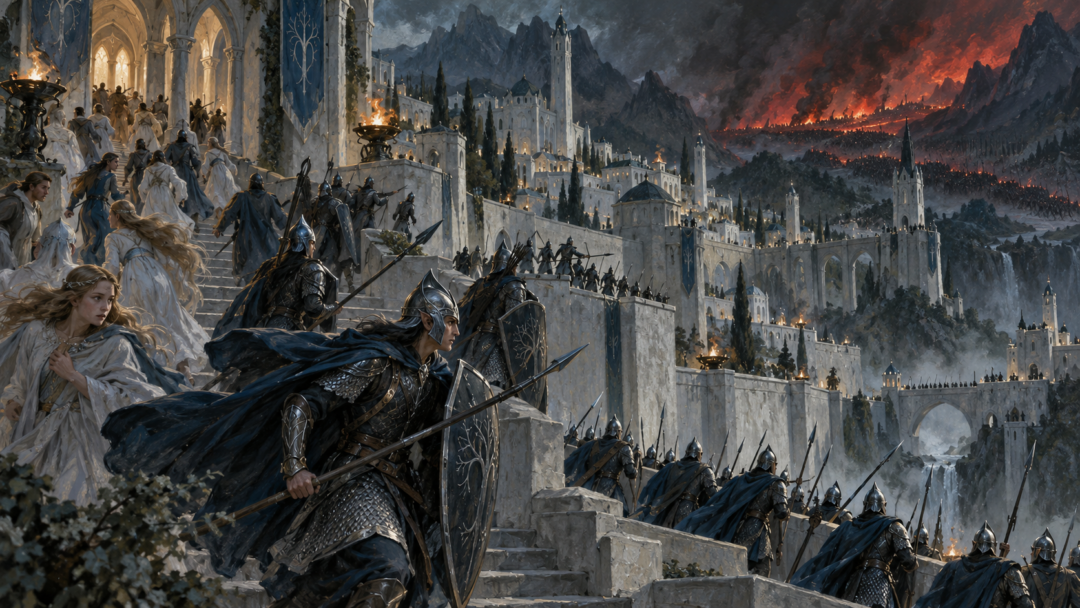
On the morning Gondolin falls, the people are waiting for light. The hidden city has survived for generations behind the Encircling Mountains, but on the feast of the Gates of Summer its attention is fixed on the coming sunrise. Then the first ominous brightness appears from the wrong quarter: not the East, where dawn is expected, but the North, where Morgoth’s power lies. That reversal gives the attack one of the sharpest visual shocks in the story.
The important distinction is that the festival does not explain how Gondolin was found. Maeglin’s betrayal has already broken the secret that protected the city. The Gates of Summer frames what happens next: an enemy who knows the city’s location arrives while Gondolin is awaiting a ceremonial dawn. The texts support that contrast. They do not establish a detailed plan in which Morgoth deliberately calculated every custom of the feast to maximize surprise.
Betrayal Ends Secrecy Before the Festival Begins
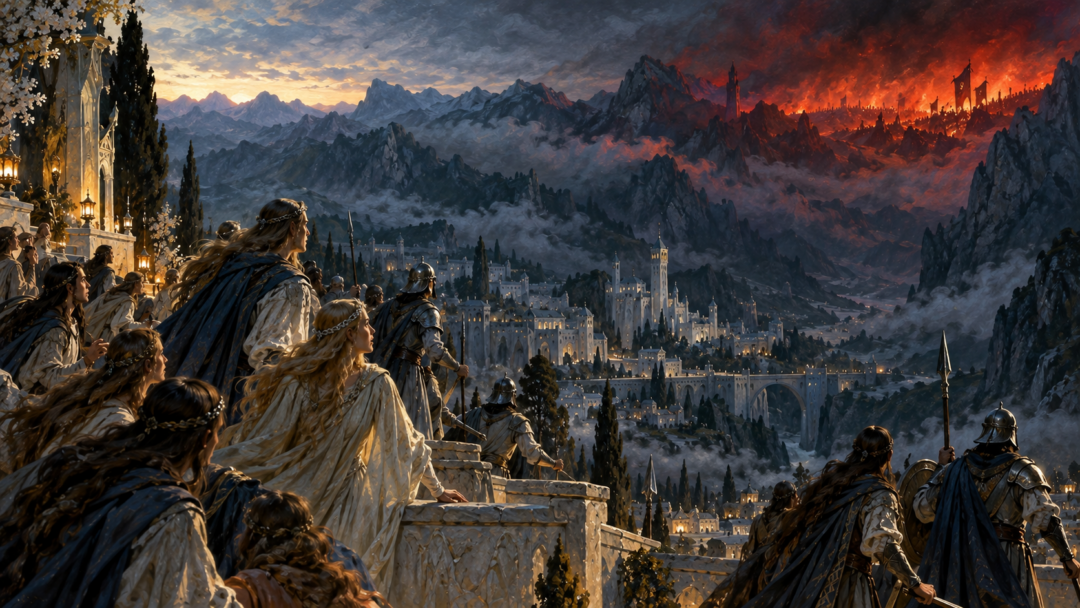
Gondolin’s great defense is concealment. Its walls and warriors matter, but the city’s deeper security comes from being hidden in Tumladen, cut off from ordinary approach and unknown to Morgoth. Once Maeglin is captured outside the city and betrays its location, that protection is fundamentally compromised. The enemy no longer has to discover Gondolin by chance or search blindly through the mountains. The essential secret has been given away.
That is a different problem from the surprise experienced by the people inside. The betrayal explains how Morgoth can bring his forces against Gondolin at all; the festival setting explains why the moment of revelation is so disorienting. The two ideas work together, but they should not be collapsed into a claim that Gondolin falls simply because everyone is distracted by a holiday.
The distinction also keeps the military logic in proportion. There is no need to imagine every sentry abandoning a post, every gate standing open, or the whole population compressed into one vulnerable crowd. The surviving accounts do not require those additions. Surprise can be real even in a defended city. What matters is that an assaulting host appears where the people do not expect one, at the hour when their communal expectation is directed elsewhere.
Gondolin Is Waiting for the Sunrise
The Gates of Summer is a feast connected with the rising Sun. In the later tradition behind the published account of Gondolin’s fall, the people gather during the night to watch for sunrise over the mountains. The setting is therefore not generic festivity. It is an observance organized around anticipation: darkness is about to end, summer is being welcomed, and eyes are turned toward the place where the first light should appear.
That makes the scene unusually precise. The people are not merely “caught celebrating” in the loose sense that they happen to be occupied with music or ceremony. They are waiting for a particular natural sign, and the story answers that expectation with another sign entirely. Gondolin has long been defined by separation from the outside world; on this morning, the horizon no longer confirms that security. It gives warning instead.
There is an irony here, but it needs no invented speech from Morgoth or elaborate theory of his planning. The feast celebrates the opening of summer; the attack opens the destruction of the city. The people await a familiar sunrise and instead perceive the sign of an invading force. The force of the episode lies in that experienced reversal, whether or not the enemy consciously chose the feast for symbolic effect.
The First Light Comes From the North
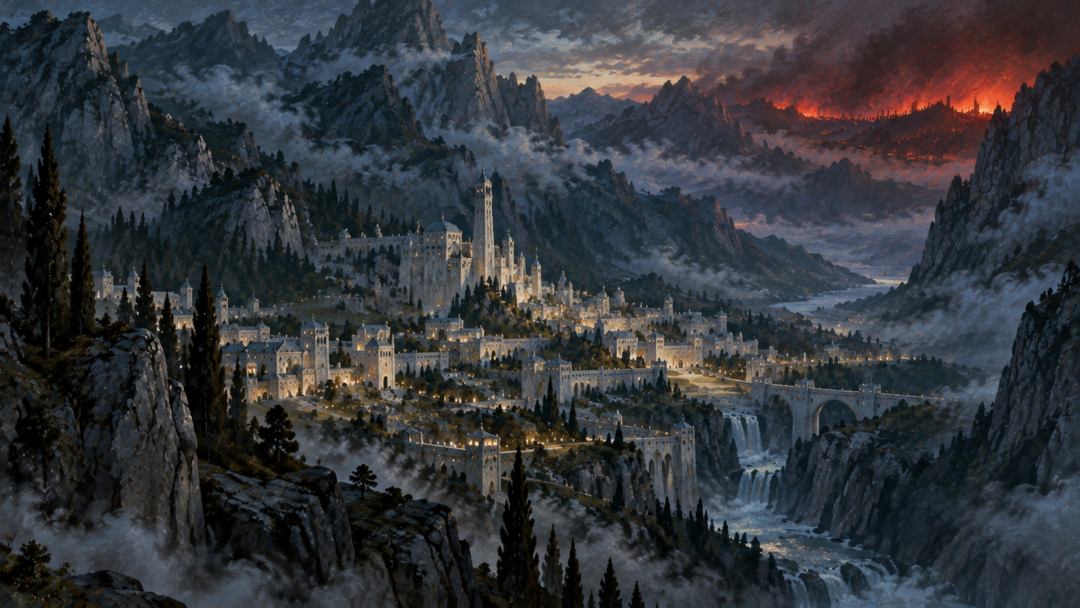
The most memorable detail is directional. The watchers expect sunrise in the East, yet a light is seen in the North. Before swords are crossed or walls are overwhelmed, Gondolin’s people receive a visual contradiction: the brightness that arrests their attention is not where dawn belongs. The approaching host is first registered as a false answer to the city’s expectation.
That helps explain why “surprise” here should not be reduced to a technical question about guard schedules. The account gives no basis for calculating an exact alarm delay or proving that the defenders lost a measurable number of minutes because of the ceremony. What it gives us is stronger as storytelling: people prepared for one kind of light are confronted by another, from a different geographical direction.
This sequence also separates strategic surprise from perceptual surprise. Strategically, Gondolin is already doomed to face an enemy that knows how to reach it; perceptually, the danger becomes real in an instant when the wrong light appears. The festival matters most at that second level. It tells us what the people are expecting to see and therefore gives the first sight of the assault a form more specific than a generic alarm from the walls.
The East and North therefore carry more than map value in the scene. The East is the expected sunrise, ordinary and life-giving; the North is the quarter from which Morgoth’s war comes. Reading symbolic force into that opposition is an interpretation, but it is anchored in the narrated contrast. The text supplies the reversed direction. It does not supply a statement that Morgoth designed the attack chiefly to exploit that symbolism.
The Early Account Makes the Ritual Richer
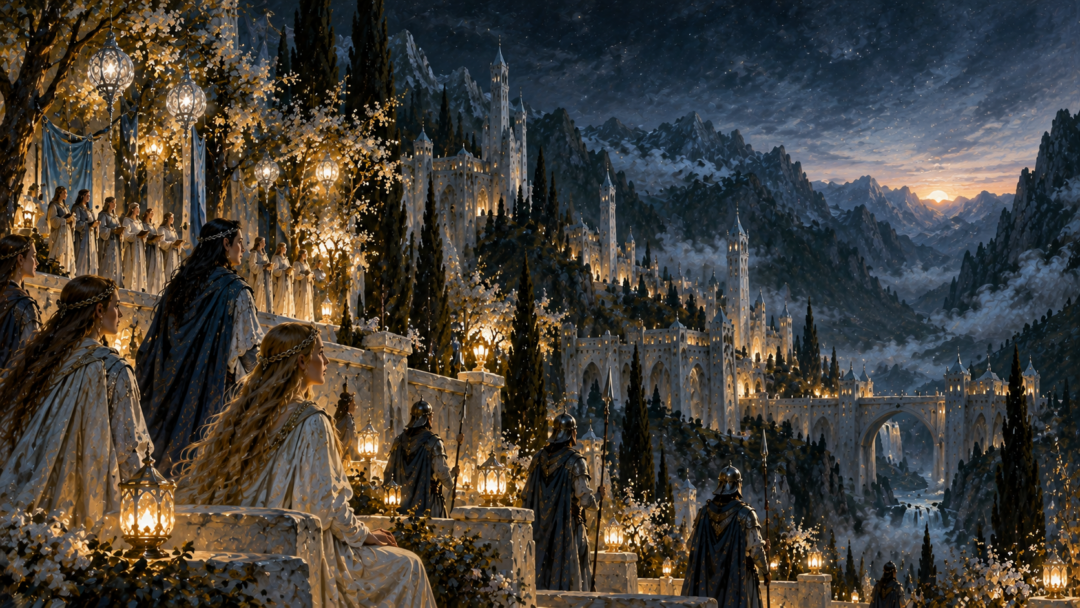
The earliest detailed version of the Fall of Gondolin gives the Gates of Summer a fuller ceremonial texture. There the feast, called Tarnin Austa in that stage of the legendarium, begins with a solemn observance at midnight. The people keep silence until daybreak, and when the Sun rises they break into ancient songs. Choirs stand upon the eastern wall. The city is bright with silver lamps and colored lights hung among the newly leafed trees.
Those details make the coming attack feel even more haunting. Silence, lamps, choirs, the eastern wall, and the expected burst of song all concentrate attention on the transition from night into morning. In that version, the city is not just celebrating summer in a broad sense; it is ritually poised on the edge of dawn. The invasion enters a scene already shaped by waiting.
But the richness of the early tale creates a common trap. It is tempting to lift every vivid detail from that account and treat it as though the published Silmarillion gives one continuous, fully harmonized description. It does not. The Gondolin material survives in different textual stages, with the early Lost Tales narrative often supplying much more scene-by-scene detail than the later, compressed accounts. The changing forms of the festival’s name likewise belong to developing linguistic conceptions, not to several simultaneous festival offices within one finished Gondolin.
So the early customs can deepen the reading without becoming proof of an undocumented tactical plan. A city keeping ceremonial silence until dawn may seem especially exposed in imaginative terms, but the text does not say that every defender was silent at a post, that military vigilance ceased, or that Morgoth possessed a schedule of the rites and timed his march to each stage. The same caution applies to battle imagery: early mechanical or monster-like conceptions and later traditions should not be fused into one definitive assault.
Surprise Is Only One Part of Gondolin’s Defeat
Even a perfectly timed shock would not by itself explain the fall. Once the city’s location is betrayed, Morgoth can bring enormous force against a kingdom whose greatest strategic advantage has already been lost. The accounts emphasize the horror of the assault while also preserving desperate resistance by Gondolin’s lords and warriors. Surprise begins the crisis; it does not replace the battle.
The defenders are not portrayed as people who simply fail to react. The traditions of the fall are filled with fighting, last stands, and costly resistance. Tuor, Ecthelion, Glorfindel, Turgon’s people, and the houses of Gondolin belong to a story of defense under catastrophic pressure. Whatever advantage the attackers gain from appearing at such a moment, the city still has to be fought for and destroyed.
Nor should the festival be made responsible for consequences better explained by earlier choices and larger forces. Gondolin’s isolation, Morgoth’s long desire to find it, Maeglin’s betrayal, and the strength of the assault matter more to the strategic outcome than any speculative lapse in ceremonial readiness. The Gates of Summer gives the opening of the attack its particular shape. After generations of secrecy, the final morning begins with recognition: the people see something they should not be seeing, and the horizon tells them the hidden city is hidden no longer.
A Dawn Reversed
The safest reading is also the most powerful one. Maeglin’s betrayal makes the assault possible; the Gates of Summer makes its arrival feel like a violated dawn. Gondolin looks east for the Sun and discovers hostile light in the North. The early tale can enrich that moment with silence, lamps, choirs, and song, as long as those details stay in their own textual frame. The shock needs no invented masterstroke. The wrong light on the horizon is enough.
Sources & Notes
- Tolkien Gateway, Gates of Summer — referenced account of the sunrise feast and its early Lost Tales customs: midnight silence, eastern-wall choirs, silver lamps and coloured lights; distinguishes early versions and the evolving festival names. https://tolkiengateway.net/wiki/Gates_of_Summer
- Tolkien Gateway, Fall of Gondolin — Maeglin’s betrayal, the northern light appearing while the people await sunrise, the assault and the defenders’ resistance; includes references to The Shaping of Middle-earth and The Book of Lost Tales Part Two. https://tolkiengateway.net/wiki/Fall_of_Gondolin
- The Encyclopedia of Arda, Gates of Summer — independent reference for the dawn observance, hostile glow from the north and the city’s betrayed location; its notes distinguish the fuller early account from the compressed Silmarillion description. https://www.encyclopedia-of-arda.com/g/gatesofsummer.html
Primary reading: The Silmarillion, “Of Tuor and the Fall of Gondolin”; The Book of Lost Tales Part Two, “The Fall of Gondolin”; and The Shaping of Middle-earth, “The Quenta”, section 16. The linked reference entries document the festival and assault. The richer ritual details belong to the early tale, not one harmonized account. The violated-dawn reading is interpretation, not evidence that Morgoth deliberately calculated the feast’s symbolism or that the defenders abandoned vigilance.