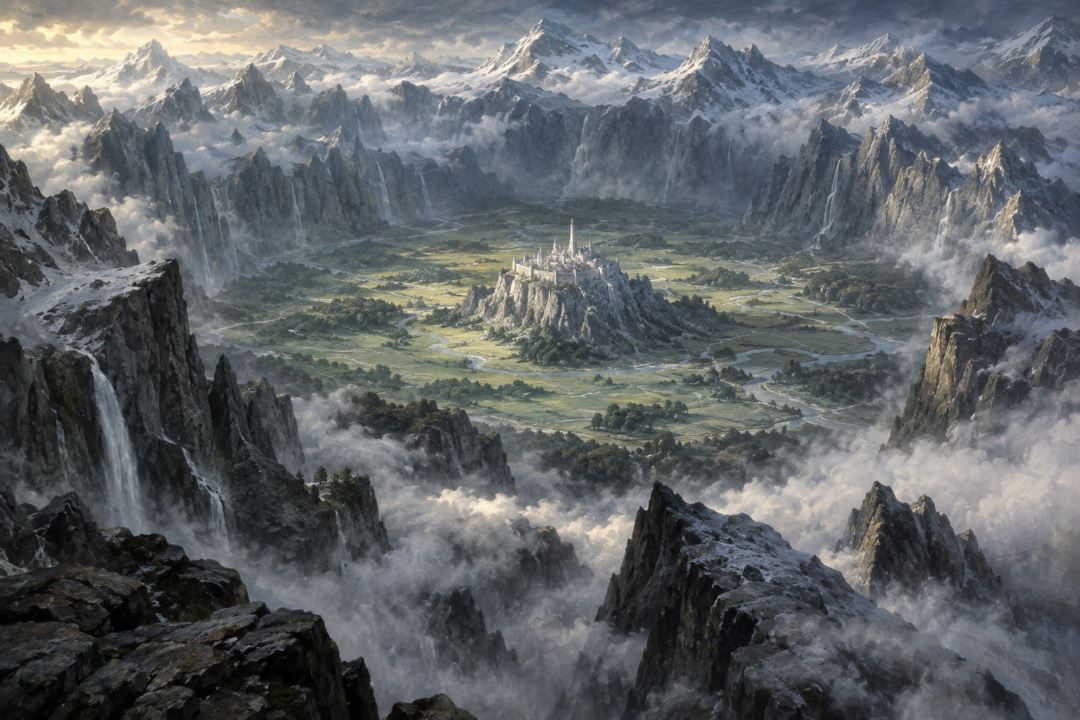
Gondolin is remembered as a walled city: white stone upon Amon Gwareth, towers rising above the hidden plain, guarded gates, armed houses, and a king determined to preserve the last great refuge of his people.
But Gondolin’s most important wall was never built by Elves.
It was the Echoriath—the Encircling Mountains.
These mountains surrounded the entire plain of Tumladen, placing miles of hostile terrain between Gondolin and the wars of Beleriand. The city walls defended Amon Gwareth. The mountains defended something much larger: the existence, location, and approaches of the whole hidden realm.
That distinction explains both Gondolin’s extraordinary longevity and the terrible nature of its fall.
Gondolin Was a Fortress Inside a Fortress
Turgon did not simply choose a defensible hill and fortify it.
Guided by Ulmo, he discovered Tumladen, a hidden valley enclosed by the Echoriath. In the middle of that plain stood the rocky height of Amon Gwareth, where Gondolin would eventually be built.
The geography therefore created several defensive layers.
An enemy first had to discover that Tumladen existed. Then it had to find a practicable route through the surrounding mountains. Only after penetrating that enormous natural enclosure would it reach the plain itself. And only after crossing Tumladen would it confront Gondolin on its hill.
The city’s own fortifications were consequently the innermost layer of a much larger defensive system.
This helps explain why secrecy mattered so intensely to Turgon. Gondolin was not designed primarily to defeat endless armies battering against its walls. Its greatest advantage was preventing those armies from arriving at the walls at all.
The Echoriath Hid an Entire Landscape
The Encircling Mountains did more than create difficult terrain. They concealed the plain behind them.
From the outside, an enemy did not simply look across open country and see Gondolin in the distance. Tumladen lay enclosed within the mountain-ring, and Gondolin stood near its heart.
That made the mountains something greater than conventional fortifications.
A stone wall tells an enemy exactly what it protects.
The Echoriath helped prevent the Enemy from knowing what was behind them.
For centuries, Morgoth sought Gondolin without discovering its location. The city survived catastrophes that destroyed or crippled other Elvish realms precisely because the normal logic of siege warfare could not begin until its position was known.
No army could march toward coordinates it did not possess.
In that sense, Gondolin’s first defense was geographical ignorance.
The Hidden Way Turned Geography Into a Controlled Gateway
The mountains were not absolutely impassable. There was a concealed approach associated with the former course of the Dry River, leading into the mountains and ultimately into the Orfalch Echor, the great ravine through which Gondolin could be approached.
That exception actually made the Echoriath more useful defensively.
Instead of having an open frontier surrounding Tumladen, Gondolin possessed a highly restricted known approach. A traveller who somehow discovered the entrance still had not reached the city. He had entered a controlled corridor.
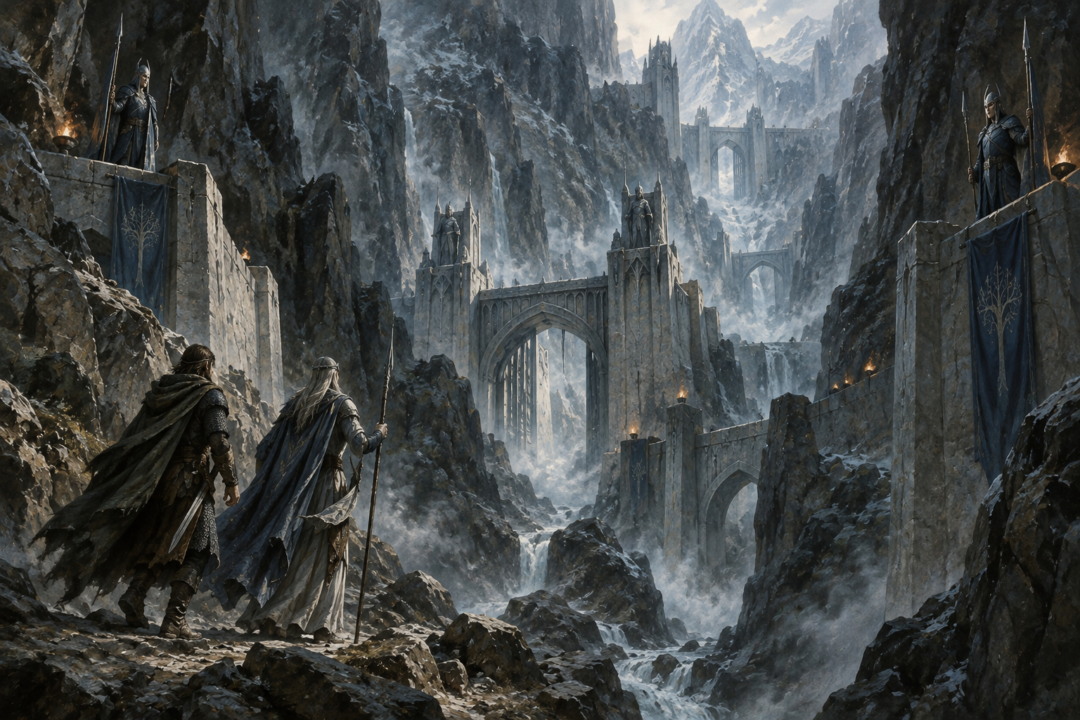
The detailed account of Tuor’s coming in Unfinished Tales makes this layered structure particularly vivid. Tuor and Voronwë pass through guarded approaches and the successive Gates before finally emerging where the hidden plain can be seen.
The famous Seven Gates therefore should not be imagined simply as Gondolin’s equivalent of seven city gates arranged around its urban wall.
They guarded the approach through the mountain barrier.
Wood, Stone, Bronze, Writhen Iron, Silver, Gold, and finally Steel transformed the narrow passage into a sequence of defensive checkpoints. An intruder who discovered the hidden route would still have to penetrate one guarded position after another.
The geography and the works of the Gondolindrim reinforced each other.
The Mountains Created Defensive Depth
Ordinary city walls concentrate defense at one perimeter.
Gondolin possessed something closer to defensive depth.
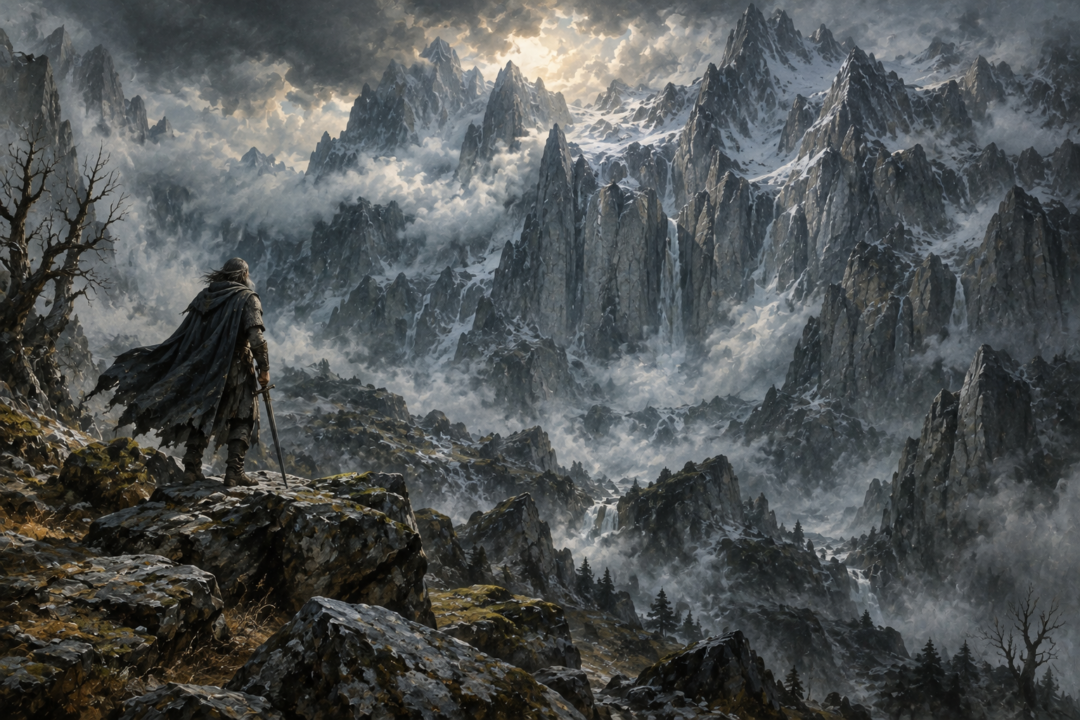
The outer world came first. Then the concealed approach. Then the mountain passage. Then the guarded Gates. Beyond them lay Tumladen. Only after crossing that plain could an attacker reach Amon Gwareth and the city itself.
This matters because every additional layer complicates surprise and movement.
The Echoriath also prevented Gondolin from being casually approached from the surrounding lands. Even friendly travellers did not simply wander into Tumladen.
Húrin and Huor provide an extraordinary example. They were carried into Gondolin by the Eagles rather than entering by an ordinary road. Later, after the Nirnaeth Arnoediad, Húrin returned to the region and could not regain entrance to the hidden kingdom.
The mountains had effectively separated Gondolin from the political geography around it.
That isolation was both its strength and, eventually, part of its danger.
The Eagles Added Another Layer
The southern heights of the Encircling Mountains included the Crissaegrim, associated with Thorondor and the Eagles.
Their presence added an unusual dimension to Gondolin’s security.
The mountain-ring was not merely empty wilderness. The skies and heights around the hidden realm were watched by powerful allies. The Eagles could carry individuals across terrain that would otherwise have made access extraordinarily difficult, as happened with Húrin and Huor.
This should not be exaggerated into a claim that the Eagles formed an impenetrable aerial defense system; the texts do not define their role in such mechanical terms.
But they clearly belonged to the wider protective environment surrounding Gondolin.
The Hidden City was therefore defended not merely by masonry and soldiers, but by concealment, terrain, guarded approaches, and powerful beings inhabiting the mountains themselves.
Why Morgoth Needed Information More Than Siege Engines
The history of Gondolin reveals the weakness of even the greatest fortress: defenses are useful only while the enemy must confront them on your terms.
For most of Gondolin’s existence, Morgoth’s problem was not breaking its walls.
His problem was finding it.
That is why knowledge of Gondolin’s location became strategically devastating.
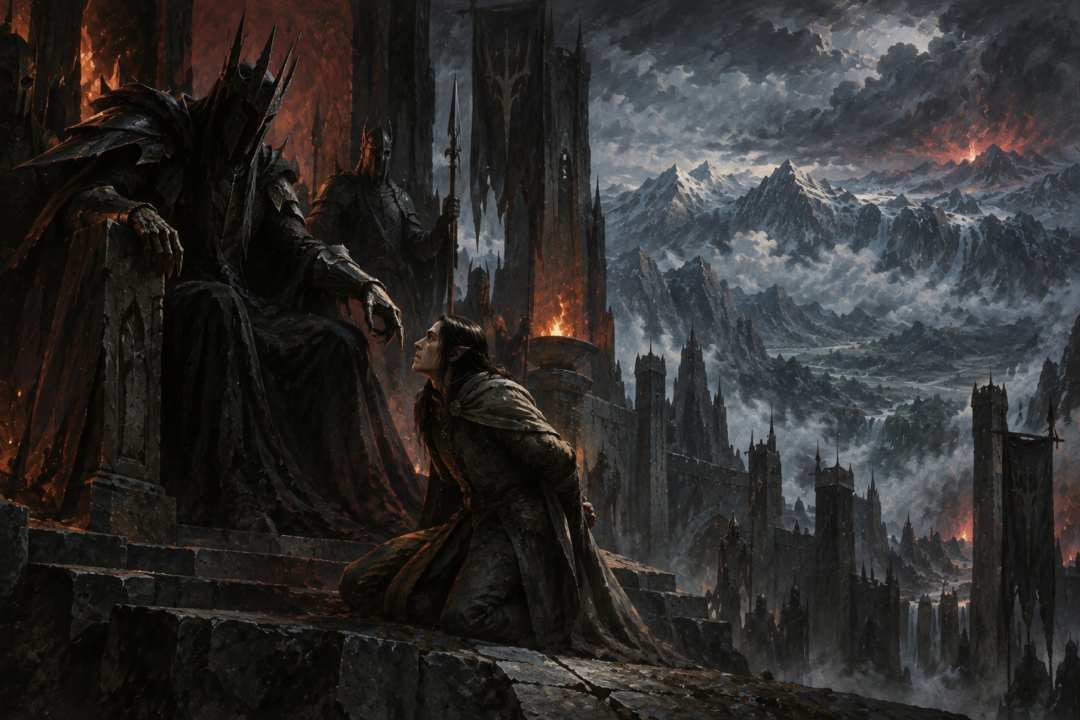
The decisive betrayal came through Maeglin. Captured by Orcs while outside Gondolin, he was brought before Morgoth and ultimately revealed the secret of the hidden kingdom.
Once that happened, Gondolin lost the advantage that had protected it for centuries.
This is one of the most important distinctions in understanding the city’s fall. The Encircling Mountains had not physically disappeared. The Seven Gates had not ceased to exist as defensive works simply because Morgoth knew where Gondolin lay.
What disappeared was uncertainty.
The enemy could now plan around the geography.
The Final Attack Exposed the Limitation of the Seven Gates
The traditional approach to Gondolin lay through the guarded way in the mountains.
But Morgoth’s assault did not need to reproduce Tuor’s journey through the Seven Gates.
Knowing Gondolin’s position allowed the attacking forces to come across the mountains from another direction. In the published Silmarillion, the host of Morgoth passes over the northern hills where they were highest and the watch least vigilant, attacking during the festival of the Gates of Summer.
That detail transforms our understanding of Gondolin’s defenses.
The Seven Gates were immensely formidable if the enemy came through the route they guarded.
But the Echoriath were the true strategic perimeter.
Once Morgoth knew enough to cross that perimeter elsewhere, the Gates could be bypassed.
A perfect door cannot save a fortress when the enemy knows how to come over the roof.
The Mountains Protected Gondolin Until Knowledge Defeated Geography
There is a tragic irony here.
Gondolin’s extraordinary natural defenses encouraged a strategy based upon remaining hidden. For centuries, that strategy worked astonishingly well.
Yet Ulmo’s warning through Tuor concerned precisely the danger of trusting too completely in Gondolin’s strength and secrecy. Turgon was urged to abandon the city, but he would not.
The same refuge that had preserved his people had become difficult to imagine leaving.
That does not mean the Echoriath somehow caused Gondolin’s destruction. The texts give the decisive causes in choices, betrayal, and the power of Morgoth.
But one reading of the story is that successful defenses can create their own temptation: survival begins to feel like proof of permanent safety.
Gondolin had remained hidden while much of Beleriand fell.
Eventually its people had centuries of experience telling them that the mountains worked.
Until suddenly they did not.
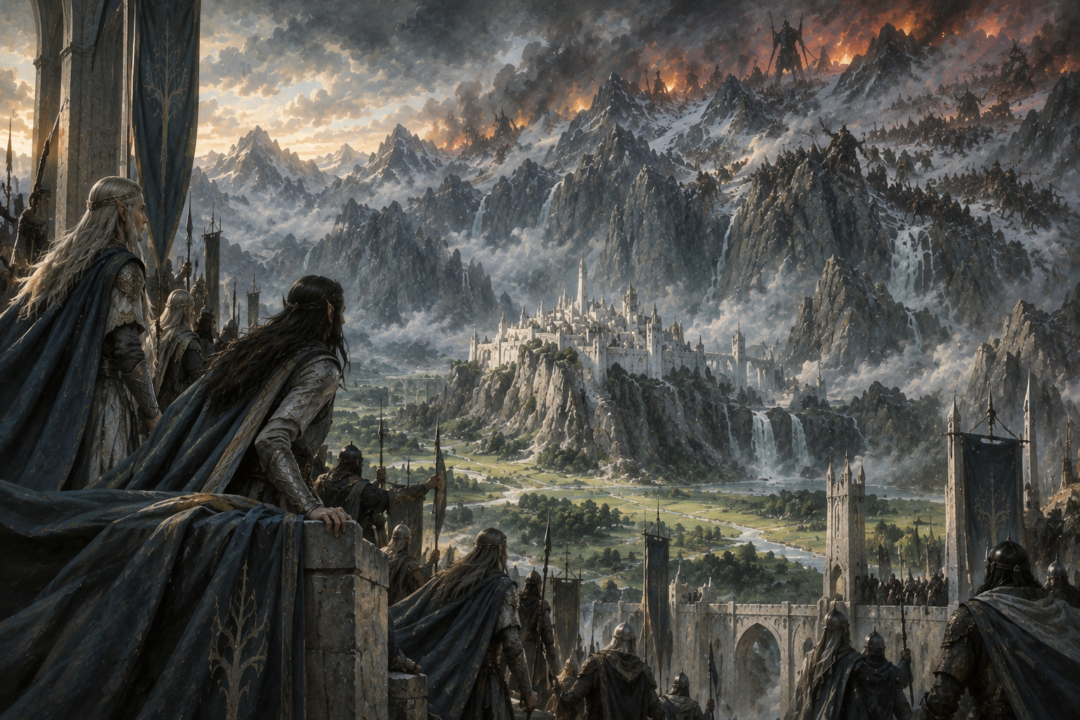
Gondolin’s Greatest Wall Was the World Around It
The walls of Gondolin protected streets, towers, homes, and people.
The Encircling Mountains protected the conditions that allowed those things to exist.
They concealed Tumladen from the wider world. They restricted ordinary movement into the valley. They enabled Gondolin’s guarded approach to function as a narrow defensive corridor. They separated the city from the wars consuming Beleriand. Together with secrecy and watchfulness, they prevented Morgoth from even beginning a conventional attack for generations.
That is why the fall of Gondolin is not fundamentally a story about walls being too weak.
Its greatest defensive system was defeated before the enemy reached the city.
Once Maeglin revealed what lay beyond the mountains, the Echoriath changed from a barrier surrounding an unknown realm into terrain an informed enemy could study, cross, and exploit.
Gondolin’s tragedy therefore rests on a powerful distinction.
A wall protects a place from an enemy who knows where it is.
The Encircling Mountains protected Gondolin by helping keep the place itself a secret.
For centuries, that difference was enough to preserve one of the greatest realms of the First Age.
And when the secret was finally broken, even mountains could not restore it.
Sources & Notes
- The Encyclopedia of Arda, “Echoriath” — describes the circular mountain range surrounding and protecting Gondolin and explains its sense as an encircling fence. https://www.encyclopedia-of-arda.com/e/echoriath.html
- The Encyclopedia of Arda, “Tumladen” — documents the hidden valley within the Encircling Mountains and Amon Gwareth at its center. https://www.encyclopedia-of-arda.com/t/tumladen.php
- The Encyclopedia of Arda, “Hidden Way” — traces the concealed tunnel and guarded ravine that led through the mountains to Tumladen and Gondolin. https://www.encyclopedia-of-arda.com/h/hiddenway.html
- The Encyclopedia of Arda, “Seven Gates of Gondolin” — details the successive defenses built across Orfalch Echor before the route opened onto Tumladen. https://www.encyclopedia-of-arda.com/s/sevengates.php
- The Encyclopedia of Arda, “Fall of Gondolin” — records the city’s destruction by Morgoth after Maeglin’s treachery and the survivors’ escape by a secret way. https://www.encyclopedia-of-arda.com/f/fallofgondolin.php
Sources document the Echoriath’s enclosure of Tumladen, the valley-and-hill geography, the concealed and fortified approach through the mountains, and Gondolin’s eventual fall after Maeglin’s betrayal.