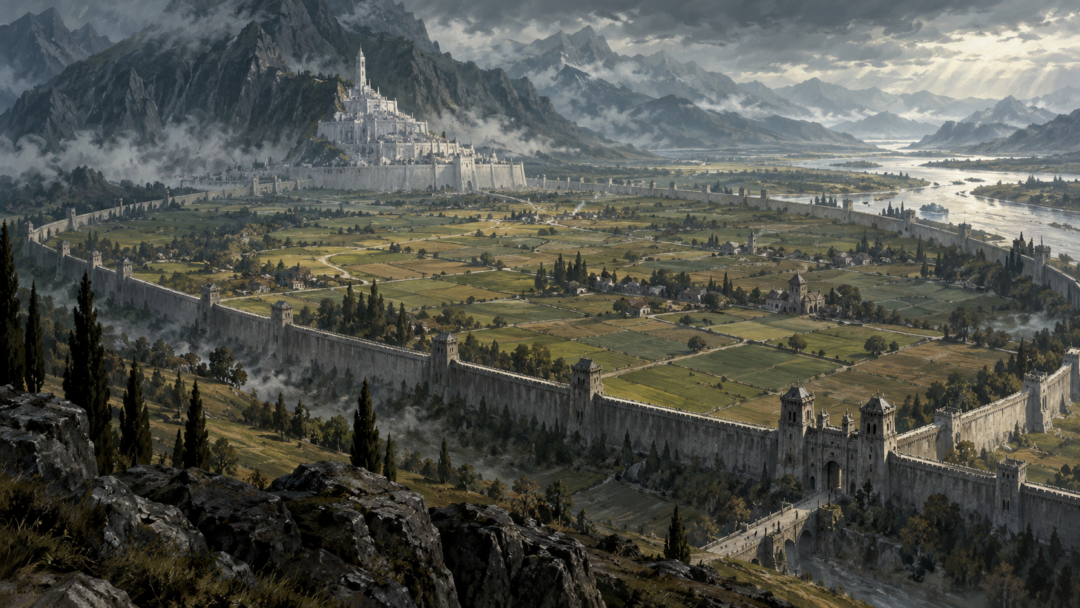
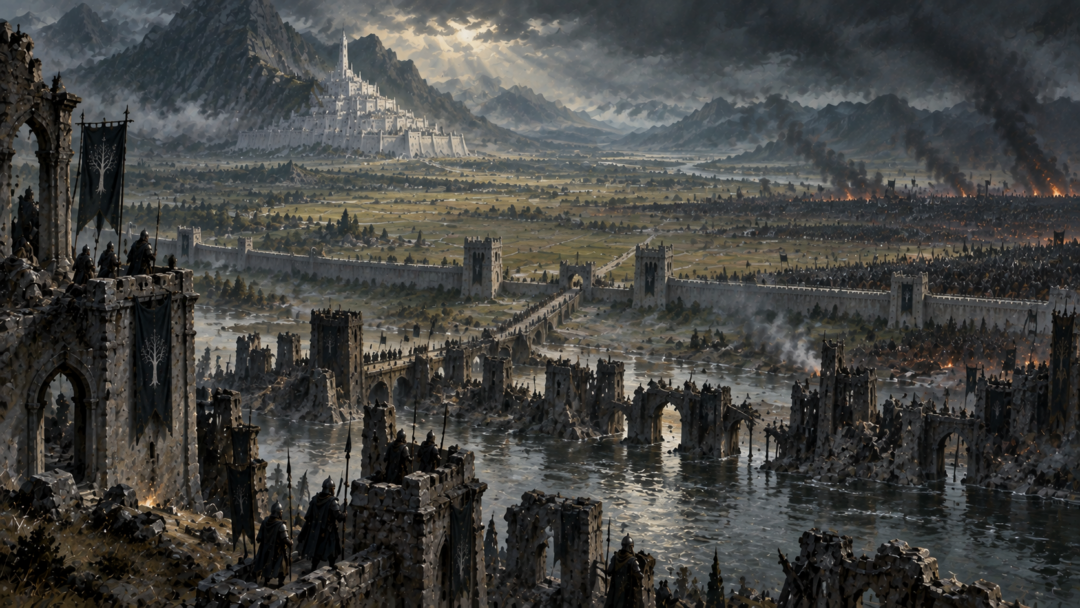
When Gandalf and Pippin finally approached Minas Tirith, they did not ride straight from the open country to the White City's gate. First they crossed another boundary: the Rammas Echor, the great outer wall enclosing the Pelennor Fields.
It was an enormous work. The wall ran for ten leagues or more, surrounding the fertile townlands beneath Minas Tirith. At its most exposed point toward Osgiliath, it stood roughly four leagues from the City's Great Gate, strengthened where the road from the Anduin passed between fortified towers.
Yet when Sauron's great assault came, the Rammas did not stop it.
The Causeway Forts were wrecked. The wall was breached. Gondor's soldiers retreated across the Pelennor. Soon the Enemy stood beneath Minas Tirith itself.
That can make the Rammas Echor look like a failed fortification. But that interpretation misses something important about Gondor's defence.
The wall did not need to be unconquerable to have military value.
What Gondor desperately needed was time.
The Wall Around More Than a City
The Rammas Echor was not simply another ring of Minas Tirith's fortifications. It enclosed the Pelennor Fields themselves.
Those fields were not empty ground. They were the City's fertile townlands, descending in slopes and terraces toward Anduin. Roads crossed them, and near their southeastern side lay the Harlond, where vessels coming upstream from Gondor's southern regions could land.
This matters because Minas Tirith depended upon a landscape outside its own stone walls.
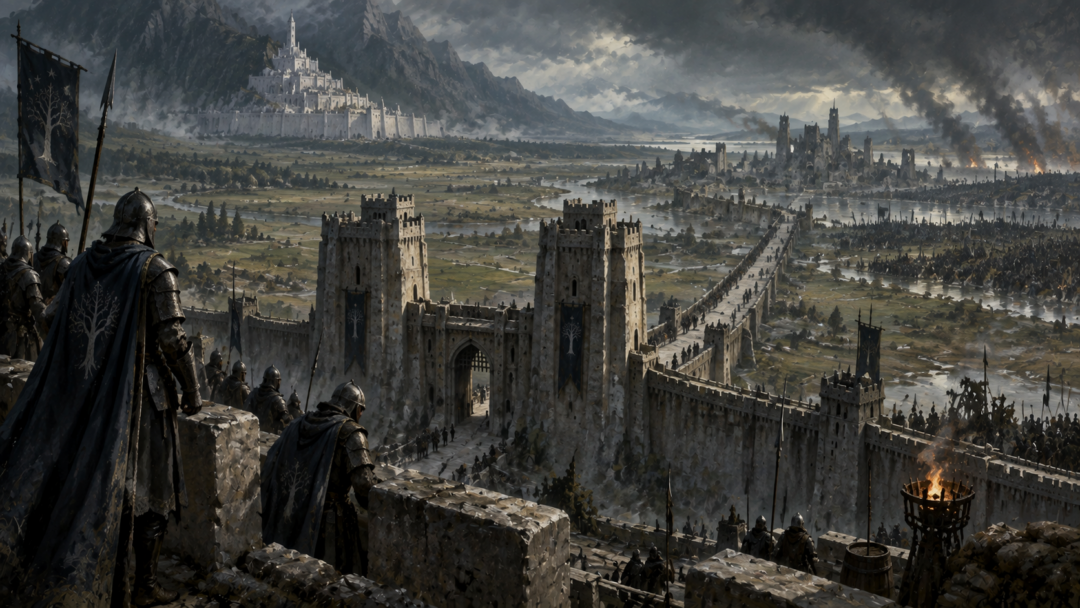
The Rammas therefore created a defended outer zone around the capital. An enemy approaching Minas Tirith from the east could not simply march from Osgiliath across open farmland and arrive immediately before the Great Gate. The attackers first had to penetrate an outer defensive perimeter.
Its strongest eastern approach was especially significant.
The road from Osgiliath entered the Pelennor through a guarded gate between fortified towers, generally called the Causeway Forts. This was the obvious line of advance from the Anduin toward Minas Tirith, and Gondor had strengthened it accordingly.
The geography reveals the basic logic of the Rammas: keep the war farther away from the City for as long as possible.
Gondor's Defence Was Built in Layers
By the War of the Ring, Gondor could no longer defend its eastern territories as it had in the days of its greatest power.
Ithilien had largely become contested and dangerous country. Osgiliath, once Gondor's great city upon Anduin, had become a battlefield and defensive outpost. Behind Osgiliath stood the Rammas Echor. Behind the Rammas stood Minas Tirith.
These positions can be understood as successive defensive layers.
That did not mean every layer was expected to survive indefinitely. Indeed, Denethor's strategy shortly before the siege shows that Gondor understood the danger of defending too far forward.
Faramir was sent to command the defence of Osgiliath. The defenders faced overwhelming numbers, and Faramir recognized the terrible calculation involved: the Enemy could be made to pay heavily for crossing the river, but if the crossing succeeded, Gondor's soldiers would then have a long and dangerous retreat.
That is exactly what happened.
The defence of Minas Tirith was therefore not one single stand at one single wall. Gondor attempted to make Sauron's army overcome position after position before reaching the capital.
And every obstacle potentially purchased something Gondor could not manufacture.
Hours.
What the Rammas Was Really Buying
There is no statement in the text declaring that the Rammas Echor was designed specifically to "buy time." Its stated context is that Gondor built the outer wall after Ithilien fell increasingly under the Enemy's shadow.
But its military function strongly implies delay as one of its principal advantages.
A wall forces choices.
An attacker must find a gate, assault a defended position, break through the masonry, climb it, or create breaches. Defenders can concentrate resistance at important approaches. Even if the attackers eventually succeed, the process can disrupt their advance.
For Gondor in March 3019, delay had extraordinary value.
Minas Tirith was waiting for reinforcements from the southern fiefs. Above all, it was waiting to discover whether Rohan would answer the Red Arrow and the beacons.
When Gandalf entered through the northern part of the Rammas, he found men still working on its defences. Ingold told him that this portion had been left until last because it faced toward Rohan and was considered the least exposed direction.
Gandalf immediately challenged that assumption. Saruman's war had already endangered the western roads, and safety could no longer be taken for granted from any direction.
The scene quietly reveals Gondor's strategic problem.
The Rammas was enormous.
The kingdom defending it was not.
A Thirty-Mile Problem
A wall more than ten leagues long demands men.
That may have been the Rammas Echor's fundamental weakness during the War of the Ring.
Minas Tirith itself was diminished from earlier days, and Gondor had to distribute its available strength among numerous responsibilities: Osgiliath, the approaches to the City, the Rammas, the City walls, and other threatened regions.
A fortification cannot defend itself.
The longer the perimeter, the more difficult it becomes to watch every section, reinforce threatened points, and prevent an enemy with overwhelming numbers from breaking through somewhere.
Sauron's forces possessed exactly that advantage.
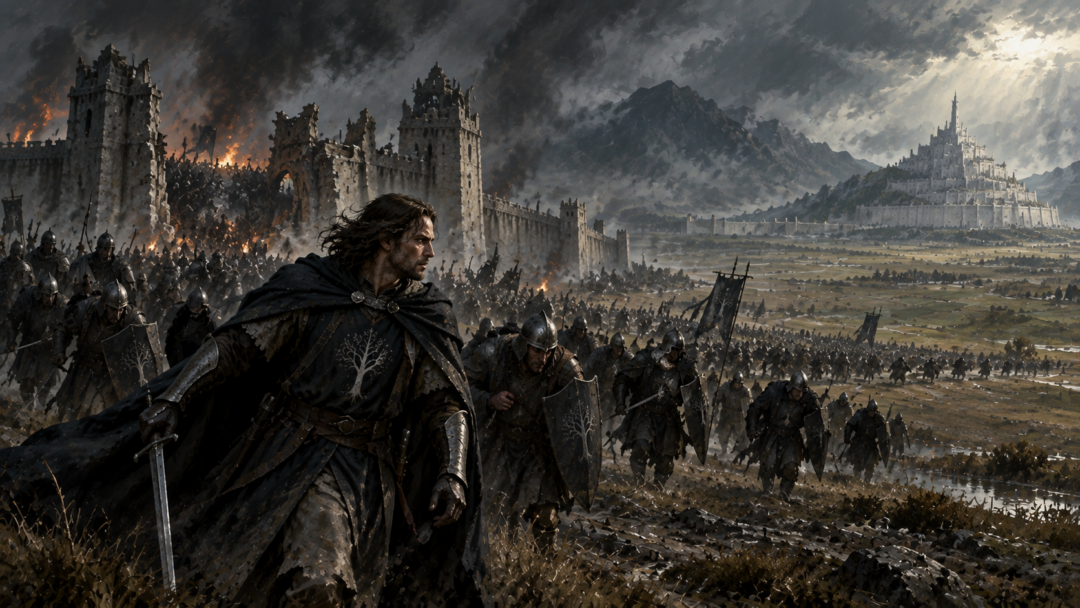
After the struggle at Osgiliath, Faramir withdrew toward the Causeway Forts. The Enemy pressed onward. The forts were eventually wrecked, and breaches were blasted through the Rammas.
Once that happened, the great outer enclosure could no longer prevent the host from entering the Pelennor.
But even here, the wall had not been meaningless.
Sauron's army had been forced through a sequence of contested positions rather than being granted an uncontested road directly to Minas Tirith.
The tragedy was that Gondor lacked enough strength to make each defensive layer cost the Enemy as much as its commanders hoped.
Faramir Paid for the Space Between the Walls
The fall of the Rammas created another danger that its enormous circumference had always implied.
The distance back to Minas Tirith was considerable.
From the eastern fortifications near the Osgiliath road, the Great Gate stood roughly four leagues away. Once Faramir's men were forced from the Causeway Forts, they had to cross that exposed ground while pursued by the Enemy.
Their retreat became disastrous.
Faramir remained with the rearguard as enemy forces overtook the withdrawing Gondorians. He was gravely wounded, and mounted forces from Minas Tirith had to ride out to rescue the survivors.
This exposes the cruel contradiction within Gondor's outer defence.
The Rammas gave Minas Tirith depth.
But defensive depth works both ways.
A distant outer position keeps the enemy farther from the capital, yet if that position collapses, its defenders must somehow cross the same distance they previously protected.
The Pelennor became a killing ground before it became the battlefield of Théoden and Aragorn.
The Enemy Broke the Wall — Then Made It Useful to Rohan
The strangest part of the Rammas Echor's story comes after its fall.
When the Rohirrim approached Minas Tirith, an intact and strongly held Rammas could have become a serious obstacle.
But the Enemy had already broken it.
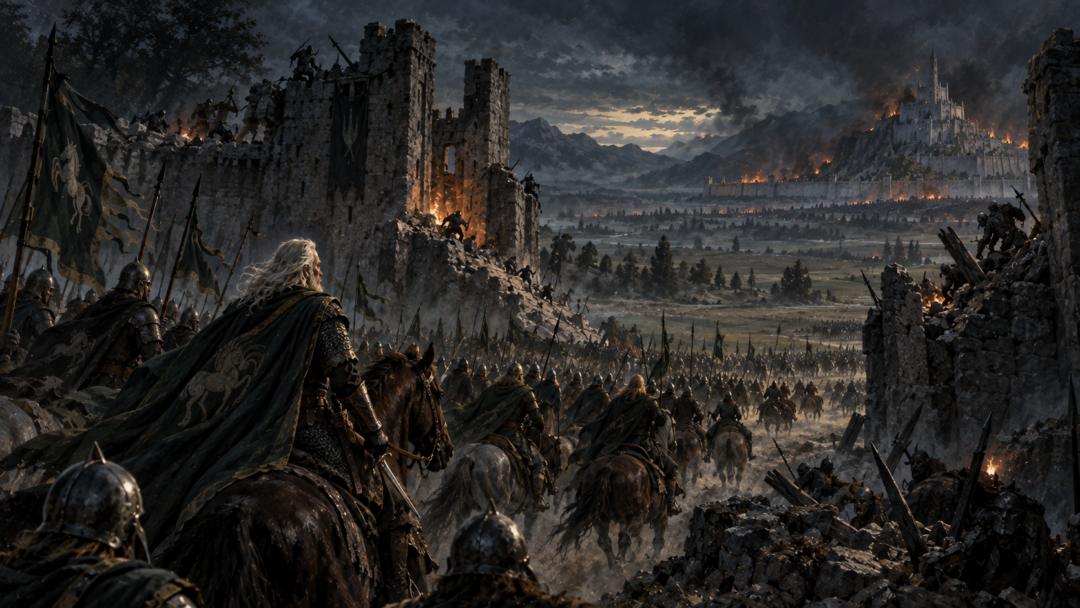
Ghân-buri-ghân brought Théoden's host through the hidden ways of the Drúadan Forest and provided information about the Enemy ahead. When the Riders finally reached the outer wall, they found ruined works and breaches.
The very destruction that had allowed Mordor onto the Pelennor now helped Rohan enter it.
This is one of the battle's sharpest strategic ironies.
Sauron's forces had smashed Gondor's outer defence because it stood between them and Minas Tirith. But once they were inside, they did not turn that entire defensive perimeter into an effective barrier against relief arriving from the north.
The Rohirrim passed through the broken Rammas and rode onto the Pelennor.
A wall had changed hands without truly becoming the Enemy's wall.
The Rammas Did Not Have to Save Minas Tirith Alone
It is tempting to judge fortifications only by whether they remain standing.
By that standard, the Rammas Echor failed spectacularly.
Its towers were wrecked. Its masonry was blasted open. The Enemy flooded across the Pelennor and eventually reached the Great Gate of Minas Tirith.
But Gondor's defence was never resting upon one wall.
Osgiliath was a barrier. The Causeway Forts were another. The Rammas was another. The Pelennor itself created distance. Finally there stood Minas Tirith, rising in seven levels against Mindolluin.
Each position forced the Enemy to advance farther and spend more effort before reaching Gondor's heart.
And during those final days, time mattered more than stone.
Rohan was riding.
Forces from southern Gondor were moving toward the war by another path under Aragorn.
Every hour that Minas Tirith remained unconquered preserved the possibility that the battle could change.
That is the deeper meaning of the Rammas Echor.
It was not a magical boundary and not an impregnable fortress. It was the outermost expression of a kingdom that no longer possessed enough strength to meet Mordor far beyond its capital and destroy the threat there.
So Gondor built walls closer to home.
The Rammas enclosed farms, roads, landing places, and precious miles of open ground. When the Enemy came, those miles became part of the defence.
The wall ultimately broke.
But what Gondor needed from every river crossing, tower, gate, wall, and rearguard was the same increasingly precious thing:
one more obstacle between Sauron's army and the White City, and one more span of time in which help might still arrive.
Sources & Notes
- Tolkien Gateway — Rammas Echor: geography, construction, repair, and wartime history. https://tolkiengateway.net/wiki/Rammas_Echor
- Tolkien Gateway — Causeway Forts: the fortified eastern entrance and its role in the siege. https://tolkiengateway.net/wiki/Causeway_Forts
- Tolkien Gateway — Pelennor Fields: geography, roads, distances, and the battlefield enclosed by the wall. https://tolkiengateway.net/wiki/Pelennor_Fields
Sources on the Rammas Echor’s geography, defensive role, eastern gate, and the fighting at the Causeway Forts.