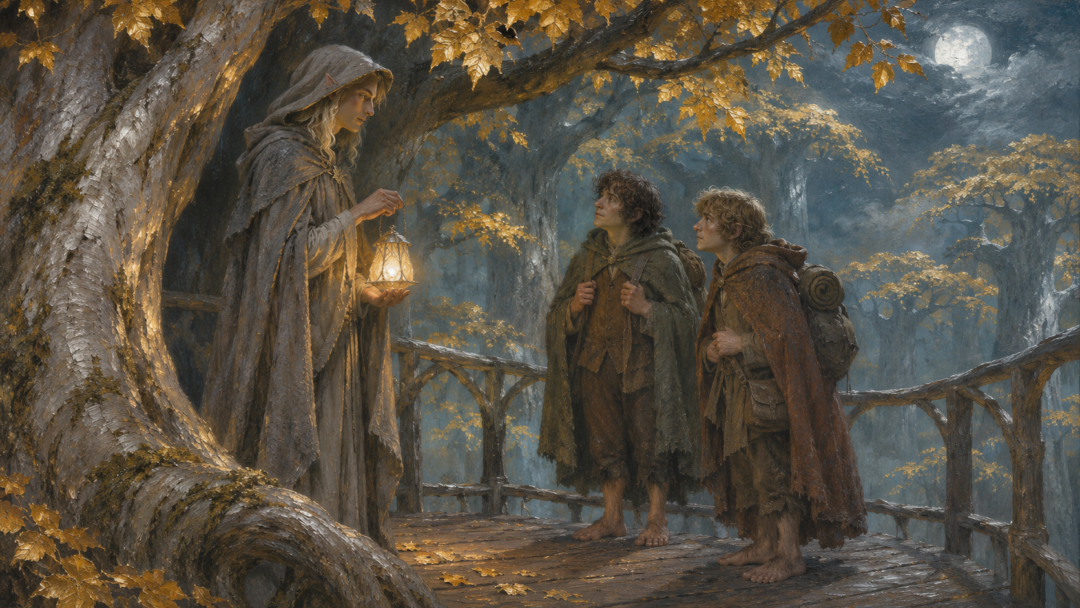
High among the trees of Lothlórien, the Fellowship finds shelter on a wooden platform while danger moves through the woods below. Haldir, the Elf who meets them there with his brothers, is accustomed to guarding a realm that does not readily welcome strangers. Yet among the travellers are four people who surprise him for a different reason: Hobbits. His remark about whether any of them “yet dwelt” in Middle-earth can sound as though he is hinting at some mysterious country beyond the known world.
He means something much simpler. Haldir did not know whether any Hobbits still lived in Middle-earth. Here, yet means still, dwelt means lived, and any refers to Hobbits, whom he also calls halflings. He is admitting a gap in the news available to him, not reporting that Hobbits had vanished from existence, once lived outside Middle-earth, or departed across the Sea. The wording is old-fashioned; the uncertainty is entirely ordinary.

What Haldir’s words actually say
The important sentence comes as Haldir explains why these visitors are unusual: “We had not heard of — hobbits, of halflings, for many a long year, and did not know that any yet dwelt in Middle-earth.” The two halves belong together. He first says that his people have received no news about Hobbits for a long time. Then he gives the consequence: they did not know whether any remained alive and living in the lands they knew.
In modern conversation, yet often points toward something expected to happen later. A reader may therefore hear the phrase as if Haldir were talking about Hobbits who had not yet settled somewhere. But this is not the sense of the sentence. In older or more literary English, yet can also express continuation: something was true before and is still true now. Haldir is asking, in effect, whether the existence of Hobbits has continued into his own day.
Dwelt is the past tense of dwell, a word for residing or making one’s home somewhere. It does not imply a different realm of existence, a temporary visit, or a particular kind of dwelling. The point of saying in Middle-earth is to locate the people whose survival he is discussing. He is not contrasting Middle-earth with another continent where surviving Hobbits might be hiding. Nothing in his sentence proposes an alternative homeland beyond its borders.
There is also a difference between not knowing that something is true and knowing that it is false. Haldir does not announce that the Hobbits became extinct; he says the Galadhrim lacked information confirming that they still existed. His surprise makes sense because living Hobbits are suddenly standing in front of him. They answer a question that news from distant places had left open, without requiring some forgotten catastrophe to explain the silence.

An informed Elf in a secluded country
Haldir’s conversation makes the limits of his information easier to understand. When the travellers first meet him and his brothers, the exchange begins in Elvish before he speaks slowly in the Common Speech. The Elves of Lórien rarely use other tongues and do not willingly deal with outsiders. Their woodland home is a guarded place, and meeting strangers involves decisions about safety as much as hospitality. It is not a setting where every rumour from the wider world arrives promptly.
Even within this little group of guards, knowledge is unevenly distributed. Haldir explains that some of his people still travel abroad to gather news and watch their enemies; he is one of them. His brothers, Rúmil and Orophin, speak little of the visitors’ language. That small detail helps distinguish having contact with the outside world from knowing everything about it. Haldir has experience beyond the trees, but his duties do not make him a complete chronicler of the peoples of Middle-earth.
The separation extends beyond language. Haldir tells the travellers that even the Elves’ own northern kindred are cut off from them. That is a striking admission in a story where Elves can seem to carry the memory of ages. Long lives do not guarantee easy communication. A person may remember stories from long ago while remaining uncertain about events in a region not regularly visited. The absence of fresh reports about Hobbits fits that wider condition of interrupted contact.
And Lórien is not wholly ignorant of the Fellowship. Messengers of Elrond have passed by with word that the company may come, so Haldir has some reason to expect these particular travellers. That recent message should not be mistaken for a general report on how many Hobbits are living in the Shire or elsewhere. News of a small party approaching a guarded border can travel along a specific route even when ordinary information about a distant people has not circulated for years.
His actions show how selective that knowledge is. Haldir learns that there are eight travellers, including four Hobbits, and is willing to receive them partly because they come with Legolas and have Elrond’s recommendation. Gimli, however, presents a different difficulty: the laws of Lórien restrict a Dwarf’s passage, and special conditions are imposed. Haldir is neither foolish nor all-knowing. He is a capable border guardian making careful judgments from the information and rules available to him.

How Hobbits passed out of sight
The Prologue to The Fellowship of the Ring offers a useful background to Haldir’s surprise. It describes Hobbits as an ancient, unobtrusive people whose beginnings have been lost or forgotten. They had lived quietly in Middle-earth long before other peoples paid them much attention. The surviving records of the Elves chiefly concern Elvish affairs, and Hobbits scarcely appear in them. That is a very different situation from a people whose every settlement and movement was closely observed.
What can be recovered of early Hobbit history points east of the Shire. Their oldest tales faintly recall life in the upper vales of the Anduin, between the great forest once called Greenwood and the Misty Mountains. This was a river landscape of eastern valleys and forest edges, not a place beyond Middle-earth. The account is deliberately cautious: those tales offer a glimpse of an early dwelling region, not a certain answer about where Hobbits first came into being.
Later, Hobbits moved westward across the Misty Mountains into Eriador, the broad region where the Shire would eventually lie. It helps to picture the change in setting. The old tales look toward the Anduin and the woodland east of the mountains; the Hobbits whom the reader knows live far to the west in settled country of fields, lanes, and villages. A people can remain very much alive while ceasing to be familiar to observers who associate them with an older region.
That movement offers context for the lack of recent news, but it is not a documented explanation of Haldir’s particular memory. The book does not say that he personally met Hobbits in the Anduin valleys, watched their migration, or lost touch at a precise moment. His remark establishes that they were known by report in Lórien long ago. Where that knowledge came from, and which communities it concerned, are not specified. Filling in those blanks would make the story sound more certain than it is.
The gaps are not confined to the Elves. By Bilbo’s day, the Hobbits themselves no longer remembered their original home. Their written records began only after the Shire was settled, while older family traditions reached back imperfectly into their wandering past. Their love of genealogies did not amount to a complete history of their earliest movements. If the Hobbits could lose sight of parts of their own story, there is little reason to assume distant woodland guards possessed an unbroken account of it.

What the meeting reveals about knowing Middle-earth
It would be a mistake to turn Haldir’s admission into a rule about every Elf. Elrond knows of the Hobbits in the Fellowship, Legolas has travelled with them, and Lórien’s leaders are not shown to share every limitation of their border guards. Haldir speaks from the knowledge of his own people and his own experience. His statement is useful precisely because it reveals a particular perspective, rather than delivering an authoritative census of all the inhabitants of Middle-earth.
There is a quiet contrast between what the reader knows and what Haldir has heard. We have spent time among Hobbit families, followed Frodo out of the Shire, and seen four Hobbits become central members of a dangerous undertaking. To Haldir they arrive as representatives of a people whose continued presence had become uncertain. A familiar name in one part of the story is almost a relic of old reports in another. Both experiences can be true within the same world.
That contrast also gives the scene some of its charm. The Galadhrim inhabit a place that feels ancient and watchful, yet their first encounter with these small travellers involves surprise, questions, and caution. Knowledge in Middle-earth follows paths made by journeys, friendships, messages, and memory. It does not spread evenly just because a people is old or wise. On a platform in the trees, the distant life of the Shire suddenly becomes something Haldir can see for himself.
So the natural modern reading is that Haldir had not known whether any Hobbits still lived in Middle-earth. He is not pointing toward an overseas refuge or announcing a lost race. He is standing before four living answers to an old uncertainty, beneath the branches of a forest where news from far away has long been scarce.
Sources & Notes
- Tolkien Gateway, Haldir — the Lórien border guard's knowledge, travels, and encounter with the Fellowship — https://tolkiengateway.net/wiki/Haldir
- Tolkien Gateway, Lothlórien (chapter) — Haldir's meeting with the four Hobbits — https://tolkiengateway.net/wiki/Lothl%C3%B3rien_(chapter)
- The Encyclopedia of Arda, Hobbits — early origins, the three branches, and westward migrations — https://www.encyclopedia-of-arda.com/h/hobbits.php
Reading references: The Fellowship of the Ring, Lothlórien and Prologue, Concerning Hobbits. Haldir's statement concerns the absence of recent information. The Hobbits' migration provides historical context but does not establish Haldir's personal memories.