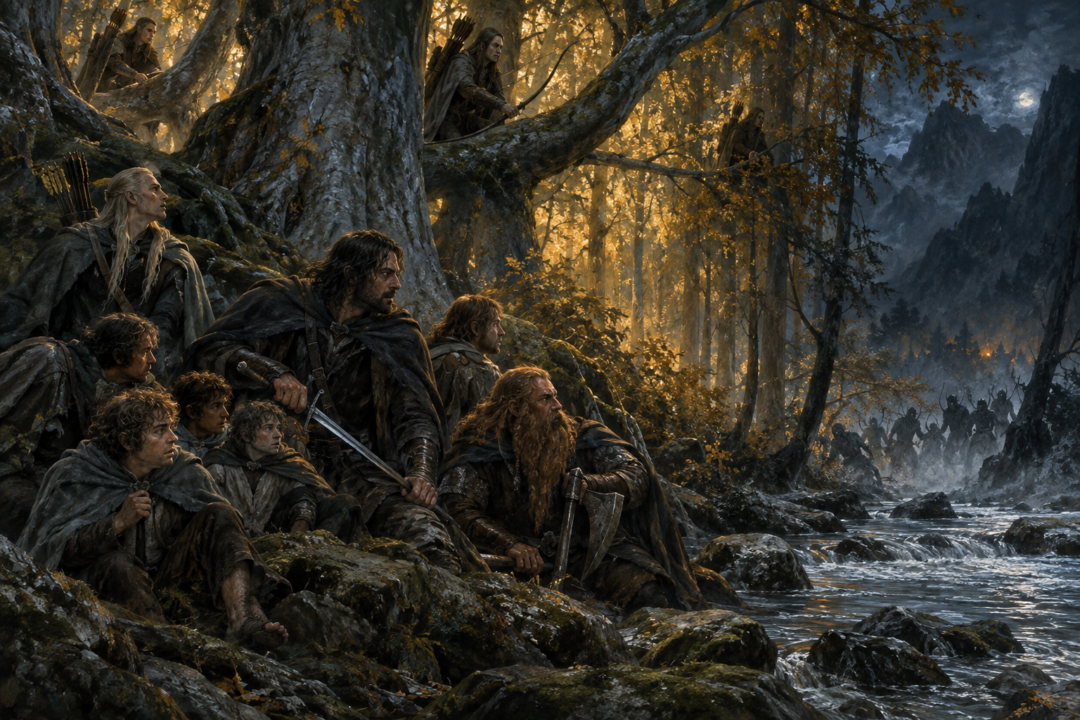
When the Fellowship escapes Moria, Lothlórien seems almost close enough to touch. Aragorn knows where they must go. Legolas recognizes the country. Beyond the cold streams and winter woods lies one of the last great Elven refuges in Middle-earth.
Yet reaching its trees does not mean being admitted.
This is one of the easily overlooked details of the journey after Moria: Lothlórien has no obvious stone wall around it, but it has a border all the same. The Fellowship cannot simply cross that border and continue toward Caras Galadhon. They are challenged, questioned, watched, and eventually led onward under conditions imposed by the Galadhrim.
The reason is larger than ordinary Elven secrecy. By January of T.A. 3019, Lórien is a surviving enclave in a world increasingly dominated by enemies. Its isolation is part of its defense, and the Fellowship arrives at almost the worst imaginable moment: pursued by Orcs, carrying a Dwarf, grieving Gandalf, and secretly bearing the One Ring.
The strange welcome they receive reveals what it costs to preserve a place like Lothlórien.
The Border Is Real Even Without a Wall
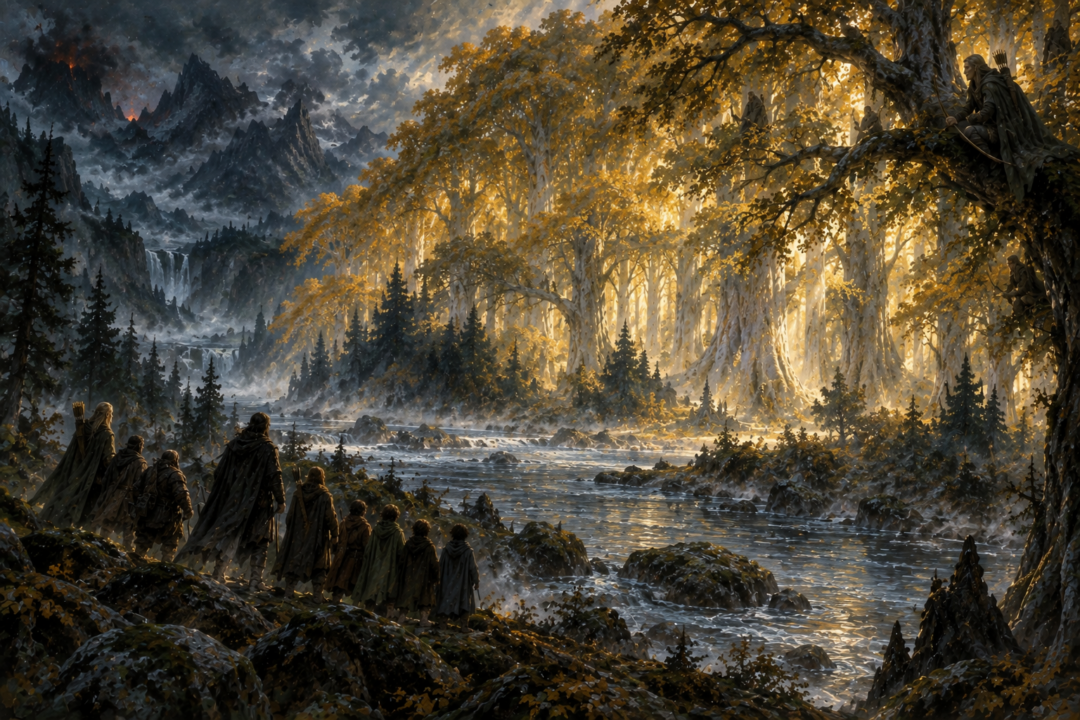
After escaping Khazad-dûm, Aragorn leads the Company toward the valley of the Silverlode and the stream of Nimrodel. The transition into Lórien is beautiful rather than militarized. There is no monumental gatehouse and no visible fortification stretching across the forest.
That does not make the frontier open.
The northern borders are watched by the Galadhrim. Haldir and his brothers Rúmil and Orophin are encountered there as wardens of the land, and Haldir becomes the Company's guide. The “Northern Fences” should therefore not be imagined simply as a constructed wall. The surviving descriptions point instead to a guarded boundary associated with the edge of Lórien itself.
Encyclopedia of Arda
This distinction matters. Lórien's defense depends partly on controlling knowledge: who enters, where they travel, and what they are allowed to see.
The Fellowship has physically reached the Golden Wood. Politically and practically, however, they have not yet been accepted into it.
Haldir Has Reasons to Be Suspicious
The Company is not treated as a random collection of trespassers. Legolas is recognized as one of the northern Elven kindred, and the Galadhrim have already received news connected with the Company's mission through the sons of Elrond. That gives the travellers a degree of credibility.
But it does not erase the danger surrounding them.
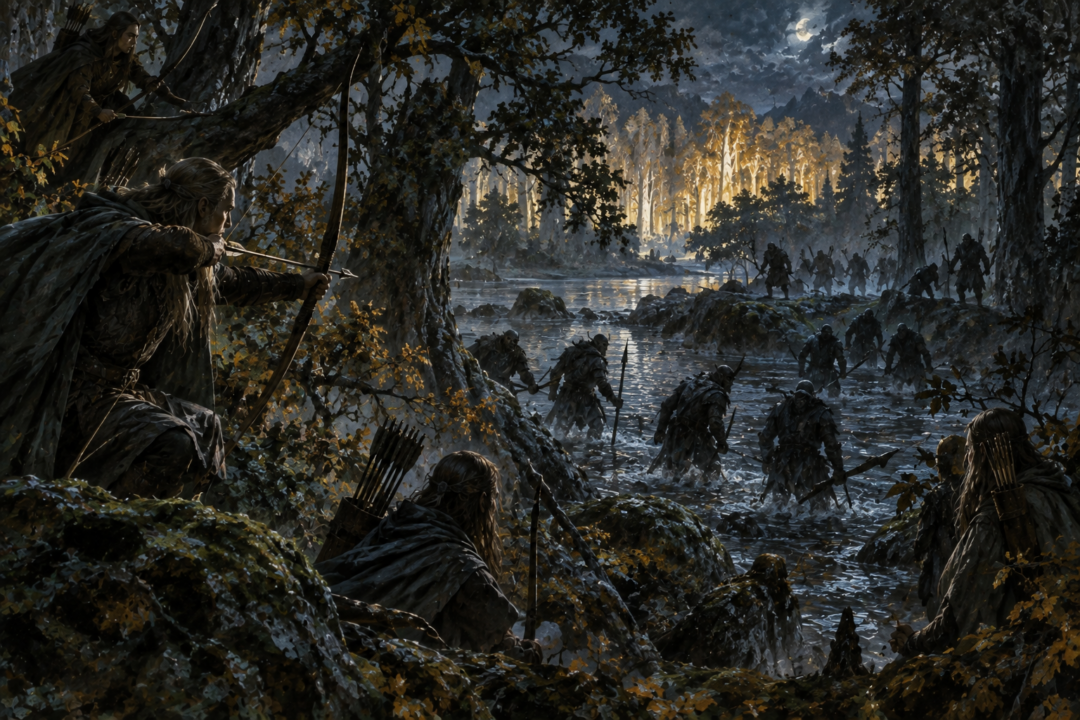
Orcs have followed them out of Moria. Indeed, during their first night near the border, Orcs cross the Nimrodel, and the Galadhrim respond militarily. This makes the wardens' caution immediately understandable: the Fellowship has arrived with the Enemy almost at its heels.
Haldir is therefore dealing with two conflicting realities. The strangers may be allies, but allowing strangers through Lórien's guarded country can expose the very thing the Galadhrim are trying to protect.
The Fellowship knows it desperately needs sanctuary.
The wardens know that sanctuary survives partly because outsiders cannot claim entry whenever they need it.
Gimli Makes the Problem Harder
The most visible dispute concerns Gimli.
Haldir's reluctance to allow a Dwarf into Lórien is not merely an arbitrary inconvenience invented for the journey. Relations between Lórien and the Dwarves had long since broken down. Haldir speaks of a separation dating from the “Dark Days,” though the precise historical scope of that expression is not fully explained in the narrative.
A plausible connection is the catastrophe surrounding Khazad-dûm after the awakening of Durin's Bane. That disaster did not affect the Dwarves alone. It brought fear and upheaval to nearby Lórien, and the later history preserved in Unfinished Tales connects the unrest of that period with the departure of many of its people and the loss of Amroth. The exact motives behind every later prejudice should not be overstated, but the estrangement between the communities is explicit.
Encyclopedia of Arda
Gimli consequently represents something uncomfortable at Lórien's border: an ally whose people are associated with an old rupture between neighboring realms.
Haldir ultimately permits him to proceed, but under a humiliating condition.
He must be blindfolded.
The Blindfold Is About More Than Gimli
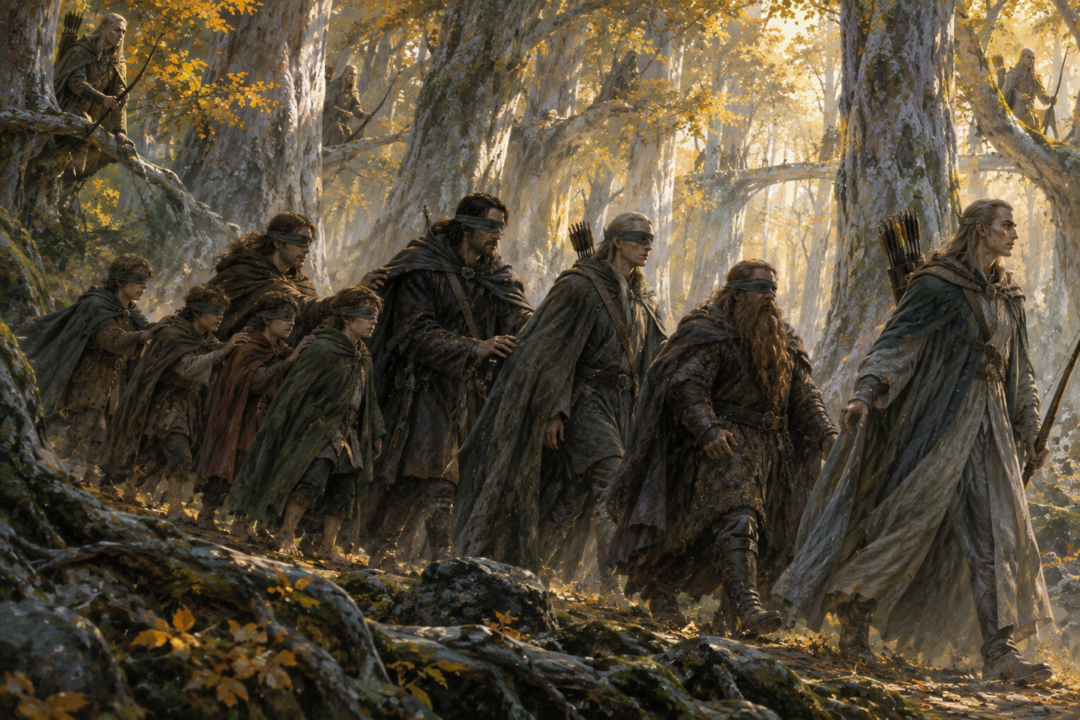
Gimli refuses to accept being singled out. Legolas is angered by the resulting dispute. Aragorn solves the immediate crisis by declaring that the entire Company will go blindfolded.
That decision transforms an insult directed at one member into a burden shared by all.
It is also a revealing moment in the Fellowship's internal story. They have just lost Gandalf, the figure who repeatedly guided them through dangers they did not understand. Now Aragorn must hold together a Company containing old cultural tensions that the Quest itself has not magically erased.
The solution is not to pretend those tensions do not exist. It is to prevent them from breaking the Company apart.
So Men, Hobbits, Elf, and Dwarf all surrender their sight together.
The episode also preserves Lórien's demand for secrecy. The travellers may enter, but they will not initially learn the ways through the protected land simply because they have been admitted. The Fellowship is indeed led blindfolded until word arrives that changes the conditions of their passage.
That is an important distinction: hospitality in Lórien is controlled hospitality.
Galadriel Changes the Terms
The blindfolding does not last all the way to Caras Galadhon.
A message comes from the Lord and Lady, and the Fellowship is permitted to uncover their eyes. Haldir specifically acknowledges that the command has changed. From that point onward, they are no longer merely strangers being cautiously escorted through forbidden country.
The shift tells us something about where authority ultimately lies.
Haldir is not inventing Lórien's policy for himself. He is enforcing the defensive customs of his people. Galadriel and Celeborn can override those restrictions because they possess the authority to accept the risk.
This is why the Fellowship cannot simply walk in even though Aragorn knows Lórien, Legolas is an Elf, and their mission concerns the fate of all the Free Peoples. Recognition is not permission.
Permission must come from within.
Moria Explains Why Lórien Has Learned Caution
There is a darker irony behind the border episode.
The Fellowship has come to Lórien because Moria has nearly destroyed them. Yet the ancient terror beneath Moria is also one reason Lórien has cause to fear what comes from beyond its borders.
When Celeborn later hears the full account of the Company's passage through Khazad-dûm, he reacts strongly to the revelation that the Balrog has emerged. He says that had he known the danger had been awakened, he would not have permitted the travellers to enter Lórien.
Galadriel responds more generously, especially toward Gimli, and Celeborn withdraws his harsh words.
But his reaction is significant.
The Fellowship thinks of itself as fleeing from evil. From Lórien's perspective, that same evil may be following them.
The Orc pursuit proves that this fear is not theoretical.
A refuge can be endangered by the people who most desperately need refuge.
The Golden Wood Is Preserved, Not Merely Hidden
Lothlórien often feels timeless when experienced through Frodo's perception. Once the Company reaches its heart, the ordinary decay of the outside world seems strangely distant. Cerin Amroth especially gives Frodo an extraordinary sense of encountering something belonging to an older world.
Yet the journey into that beauty is surrounded by reminders that Lórien is not outside history.
Its wardens carry bows. Its borders are watched. Orcs can approach them. Messages move between guards and rulers. Outsiders are questioned. Routes through the land are protected.
Even Caras Galadhon is not simply sitting undefended in an enchanted forest.
The contrast is deliberate and powerful: what appears effortless from inside has required vigilance from those protecting it.
Galadriel's Ring, Nenya, is later revealed to Frodo, and her preservation of Lórien is connected with one of the Three Rings. But the text does not reduce the realm's safety to an automatic magical shield. There are still scouts, warriors, boundaries, and choices about whom to trust.
Lórien survives through both power and vigilance.
The Fellowship Crosses More Than a Geographical Border
By the time Haldir leads the travellers deeper into the land, their arrival has become a small test of the Fellowship itself.
Gimli could have been excluded.
Legolas could have insisted on his privileged status.
Aragorn could have allowed one companion to bear an indignity for everyone else's convenience.
Instead, the Company accepts blindness together.
That choice anticipates one of the most important developments to come in Lórien: the gradual breaking down of the hostility between Elf and Dwarf. Galadriel will speak to Gimli with extraordinary courtesy, and Gimli will leave the Golden Wood profoundly changed by his encounter with her.
The border dispute therefore begins with inherited suspicion but does not end there.
Lothlórien's defenses are necessary because Middle-earth has become dangerous. Yet absolute suspicion would eventually destroy the very alliances needed to resist that danger.
The Fellowship enters because someone finally chooses trust without pretending risk has disappeared.
Why They Cannot Simply Walk In
The answer is therefore not that an invisible spell physically prevents the Fellowship from entering.
They cannot simply walk into Lothlórien because Lórien is a guarded realm whose survival depends on controlling its borders. Its northern approaches are watched by the Galadhrim; strangers require permission and guidance; the paths of the land are protected from outsiders; relations with Dwarves are burdened by old estrangement; and enemies are active close enough that Orcs arrive almost alongside the Fellowship.
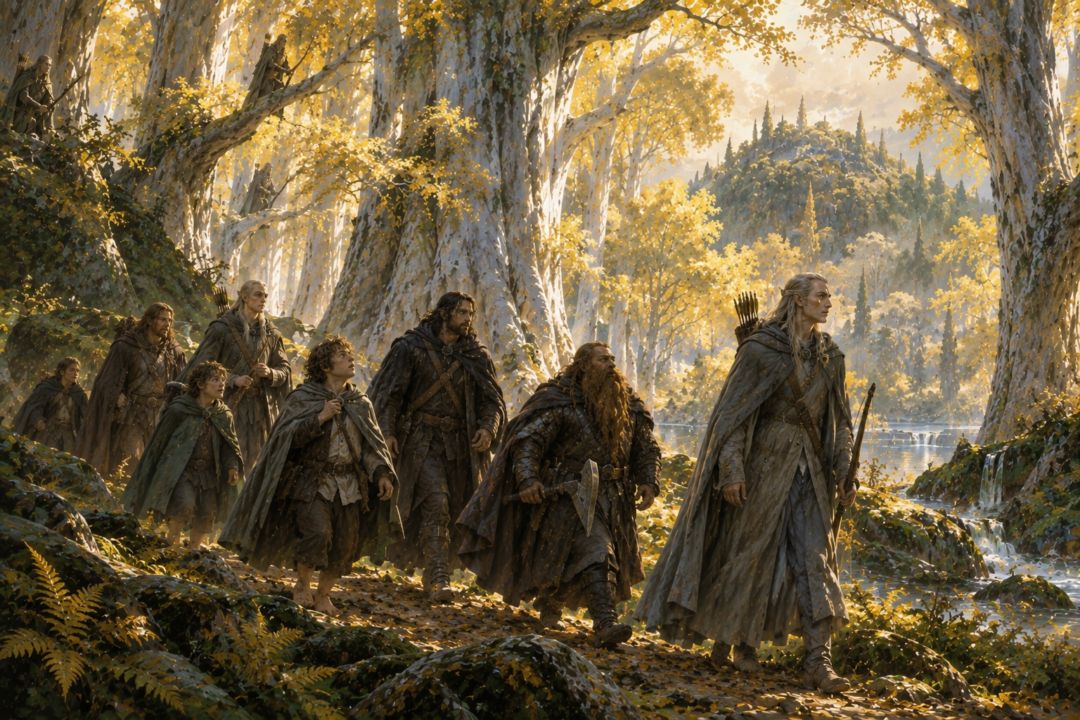
Encyclopedia of Arda
That makes the episode more than an obstacle between Moria and Galadriel.
The Company has just escaped a ruined civilization whose defenses ultimately failed. Now it encounters a surviving realm determined not to suffer the same fate.
And that creates one of the quiet contradictions at the heart of Lothlórien.
The Golden Wood is beautiful because much of the darkness of Middle-earth has been kept outside.
But when eight exhausted travellers arrive at its edge, Lórien must decide whether keeping darkness outside also means keeping out those who are fighting it.
For a time, the Fellowship stands on the wrong side of that question.
Sources & Notes
- Tolkien Gateway — Lothlórien https://tolkiengateway.net/wiki/Lothl%C3%B3rien
- Tolkien Gateway — Fellowship of the Ring https://tolkiengateway.net/wiki/Fellowship_of_the_Ring
- Tolkien Gateway — Nimrodel https://tolkiengateway.net/wiki/Nimrodel_(river)
These reference entries document Lothlórien's guarded borders, the Fellowship's journey, and the geography around Nimrodel. The logistical interpretation of their entry remains the article's synthesis.