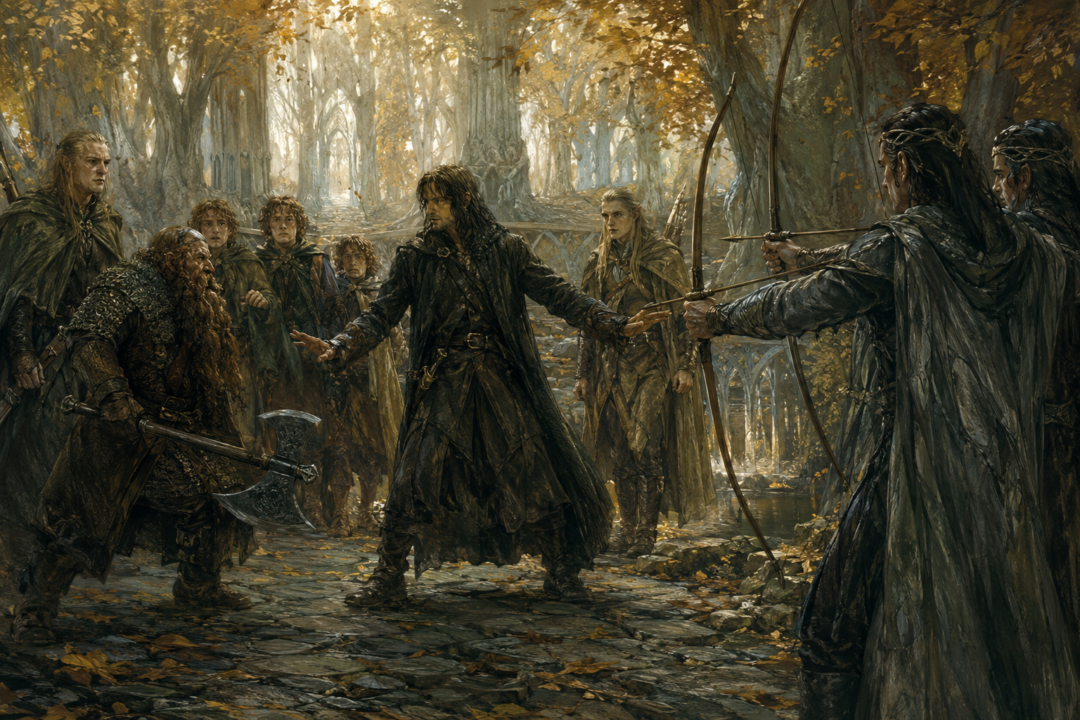
The Fellowship has escaped Moria, Gandalf is gone, Orcs are pursuing them, and the Quest of the Ring is hanging by a thread. Yet at the borders of Lothlórien, the Company nearly fractures over something far smaller than a battle: a blindfold.
The Elves of Lórien will permit the Fellowship to continue into their guarded realm, but Gimli must enter without seeing the way.
Gimli refuses.
Legolas becomes angry.
Weapons are suddenly close to deciding what words cannot.
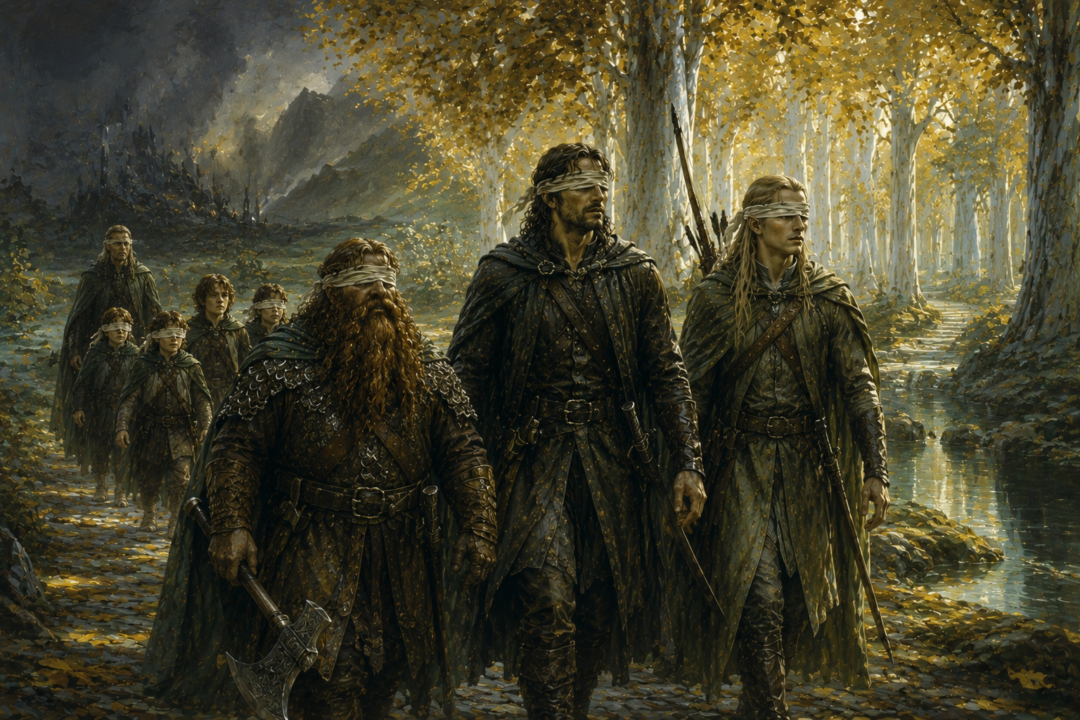
Then Aragorn intervenes. His solution is remarkably simple: if Gimli must be blindfolded, everyone will be blindfolded—including Legolas.
It is a brief episode in The Fellowship of the Ring, but it reveals something important about Aragorn's emerging leadership. He does not force Lórien to abandon its precautions, and he does not demand that Gimli silently accept the humiliation of being singled out.
Instead, Aragorn changes who bears the burden.
Why Lothlórien Distrusts Gimli
The dispute begins before the blindfold itself.
When Haldir and his companions first encounter the Fellowship in Lórien, Legolas is recognized as an Elf and northern kinsman. Gimli receives a very different reception. Haldir makes clear that Dwarves have not entered the land for many years and that the people of Lórien do not readily trust them.
This is not presented merely as Haldir having a personal dislike of Gimli. The mistrust belongs to a much older estrangement between Elves and Dwarves.
There is also an immediate military reason for Lórien's caution.
The Golden Wood exists in a dangerous world. Orcs are nearby. Sauron's power is growing. Lórien survives partly because its borders are guarded and outsiders do not freely learn its secrets.
Haldir therefore insists that Gimli cannot proceed farther into the Naith unless he is blindfolded.
From Lórien's perspective, the restriction is defensive.
From Gimli's perspective, it is an insult.
Both facts matter.
Gimli Objects to Being Treated as the Suspicious One
Gimli's anger is not simply stubbornness.
He has crossed the Wild with the Fellowship. He has survived the attack of the Watcher in the Water, entered Moria with them, fought beside them, and fled the Orcs with them after Gandalf's fall.
Yet when they reach an allied land, Gimli alone is marked as the member who cannot be trusted with his own sight.
He refuses to accept it.
The confrontation escalates dangerously. Gimli draws his axe, while Haldir and his companion bend their bows.
The Fellowship has just survived the servants of the Enemy, and now allies of the same larger cause are moments away from violence.
That irony is central to the scene.
The Shadow does not need to make every opponent serve Sauron directly. Old suspicion can do damage of its own.
Haldir himself soon identifies the deeper problem: the estrangement among those who oppose the Dark Lord is one of the clearest signs of his power in the world.
Aragorn's response therefore has to accomplish more than preventing a fight. He must keep the Company together without dismissing the legitimate fears of Lórien.
Aragorn Does Not Simply Order Gimli to Submit
Aragorn could take the easiest route.
After Gandalf's fall, he has assumed practical leadership of the Company. He could tell Gimli that Lórien's rules must be obeyed and that the Quest is too important for personal pride.
There would be logic in that decision.
But Aragorn recognizes what is wrong with the arrangement. Gimli is not merely being asked to endure inconvenience. He is being separated symbolically from his companions.
Aragorn states the heart of the matter plainly: “It is hard upon the Dwarf to be thus singled out.”
That is the key to his solution.
He does not declare Lórien's caution meaningless. Nor does he claim that Gimli possesses some absolute right to see the hidden ways of a guarded Elven realm.
Instead, he removes the unequal part of the burden.
If sight must be surrendered, everyone will surrender it.
“The Company Shall All Fare Alike”
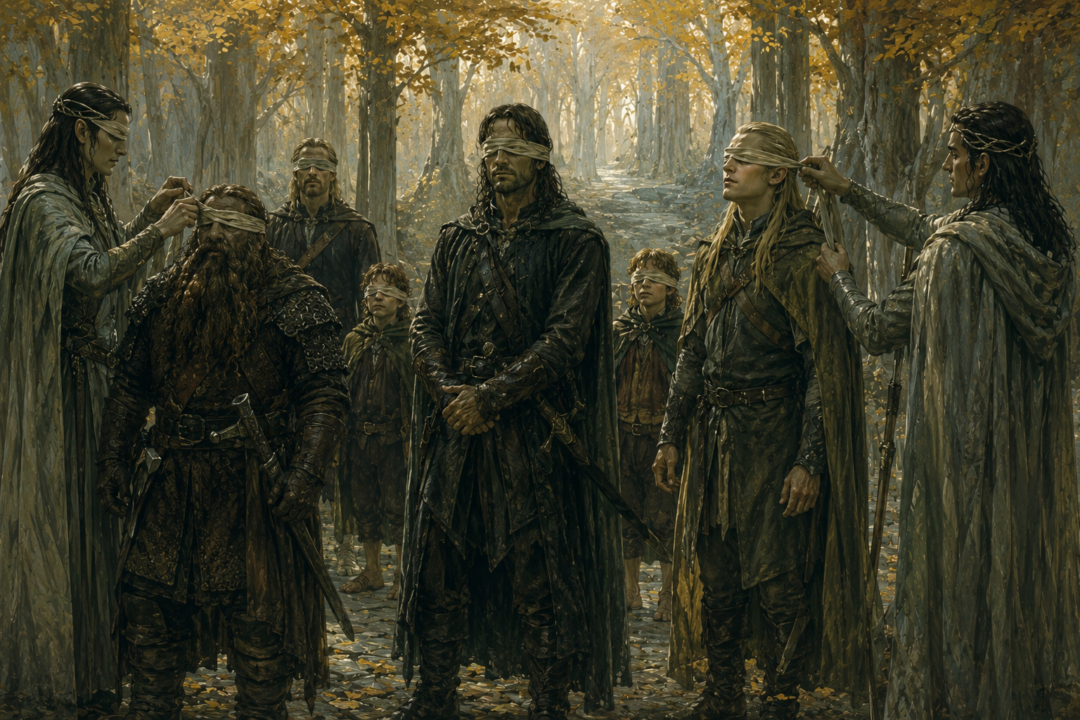
Aragorn orders the whole Fellowship to be blindfolded.
That includes Legolas.
This detail matters because Legolas has the strongest argument for exemption. He is an Elf, Haldir recognizes him as kin, and the restriction was never intended for him.
Gimli immediately finds Aragorn's proposal acceptable provided Legolas shares his blindness.
Legolas, unsurprisingly, objects.
He is now being asked to suffer a restriction imposed because of someone else's mistrust. Aragorn answers his anger with humor, turning Legolas's earlier complaint about the “stiff necks” of Dwarves back upon the Elves.
Then comes Aragorn's governing principle:
“The Company shall all fare alike.”
The solution is not equality because everyone originally stands in the same relationship to Lórien. They plainly do not.
It is equal treatment because Aragorn deliberately makes the Fellowship share a burden that would otherwise isolate one member.
Gimli keeps his dignity.
Lórien keeps its secrecy.
The Fellowship keeps moving.
No side receives everything it wants, but nobody needs to shed blood.
Aragorn Makes Himself Share the Cost
There is another important element in Aragorn's decision: he blindfolds himself too.
He does not impose solidarity only on other people.
Aragorn knows Lórien. He has been there before, and the land carries profound personal significance for him. Later, at Cerin Amroth, his memories reveal just how deeply the place is connected with Arwen and his own past.
Yet he voluntarily gives up his sight alongside Gimli.
Boromir does the same. Frodo, Sam, Merry, and Pippin do the same. Legolas, despite his frustration, does the same.
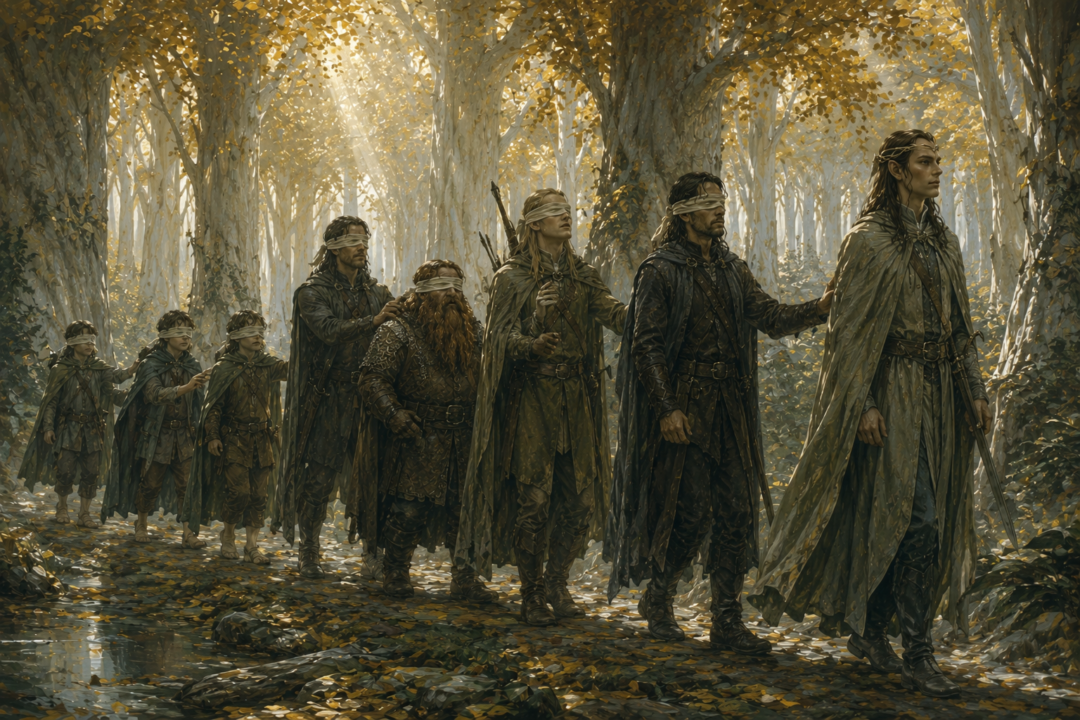
The entire Fellowship becomes dependent upon Haldir's guidance.
That transforms Gimli's position.
He is no longer the suspicious outsider being escorted through Lórien under special restriction. He is one member of a Company traveling under the same condition.
Aragorn has not removed the blindfold.
He has removed its power to isolate Gimli.
The Scene Shows the Kind of Leader Aragorn Is Becoming
This moment comes at an especially important point in Aragorn's story.
Gandalf has fallen in Moria.
Until then, Gandalf has been the Fellowship's principal guide. Once he is lost, responsibility falls heavily upon Aragorn.
The blindfold dispute is therefore one of the early tests of what Aragorn's leadership will actually look like.
There is no monster to kill here.
No swordsmanship can solve the problem.
Aragorn must understand several competing truths at once.
Lórien has genuine reasons for secrecy. Gimli has genuine reason to resent being singled out. Legolas genuinely belongs among the Elves and dislikes being treated like a stranger. The Quest cannot afford a violent quarrel among allies.
Aragorn's answer preserves what is necessary while redistributing what is painful.
That is a more subtle form of authority than simply issuing commands.
He does issue one—“you must do as I bid”—but the command succeeds because it is attached to a solution that he himself accepts.
Haldir Reveals the Larger Tragedy
Legolas remains unhappy as they travel blindfolded.
His complaint exposes the absurdity of the situation: everyone in the Company and everyone guarding Lórien is opposed to the same Enemy, yet they cannot fully trust one another.
Haldir agrees that it is folly.
But he also explains why the folly persists.
Lórien lives surrounded by danger. Trust beyond its borders has become scarce, and its people fear that careless openness could destroy what they are protecting.
This prevents the scene from becoming a simplistic lesson in which the suspicious Elves are merely wrong.
Their fear has reasons.
That makes Aragorn's intervention more interesting.
He cannot heal the entire history of estrangement between Elves and Dwarves beside the Celebrant. He cannot guarantee that trust will never be betrayed.
What he can do is prevent inherited suspicion from dividing his own Company.
For the moment, that is enough.
The Blindfolds Do Not Last
Eventually a message arrives from Celeborn and Galadriel.
The Fellowship is welcomed, and the order concerning their eyes is withdrawn.
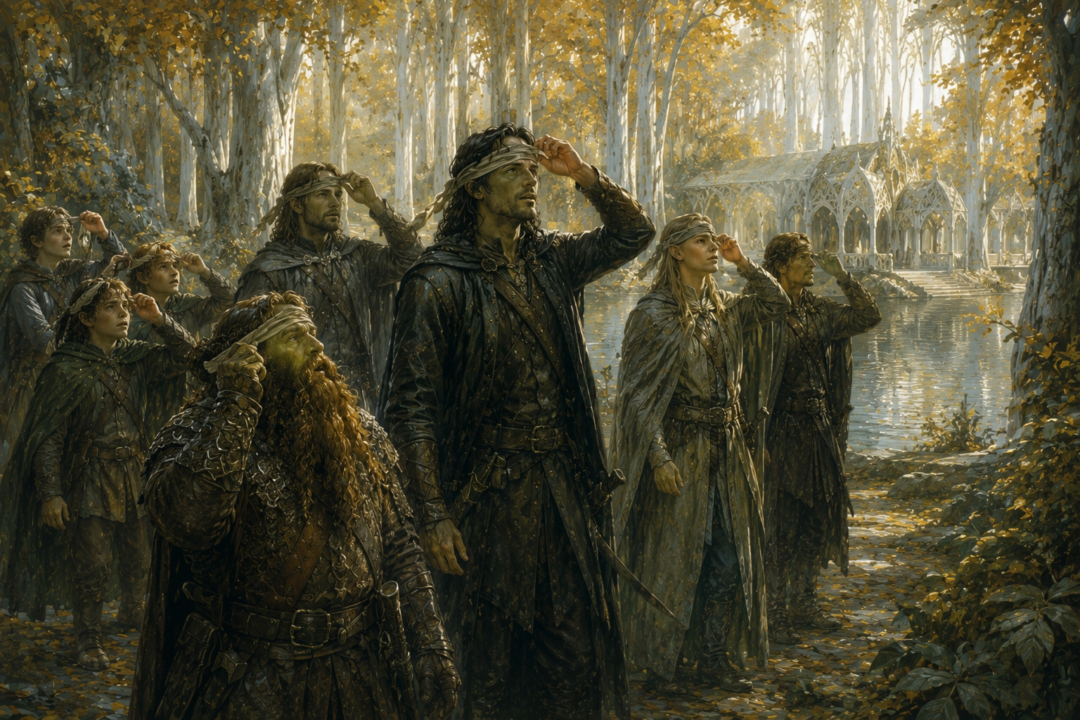
The blindfolds are removed before they behold Cerin Amroth.
The timing gives the episode an almost symbolic shape, even if it should not be pressed into a rigid allegory.
The Company first enters deeper into Lórien deprived of sight because trust is incomplete. Then, through the authority of the Lord and Lady, that restriction is lifted.
Gimli is permitted to see what he had originally been forbidden to see.
More importantly, his relationship with the Elves is about to change dramatically.
His meeting with Galadriel will become one of the crucial moments in his story, and his growing friendship with Legolas will cross one of Middle-earth's oldest cultural divisions.
The blindfold dispute therefore occurs at the beginning of a larger movement from suspicion toward understanding.
Aragorn does not create that reconciliation himself.
But he prevents the quarrel from destroying the possibility of it.
Aragorn's Solution Is Small, but Its Principle Is Large
The scene lasts only a short time, yet it contains a remarkably practical vision of fellowship.
Aragorn cannot make everyone equally trusted.
He cannot erase the history between Elves and Dwarves.
He cannot command Haldir to forget his duty to Lórien.
So he does something achievable.
He refuses to let one companion carry the humiliation alone.
That distinction is important.
Aragorn's decision is not based on pretending that differences do not exist. Legolas really is an Elven kinsman in Lórien; Gimli really is a Dwarf entering a land whose people distrust Dwarves.
Aragorn acknowledges the unequal circumstances and then deliberately chooses a shared burden.
The Fellowship survives because its members repeatedly learn to carry things for one another: danger, grief, responsibility, and sometimes even restrictions that were originally meant for someone else.
At Lórien's border, that principle becomes almost literal.
One Dwarf is told that he must walk in darkness.
Aragorn's answer is not to leave him there alone.
The whole Company closes its eyes and walks beside him.
Sources & Notes
- The Encyclopedia of Arda, “Aragorn” — https://www.glyphweb.com/arda/a/aragorn.html
- The Encyclopedia of Arda, “Lothlórien” — https://www.glyphweb.com/arda/l/lothlorien.html
- The Encyclopedia of Arda, “Gimli” — https://www.glyphweb.com/arda/g/gimli.html
Reference entries document the people, places, events, and objects directly discussed in this article.