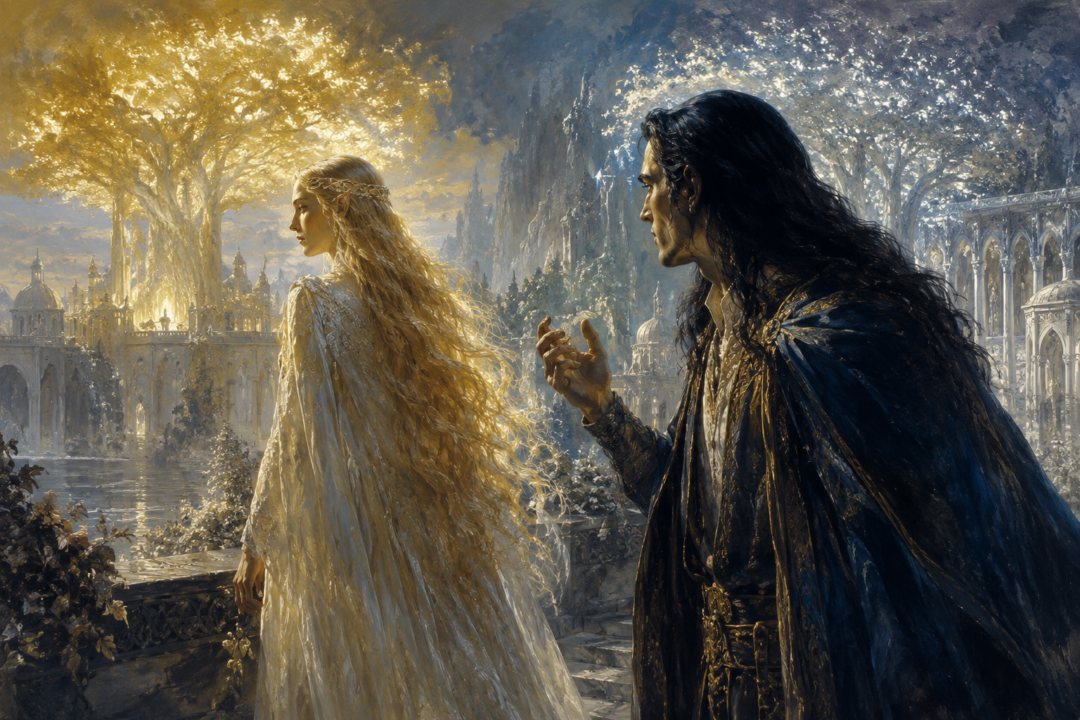
When Gimli stood before Galadriel in Lothlórien and was commanded to name the gift he desired, he asked for something astonishingly small: a single strand of her hair.
He did not demand it. In fact, he carefully said that he was not truly asking for the gift at all. He had been ordered to name his desire, and so he confessed it.
Galadriel gave him three hairs.
Within The Lord of the Rings, the scene is already remarkable. The surrounding Elves murmur, Celeborn looks at Gimli in wonder, and Galadriel herself calls his request both bold and courteous.
But another text gives the moment a far deeper history.
Long before Gimli was born, in Valinor beneath the light of the Two Trees, Fëanor had admired that same extraordinary hair. He too desired some of it.
Three times Fëanor asked Galadriel for a tress.
Three times she refused him.
That parallel transforms the later gift into something much larger than an amusing contrast between an Elf and a Dwarf. Across thousands of years, the same beauty is approached by two great craftsmen. One is denied even a single hair. The other asks for one and receives three.
The difference is not simply who asks.
It is what each encounter reveals about possession, reverence, memory, and the difference between wanting something beautiful and believing beauty should become yours.
Galadriel’s Hair Was Already Connected to the Light of Valinor
The importance of Galadriel’s hair reaches back to the Blessed Realm.
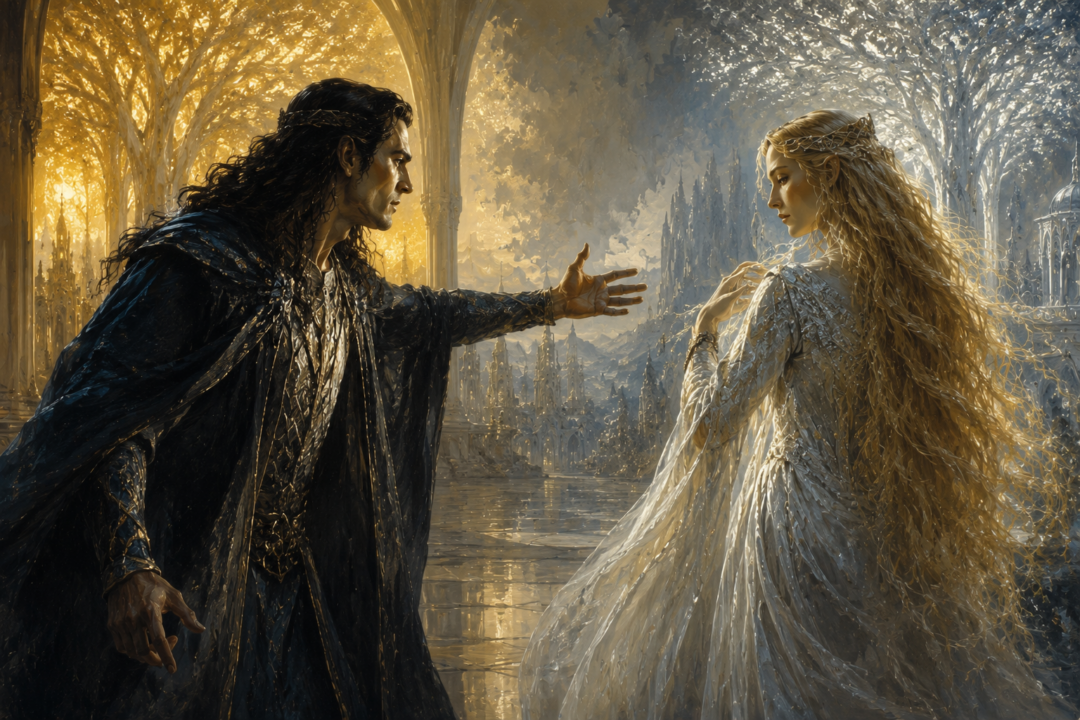
In material published in Unfinished Tales, her hair is described as unusually radiant even among the Eldar. Its gold came from the line of her father Finarfin and his Vanyarin mother Indis, while its silver quality recalled Galadriel’s Telerin mother, Eärwen.
The Eldar even said that the mingled light of Laurelin and Telperion had been caught in her hair.
That description matters because Fëanor was fascinated by it.
The tradition says that many believed Galadriel’s hair first gave Fëanor the idea of capturing and blending the light of the Two Trees, an idea that eventually found incomparably greater expression in the Silmarils.
This is presented as what “many thought,” not as an absolute statement of Fëanor’s private creative process. The distinction matters. The text establishes the association without claiming that Galadriel’s hair was certainly the sole inspiration for the Silmarils.
But the thematic connection is unmistakable.
Galadriel bears something beautiful that appears to mingle the gold and silver lights of Valinor.
Fëanor sees it.
And Fëanor wants part of it.
Fëanor Asked Three Times — and Galadriel Refused Three Times
Fëanor did not merely admire Galadriel’s hair from a distance.
He asked her for a tress.
Then he asked again.
And again.
Galadriel refused every request. She would not give him even one hair.
This episode belongs to later writings concerning Galadriel and should therefore be handled with some care when constructing a single seamless chronology from Tolkien’s evolving accounts. Yet within that tradition, the meaning of the refusal is strengthened by Galadriel’s relationship with Fëanor.
She possessed unusual insight into others, and the text says that she perceived in Fëanor a darkness that she hated and feared. The two became estranged.
The hair therefore becomes part of a much larger conflict of character.
Fëanor is one of the supreme makers among the Children of Ilúvatar. His ability to transform beauty into crafted form reaches its greatest expression in the Silmarils. But his tragedy increasingly concerns what happens when love of a created thing becomes possessiveness.
The Silmarils begin as works of astonishing beauty.
Eventually, Fëanor will claim them so absolutely that their theft helps drive him toward the Oath, rebellion, violence, exile, and catastrophe.
Galadriel’s refusal of her hair does not cause those events, nor should the small episode be treated as a simplistic prophecy of everything Fëanor later becomes.
It does, however, fit a pattern.
He encounters beauty.
He desires to take some portion of it into his own keeping.
Galadriel says no.
Then a Dwarf Makes Almost the Same Request
Thousands of years later, the Fellowship arrives in Lothlórien.
Gimli enters with inherited suspicion between Dwarves and Elves hanging over him. The estrangement is particularly painful because of the long hostility associated with the ruin of Doriath and because relations between the peoples have often been marked by distrust.
Yet Galadriel does something important when she speaks to him.
She acknowledges his grief over Moria and speaks respectfully of Khazad-dûm and its mountains using names dear to the Dwarves. Gimli is deeply moved.
By the time the Fellowship leaves Lórien, his attitude toward Galadriel has been transformed.
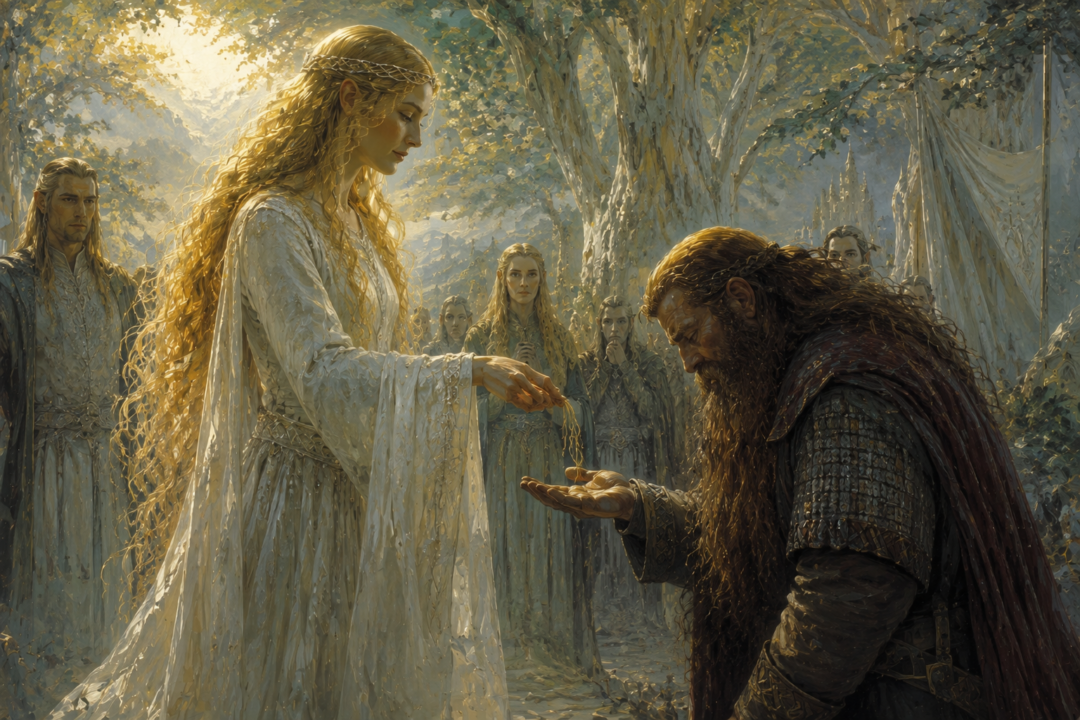
She distributes gifts to the Company. When she comes to Gimli, he initially says that he wants nothing.
Galadriel presses him to name something she could give.
Only then does he confess his desire: one strand of her hair.
And his language makes his intention crucial.
Gimli does not behave as though beauty gives him a right of possession. He explicitly distances himself from demanding the object he desires.
He wants the hair because he reveres Galadriel.
That is already different.
Then Galadriel asks what he would do with it.
His answer makes the difference even clearer.
Gimli Wants to Preserve a Relationship, Not Capture Beauty for Himself
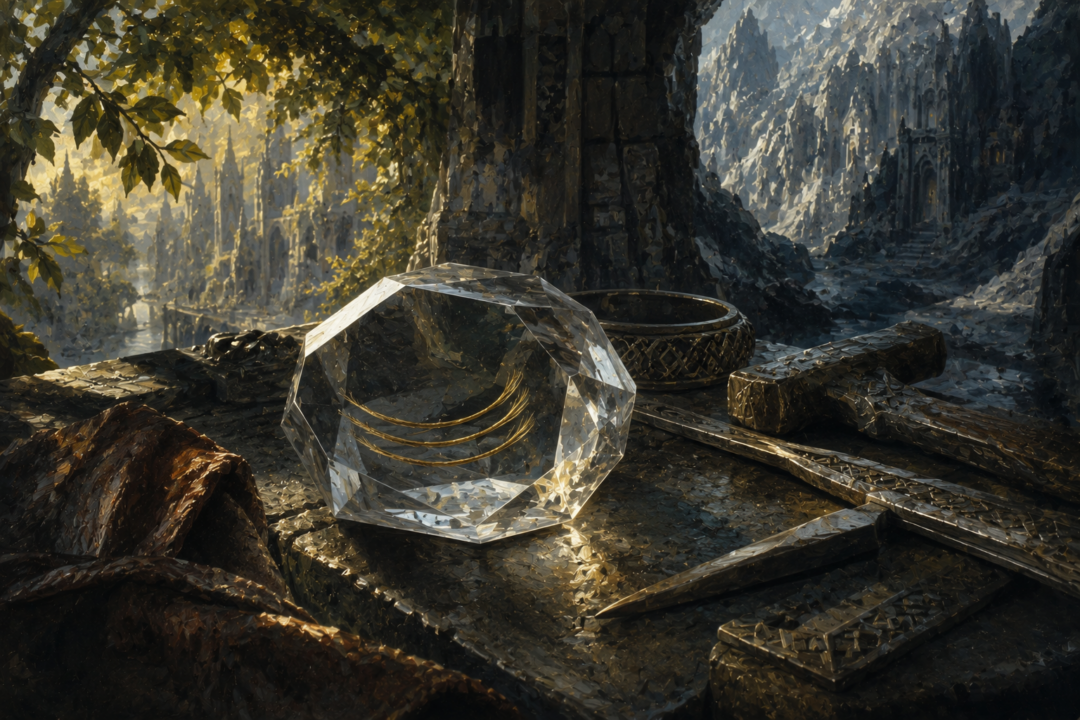
Gimli intends to set the hair in imperishable crystal if he returns to his people.
At first glance, this sounds strikingly close to the older association with Fëanor. Once again, a master craftsman encounters Galadriel’s luminous hair and imagines preserving it within a jewel-like substance.
But Gimli explains what the finished object would mean.
It would become an heirloom of his house and, more importantly, a pledge of goodwill between the Mountain and the Wood.
That changes everything.
The proposed artifact is not ultimately about ownership.
It is about relationship.
Gimli wants the hair to commemorate kindness shown to him and to symbolize friendship between peoples historically divided from one another. The value of the object lies precisely in the fact that it was freely given.
He does not want to recreate Galadriel’s beauty.
He does not claim mastery over it.
He wants to remember an encounter with it.
This is one of the quiet distinctions that repeatedly matters in Middle-earth: possession and stewardship can look similar from the outside while being morally worlds apart.
Why Three Hairs Matter
Galadriel does not give Gimli the single strand he names.
She gives him three.
The numerical correspondence with Fëanor’s three requests is difficult to ignore when the two traditions are read together: Fëanor asks three times and receives nothing; Gimli asks, reluctantly, for one strand and receives three hairs.
The texts do not provide an explicit authorial explanation saying, in effect, “Galadriel chose three because Fëanor had asked three times.” It is therefore safest not to present that interpretation as a stated fact.
But the literary parallel is extraordinarily strong.
The gift reverses the earlier refusal.
And that reversal is not based on status.
If rank, lineage, genius, or closeness of kin determined who deserved Galadriel’s favor, Fëanor would possess overwhelming advantages. He was her kinsman and among the greatest of the Noldor.
Gimli is a Dwarf from a people with whom the Elves have a long and difficult history.
Yet it is Gimli who receives what Fëanor could not.
The contrast suggests that worthiness here has nothing to do with greatness.
It has to do with the manner in which beauty is approached.
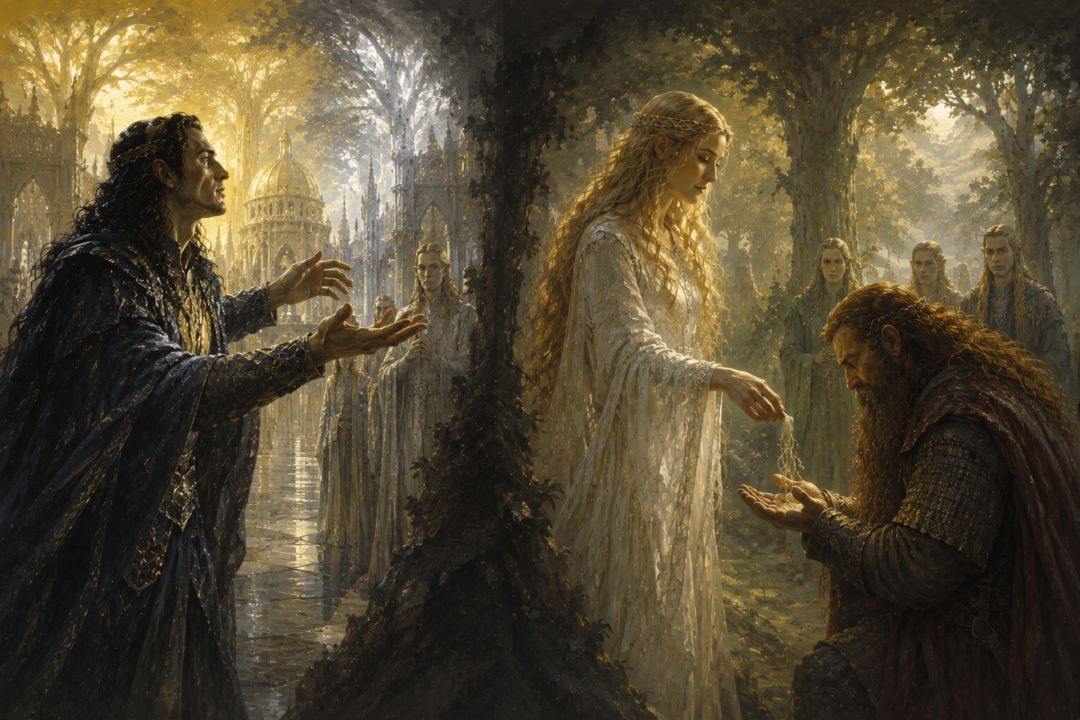
The Greatest Craftsman Is Refused; the Humble Craftsman Receives
The irony becomes sharper because Gimli is himself a craftsman.
Galadriel even plays upon the reputation of Dwarves for skill in their hands when praising the courtesy of his speech.
So this is not a contrast between a dangerous maker and someone indifferent to making.
Both Fëanor and Gimli belong to cultures in which craftsmanship, precious substances, and enduring works carry enormous importance.
Both recognize extraordinary beauty.
Both imagine, directly or indirectly, beauty preserved through craft.
Yet Gimli’s intended crystal would testify to something outside himself.
Its meaning would depend upon Galadriel’s voluntary gift and upon the friendship it represented.
This distinction echoes one of the deepest moral patterns surrounding created things in Middle-earth. Making is not inherently corrupt. Jewels, weapons, gardens, songs, ships, towers, and works of craft can all be beautiful.
The danger comes when creation becomes domination, when preservation becomes possessiveness, or when love says: because this thing is precious to me, it must therefore belong to me.
Gimli’s response moves in the opposite direction.
He receives because he does not presume that he may take.
Galadriel Has Also Changed
There is another dimension to the scene.
Galadriel is not merely the same static figure judging two different petitioners across the ages.
She too has lived through the long consequences of the rebellion of the Noldor, the destruction of Beleriand, the rise and fall of kingdoms, and the fading of the Elves in Middle-earth.
In Lothlórien she also faces her own great test.
When Frodo freely offers her the One Ring, Galadriel imagines what she might become if she accepted it. She ultimately refuses and accepts that she will diminish and depart into the West.
That decision and the gift to Gimli occur within the same final period of her rule in Middle-earth.
The parallel should not be forced into a precise equation, but the thematic connection is powerful.
Galadriel refuses the ultimate instrument of possession and domination.
She freely gives away something of her own beauty.
One object would allow her to seize and order others according to her will.
The other gift creates friendship precisely because no seizure occurs at all.
A Tiny Gift Answers an Ancient Tragedy
The three hairs do not undo Fëanor’s tragedy.
They do not erase the Kinslaying, the Oath, or the wars over the Silmarils.
But symbolically, they offer a remarkably gentle answer to the mentality that helped destroy so much.
Fëanor’s story became entangled with jewels that their maker would not surrender.
Gimli’s treasure begins with something its owner freely gives.
Fëanor’s possessiveness contributes to division among the Eldar.
Gimli wants his treasure to become a pledge between divided peoples.
And while the Silmarils become objects of desperate pursuit, Gimli’s imagined crystal is meant to preserve memory.
That is why Galadriel’s gift is more than a charming reward for an unexpectedly eloquent Dwarf.
One of the smallest objects in The Lord of the Rings quietly touches one of the oldest tragedies behind it.
A Noldorin prince once saw beauty and asked to possess a part of it.
Galadriel refused.
Ages later, a Dwarf saw that beauty and scarcely dared to ask for anything at all.
Galadriel opened her hand and gave him three hairs.
The difference was never the value of the hair.
It was the kind of love that wanted it.
Sources & Notes
- The Encyclopedia of Arda, “Galadriel” — https://www.glyphweb.com/arda/g/galadriel.html
- The Encyclopedia of Arda, “Gimli” — https://www.glyphweb.com/arda/g/gimli.html
- The Encyclopedia of Arda, “Fëanor” — https://www.glyphweb.com/arda/f/feanor.html
Reference entries document the people, places, events, and objects directly discussed in this article.