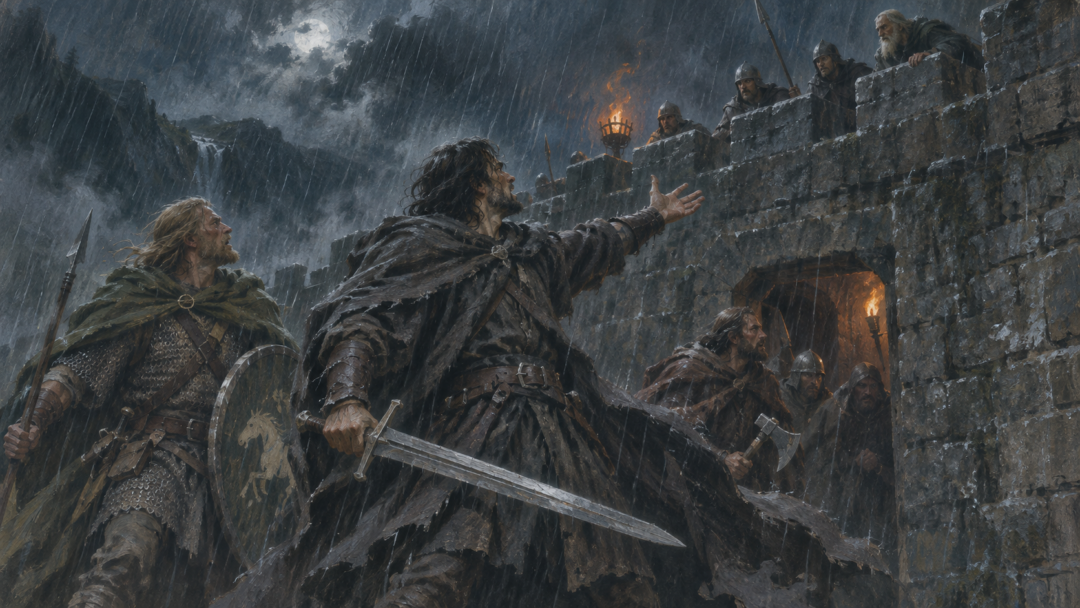
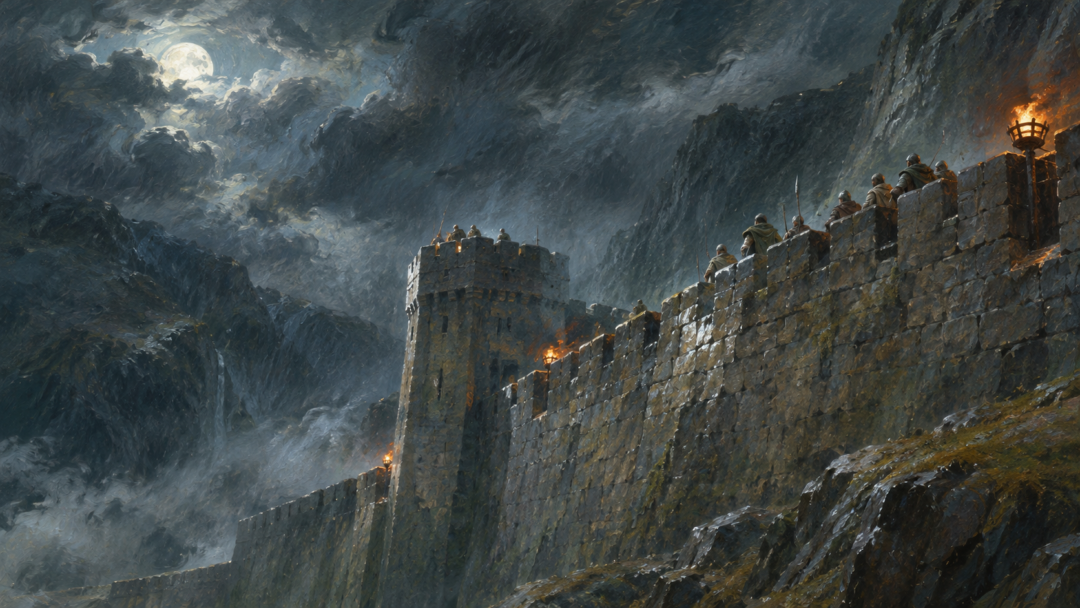
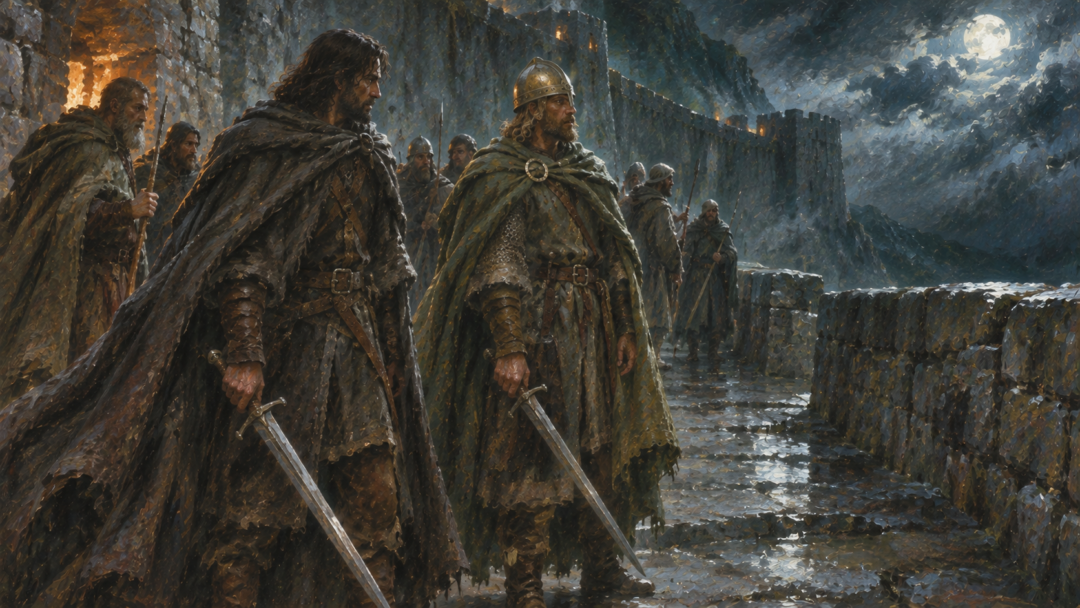
The gates of the Hornburg are under attack, and the night above Helm’s Deep is alive with thunder. Aragorn and Éomer race from the wall, gather a few swordsmen, and slip through a narrow postern door to strike the attackers from the side. Their swords come free together. Then, above the fighting, two names ring out: Gúthwinë and Andúril. From the wall and tower comes an answering cry about the Blade that was Broken shining again.
That response can sound surprisingly well informed. Narsil was the famous broken sword; Andúril is its new name after reforging. How could Rohirrim fighting for their lives know the change? The simplest answer is right in the scene: Aragorn himself calls out Andúril before the defenders echo it. Earlier encounters in Rohan help explain why the sword’s older identity might resonate, but the book never requires a messenger to have distributed its new name in advance.
The answer is in the order of the shouts
In The Two Towers, the defenders are trying to protect the Hornburg’s battered gate. Aragorn and Éomer see the danger from the Deeping Wall and lead a small party through a postern in the fortress wall. This is a sortie, not an address to assembled troops. Their purpose is to hit the enemy working at the gate before it can break through. The narrow way beside the Rock brings them around to attack from an unexpected direction.
As they rush out, Éomer invokes his sword, Gúthwinë, and the Mark of Rohan. Aragorn answers in the same pattern: ‘Andúril!’ cried Aragorn. ‘Andúril for the Dúnedain!’ They charge into the attackers, and the defenders above respond: ‘Andúril! Andúril goes to war. The Blade that was Broken shines again!’ The sequence matters because the new name does not first appear on the lips of an unexplained spectator. It comes directly from the man wielding the blade.
The wall’s shout follows the sortie, while Aragorn is visibly using his sword against the attackers. A listener who caught his call would have both a name and an unmistakable object to associate with it. The scene does not establish precisely who heard what over the noise. It gives a clear source for the word, though, and then describes the response as a shout rising from the defenses rather than a separately identified speaker delivering a lesson in sword lore.
There is a difference between hearing a name and knowing its history. Someone could repeat Andúril after Aragorn without having heard it before. Someone else could recognize the legendary Blade that was Broken from stories or from earlier news about Aragorn, then connect that story to the name he has just cried. The narrative permits either experience, and probably invites the reader to hear the response as a shared moment of recognition. It does not inventory the knowledge of every man on the ramparts.
Narsil is the old name, not a different sword
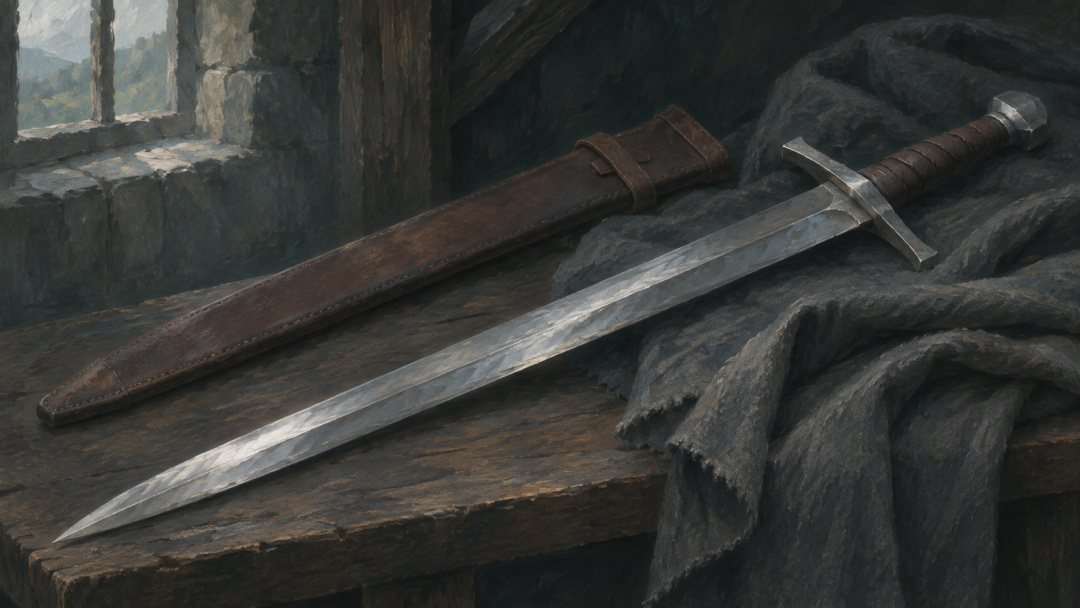
The apparent puzzle starts with two names belonging to one blade at different points in its story. Narsil was the sword of Elendil, broken long before the War of the Ring. Its fragments survived as an heirloom. Before the Fellowship left Rivendell, the sword was reforged and given a new name, Andúril, the Flame of the West. Aragorn therefore carries neither an unrelated replacement nor an ordinary weapon that happens to resemble a relic. The restored sword carries the history of the broken one forward.
That is why the defenders’ cry can use the new name and the old description together without contradiction. Andúril tells us what the sword is called now. The Blade that was Broken tells us what makes it remarkable. Those are different kinds of identification: one is the name Aragorn uses in battle; the other is a description that connects the weapon to a story older than anyone fighting there. A listener need not know every detail of the reforging to understand that connection. Nor does the blade need a magical power to declare its name; Aragorn has already done that aloud.
What Éomer actually heard before Helm’s Deep
The earlier meeting with Éomer in the chapter “The Riders of Rohan” provides useful context, though not quite the evidence sometimes claimed for it. On the plains of Rohan, Aragorn reveals his sword while identifying himself to Éomer and his riders. The narrator calls the bright weapon Andúril as Aragorn draws it. Aragorn’s own speech, however, identifies it as the Sword that was Broken and forged again. He does not speak the name Andúril in that declaration.
This is an easy distinction to miss when remembering the scene. Readers are told the blade’s name, so it can feel as though everyone standing there was told too. But a narrator’s identification is not necessarily information heard by a character. What Éomer demonstrably encounters is Aragorn making a striking claim about his lineage and presenting a restored, legendary sword as evidence of who he is. That earlier claim makes the cry about the Blade that was Broken less isolated when the two men later fight side by side.
Still, Éomer’s presence at the postern matters. He is not an anonymous listener suddenly confronted by an unfamiliar wanderer with a strangely named sword. He has met Aragorn, seen his claim to the broken blade, and now fights beside him. Their paired cries accompany the attack. That familiarity helps anchor the episode, but it tells us nothing definite about what the men on the walls knew in advance. Any report passed among Rohan’s soldiers remains an inference, not a recorded event.
Aragorn had already said Andúril in Rohan
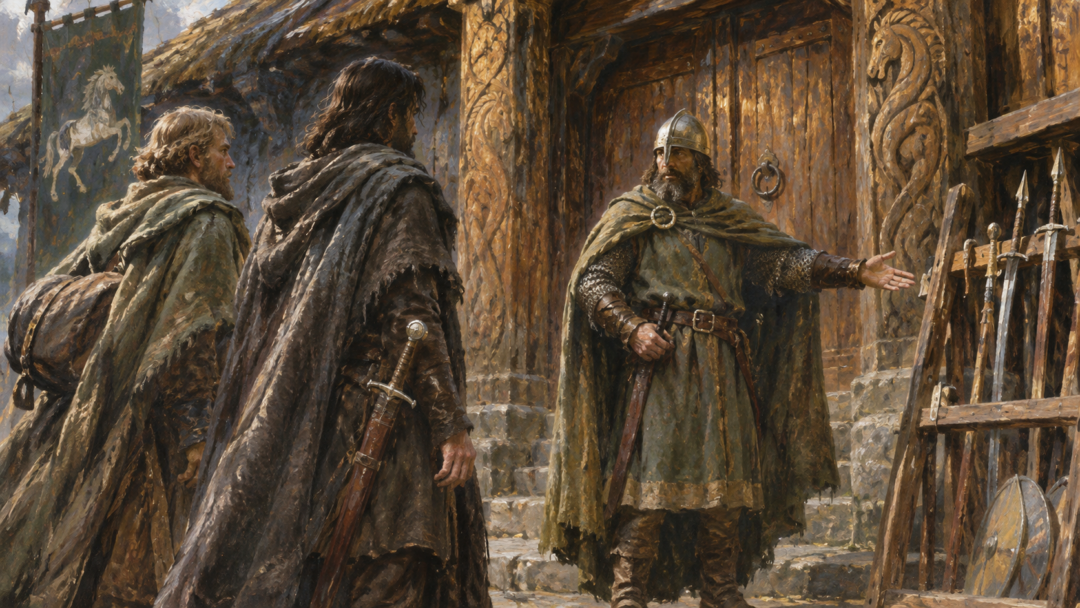
There is also a more direct earlier use of the name, at the doors of Meduseld in “The King of the Golden Hall.” Háma, Théoden’s doorward, requires visitors to lay aside their weapons before entering. Aragorn resists surrendering his sword to another man’s hand. During the exchange he calls it Andúril, and he repeats the name when explaining why this weapon is an exception in his eyes. Unlike the encounter with Éomer, this is spoken dialogue, not merely the narrator telling the reader what the blade is called.
Háma’s reply is revealing. He insists that the weapon must be left outside whatever its name may be. That is hardly the response of a man who has already been established as an authority on Andúril’s recent history. He understands the practical demand of guarding the hall and is not initially persuaded by a special name. As Aragorn explains the sword’s identity and his claim to it, the encounter takes on the scale of an old tale entering the king’s doorway.
Eventually Aragorn places the weapon against the wall himself. The scene makes the sword memorable without depicting a public announcement to the people of Rohan. Háma hears its current name and its connection to the famous broken blade; others among the travellers are present for the dispute. It is reasonable to imagine that such an unusual exchange might be talked about. It is not reasonable to promote that possibility into a definite story in which Háma passes the news through the ranks before Helm’s Deep.
A battle cry can spread faster than an explanation
The paired calls of Éomer and Aragorn are shaped alike, but they point toward different loyalties. Éomer names Gúthwinë for the Mark; Aragorn names Andúril for the Dúnedain. Neither pauses to describe the weapon he is holding. They are invoking swords and the peoples they fight for, turning the sudden rush through the postern into something more than a desperate maneuver. The symmetry makes Aragorn’s cry easy to pick up, even for a defender who cannot recount Narsil’s full history.
It is also worth noticing where the answering words come from. The narrator says a shout rises from wall and tower. That is a collective description, not testimony from a named Rohirric soldier who explains when he first learned the name. A few voices could have started the call and others joined; the wording does not tell us. Trying to assign the entire sentence to every person on the battlements treats a sweeping narrative image as though it were a transcript of individual conversations.
The second half of the shout is more evocative than a simple echo. The defenders do not merely repeat Andúril; they celebrate the Blade that was Broken shining again. That phrase ties the visible counterattack to the legacy Aragorn has already invoked in Rohan. It may reflect some listeners’ knowledge of the legend, a cry taken up from those who know it, or the narrative’s way of giving the garrison a common voice. The passage does not specify which, and no hidden explanation is needed to make the scene work.
More important, the call follows action. Aragorn and Éomer have emerged from the stronghold to confront the attackers at the gate, and the sword is being used before the defenders’ eyes. Naming Andúril is therefore a recognition of something happening now, not just an exchange of historical information. The men above have reason to watch, and reason to shout. In the storm and confusion, a word cried by the fighter below becomes part of the fortress’s response to his charge.
The defenders’ individual knowledge stays beyond the page. But the scene gives us something better than a roster of informed soldiers: a name called at the instant a sword is drawn into the fight, and an older legend rising to meet it. Outside the battered gate, Aragorn cries out from the narrow path beneath the walls. Above him, voices answer in the dark.
Sources & Notes
- Tolkien Gateway, Helm's Deep — the chapter's battle and Aragorn and Éomer's sortie — https://tolkiengateway.net/wiki/Helm%27s_Deep_(chapter)
- The Encyclopedia of Arda, Andúril — Narsil's reforging, new name, and use by Aragorn — https://www.encyclopedia-of-arda.com/a/anduril.php
- Tolkien Gateway, The King of the Golden Hall — Háma's weapon surrender and the earlier naming of Aragorn's sword — https://tolkiengateway.net/wiki/The_King_of_the_Golden_Hall
Reading references: The Two Towers, The Riders of Rohan, The King of the Golden Hall, and Helm's Deep; The Fellowship of the Ring, The Ring Goes South. The sequence of battle cries is textual evidence; how widely each defender previously knew the sword's history is not specified.