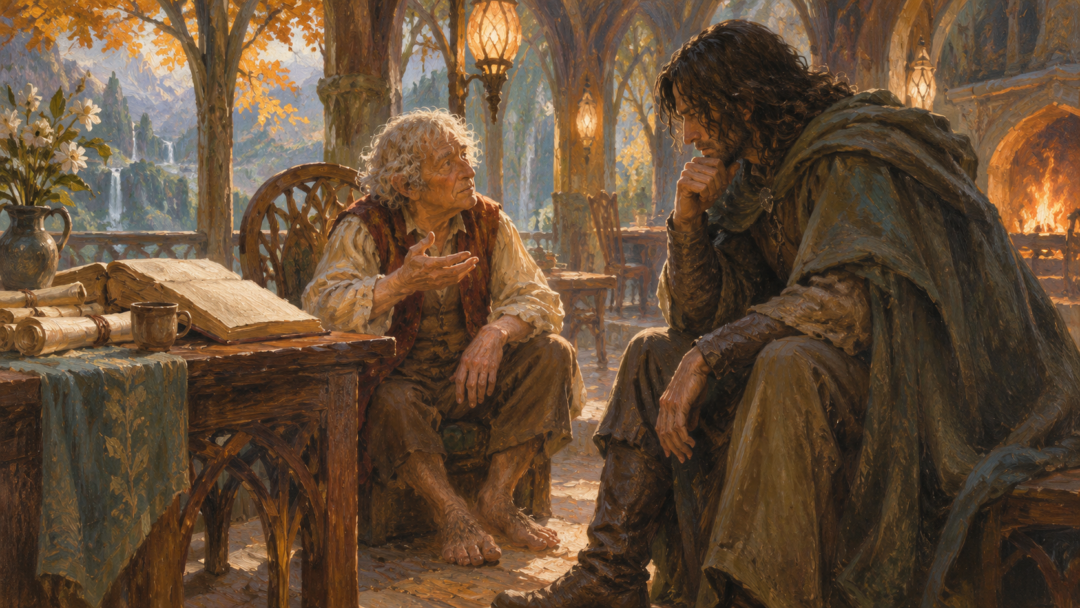
In Rivendell’s Hall of Fire, Bilbo stands before an audience of Elves and sings about Eärendil, the mariner who sailed beyond the familiar shores of Middle-earth. Frodo listens in a half-dream, and Aragorn has helped with the poem. Only afterward does Bilbo reveal one peculiar detail: Aragorn was especially concerned that the song should mention a green stone. That small detail invites a large question.
Is that stone the Ring of Barahir, the ancient heirloom of Aragorn’s family? Not explicitly, and the description points away from the ring. Bilbo’s verse gives Eärendil an emerald on his breast, not a ring passed down to Aragorn. The stronger connection is to the Elfstone, or Elessar, a green jewel closely bound to Aragorn’s later identity. Still, the book leaves room for interpretation: Bilbo admits that he does not know why Aragorn wanted the addition.
The emerald in Bilbo’s song
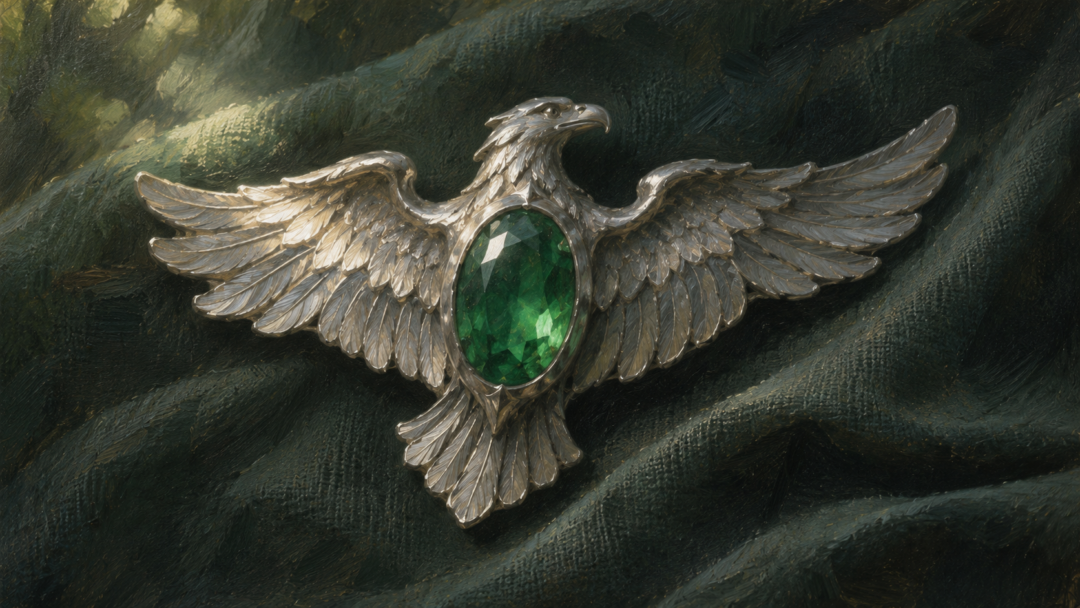
Bilbo’s intricate song follows Eärendil’s voyages and destiny. Among the ornaments he imagines for the mariner is an emerald worn upon his breast. The jewel is part of a poetic portrait among other shining objects. No character takes out an emerald in the hall, and there is no exchange of treasure.
After the performance, Frodo wonders who made the verses. Bilbo says the song is his own, with one exception: “Aragorn insisted on my putting in a green stone.” He adds that Aragorn seemed to consider it important, but he cannot explain why. It establishes the detail’s origin, but not its meaning. The motive remains unstated.
Bilbo also reports Aragorn’s warning about the boldness of making verses on Eärendil in Elrond’s house. Eärendil is Elrond’s father, not merely an ancient hero from a tale that happens to be popular among the Elves. The verses recount family history before a member of that family. Aragorn takes the subject seriously, while leaving the poem to Bilbo.
The position of the emerald matters, too. In the song it is worn on the chest, where a brooch or pendant could be displayed. Poetry, though, need not specify a jewel’s exact setting. It does, however, make the first picture a green jewel rather than a finger-ring. The song’s ornaments are not necessarily catalogued historical relics.
Why the Ring of Barahir is an attractive guess
The Ring of Barahir is genuinely linked to Aragorn and to green gemstones. It began as a token of friendship and obligation: Finrod Felagund gave his ring to Barahir after Barahir helped save him in the wars against Morgoth. When Barahir was killed, his son Beren recovered it. Beren later used the ring to establish his claim upon Finrod’s promised help. It signified an oath between Elves and Men, not the powers of the later Rings.
There is also a visual reason for the confusion. In The Silmarillion, the ring bears the device of Finarfin’s house: two serpents with emeralds for eyes, their heads meeting beneath golden flowers. A reader remembering an old Noldorin heirloom with green stones is not mistaken. But its details differ. The ring contains several green jewels within a particular emblem; Bilbo’s poem describes a single emerald on Eärendil’s breast, without serpents, flowers or even a ring.
Their family histories also overlap. Beren and Lúthien were the grandparents of Elwing, who married Eärendil. Their sons were Elrond and Elros, and Aragorn’s ancestry leads back through the descendants of Elros. The ring therefore belongs to the song’s wider family history. But kinship does not establish that Eärendil wore it. The poem never claims that he did.
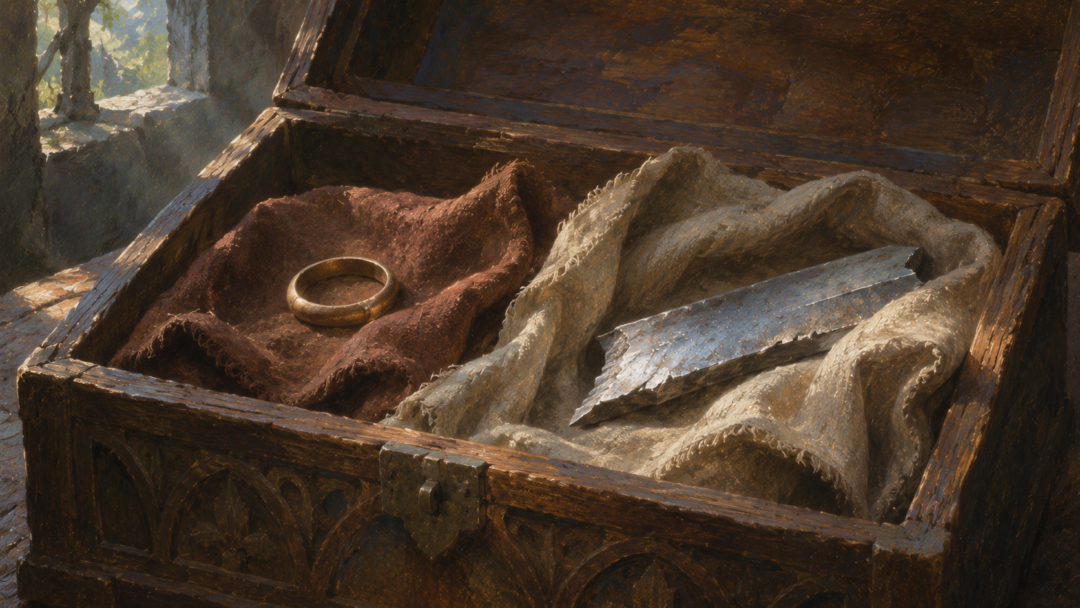
The later record makes the distinction clearer. Appendix A lists the Ring of Barahir among the northern heirlooms safeguarded in Rivendell, alongside the shards of Narsil, the Star of Elendil and the Sceptre of Annúminas. Elrond gave the ring to Aragorn when he revealed his true name and lineage. Appendix B then records Aragorn giving it to Arwen when they pledged their troth in Lórien in the year 2980 of the Third Age, long before Bilbo’s song was performed in 3018. The ring has its own place in Aragorn’s story.
The green jewel Aragorn does receive
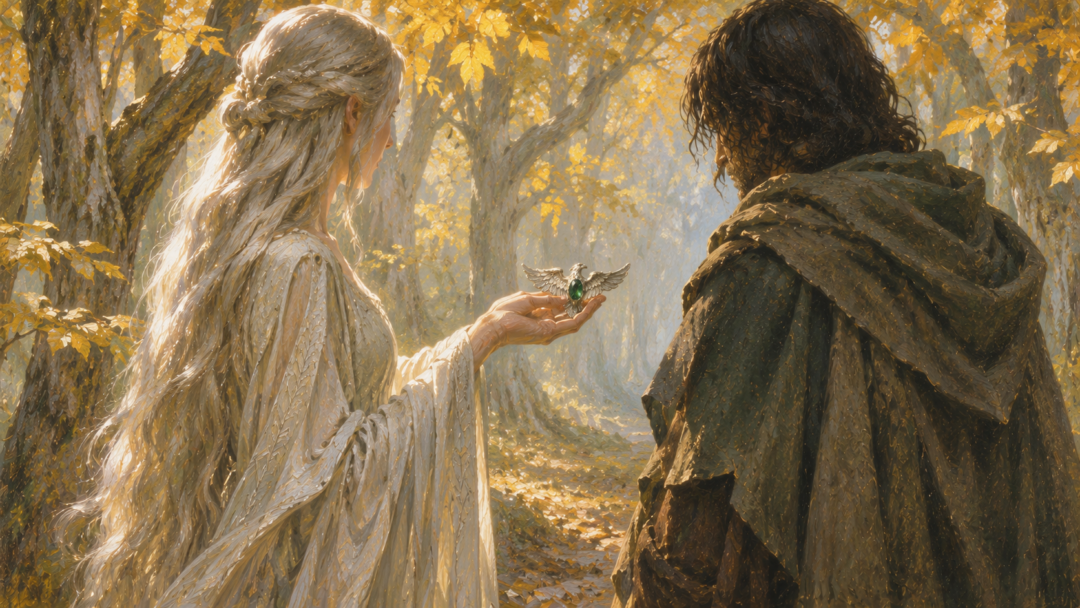
For a much closer parallel, follow the Fellowship beyond Rivendell to the chapter “Farewell to Lórien.” There Galadriel presents Aragorn with “a great stone of a clear green, set in a silver brooch”. The brooch is shaped like an eagle with its wings spread, and Aragorn fastens it to his breast. Here both the setting and the act of giving are explicit.
Galadriel explains the immediate history of the stone. She had given it to her daughter Celebrían, who gave it to her own daughter, Arwen. It had then been left in Galadriel’s care for Aragorn, should he pass through Lórien. She calls it a token of hope and names him Elessar, the Elfstone of the House of Elendil. That is the stated chain. It does not say that Bilbo had handled the jewel, that Aragorn already possessed the brooch in Rivendell, or that the poem records this particular object’s entire earlier journey.
Aragorn has just spoken of his deepest desire: a future with Arwen, which Galadriel cannot herself grant. The stone comes from Arwen’s family and reaches him at a moment when the road ahead is dark. It speaks to hope and to his unclaimed kingship. After he puts on the brooch, the others see him with a renewed, kingly bearing. A green stone is now visibly associated with the person he may become.
That later scene gives the emerald in Bilbo’s song a powerful echo. Eärendil’s jewel sits upon his breast in the poem; Aragorn’s green Elfstone is pinned upon his breast during the journey. The resemblance needs no literal transfer of property. At the time of “Many Meetings,” Aragorn has not yet received the Lórien brooch on the page. The story can anticipate an image before the event that makes the image especially meaningful.

Did Eärendil own the stone, or pass it down?
So how did Eärendil acquire his green stone? Within “Many Meetings,” there is no answer beyond the poem itself: Bilbo describes the mariner wearing an emerald, and Aragorn requested that detail. Neither speaker traces its origins or fate. A historical hero in a song need not have a documented inventory of possessions.
Nor is it necessary to make Eärendil the carrier of the Ring of Barahir. The ring is associated with Beren’s descendants, and Eärendil became part of that family through Elwing. An heirloom might pass through unnamed hands. Yet no passage in this scene puts the ring on Eärendil’s hand or says that he transmitted it to Elros. A complete route from Eärendil to Aragorn would be conjecture.
There is another famous jewel in Eärendil’s story, but it does not solve this puzzle: the Silmaril brought to him by Elwing. That brilliant treasure is central to his voyage and to his light in the heavens. It is not presented in Bilbo’s song as an ordinary green emerald or as the Ring of Barahir. The poem can hold several kinds of significance. His destiny as the bearer of a Silmaril does not automatically identify every ornament that appears earlier in the verses.
What about a general Noldorin symbol? Beautiful jewels and family emblems recur throughout these histories. The Ring of Barahir itself is a striking example of Noldorin work. Yet a lone emerald is not a badge with one fixed meaning. The poem names no serpent device or heraldry. If the green stone works symbolically, its strongest force comes from the scene around it and from Aragorn’s later name, not from a universal code for green stones.
Why Aragorn might have cared
Aragorn’s story begins long before the Fellowship. He is already the heir of Isildur, already bound to Arwen, and already living with a future that depends on dangers he cannot simply avoid. The name Elessar belongs to that future. Perhaps he responds personally to a traveller bearing a green jewel. But Bilbo supplies no confirmation.
The conversation also shows the difference between the two friends. Bilbo brings the craft of verse and an elaborate account filled with splendid details. Aragorn knows the histories, the people and the living weight of the names. When he insists on an emerald, the reader briefly sees the poem through someone for whom the ancient past is not safely finished. No secret ring is required. The smallest alteration to a song can carry a private association that its singer does not fully understand.
Eärendil adds another resonance. Elrond’s father crossed the sea on a world-changing quest; Aragorn stands in Elrond’s house before his own trial. The two stories are not identical, but their juxtaposition makes the emerald more than decorative colour. Later, the Elfstone will be offered to Aragorn as hope rather than as proof that his road is easy. The song anticipates that image without explaining Aragorn’s reason.
The green stone in “Many Meetings” is best understood as a suggestive poetic detail, not a hidden appearance of the Ring of Barahir. Its nearest book-level resonance is the Elessar that Aragorn will wear, though the text does not certify that Bilbo meant the very same jewel. In the Hall of Fire, the emerald belongs to a song about a mariner beneath the stars. Farther down the road, a green stone will shine on another traveller’s breast.
Sources & Notes
- Tolkien Gateway, Song of Eärendil — Bilbo's poem and Aragorn's green-stone addition — https://tolkiengateway.net/wiki/Song_of_E%C3%A4rendil
- The Encyclopedia of Arda, Elessar — Aragorn’s royal name and Galadriel’s gift of the green brooch — https://www.encyclopedia-of-arda.com/e/elessar.php
- The Encyclopedia of Arda, Ring of Barahir — the distinct ring's emerald-eyed serpents and inheritance — https://www.encyclopedia-of-arda.com/r/ringofbarahir.php
Reading references: The Fellowship of the Ring, Many Meetings and Farewell to Lórien; The Return of the King, Appendix A, The Tale of Aragorn and Arwen. The connection between Bilbo's emerald and Aragorn's Elfstone is an interpretation, not an explicit identification in Many Meetings.