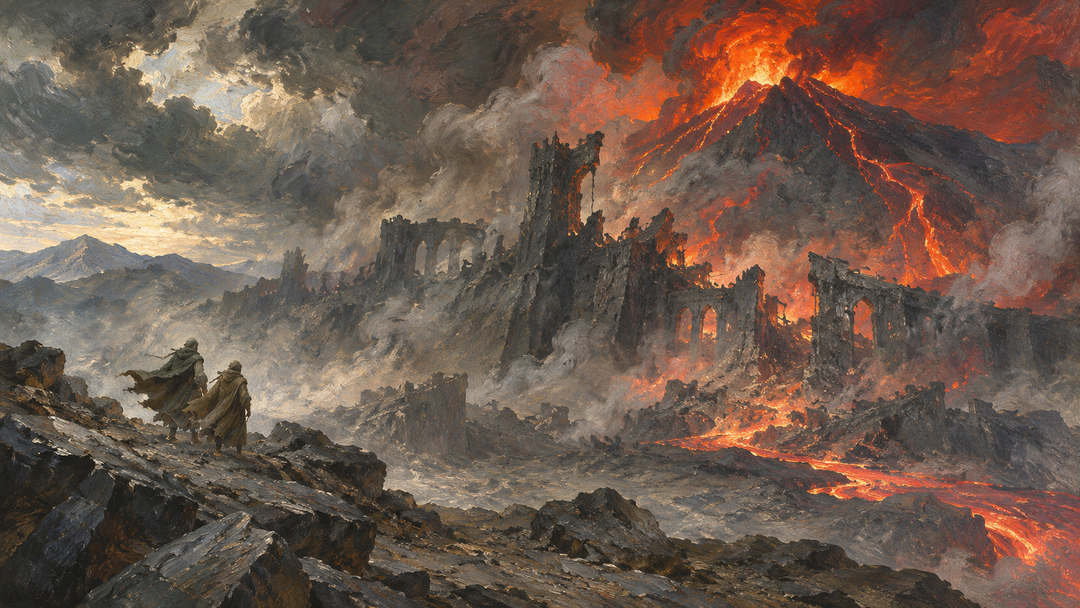
On 25 March in the Third Age year 3019, the One Ring falls into the fire of Mount Doom, and Sauron’s fortress of Barad-dûr collapses. The armies facing Aragorn at the Black Gate lose the will that held them together. Yet victory neither settles every war nor restores Middle-earth to its former condition. Tolkien follows its military and political consequences, the decline of Elven power and the personal cost of success.
There is also a crucial qualification to the familiar version of events: Frodo does not deliberately throw the Ring away. At the Cracks of Doom he claims it. Gollum attacks, bites off the finger bearing it, and falls into the fire while celebrating his recovery of his treasure. That matters because the ending is about more than destroying a weapon.
The fall of Sauron is immediate, but not simple
In The Return of the King, Sauron becomes aware of Frodo only when the hobbit puts on the Ring inside the mountain. His attention turns from the battle outside the Black Gate towards the danger at the heart of his realm. He sends the remaining Ringwraiths towards Mount Doom, but they arrive too late. The Ring is destroyed with Gollum, the mountain erupts, and the foundations of Barad-dûr give way.
Sauron does not merely lose a convenient tool. He placed a great part of his own native power into the Ring when he made it, to dominate the other Rings of Power. Destroying it permanently deprives him of that strength. Gandalf has already explained that Sauron will be reduced to an impotent spirit of malice, unable to rebuild himself into a power capable of ruling or taking shape again. He is defeated, not killed like a mortal.
The distinction is especially important because Sauron is a Maia, an immortal spirit, rather than a human king whose existence ends with his body. In the book, a vast shadow rises above Mordor, reaches out and is blown away. This signifies impotence, not the extinction of his spirit. Earlier defeats cost him physical forms without ending the threat; this one does.
The Nazgûl perish in the catastrophe. Their prolonged existence and power were bound to Sauron’s domination through the Nine Rings, and they cannot continue as the terrifying servants seen throughout the war. The Dark Tower and the Black Gate fall, while the volcanic destruction spreads across the surrounding country. But neither every stone in Mordor nor every Orc suddenly disappears. Tolkien describes Sauron’s forces losing direction: many flee, some surrender, and others continue fighting in terror or despair. A controlling will has vanished, not every individual enemy.
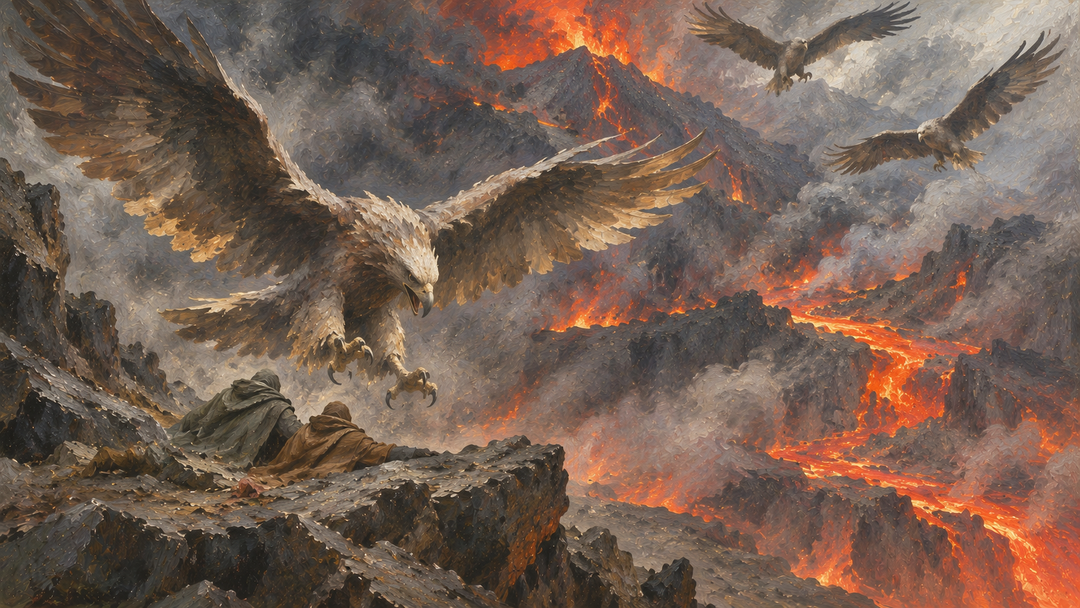
The immediate rescue is equally specific. Frodo and Sam escape the chamber but are trapped on the slopes amid the destruction. Gandalf arrives on the eagle Gwaihir, accompanied by Landroval and Meneldor, and the eagles carry the hobbits to safety. They recover in Ithilien and are honoured at the Field of Cormallen on 8 April. The story continues well beyond the volcano.
Peter Jackson’s film The Return of the King conveys the collapse through the enormous flaming Eye, the tower’s destruction and the earth opening under Mordor’s army. In the novel, the Eye is chiefly a representation of Sauron’s watchfulness and will; it is not presented as a literal searchlight mounted on his tower. Tolkien also indicates that Sauron has taken bodily form during the Third Age. The film’s images are effective shorthand, but they should not be mistaken for the book’s exact account.
The other Rings lose their purpose, and the war still has consequences
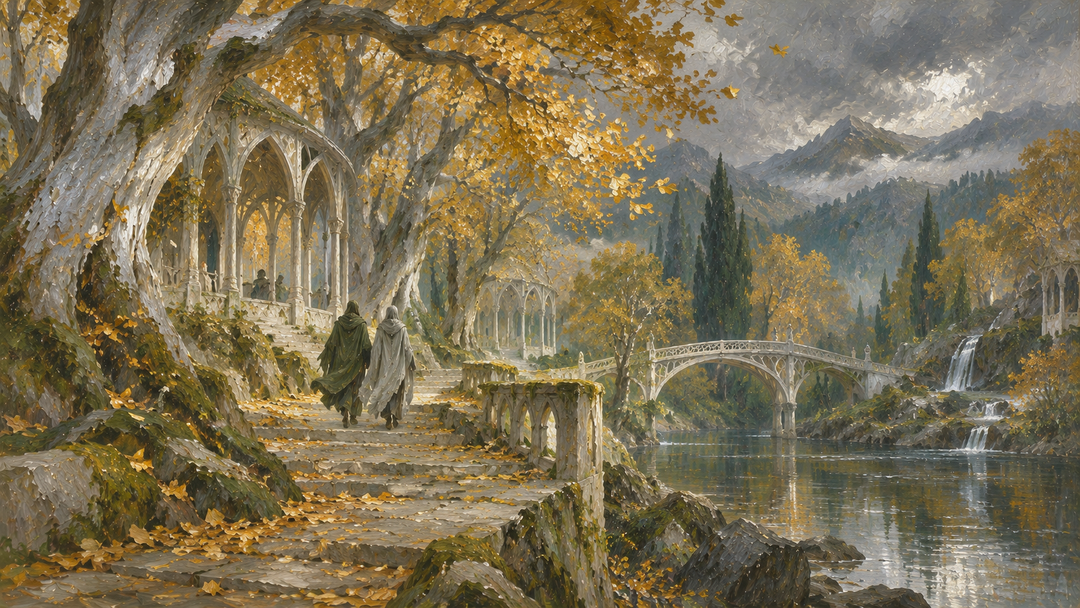
The destruction affects much more than Sauron’s servants. The Three Elven Rings were never touched by him, but their makers’ work was still connected to the power of the One. Elrond and Galadriel understand that victory will mean the ending of the Rings’ ability to preserve what they cherish. Rivendell and Lothlórien will no longer be sustained in the same way. Destroying the enemy’s central source of power also ends a form of protective magic.
This does not mean that every enchanted object stops working at once or that all Elves die or depart immediately. Tolkien offers no universal rule that all magic vanishes on 25 March. The loss is particular to the Rings and the works dependent on them, against a broader historical movement in which the Elves diminish and the dominion of Men grows. Treating the event as a worldwide cancellation of supernatural power is a fan simplification, not something the text establishes.
Victory reaches other fronts too. While the main story follows Frodo, the armies of Sauron and his allies have also attacked Dale, Erebor and the woodland realms in the north. King Brand of Dale and Dáin Ironfoot die defending their people. Their successors, Bard II and Thorin III, eventually drive back the attackers. In the forest, Thranduil’s people and the forces of Lothlórien survive their own battles. After Sauron’s fall, Celeborn and Galadriel help bring about the destruction of Dol Guldur, the stronghold that had menaced the region.
Nor does victory mean that everyone who fought for Mordor was inherently evil or beyond reconciliation. Southrons and Easterlings are human peoples, not creatures extinguished by the Ring. Aragorn later makes peace with former enemies and frees the slaves who had worked the fields around the Sea of Núrnen, giving them that land. Mordor was not just a wasteland of monsters; its captives needed new lives.
The military result nevertheless creates a decisive political opening. Sauron can no longer direct armies against Gondor, and his principal fortress is gone. The surviving leaders can begin rebuilding a kingdom rather than preparing for inevitable conquest. Ruined cities, resentment and lesser tyrants remain, but lasting peace becomes possible.
Aragorn becomes king, while the hobbits discover unfinished business
On 1 May 3019, Aragorn is crowned King Elessar in Minas Tirith. His kingship reunites the southern kingdom of Gondor with the northern royal line of Arnor. He does not simply inherit Sauron’s territories or receive command of all Middle-earth. His authority remains limited by other peoples and realms. His marriage to Arwen at midsummer gives the restoration a personal dimension, but their choice also has consequences for the Elves’ departure and Arwen’s mortal future.
Gondor’s renewal includes Faramir’s appointment as Prince of Ithilien and his marriage to Éowyn, whose recovery from the war is not merely a matter of physical healing. Éomer becomes king of Rohan after Théoden’s death. The friendship between Rohan and Gondor survives the emergency that brought their armies together. Tolkien’s appendices describe further years of governance and reconstruction, although they do not offer a detailed account of every province or settlement.
For Frodo, Sam, Merry and Pippin, the journey home proves that the victory has not reached everywhere. In the book’s chapter ‘The Scouring of the Shire’, they return to find the Shire polluted, trees cut down, ordinary pleasures restricted and local life controlled by bullying officials. The system ultimately traces back to Saruman, who has been reduced in power but remains capable of spite. The hobbits organise resistance themselves; Gandalf does not arrive to solve the problem for them.
This is not an invasion mounted by a resurgent Sauron. Saruman’s petty rule shows that domination can persist after the great tyrant is gone, especially when fear, greed and obedience have already taken root. The ruffians are defeated, and Saruman is killed by his servant Gríma, who is then shot by hobbit archers. Their deaths take place in the Shire, not at Orthanc. The theatrical film version cuts the Scouring and instead shows Saruman’s death at Isengard in the extended edition, substantially changing the return home.
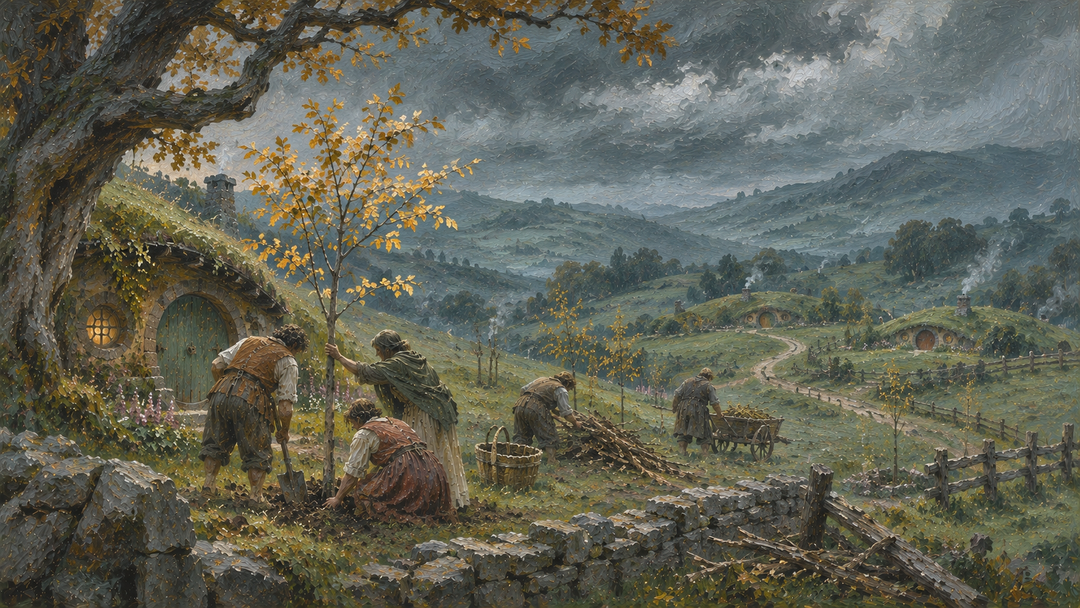
The Shire’s restoration is practical, not instantaneous. Sam helps replant devastated places, using the gift of earth Galadriel gave him and planting a special seed that grows into a mallorn tree. The following year becomes remarkable for its abundance. Yet the trees need tending and the community must repair its own institutions. The four travellers have brought back skills, confidence and responsibility, not an exemption from the consequences of war.
The final victory brings healing, separation and a new age
The most painful aftermath belongs to Frodo. His burden ends when the Ring is destroyed, but his wounds remain. He has been stabbed by the Morgul blade on Weathertop, poisoned by Shelob and worn down by carrying the Ring. Back in the Shire, anniversaries bring renewed illness. He can recognise the peace he helped secure without being able to live fully within it. Tolkien refuses the easy assumption that saving a home guarantees the saviour a comfortable return.
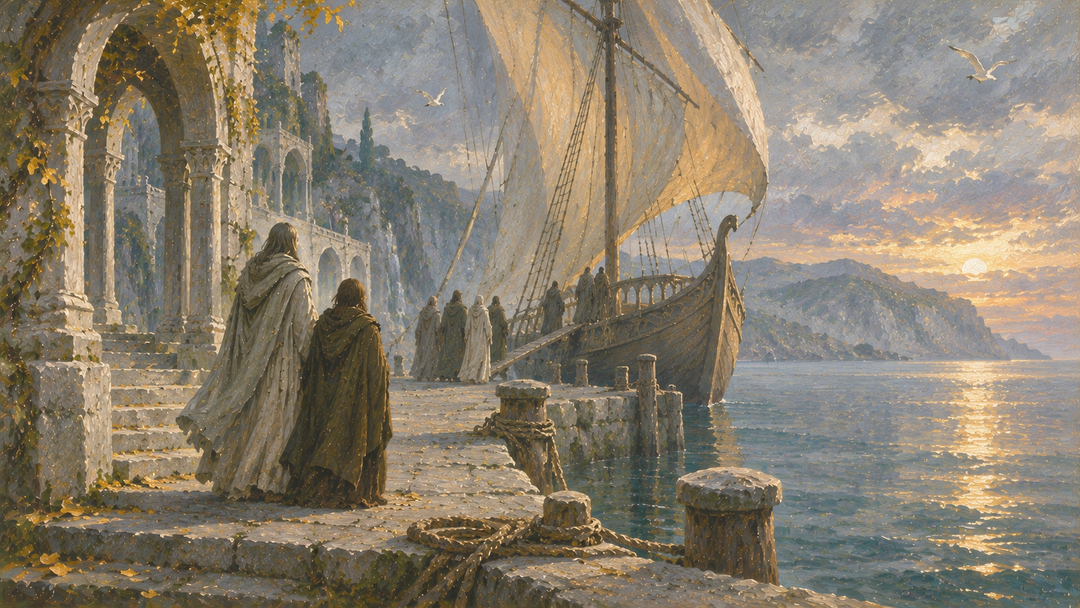
In September 3021 Frodo sails from the Grey Havens with Bilbo, Gandalf, Elrond, Galadriel and other Elves. His departure is a special grace granted to a mortal Ring-bearer, not proof that he becomes immortal. Tolkien’s later explanations indicate that the journey west offers the possibility of healing before death, not escape from mortality. The narrative does not describe Frodo’s subsequent life or certify exactly how complete that healing becomes. He does not gain everlasting life.
Arwen makes the opposite choice. By remaining with Aragorn, she accepts a mortal life and eventual separation from her Elven kin. Elrond’s departure therefore marks not only the fading of the Three Rings but a lasting family parting. Galadriel’s departure also fulfils the consequence she foresaw when she refused the One Ring: she preserves herself from its corruption, but cannot preserve her realm unchanged. The end of Sauron’s dominion and the end of the Elves’ great age are intertwined rather than separate victories.
It is tempting to describe the destruction of the Ring as an act of straightforward heroic will. The book deliberately resists that interpretation. At the decisive moment Frodo cannot surrender it. In a later letter discussing the ending, Tolkien argued that Frodo had endured to the limit of his ability and that his earlier mercy towards Gollum was essential. Gollum’s fall involves accident and, in Tolkien’s account, providence. The idea that Frodo secretly planned the fall, or that a particular curse mechanically forced it, is speculation rather than established narrative fact.
Likewise, counterfactual claims that Aragorn, Gandalf or Galadriel could simply have used the Ring to guarantee a better future confuse defeating Sauron with overcoming its temptation. Gandalf and Galadriel reject it precisely because commanding others through such power would corrupt even apparently good intentions. Tolkien considered hypothetical struggles for control in his letters, but those discussions are not alternative events that happened in the story.
The Third Age formally ends with the departure from the Grey Havens in September 3021, although Gondor’s calendar reckons the Fourth Age from 25 March that year. Men become the principal stewards of Middle-earth’s future, while the surviving Elves gradually recede. The final scene is not a coronation or a battlefield triumph. It is Sam returning to Bag End, to Rosie and their family. The Ring’s destruction makes that ordinary future possible, but only because others accept loss, govern wisely and do the work of rebuilding.
Sources & Notes
- Tolkien Gateway, The Scouring of the Shire — chapter-level account of the Shire under the Chief and Saruman's ruffians, the hobbits' own rising, the Battle of Bywater, and the deaths of Saruman and Gríma in the Shire (30 October–3 November T.A. 3019). https://tolkiengateway.net/wiki/The_Scouring_of_the_Shire
- Wikipedia, The Scouring of the Shire — overview of the penultimate chapter: the despoiled Shire, 'Sharkey' identified as Saruman, the rebellion and Battle of Bywater, and the chapter's critical reception. https://en.wikipedia.org/wiki/The_Scouring_of_the_Shire
- Tolkien Gateway, Field of Cormallen — the tree-lined field in North Ithilien where Aragorn camped after the Battle of the Morannon, where the rescued Frodo and Sam were healed and honoured on 8 April T.A. 3019. https://tolkiengateway.net/wiki/Field_of_Cormallen
- Tolkien Gateway, Grey Havens — Mithlond, Círdan's havens; the Last Riding of the Keepers of the Rings, Bilbo and Frodo sailing as Ring-bearers, and Sam's later departure in Fo.A. 61. https://tolkiengateway.net/wiki/Grey_Havens
- Tolkien Gateway, Fourth Age — the age beginning after the Ring's destruction: the Third Age held to end with Elrond's departure on 29 September T.A. 3021, while Gondor's New Reckoning begins Fo.A. 1 on 25 March T.A. 3021. https://tolkiengateway.net/wiki/Fourth_Age
Primary reading: The Return of the King, Book VI chapters 3–9 and 9 (Mount Doom through The Grey Havens), with Appendix A (Gondor and the Heirs of Anárion), Appendix B (the Tale of Years), and The Letters of J.R.R. Tolkien no. 246 on Frodo's endurance, his mercy to Gollum, and the role of providence at the Cracks of Doom. The linked reference entries document the Scouring, the Field of Cormallen, the Grey Havens departure and the Fourth Age reckoning. Reading the post-war settlement as incomplete victory, and Éowyn's recovery as more than physical healing, is this article's interpretation rather than a stated rule of the text; Tolkien gives no detailed account of every province after the war.