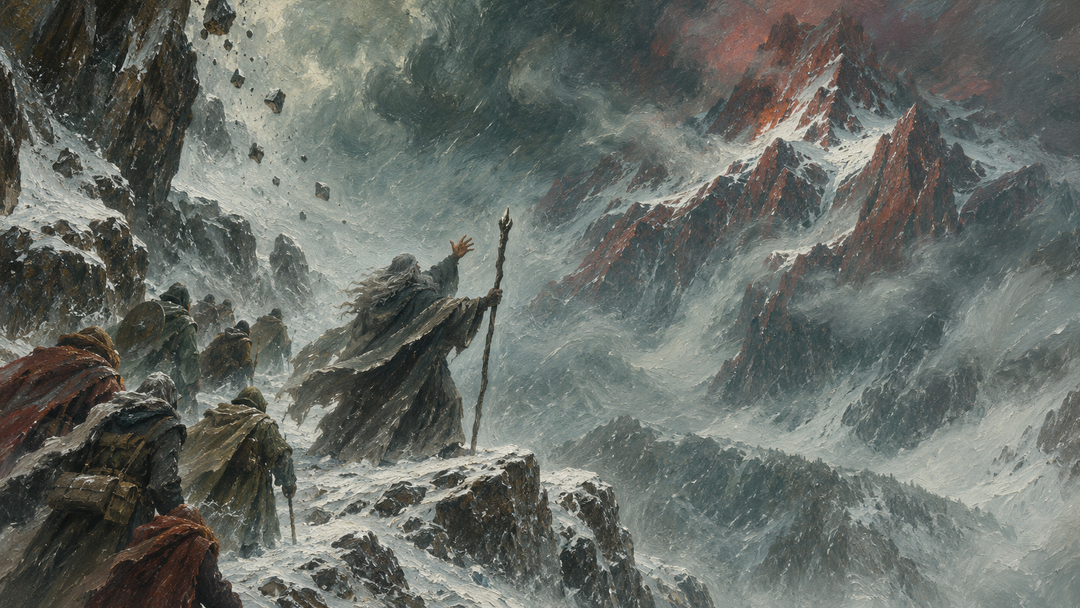
On the snowy slopes of Caradhras in Peter Jackson’s 2001 film The Lord of the Rings: The Fellowship of the Ring, Gandalf raises his staff and shouts towards the mountain while Saruman chants from the tower of Orthanc. Their words sound like competing spells, and that is precisely how the film presents them. Saruman is urging the mountain to unleash its violence; Gandalf is asking it to become quiet. But this exchange does not occur in J. R. R. Tolkien’s novel. The film turns a mysterious mountain storm into a visible contest between two wizards.
The film’s Elvish can be translated precisely. The book has a different incantation from Gandalf, no spell from Saruman and no definitive identification of the storm’s cause.
The words spoken in the film
Saruman begins the confrontation while the Fellowship struggles along the mountain path. In Quenya, the High-elven language, his incantation is commonly transcribed as: Cuiva nwalca Carnirassë! Nai yarvaxëa rasselya taltuva ñotto-carinnar! He chants in stages, heard first on the mountain and then from Orthanc.
In straightforward English, Saruman commands cruel Redhorn to awaken and wishes for its bloodstained peak to fall upon the heads of enemies. Saruman treats the mountain as a force capable of striking the travellers, whom his reference to enemy heads marks as the intended victims.
Gandalf replies in Sindarin, the other major Elvish language heard throughout the story: Losto Caradhras, sedho, hodo, nuitho i ‘ruith! His words ask Caradhras to sleep, remain still and restrain its anger. Saruman calls for violent awakening; Gandalf calls for rest. Both address the same mountain.
The scene also contains ordinary spoken dialogue. Legolas notices a threatening voice carried by the wind, and Gandalf identifies it as Saruman. Aragorn interprets the falling rocks as an attempt to bring down the mountainside and presses for retreat. Earlier, Saruman has contemplated Gandalf’s route and the possibility that failure at the pass will force the Company towards a more dangerous alternative. His intentions are clear before the chanting begins.
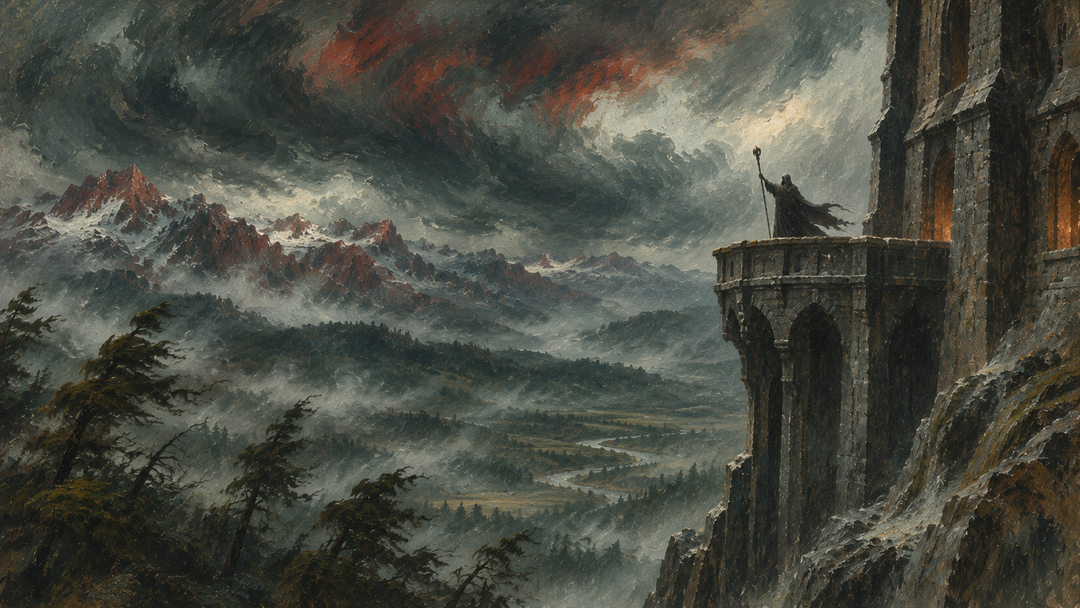
The camera supplies the decisive context. Saruman is not standing somewhere on Caradhras, concealed above the travellers. He is far away at Isengard, calling towards the mountains as clouds converge. The sequence links his voice with violent weather, falling stone and eventually an avalanche. Whatever limits magic may normally have in Tolkien’s world, the film wants viewers to understand this particular disaster as Saruman’s intervention.
Some transcriptions omit the accents in Carnirassë and yarvaxëa, or write the last compound with an ordinary n rather than ñ. Gandalf’s final words are likewise sometimes printed without the apostrophe before ruith. These differences do not change either speech’s meaning. Neither spell is the Black Speech of Mordor, and neither is a quotation from Tolkien’s account of the crossing.
What the languages reveal about the spells
The two names for the mountain make the linguistic contrast especially clear. Caradhras is Sindarin for Redhorn, while Carnirassë is its Quenya counterpart. The Dwarves have another name, Barazinbar, in their own language, Khuzdul. All three point to the same peak above the ancient Dwarf-realm of Khazad-dûm.
Saruman’s opening verb, cuiva, is an instruction to wake. Nwalca describes something cruel, and Carnirassë names the Redhorn. His next clause is framed as a wish or invocation: nai introduces the hoped-for outcome, while rasselya refers to the mountain’s horn and taltuva expresses falling. The compound at the end directs that fall against enemy heads. It is a forceful request for catastrophe rather than a neutral forecast of snow.
Gandalf’s Sindarin is built from opposing commands. Losto tells the mountain to sleep; sedho and hodo reinforce the demand for stillness and rest. Nuitho calls for restraint, while the closing phrase concerns wrath. The repetition may sound like formal spellcasting, but the overall instruction is plain: stop raging and let the travellers pass. Gandalf tries to calm the mountain, not strike Saruman with another storm.
The languages also identify a common misconception. Quenya is not an evil tongue because Saruman uses it here, and Sindarin is not automatically more benevolent because Gandalf speaks it. Both are Elvish languages associated with different histories and communities. Gandalf is perfectly capable of using Quenya elsewhere, and Saruman’s choice does not make his words a secret language of dark wizards.
Nor does this scene establish that Quenya spells are inherently stronger than Sindarin spells. The film shows Saruman prevailing in this encounter, but the result is a matter of the scene’s action, not a stated ranking of languages. Treating the exchange as a formal duel with fixed rules about magical power goes beyond what the dialogue supplies. Counterfactual claims that Gandalf could have won by using another language are fan speculation, not established rules of Tolkien’s world.
There is a further authorship distinction. The film’s Elvish dialogue was developed for the adaptation, with linguist David Salo associated with its language work. Its vocabulary and forms draw on Tolkien’s invented languages, but the Caradhras exchange should not be passed off as a passage Tolkien wrote. Film dialogue lists and screenplay transcriptions help explain what the actors say, yet their spelling conventions need not be identical to a definitive Tolkien manuscript.
What happens on Caradhras in Tolkien’s book
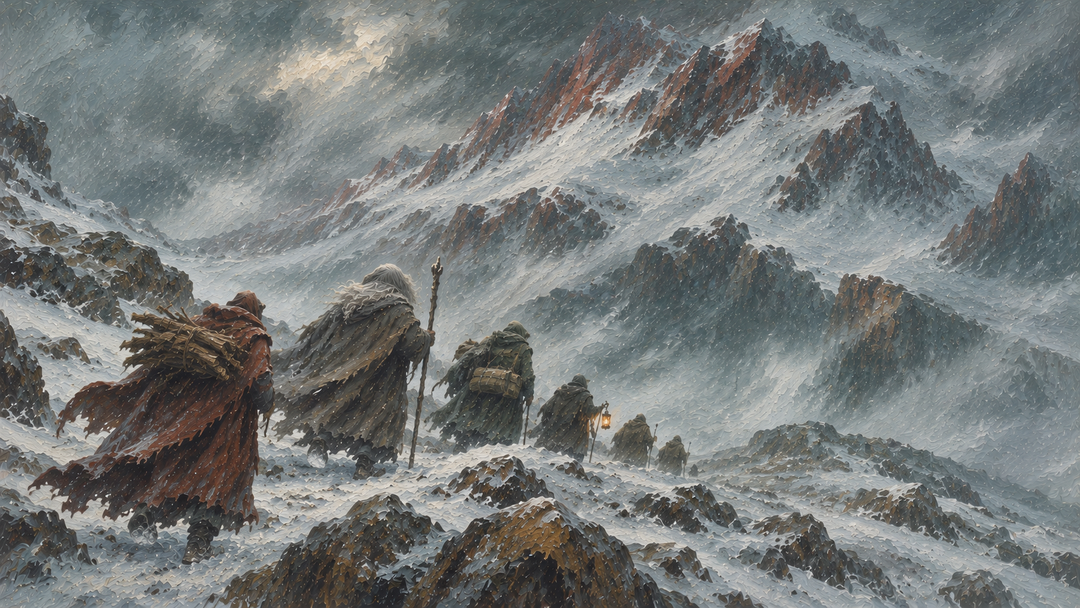
In The Fellowship of the Ring, the attempt to cross the Redhorn Gate occurs in the chapter The Ring Goes South. It is a dangerous winter journey, not a staged confrontation with Saruman in a distant tower. The Company encounters worsening snow, fierce winds and falling stones. The narrative is close to Frodo’s experience, so the source of these disturbances is never laid out for readers in a separate scene at Isengard.
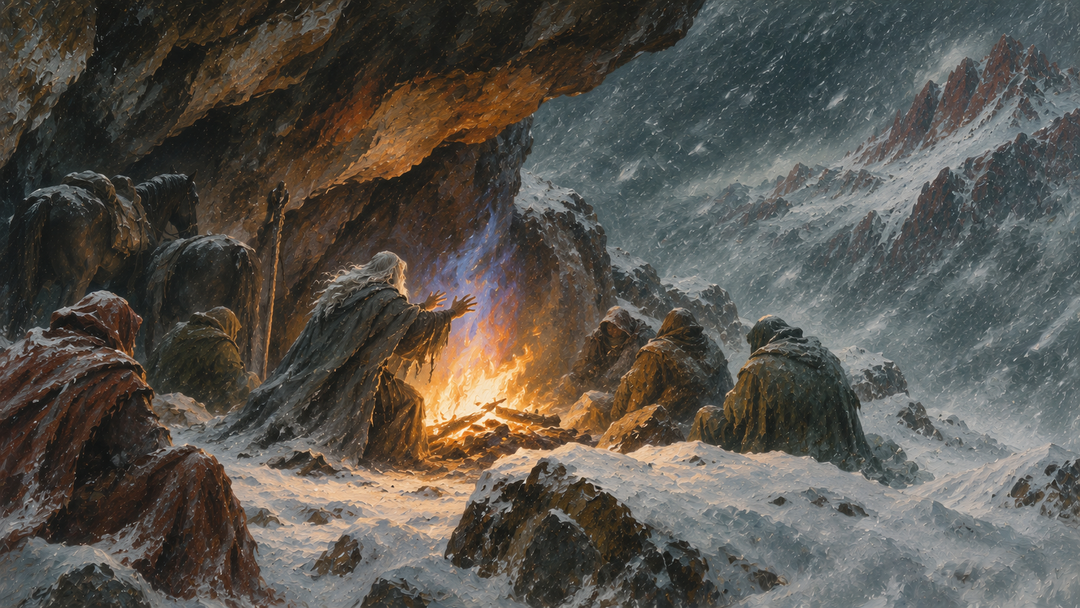
There is one actual Elvish incantation from Gandalf during the storm: Naur an edraith ammen! Roughly, it calls for fire to come to the Company’s rescue. Gandalf uses it to ignite the wood they have carried, producing a burst of coloured flame that gives the freezing travellers a chance to survive the night. It does not command the mountain to sleep, drive away the storm or counter an audible spell from Saruman.
This moment is more limited than the film’s mountain-addressing magic. Gandalf intervenes when ordinary methods fail. He then acknowledges the risk of revealing his presence to watchers by such a conspicuous display. His power solves the immediate problem of heat but also works against the Company’s need for secrecy. Even after the fire takes hold, the snow continues to fall.
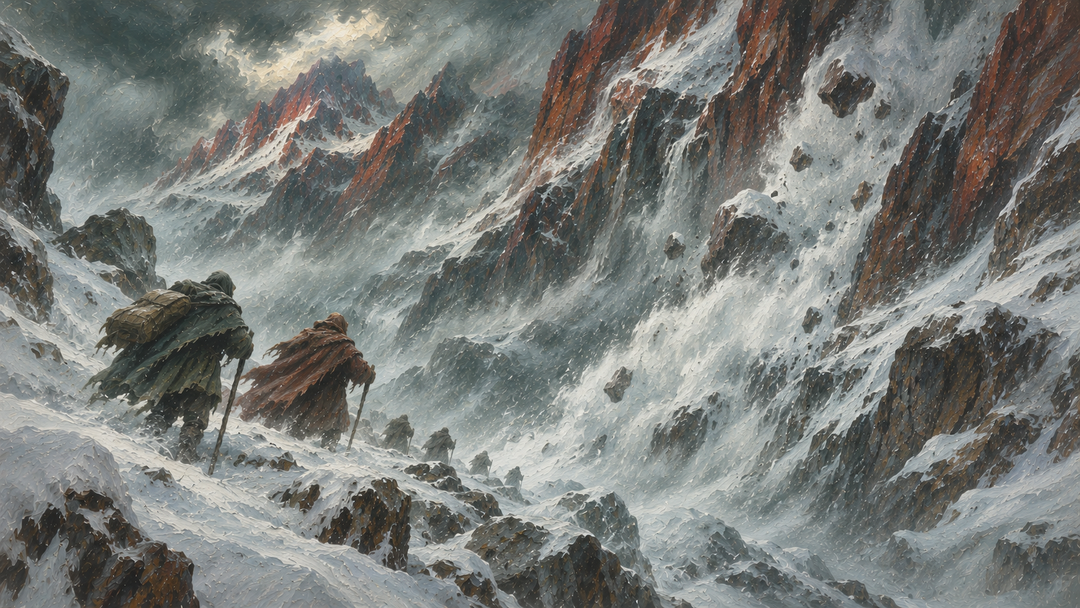
The characters openly disagree about what is attacking them. Boromir wonders whether the Enemy has contrived the weather, recalling reports that Sauron can command storms around Mordor. Gimli questions whether Sauron’s reach could extend so far north. Gandalf’s brief reply accepts that Sauron’s influence has grown, but it is not a declaration that Sauron personally generated every snowflake or hurled every stone.
Other details resist that simple explanation. The travellers hear cries and laughter in the wind, but the narration allows that these might be effects of air passing through rocky gaps. Boromir regards the noises and stones as hostile. Aragorn observes that some unfriendly things in the world have their own purposes and are not servants of Sauron. Gimli adds that Caradhras had a cruel reputation long before Sauron became a threat in those lands.
Gandalf does not settle their dispute. He focuses on whether they can continue safely and decides the higher path offers too little shelter. The danger is certain; its cause is not. Rocks fall, the travellers are endangered and the pass becomes impossible; none of these facts proves that Saruman has been chanting over them from Orthanc.
The book repeatedly gives Caradhras an almost personal hostility. Gimli speaks as though the mountain has not forgiven them, and the narration describes the final fall of stone during their retreat as if the mountain were satisfied to have driven them away. Such wording encourages readers to take its malice seriously. Yet personification and a reported ill reputation do not, by themselves, establish whether the mountain is literally conscious, independently magical or influenced by another power.
The escape also depends heavily on practical action. Boromir has insisted that they bring firewood; later, he and Aragorn force a route through deep drifts. Legolas, who can move lightly across the snow, scouts the way. Gandalf even rejects the idea that he can simply melt a passage through the snow by producing unlimited flame. Magic contributes but does not replace effort.
Who causes the storm, and what the change means
In film continuity, the answer is direct: Saruman uses a Quenya invocation to stir up the violence of Caradhras, and Gandalf answers in Sindarin without stopping the disaster. Saruman’s appearance at Orthanc, Gandalf’s recognition of his voice and the visual connection between the chanting and avalanche all establish the filmmakers’ intended cause. The words matter because they make the mountain seem like a dangerous presence that two wizards are trying to influence in opposite ways.
In book continuity, that answer cannot be stated as fact. Saruman is certainly an enemy by this stage, and the earlier imprisonment of Gandalf proves his treachery. But Tolkien does not place Saruman in the mountain scene, report his weather spell or identify his voice in the wind. The Company suspects hostile forces without acquiring a conclusive explanation. Attributing the storm specifically to Saruman is therefore an adaptation detail, not an inference demanded by the novel.
Several explanations remain possible for the book. Sauron may have influenced the weather, as Boromir fears; Caradhras may possess an older and independent hostility, as Aragorn’s reasoning and Gimli’s history suggest; or the storm may combine dangerous natural conditions with an unsettling suggestion of malice. The text does not choose conclusively among them. Theories that name a particular spirit, servant of Sauron or distant wizard as the controlling intelligence should be labelled fan speculation unless supported by additional explicit evidence.
The change also affects the journey to Moria. In the film, Saruman’s assault helps drive the Fellowship off the pass, after which Frodo is asked to choose whether they will enter the mines. The film presents Gandalf as deeply apprehensive about that route. In the novel, Gandalf has already argued for the possibility of Moria, while Aragorn is particularly troubled by it. The argument continues beyond the mountain, and a later attack by wolves contributes to the decision to seek the underground passage.
This is why the cinematic exchange can mislead readers who remember the scene vividly. It supplies a recognisable villain, a visible source of danger and a clearly opposed pair of commands. Tolkien’s episode offers harsher uncertainty: the Company must respond to a hostile world without knowing whether nature, an ancient will or the power of Sauron lies behind every danger. Gandalf’s actual book spell helps them stay alive; it does not answer the mystery.
So the precise answer depends on the version. In the film, Saruman tells Redhorn to wake and strike his enemies, while Gandalf tells Caradhras to sleep and restrain its wrath. In Tolkien’s book, Saruman says nothing on the mountain, and Gandalf calls up fire instead. The pass defeats the Fellowship in both versions, but the explanations differ.
Sources & Notes
- Gwaith-i-Phethdain — Languages in The Fellowship of the Ring — https://www.elvish.org/gwaith/movie_fotr.htm
- The Encyclopedia of Arda — Caradhras — https://www.encyclopedia-of-arda.com/c/caradhras.php
- Tolkien Gateway — The Ring Goes South — https://tolkiengateway.net/wiki/The_Ring_Goes_South
The film dialogue transcription supplies the adaptation's opposing incantations. Tolkien's book episode is The Fellowship of the Ring, The Ring Goes South: Gandalf calls for fire, while the cause of the mountain's hostility is not conclusively assigned to Saruman. Film-language reconstructions are not Tolkien-authored novel dialogue.