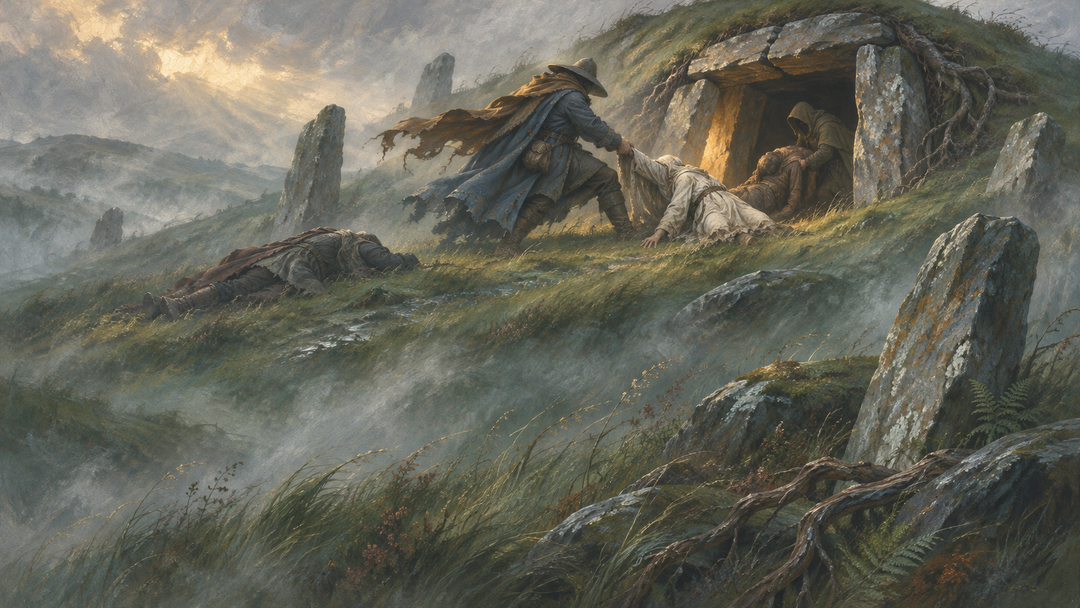
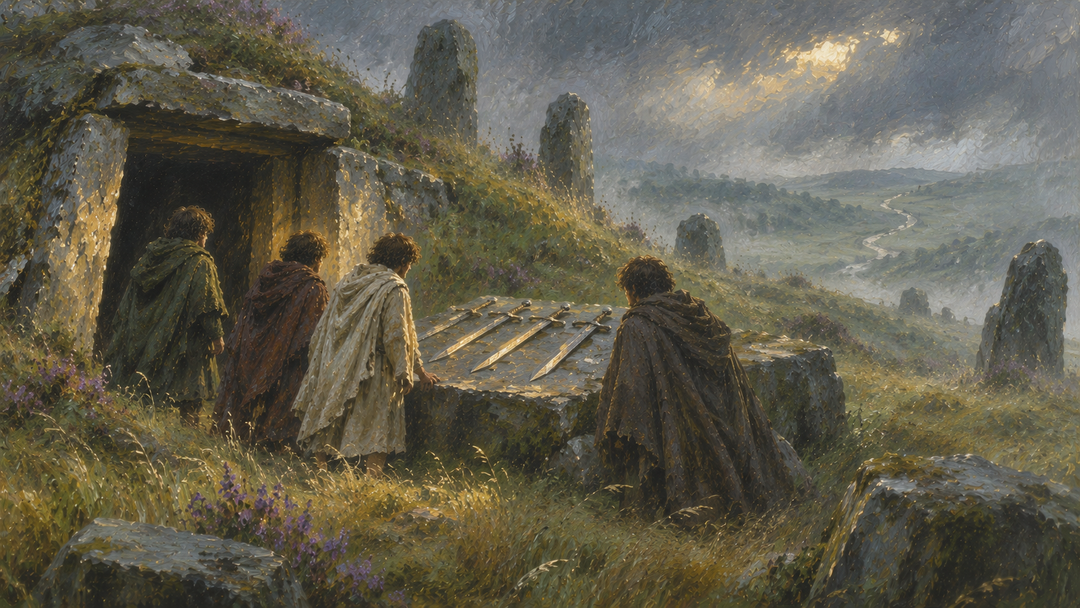
On 28 September 3018, Frodo Baggins woke inside a burial mound with his three companions lying unconscious beside him. A sword lay across their necks, and a Barrow-wight’s hand was moving towards it. Frodo struck the hand with a short sword, which shattered, then remembered a song that Tom Bombadil had taught him. He sang for help. Tom answered, opened the mound and brought the hobbits into daylight.
That narrow escape in The Fellowship of the Ring offers a serious counterfactual: without Frodo’s timely appeal, the four travellers might never have reached Bree, let alone Rivendell or Mordor. But the headline also suggests an earlier incident, when the hobbits encountered Tom beside Old Man Willow. The distinction matters. There were two rescues, and only the second involved a deliberate call for Bombadil by name. Both show how much of the quest depended on timely help.
Two Rescues, but Only One Summons
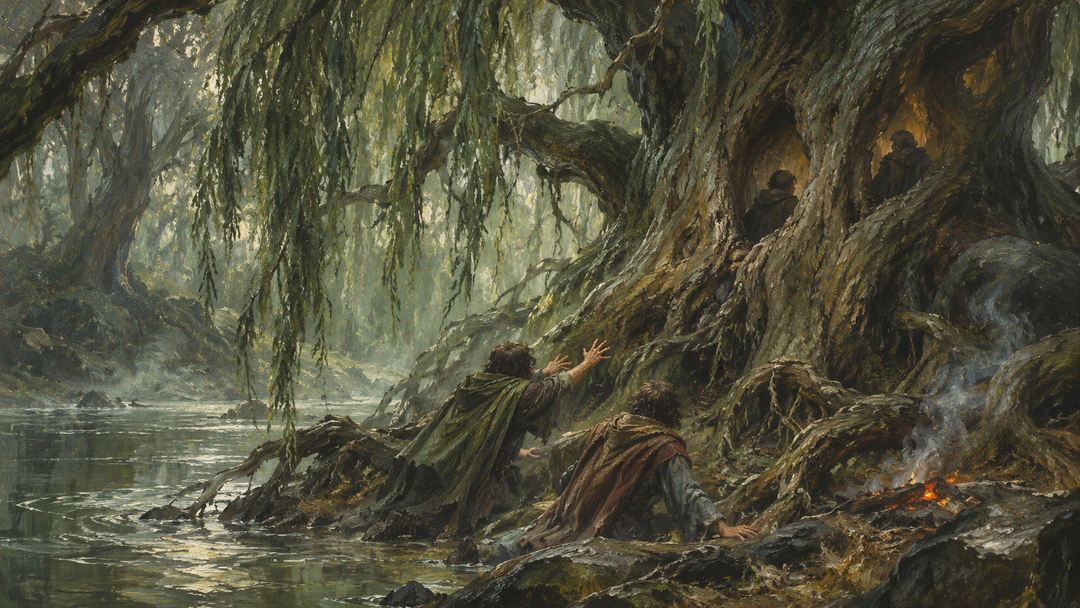
The first emergency takes place in the Old Forest, after Frodo, Sam, Merry and Pippin leave Buckland to avoid the roads watched by the Black Riders. The forest seems to direct their course towards the Withywindle. Beside its waters, Old Man Willow uses enchantment and drowsiness to overcome them. Frodo ends up in the river, held by a root until Sam pulls him free. Merry and Pippin are trapped inside the tree’s trunk.
Sam and Frodo cannot simply cut their friends out. An attempt to use fire makes matters worse: the willow threatens to crush Merry unless they stop. Frodo cries for help, but he does not call for Tom Bombadil specifically. He has not met Tom and does not know the name of the person who might save them. Tom approaches singing, carrying water-lilies intended for Goldberry, and orders Old Man Willow to release the captives.
Later, in the chapter ‘In the House of Tom Bombadil’, Frodo asks whether Tom heard him shouting. Tom says he did not; he was singing himself. He describes their meeting as chance, while also suggesting that this word may not tell the whole story. He had heard about the travellers and expected them somewhere in his country, but his immediate reason for visiting the river was to gather flowers. The novel therefore does not portray their cries as a magical signal summoning him through the forest.
Tom shelters the hobbits and Goldberry welcomes them. During their stay, Tom tells them about the land beyond the forest and supplies a rhyme to use if they need his help again. That preparation matters on the Barrow-downs. This time Frodo knows exactly whom he is calling. The words matter because he remembers a specific means of reaching someone who has already demonstrated power over dangerous things in that country.
It is tempting to combine these incidents into a single story about Bombadil appearing whenever summoned. Tolkien does not provide such a rule. The first arrival is a fortunate encounter with a traveller who has his own errand; the second is a response to an appeal he has explicitly invited. Their different circumstances make the consequences of a missed call different too.
If Help Had Arrived Too Late in the Old Forest
The danger at Old Man Willow is immediate but uneven. Frodo has already been saved from the water when Tom appears. Sam remains free to act. Merry and Pippin, however, are imprisoned in living wood, and Merry’s warning about being squeezed gives the rescue urgency. A few extra minutes could have left the trapped hobbits seriously injured or dead. That is a plausible reading of the danger, not an outcome Tolkien narrates.
The fire also shows the limits of the rescuers’ options. Ordinary force does not overcome this adversary; it provokes him. Sam’s loyalty and Frodo’s persistence are not enough to provide a reliable method of escape. They could abandon the trapped pair, but that would be a devastating moral decision, and the forest itself remains hostile. They might search for another solution, yet the novel names no nearby helper with Tom’s knowledge of the willow.
Another possibility is that Tom might have appeared regardless of the shouting. In fact, his later explanation supports that possibility more strongly than the idea of a successful summons. His route for collecting lilies brought him past the tree at just the right time. Had the hobbits been quieter, he might still have noticed them; had they arrived much later, he might already have passed. He says that his seasonal visit to gather those lilies will not be repeated until spring. That detail makes the coincidence unusually consequential without proving that a missed encounter meant certain death.
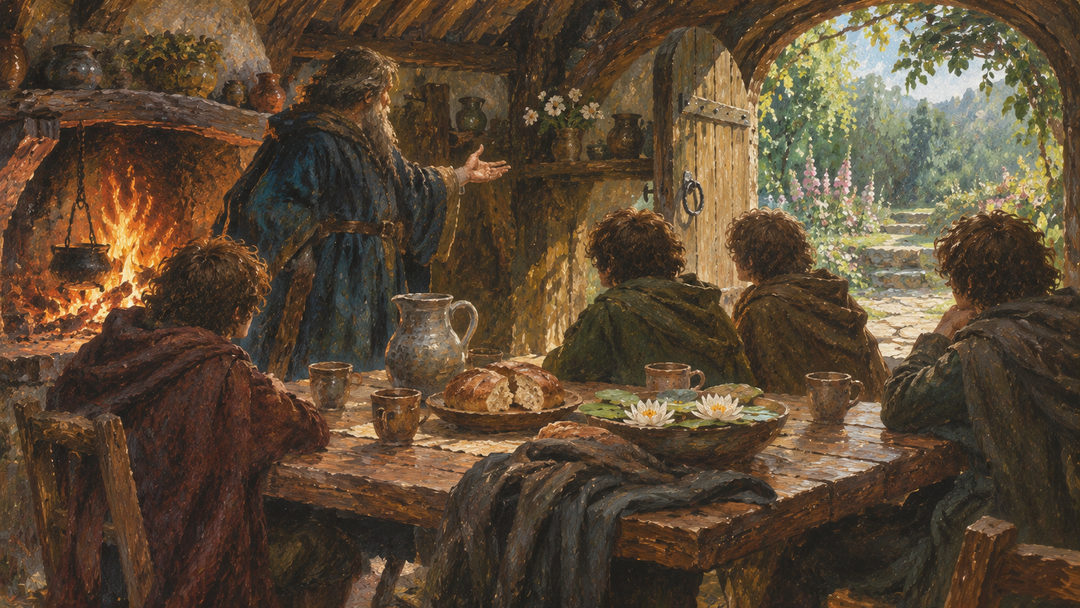
There is a further knock-on effect. Without Tom’s hospitality, the hobbits would not have heard his account of the region, learnt his emergency rhyme or received his guidance towards Bree. They might nevertheless have reached the road by another route; the story does not map every possible path through the forest. But they would approach the Barrow-downs without the particular knowledge that eventually saves them there.
Fan speculation sometimes treats Tom as a guardian secretly arranging the journey from the beginning. His anticipation of the hobbits and his peculiar authority make that interpretation understandable. Yet the narrative also gives him independent interests, including Goldberry and the lilies. It does not say he engineered the willow’s attack, that he watched every step, or that he would have intervened wherever they wandered. Calling the meeting providential is a defensible interpretation; describing it as a planned rescue is not an established fact.
The Barrow Offered Even Less Room for Delay
The second crisis occurs after the hobbits leave Tom’s house. Fog separates them on the Barrow-downs, and Frodo is overpowered. On waking inside a mound, he sees Sam, Merry and Pippin laid out as though for burial, dressed in white and surrounded by treasure. The wight’s chant and the naked sword across their necks suggest more than imprisonment. They face an immediate, supernatural threat, although Tolkien does not specify precisely what would happen to each of them if the ritual were completed.
Frodo’s first victory is inward. He considers using the Ring to become invisible and escape alone, then rejects the idea of abandoning his friends. He attacks the creeping hand instead. His sword breaks in doing so, and the threatening presence does not simply disappear. Only afterwards does he recall Tom’s rhyme. He begins weakly, finds his voice, and hears Tom answer from outside. The mound opens to daylight; Tom drives out the wight, carries the others into safety with Frodo’s help and wakes them.
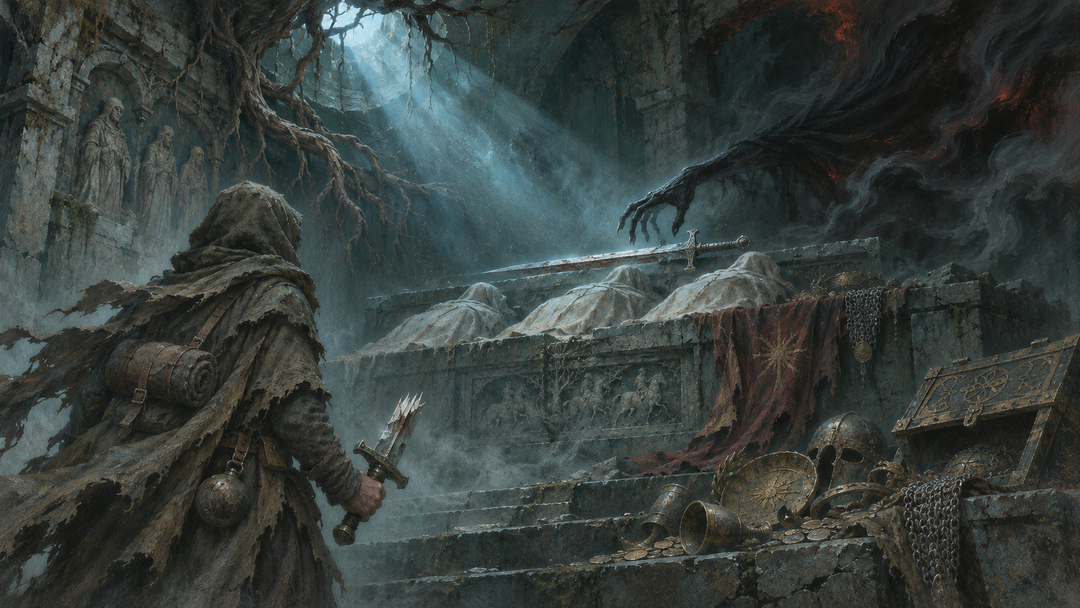
Had Frodo hesitated longer, the hand might have reached the sword. Had he put on the Ring and fled, his companions might have remained in the wight’s power. Had he forgotten the rhyme entirely, he would have been trapped with a broken weapon and three unresponsive friends. Those possibilities follow from the scene, but are not certain.
The novel does not tell us how fast the wight could have killed them, whether Frodo could have found another exit, or whether Tom would have sensed their danger without the song. The rescue is remarkably prompt, but no timetable or automatic protection is established. Nor does the wight’s association with the old evil of Angmar prove that Sauron had personally directed this particular attack against the Ring-bearer.
What is clear is that the quest could have ended before reaching Bree. Gandalf is absent, Aragorn has not yet met the hobbits, and neither appears as an available rescuer in the mound. If Frodo were killed or held there, the Ring might remain buried, pass to another finder or eventually come to the attention of Sauron’s servants. Nothing in the text permits a confident choice among those outcomes. The safer conclusion is narrower: the recognised route to destroying the Ring would have been interrupted at its earliest stage.
Consequences for the Wider Story and Its Adaptations
Tom’s intervention also changes what the hobbits carry away. He takes weapons from the barrow’s hoard and gives them long knives made by the Men of Westernesse. These are not interchangeable pieces of equipment. They connect the travellers to Arnor’s old conflict with Angmar.
At the Battle of the Pelennor Fields in The Return of the King, Merry strikes the Witch-king behind the knee with the blade he received after the barrow rescue. Tolkien explicitly singles out its special effect: the weapon breaks the spell bound up with the Ringwraith’s unseen body. Éowyn then delivers the final blow. Without that blade, the confrontation might have unfolded very differently. But it would be an overstatement to say that the Witch-king was necessarily unbeatable by any other means, or that Sauron would therefore have won. Tolkien describes one actual victory, not an exhaustive catalogue of possible ones.
The chain of dependence is nevertheless remarkable. A timely song releases the hobbits from an ancient tomb; the rescue supplies Merry with a weapon forged against Angmar; centuries after its making, that weapon helps defeat Angmar’s former ruler. The battle also depends on Éowyn’s courage. Its importance lies in a specific material link between an apparently local adventure and a decisive event in the war.
Tom cannot simply be inserted as a substitute for the Fellowship’s later protectors. In Rivendell, the Council of Elrond considers giving him the Ring. Although the Ring seems unable to dominate him, Gandalf explains that Tom would not be a dependable keeper and could not defeat Sauron’s power for everyone else. Tom also declines to accompany the hobbits beyond his own country. The text does not define an impassable magical boundary, but it gives no warrant for assuming that a further cry would bring him to Weathertop, Moria or Mordor.
The film continuity is separate. Peter Jackson’s 2001 film The Fellowship of the Ring omits the Old Forest encounter, Bombadil’s house and the Barrow-downs rescue. Aragorn provides the hobbits with swords in the film, so their journey continues through a different sequence of causes. Merry still helps Éowyn confront the Witch-king in the film trilogy, but the films do not establish his weapon’s barrow history. That is an adaptation choice, not an escape route established in the book.
Bombadil also predates the novel. Tolkien published a poem about him in 1934, and a revised version appeared in the 1962 collection The Adventures of Tom Bombadil. The poem connects Tom with Old Man Willow and a Barrow-wight, but does not describe Frodo’s party. It illuminates how Tolkien brought an older character into the Ring narrative, rather than settling the counterfactual.
Ultimately, missing Tom at the willow could have cost Merry and Pippin their lives and deprived all four hobbits of vital guidance. Failing to call him inside the barrow presents an even sharper danger: Frodo and his friends are already captive, their improvised defence is exhausted, and no other rescue is shown. The most likely immediate consequence is disaster for the party, with immense risks for the quest. Beyond that point the alternatives remain unwritten. Tolkien makes timely assistance indispensable to the story he tells, without claiming that every road not taken must end the same way.
Sources & Notes
- The Encyclopedia of Arda — Tom Bombadil — https://www.encyclopedia-of-arda.com/t/tombombadil.php
- Tolkien Gateway — Fog on the Barrow-downs — https://tolkiengateway.net/wiki/Fog_on_the_Barrow-downs
- The Encyclopedia of Arda — Old Man Willow — https://www.encyclopedia-of-arda.com/o/oldmanwillow.php
Primary reading: The Fellowship of the Ring, The Old Forest, In the House of Tom Bombadil, and Fog on the Barrow-downs. The first rescue is a chance encounter; the second follows Frodo's remembered summons. Outcomes without either rescue are counterfactual interpretation, not narrated events.