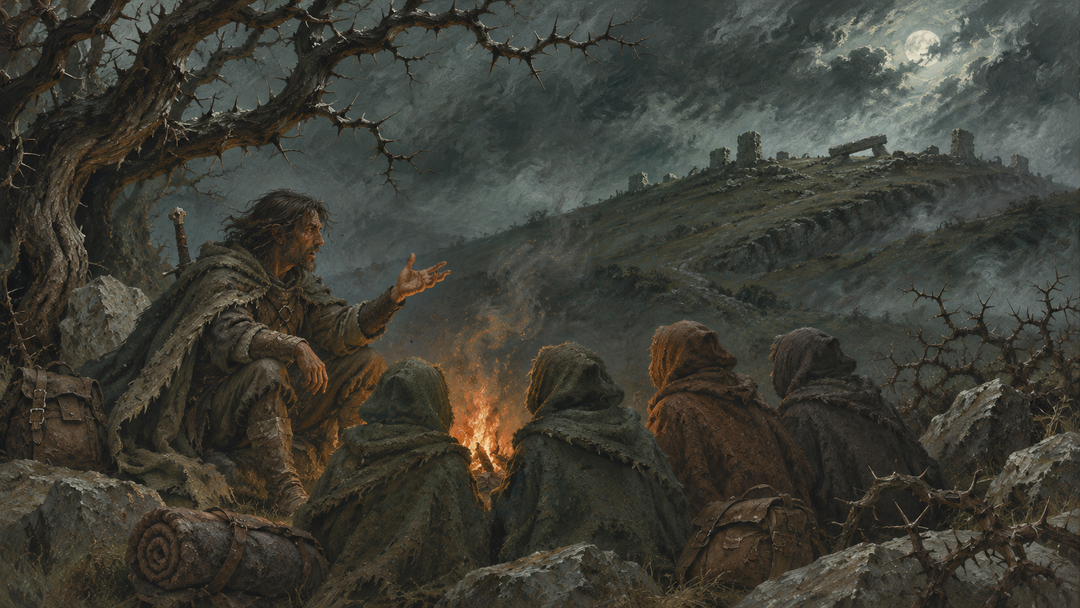
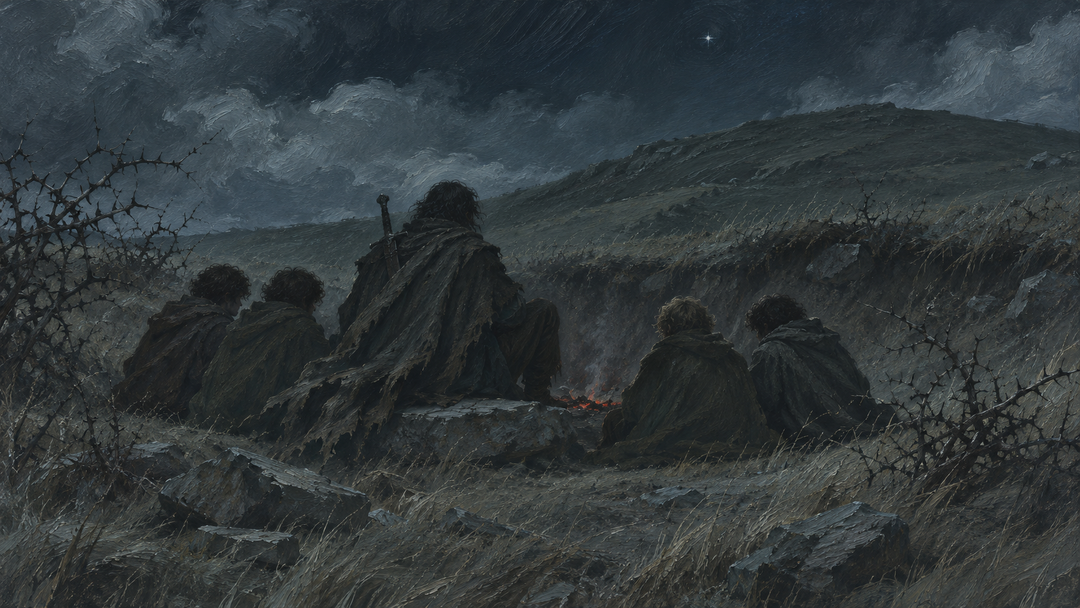
On the night of 6 October 3018, Aragorn sits with four hobbits in a sheltered hollow below Weathertop, with Black Riders nearby. He sings about Beren and Lúthien, then explains how their family survived into later ages. His final sentence is: “And of Eärendil came the Kings of Númenor, that is Westernesse.” The history he recounts is also his own.
The wording in the question changes an important detail. Aragorn does not say that Eärendil “came to” the kings, as though he travelled to meet them. He says the kings came “of Eärendil”: they were descended from him. The statement concerns descent, not a visit. Númenor did not yet exist when Eärendil undertook the voyage for which he is famous.
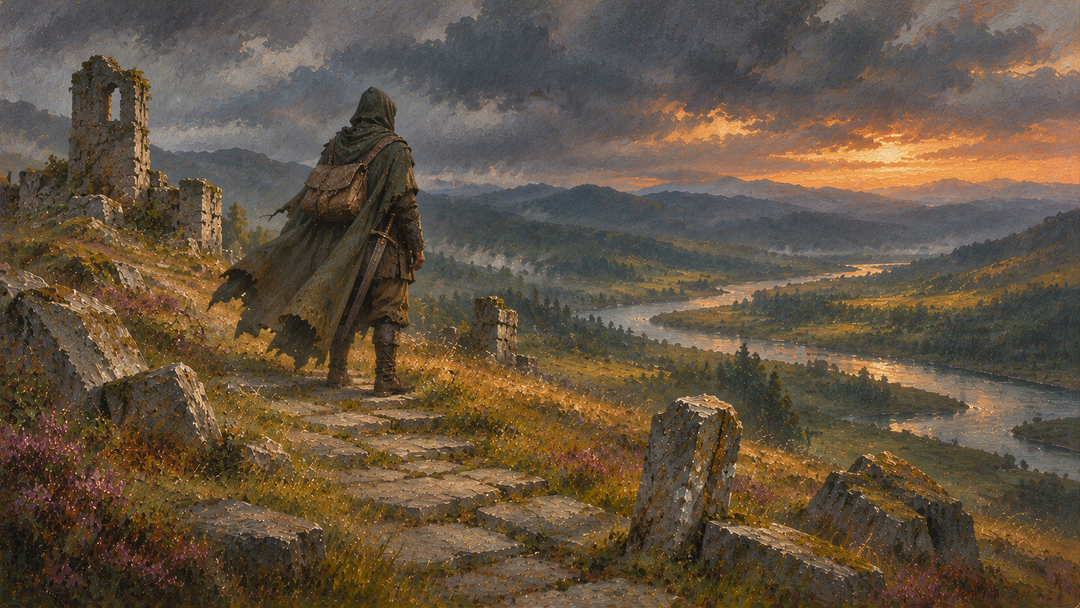
The words belong to a story told on Weathertop
The passage appears in “A Knife in the Dark”, Book One, Chapter 11 of The Fellowship of the Ring. Aragorn is still generally called Strider by his companions. He has led Frodo, Sam, Merry and Pippin from Bree towards Rivendell, amid growing danger. At Weathertop they find signs of Gandalf and fear the Riders are closing in.
As darkness gathers, the hobbits ask for tales of earlier days. When Frodo begins speaking of Gil-galad, Aragorn stops him: he does not want that story told openly with servants of the Enemy nearby. Instead he offers the tale of Tinúviel, another name for Lúthien. The song recalls her First Age meeting with the mortal Beren.
Aragorn then supplies prose explanations because the song alone cannot make its background clear. Beren and Lúthien faced Morgoth, the first Dark Lord and Sauron’s former master. Their quest involved recovering a Silmaril, one of the extraordinary jewels stolen by Morgoth. The story also concerns loss and a remarkable choice: Lúthien relinquished the ordinary fate of the Elves so that she could share Beren’s mortality.
That ending is not simply a romantic tragedy. Aragorn moves from the lovers themselves to their descendants, explaining that the bloodline of ancient Elven rulers continued among Men. He names their son Dior, Dior’s daughter Elwing and Elwing’s husband Eärendil. The reference to Númenor completes the chain from a First Age love story to the great human kingdoms of subsequent ages.
The explanation serves listeners who know fragments of old lore. “Westernesse” identifies Númenor by another name rather than introducing a second kingdom. Aragorn has not suddenly changed subjects; he is explaining what became of the family whose story he has just sung. The Riders soon attack, sharply contrasting ancient victory with present danger.
How Eärendil’s descendants became kings
The family connection starts with Beren and Lúthien. Their son Dior became heir to Thingol, Lúthien’s father and a king of the Elves. Dior’s daughter Elwing survived the destruction of Doriath and eventually married Eärendil. Eärendil himself came from another celebrated union of Elves and Men: his father was the mortal Tuor and his mother was Idril, daughter of Turgon, the Elven king of Gondolin.
These two lines united in Eärendil and Elwing, parents of Elrond and Elros. That is the missing generation in Aragorn’s compressed explanation. The first king was Eärendil’s son Elros, not Eärendil himself. The Silmarillion, particularly “Of the Voyage of Eärendil and the War of Wrath” and “Akallabêth”, provides the larger history behind the sentence.
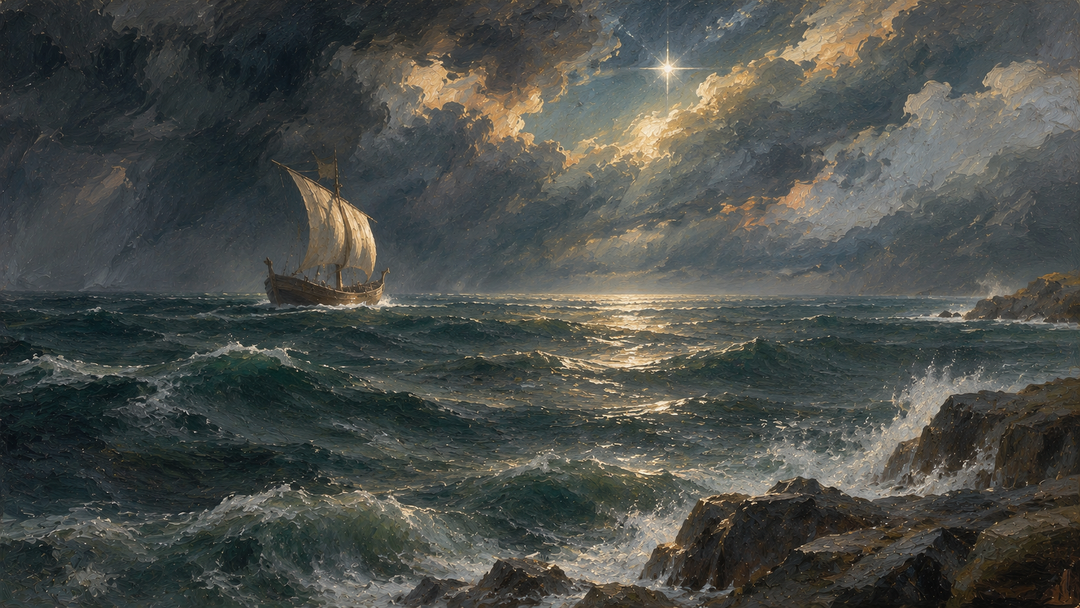
Eärendil sailed west carrying a Silmaril, seeking aid against Morgoth near the end of the First Age. His appeal was answered, and the resulting War of Wrath brought Morgoth’s defeat. Eärendil was afterwards associated with a shining star as he sailed the heavens bearing the jewel. This was no path to earthly kingship.
After the war, the Valar provided a new island homeland for the Edain, the human peoples who had supported the Elves against Morgoth. This island was Númenor. The settlers sailed towards it under the guidance of Eärendil’s star. Besides ancestry, he was linked to the country through the star: his light marked the route to the home where his son’s royal line would begin.
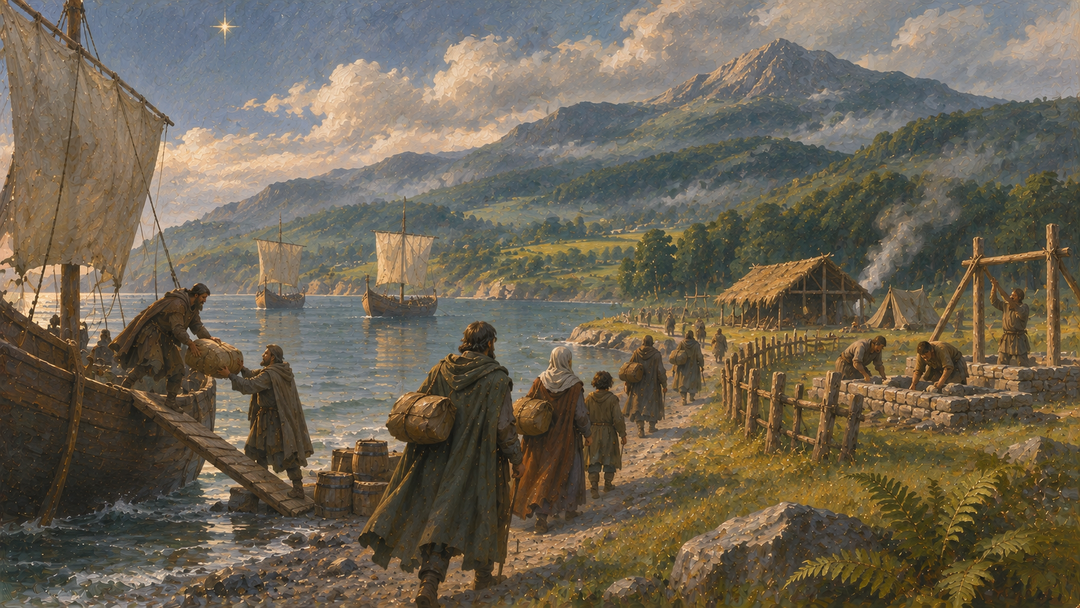
Elrond and Elros, often described as Half-elven, were granted a choice concerning the fate of their kindred. Elrond chose to be counted among the Elves. Elros chose the fate of Men and became the first King of Númenor, reigning under the name Tar-Minyatur. According to the chronology developed in Tolkien’s later writings, his reign began in the thirty-second year of the Second Age. He lived exceptionally long, but remained mortal.
Elros’s descendants inherited the royal house. This does not mean every inhabitant of Númenor descended from Eärendil. The inhabitants included many Edain families; the royal dynasty traced its descent through Elros. The distinction matters: Aragorn is identifying the origin of a dynasty, not claiming that the star-mariner was the father of an entire people.
Centuries later Númenor grew powerful, and its rulers became increasingly troubled by human mortality. Under Sauron’s influence, its last king, Ar-Pharazôn, attempted to challenge the prohibition against sailing to the Undying Lands. Númenor was destroyed in the Second Age, in the year 3319. Elendil and his sons escaped with other members of the Faithful, bringing Númenórean traditions and royal descent back to Middle-earth.
Elendil belonged to the line of Elros through the Lords of Andúnië, whose ancestry ran through Silmariën, a daughter of the Númenórean king Tar-Elendil. Elendil established the northern kingdom of Arnor, while his sons Isildur and Anárion ruled in Gondor. Aragorn eventually inherited the northern royal line through Isildur and the chieftains of the Dúnedain. The line ultimately leads to Strider. Yet royal ancestry alone could not restore the divided kingdoms: generations of Stewards had ruled Gondor after its line of kings ended. Aragorn would still have to establish his right to rule through his actions and the acceptance of others.
Why the connection matters to Aragorn
Aragorn does not explicitly announce his claim to kingship during the telling. The hobbits have already encountered the name Aragorn in Gandalf’s letter at Bree, but they are still learning what kind of person has become their guide. His poetry, languages and familiarity with Elrond’s household suggest a wider world than his weather-beaten appearance first promised.
The genealogy gives that impression a precise basis. Aragorn is a Dúnadan, one of the surviving descendants of the Númenóreans in Middle-earth, and the heir of Isildur. His ancestral claim reaches back through Elendil’s house to Elros and Eärendil. The passage is therefore dramatic irony: the hobbits hear the history of a royal line from a man who belongs to it, without a formal declaration of kingship.
It also explains why Elrond figures in the same account. Elrond and Elros were brothers, so the house of Rivendell and the kings of Númenor share an ancient family origin. Elrond’s long life makes him a living witness to a past that, for the hobbits, seems almost mythical. Their guide is connected to it by descent and upbringing.
There is a more personal layer. In “The Tale of Aragorn and Arwen”, included in Appendix A of The Return of the King, Aragorn first encounters Arwen while singing about Lúthien and mistakes her for the legendary maiden. Arwen is Elrond’s daughter and therefore also belongs to Eärendil’s family. Her eventual decision to share Aragorn’s mortal life echoes the choice of Lúthien, though the circumstances and consequences are not identical.
The story matters to Aragorn in two ways: it concerns his ancestors, and it anticipates the love and loss bound up with his relationship with Arwen. Reading the Weathertop passage with the appendix in mind makes his emotional involvement more intelligible. As he speaks by the fire, the hobbits see an intensity that had been hidden beneath his guarded manner.
Still, Tolkien never states that Aragorn selected this particular ending as a coded message about his future coronation or marriage. That is an interpretation, not a documented intention of the character. The narrative does, however, place the royal genealogy in the mouth of the future king, immediately before the Riders arrive. The rising moon behind Weathertop can suggest a distant crown to a reader, but it is no coronation or prophecy.
What “Westernesse” adds, and what the sentence does not mean
Númenor is a name from Tolkien’s Elvish languages, meaning roughly “West-land”. “Westernesse” is its name in the Common Speech as represented in the English text. Tolkien drew the English form from medieval romance, notably the rare name Westernesse in King Horn. He associated its ending with romance names such as Lyonesse. The word lends the island a legendary sound.
That matters because Tolkien frames The Lord of the Rings as a translation of an older account, not as dialogue originally spoken in modern English. Aragorn’s explanation is presented in words the hobbits, and readers, can follow. “That is Westernesse” clarifies the geographical reference without implying that Westernesse and Númenor are different places. Neither name means Valinor, the Undying Lands to which Eärendil sailed.
The distinction also prevents a chronological mistake. Eärendil’s voyage belonged to the end of the First Age; Númenor was founded afterwards. Nothing in Aragorn’s statement says he visited its kings, founded its government or ruled the island. The later history makes the intended meaning secure: his son Elros established the royal line. A meeting with later rulers is a counterfactual, unsupported by Tolkien.
The books offer varying detail without reversing its meaning. The Fellowship of the Ring gives the brief family connection; the appendices describe Númenórean and Dúnedain succession; The Silmarillion and Unfinished Tales, published after Tolkien’s death, give fuller accounts of Eärendil, Elros and the kings. Details in Tolkien’s wider mythology sometimes changed during composition, so not every surviving version should be treated as equally final. The central father-to-son relationship here is nevertheless consistent.
Film continuity should be kept separate. In the extended edition of Peter Jackson’s The Fellowship of the Ring, Aragorn sings about Beren and Lúthien while travelling with the hobbits, and Frodo asks about the woman in the song. The film abbreviates and relocates elements of the book’s account; it does not supply the quoted Númenórean genealogy in the same form. The quotation belongs to the novel, not the film.
Some fan readings go further, suggesting that Aragorn deliberately tests whether the hobbits recognise his royal ancestry, or that he is hinting at a destiny he has already accepted. The text confirms neither idea. What it does confirm is more substantial: the ranger has an intimate connection with the people whose story he tells, and the family line he describes will become central to the restoration of kingship.
So Aragorn says that the kings came “of Eärendil” because their first ruler, Elros, was Eärendil’s son. He adds “Westernesse” to identify Númenor for his listeners. At Weathertop, an ancient family history quietly links the love of Beren and Lúthien, the founding of Númenor and the future of the man guarding the hobbits. No visit to a royal court is implied. It is about the remarkable length, survival and significance of his descendants’ line.
Sources & Notes
- Tolkien Gateway, Eärendil — the First Age voyage west with a Silmaril, the appeal that brought the War of Wrath, and his later association with the star that guided the Edain; references The Silmarillion, 'Of the Voyage of Eärendil and the War of Wrath'. https://tolkiengateway.net/wiki/E%C3%A4rendil
- Tolkien Gateway, Elros — the Half-elven choice, Elros Tar-Minyatur as first King of Númenor, and the royal line descended from him rather than from Eärendil directly. https://tolkiengateway.net/wiki/Elros
- Tolkien Gateway, Númenor — the island given to the Edain after the War of Wrath, its founding under Elros, the guided voyage, and 'Westernesse' as an alternative name. https://tolkiengateway.net/wiki/N%C3%BAmenor
- Tolkien Gateway, A Knife in the Dark — the Fellowship of the Ring Book I chapter 11 setting at Weathertop, Aragorn's tale of Tinúviel and his closing genealogy from Eärendil to the Kings of Númenor. https://tolkiengateway.net/wiki/A_Knife_in_the_Dark
- Tolkien Gateway, Westernesse — the name applied to Númenor, clarifying that Aragorn's phrase identifies one kingdom rather than two. https://tolkiengateway.net/wiki/Westernesse
Primary reading: The Fellowship of the Ring, Book I, ch. 11 'A Knife in the Dark'; The Silmarillion, 'Of the Voyage of Eärendil and the War of Wrath' and 'Akallabêth'; and the Appendices for the line of Elros. The linked reference entries document Eärendil's voyage and star, Elros Tar-Minyatur, the founding of Númenor and the name Westernesse. The reading that Aragorn's sentence concerns descent rather than a visit, and that 'Westernesse' is simply Númenor under another name, is a close-reading conclusion from the syntax and the published genealogy rather than an explicit gloss in the text.