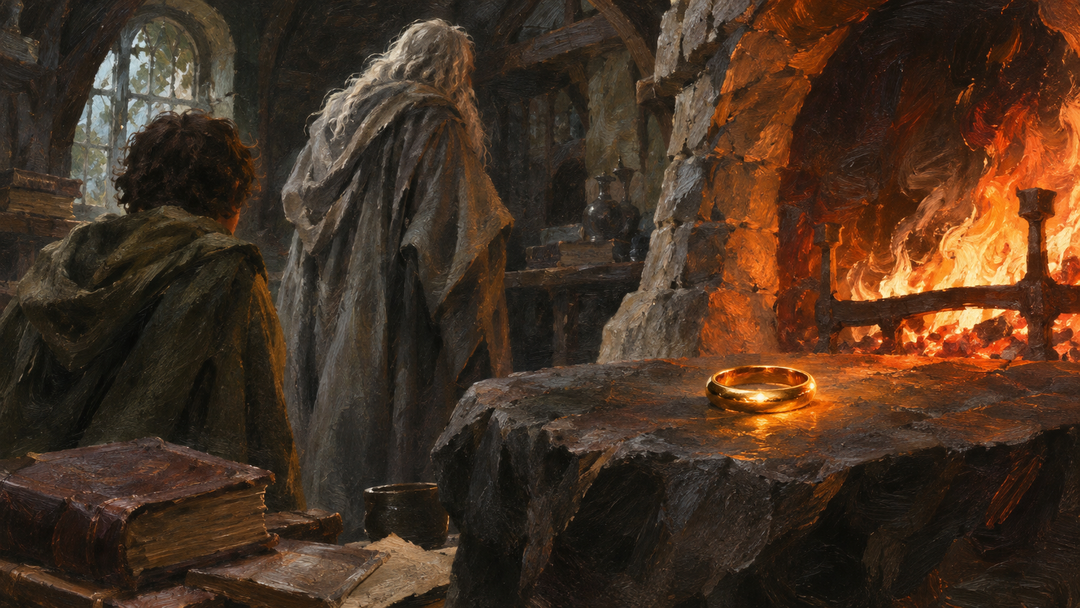
When Gandalf heats Frodo’s ring in the fireplace at Bag End, letters appear on the gold that were previously invisible. Frodo cannot read them. Gandalf explains that the letters are Elvish, but the language is Mordor’s. That distinction matters: the famous inscription is not an Elvish spell, nor is it written in a uniquely evil alphabet. It is a short surviving specimen of the Black Speech, a language deliberately devised by Sauron.
The Black Speech is not another name for every Orc dialect, and Tolkien did not leave a complete language that readers can speak fluently. The evidence reveals an attempted imperial language, a few phrases and names, and a gap between Sauron’s intended order and his servants’ actual speech habits.
Why Sauron made it
Appendix F of The Lord of the Rings says that Sauron devised the Black Speech during the Dark Years. It arose in the Second Age, as he established power after Morgoth’s defeat. The One Ring was forged around the year 1600 of that Age, so the language already existed. Tolkien supplies no precise invention date or account of Sauron teaching it.
Sauron’s stated ambition was to make it the language of everyone who served him. Unlike a dialect that develops within a community, it was intended as a centrally imposed common language. Its political purpose fits the One Ring’s purpose: subordinating many independent agents to a single master.
Yet Appendix F also says the project failed. Orcs had their own shifting forms of speech, borrowed words from other peoples and altered them to suit their purposes. Their dialects could be mutually unintelligible. They did not necessarily adopt a common language, especially while living apart and quarrelling among themselves.
After Sauron’s defeat at the end of the Second Age, the ancient form was forgotten by everyone except the Nazgûl, according to the appendix. When he rose again, it became the language of Barad-dûr and the captains of Mordor. This was decline followed by attempted restoration, not uninterrupted universal use.
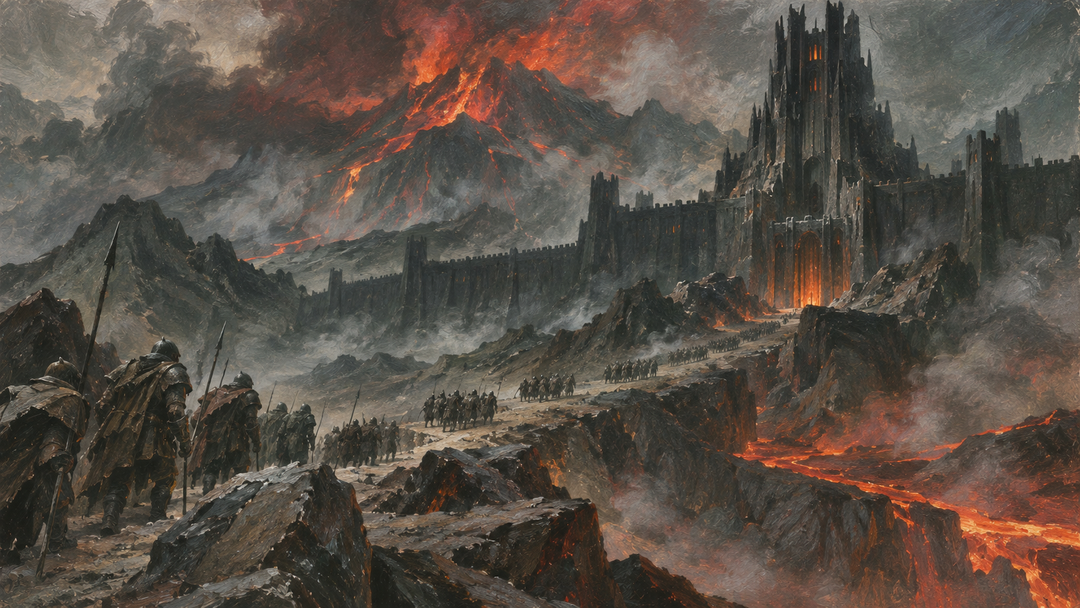
There were other speakers besides high-ranking Orcs. Appendix F describes the Olog-hai, a new kind of troll bred by Sauron, as knowing no language other than the Black Speech of Barad-dûr. The Nazgûl preserved its older form. It was more than ceremonial wording reserved for the Ring.
Even place names need sorting. Mordor is a Sindarin name meaning Black Land, while Barad-dûr is Sindarin for Dark Tower. The corresponding Black Speech name for Sauron’s fortress is Lugbúrz. A place being evil does not make its familiar name Black Speech; different peoples named the same landscape differently.
What is written on the One Ring
The clearest example of the ancient language is the inscription itself: Ash nazg durbatulûk, ash nazg gimbatul, ash nazg thrakatulûk agh burzum-ishi krimpatul. It declares that one Ring will rule the others, find them, bring them together and bind them in darkness. They are the controlling lines of the Ring-verse, not the entire poem about the Rings.
The difference matters because the longer verse, printed near the beginning of The Lord of the Rings, is presented to readers in English. Tolkien supplies no complete Black Speech original for its other lines about Elves, Dwarves and Men. Fan translations do not recover a missing Tolkien original.
Isildur had recorded the Ring’s markings after taking it from Sauron, noting that the writing faded as the gold cooled. Gandalf later finds this account in Gondor. The link between that earlier description and the letters revealed by fire helps establish the object’s identity; it is not a general method for identifying any magical ring.
The inscription uses the Tengwar, the writing system developed by the Elves, in an ancient mode. Script and language are separate things: English can be written in Roman letters without being Latin, and Sauron’s language can be written in Elvish letters without being Elvish. No separate Black Speech alphabet is established in the books, whatever adaptations may suggest.
Some words are unusually secure because the inscription has an explicit translation. Ash means one and nazg means ring. Agh means and. The roots durb, gimb, thrak and krimp are associated respectively with ruling, finding, bringing and binding. Burzum means darkness; its root burz, meaning dark, also appears in Lugbúrz. The inscription has a consistent pattern, not random threatening sounds.
Its longer words reveal something about grammar. In Tolkien’s linguistic comments, the ending -ul expresses the object them, while -ûk carries the sense of all or the whole. Durbatulûk and thrakatulûk combine several functions in single words. Tolkien described the Black Speech as agglutinative, meaning that identifiable elements can be joined together to express a more complicated meaning.
Other details are less certain. The element -ishi in burzum-ishi conveys in or inside, placed after the word for darkness rather than before it as English normally would. Tolkien also discussed an element -um in burzum, but one example cannot establish a general rule for every abstract noun. Proposed rules for -at likewise need careful attribution.
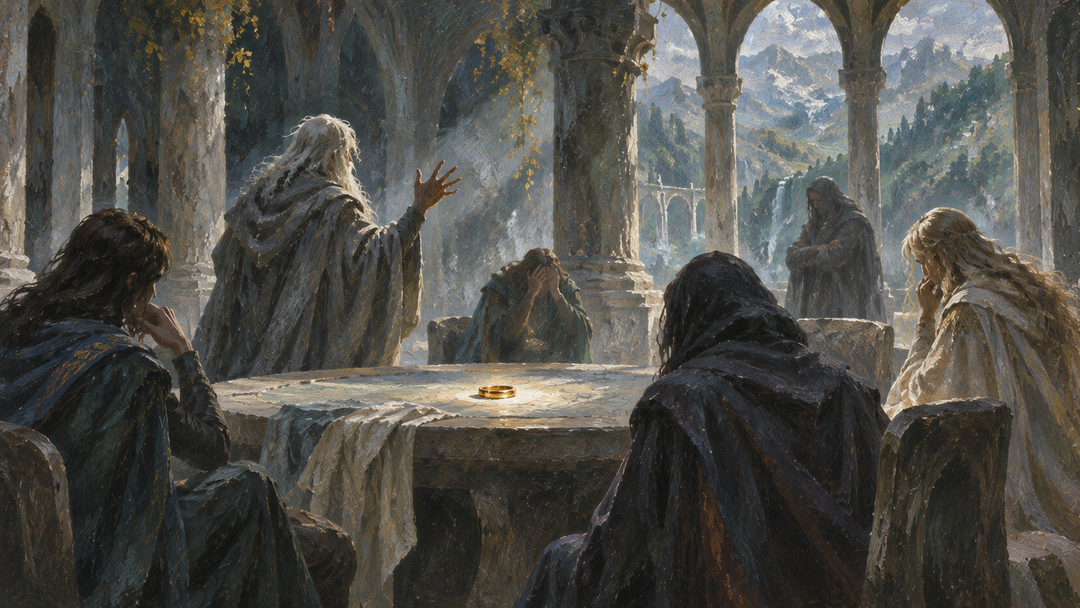
At the Council of Elrond, Gandalf speaks the inscription aloud. His voice becomes harsh and threatening, the light seems to fail, and the Elves cover their ears. Elrond objects to hearing that language spoken in Rivendell. The scene conveys the force of Sauron’s words. It does not prove that any ordinary person reciting Black Speech automatically causes darkness or performs a magical spell.
Indeed, the Ring’s power does not come from a listener correctly pronouncing its inscription. The words announce the Ring’s function, while the artefact’s power comes from Sauron’s craft. The inscription identifies the Ring for Gandalf and declares its purpose; it is not a spoken activation command.
How Orcs actually spoke it
Orkish speech is a broader and messier category than the Black Speech. Tolkien explains in Appendix F that Orcs took words from other languages and corrupted them, producing numerous varieties. They also used Westron, the Common Speech, especially when individuals from different groups needed to understand one another. The Orcs’ English dialogue represents translated speech, not a claim that they spoke English or always used Black Speech.
The rivalry between Mordor’s soldiers and Saruman’s troops in The Two Towers makes this practical problem visible. Their arguments concern orders, loyalties and the possession of the captured Hobbits, and they communicate across factional lines. Their interaction shows the practical limits of Sauron’s linguistic programme.
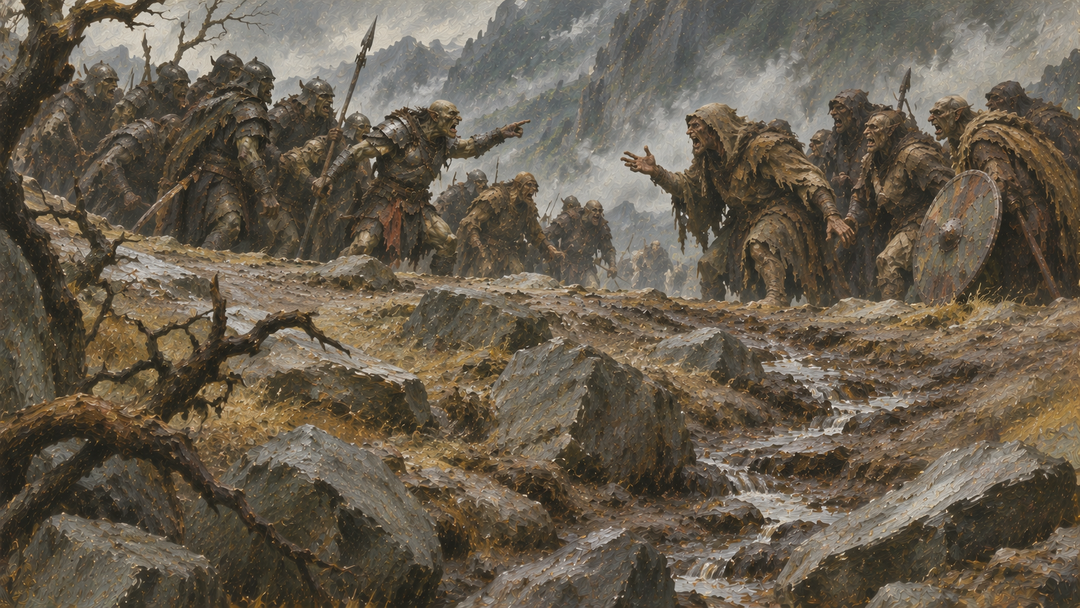
There is, however, a second substantial sample of the Black Speech family. During the quarrel, a Mordor Orc curses Uglúk in words beginning Uglúk u bagronk sha pushdug Saruman-glob. Appendix F identifies the outburst as a debased form used by the soldiers of the Dark Tower, rather than the ancient language preserved on the Ring. It cannot simply be treated as ancient Black Speech.
The published narrative does not translate this curse. Tolkien’s explanatory drafts, later printed in such sources as The Peoples of Middle-earth and Parma Eldalamberon, associate it with insults about filth, punishment and Saruman. The interpretations differ, so no single word-for-word rendering should be presented as definitive.
Shorter words and names provide further evidence. Ghâsh means fire and is identified as a widespread Orc word derived from the Black Speech. Uruk appears in names for formidable Orc soldiers, while snaga means slave and is used contemptuously among Orcs. Nazgûl combines the Black Speech word for ring with an element meaning wraith. These examples establish influence, not a full everyday vocabulary.
Sharkû, meaning old man, is another revealing case. It lies behind Sharkey, the name used for Saruman by his followers and heard in the Shire. A word connected with Mordor’s linguistic world has travelled into a nickname far from Sauron’s tower. Its use shows linguistic contact, not that every unfamiliar name belongs to Black Speech.
Orcish dialects, official Mordor terminology and ancient Black Speech overlap, but they are not interchangeable labels. An Orc might use a borrowed term, insult a rival locally and switch to the Common Speech. The linguistic disorder is also a limit on Sauron’s authority: he can command armies without completely remaking the speech habits of his servants.
What Tolkien created and what others added
Outside the fiction, Tolkien was both a novelist and a professional philologist. He devoted much more surviving material to Elvish languages such as Quenya and Sindarin than to Black Speech. For the latter he established an origin, a distinctive sound, a few grammatical patterns and a small set of examples. That suggests coherence, but does not enable ordinary conversations.
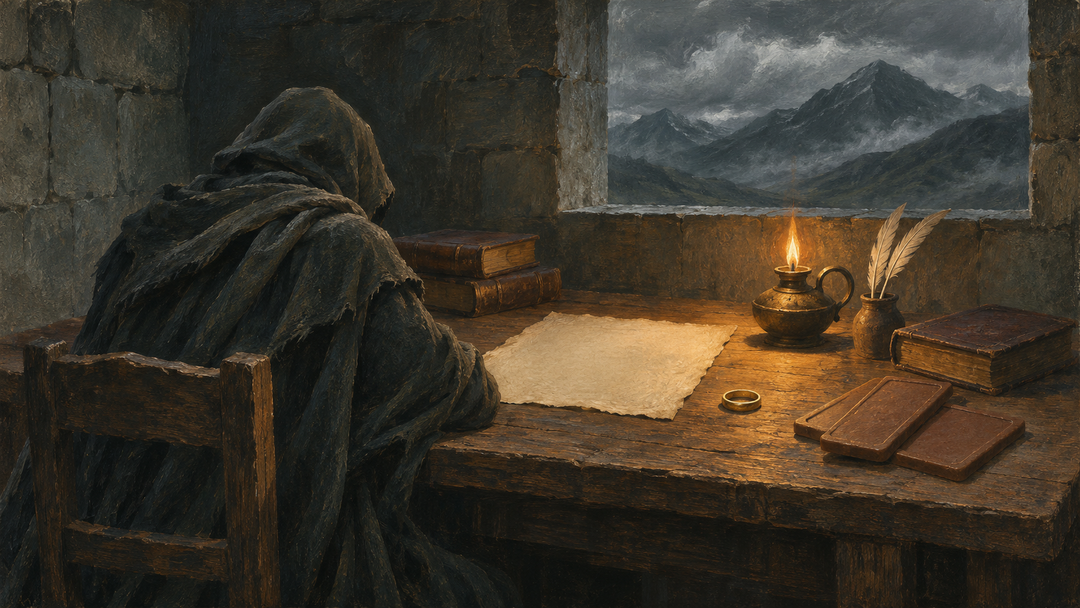
In comments published from his linguistic papers, Tolkien explained that Black Speech was meant to differ markedly from Elvish while remaining organised and expressive. He did not intend it as meaningless noise. Its clusters of consonants and repeated back vowels contribute to the impression of harshness, but the judgement that it sounds ugly belongs to the aesthetic and moral world of the story. Real languages with similar sounds are not evil.
Claims about direct models need similar caution. Fans and scholars have compared its structure with real languages, and some have noticed resemblances between individual words. Resemblance is not proof of deliberate borrowing. Tolkien did not identify a single real-world language as the template for Black Speech. Assertions that it is simply distorted Quenya, or a disguised version of another historical tongue, go beyond what the surviving evidence establishes.
The films create another boundary. Peter Jackson’s adaptations use the Ring inscription and additional material designed for performance. Linguist David Salo extended the limited evidence into what is often called neo-Black Speech and related Orcish varieties. These are screenplay additions, not forgotten passages from the books. A Black Speech dictionary compiled from film dialogue, games and fan projects can contain useful creative work while mixing several distinct continuities.
The difference also applies to pronunciation and visual presentation. Actors, dialect coaches, composers and designers must make choices that printed fiction does not always settle. Film delivery and invented inscriptions do not establish how Tolkien’s Mordor spoke. When a game supplies fluent conversations or long speeches in Black Speech, it is necessarily filling gaps left by the original texts.
Nothing in the main narrative gives a detailed account of the language’s fate after Sauron’s fall. It is reasonable to infer that the destruction of his regime removed the power that had maintained its official use, but a claim that every surviving speaker immediately forgot it would be speculation. The texts do not document a surviving speech community.
What the Black Speech actually is, then, is more precise than the usual shorthand of an evil Orc language. Sauron devised it as a common tongue for subordinates; its ancient form survives most clearly on the One Ring; later Mordor soldiers used a changed variety; and Orcs frequently relied on other speech. Tolkien made its limited surviving words carry a clear idea: even language could be organised in the service of domination, though no decree could make that project entirely succeed.
Sources & Notes
- Tolkien Gateway — Black Speech — https://tolkiengateway.net/wiki/Black_Speech
- Tolkien Gateway — Ring-inscription — https://tolkiengateway.net/wiki/Ring-inscription
- The Encyclopedia of Arda — Black Speech — https://www.encyclopedia-of-arda.com/b/blackspeech.php
Primary reading: The Lord of the Rings, Appendix F, and The Fellowship of the Ring, The Shadow of the Past and The Council of Elrond. Distinguish Tolkien's limited Black Speech corpus, the Tengwar script, differing glosses of the Orc curse, and later film or fan extensions.