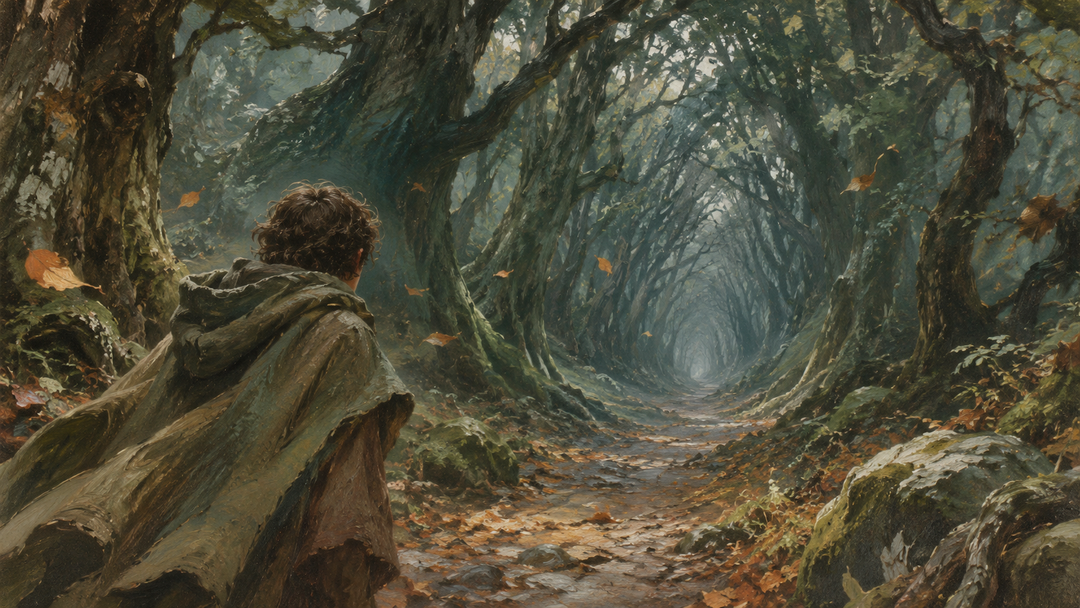
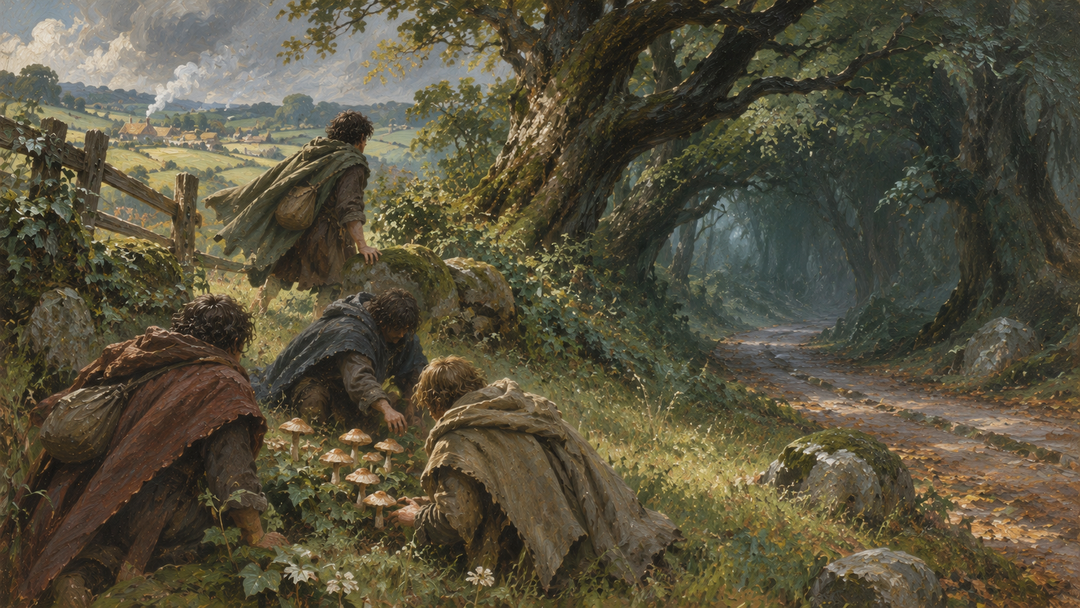
While Sam, Merry and Pippin gather mushrooms, Frodo looks down the wooded road ahead. The trees appear to surge towards him, although no tree visibly walks or falls. He becomes alarmed and urges the other hobbits to get off the road. Moments later a Black Rider approaches on horseback. The scene occurs in Peter Jackson’s 2001 film The Lord of the Rings: The Fellowship of the Ring, shortly after the hobbits tumble down a bank while escaping Farmer Maggot.
Frodo is not staring at a literal invisible wall. Nor is he watching the Old Forest advance. The most convincing explanation is that he senses an approaching Ringwraith before he can see it, and the film makes that sudden feeling of danger visible through an unsettling camera movement. The Road still lies where it was. What changes is the viewer’s perception of its depth.
That distinction matters because the sequence blends three things: a genuine enemy nearby, Frodo’s particular vulnerability as the Ring-bearer, and a visual effect designed for the audience. The film makes their connection compelling, but it does not provide a technical explanation within the story for why the trees seem to close in.
The danger at the end of the Road
Immediately before the shot, Sam, Merry and Pippin are occupied with mushrooms. Frodo remains apart, looking along the wooded route. Their differing reactions are deliberate. The others see an ordinary opportunity for food; Frodo has already been warned that the Ring is dangerous and that enemies are searching for it. He is alert to a threat his companions have not noticed.
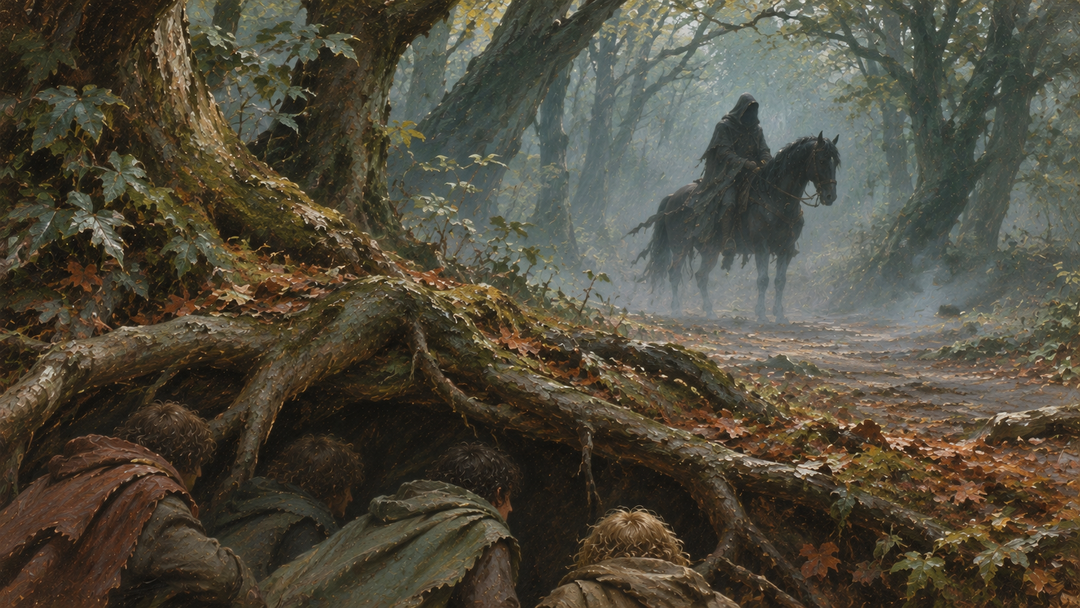
At first, he speaks cautiously, suggesting they should leave the road. The strange movement in the distance, accompanied by disturbing sound, turns caution into urgency. He orders everyone into cover. The hobbits scramble beneath the roots of a tree beside the road, and the source of the danger soon becomes unmistakable: a mounted figure in black, one of the Nazgûl, or Ringwraiths.
The Rider stops near their hiding place and searches rather than simply passing by. It sniffs and listens, then dismounts and leans towards the concealed hobbits. Frodo struggles with an impulse to take out the One Ring and put it on. A distraction thrown across the road draws the Rider away, giving the four a chance to escape.
These events establish what Frodo’s warning was about. He was not reacting to an obstacle blocking the road, a doorway opening in the trees, or an attack by the forest itself. He was reacting to danger approaching through an apparently empty space. The ominous view comes before the horse and rider are clearly presented, which allows viewers to experience the warning before they know what causes it.
The film’s screenplay describes leaves whirling along the road as though moved by an unseen wind, followed by hoofbeats and an eerie cry. That is a description of atmosphere and approaching menace, not an assertion that an invisible structure stands across the path. A viewer can reasonably call the image wall-like, because the compressed background seems to press forward, but the description should not be mistaken for an object identified by the story.
The exact point at which Frodo recognises the threat is left open. His expression suggests awareness rather than informed identification. He knows something is wrong; he does not announce that he has detected a Nazgûl by a specific supernatural sense. The audience identifies the source through what follows, not through a spoken explanation at the moment he looks down the road.
How the camera makes the forest close in
The shifting background is a practical example of a dolly zoom, sometimes called a track zoom or the Vertigo effect. It combines movement of the camera with a zoom in the opposite direction. As one changes the viewpoint and the other changes the lens’s field of view, the relative sizes and apparent spacing of things in the background alter in a way that ordinary looking does not produce.
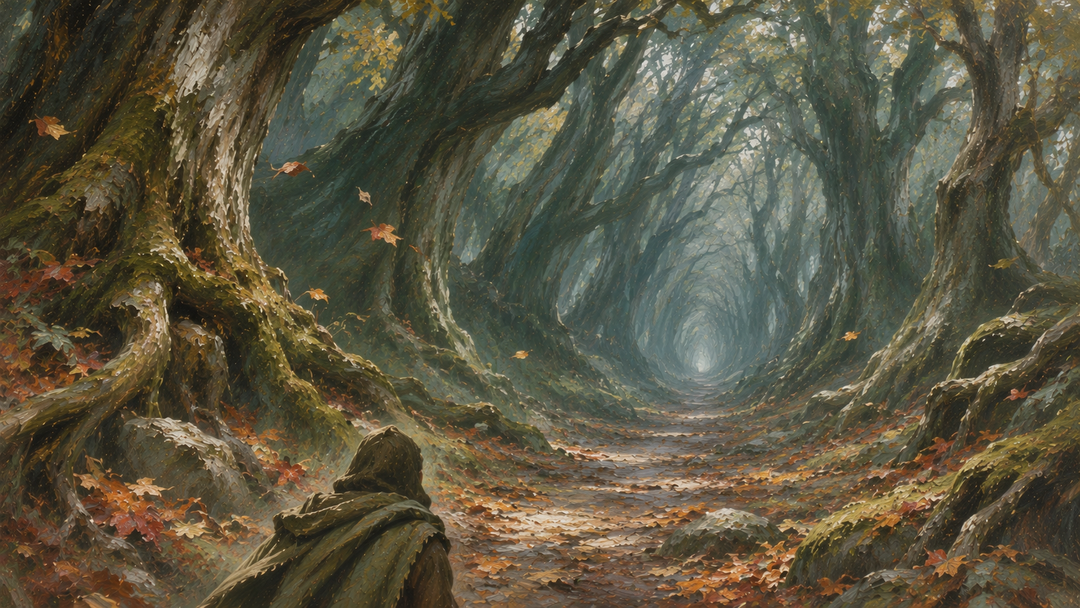
In this scene, the wooded distance appears to crowd towards the foreground. The road seems suddenly shorter, while the trees feel closer and more imposing. The effect can resemble an invisible barrier moving towards the observer, but it is a manipulation of visual perspective. It need not mean that Frodo is literally seeing the world bend or that the forest has changed shape within Middle-earth.
The technique is associated with Alfred Hitchcock’s Vertigo, released in 1958, where a related camera movement conveys a character’s disorientation. Filmmakers have since used it to suggest shock, dread or a disturbing realisation. Here it serves a similar dramatic purpose without copying the specific circumstances of Hitchcock’s film.
There is unusually direct evidence for why the shot was included. In a 2021 interview for Frame.io’s Art of the Cut series, editor John Gilbert discussed the hobbits’ hiding-place encounter. He recalled that the initial version contained a straightforward point-of-view shot of Frodo looking down the road, but that it did not quite communicate the moment. Gilbert suggested filming a track zoom. According to his account, a second-unit crew shot it a few days later, and the addition gave the scene a slightly supernatural quality.
What Tolkien’s book actually describes
J. R. R. Tolkien’s The Fellowship of the Ring contains closely related encounters, but not this precise image of a road contracting. In the chapter ‘Three is Company’, Frodo travels through the Shire with Sam and Pippin. Merry has not yet joined their walking party. As they approach the Woody End, Sam hears a horse behind them, and Frodo becomes uneasy about being seen.
They hide beside the road. A tall Black Rider appears on a black horse, stops nearby and seems to search the air by smell. Frodo feels a powerful temptation to put on the Ring, although doing so would expose him to another kind of danger. The Rider eventually moves off. The scene is unsettling because Frodo cannot initially account for the stranger’s behaviour, and because an apparently quiet part of the Shire has become unsafe.
Later that night, another encounter brings a Rider still closer. It appears to investigate the place where the hobbits were standing and comes towards their hiding place. Frodo again feels drawn to use the Ring. The arrival of singing Elves interrupts the danger, and the Rider withdraws. Tolkien therefore develops the mounting threat through repeated meetings, uncertain perception and Frodo’s temptation, rather than through a description of trees rushing together.
The film rearranges this material. Merry is present during the roadside encounter, and Farmer Maggot is a pursuer from whose field the hobbits have just fled. In the book, Maggot proves helpful, providing hospitality and transport towards the ferry. The film’s mushroom discovery is also a playful nod to the next chapter title, ‘A Short Cut to Mushrooms’. These are adaptation choices, not missing details that can be assumed to have happened exactly the same way in both versions.
Another possible confusion is with the Old Forest, which the hobbits enter later in the book after leaving the settled parts of the Shire. There, the trees and paths can indeed seem hostile, and the travellers are led towards Old Man Willow. Tolkien gives the Old Forest a disturbing agency quite unlike an ordinary woodland. But that is a separate episode, involving different hazards, and it is not what Jackson is showing in the roadside dolly zoom. The films omit the Old Forest journey and Tom Bombadil’s part in it.
The Ring, the Nazgûl and the limits of explanation
Why does Frodo react before his friends? The broader story offers a strong reason to associate his foreboding with the Nazgûl. They are servants of Sauron, sent to recover the Ring, and their presence inspires fear. Frodo carries the object they seek. His nervousness is therefore narratively appropriate even before he understands the nature of his pursuers.
Tolkien later makes the Riders’ unusual perception more explicit. In the chapter ‘A Knife in the Dark’, Aragorn explains that they do not see the daylight world as ordinary people do. They can perceive things beyond normal sight, and the living can feel their presence as a troubling influence. He also explains that the Ring draws them. This provides textual support for treating the roadside encounter as more than a chance meeting with an ordinary horseman.
It does not, however, establish a precise rule under which the Ring broadcasts a warning to Frodo or causes his sight to compress distances. The relation between Ring and Rider is dangerous and supernatural, but Tolkien does not describe the specific camera-like sensation in question. Nor does the film say that the Ring projects an image into Frodo’s eyes at that instant.
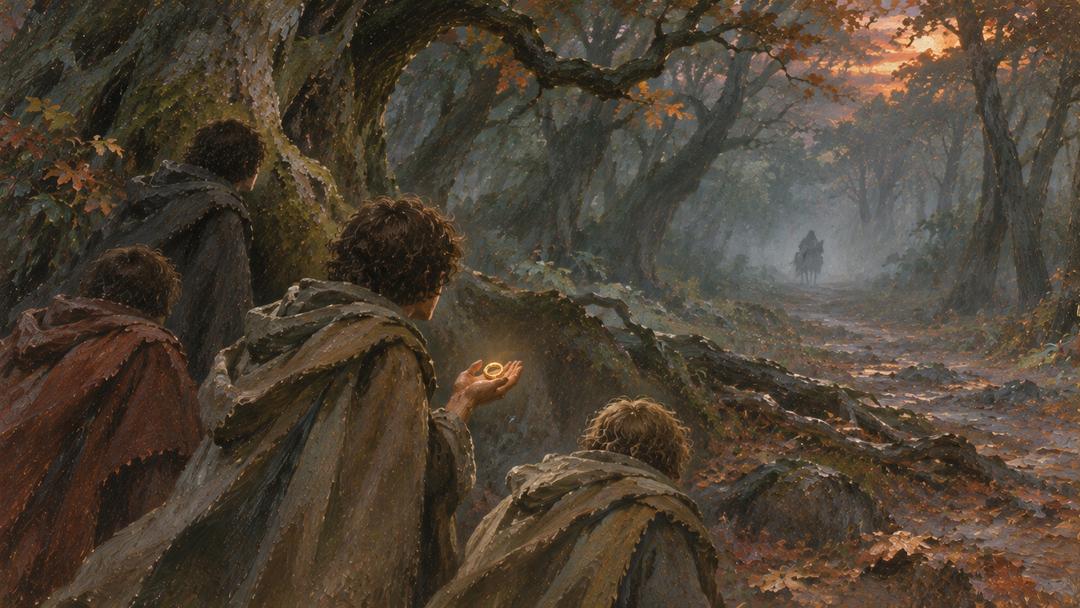
Fan speculation sometimes proposes that the Ring recognises an opportunity to return to Sauron and alerts or manipulates its bearer. That reading fits the Ring’s malign influence and Frodo’s later urge to put it on. It should nevertheless be labelled as interpretation. Neither the shot nor the editor’s explanation proves that the Ring consciously creates the apparent wall or deliberately alters Frodo’s view of the road.
A related theory is that Sauron himself is watching Frodo in that instant, with the distorted road representing the Dark Lord’s gaze. The film establishes a larger connection between Sauron, the Ring and its servants, but this particular moment shows no Eye, no direct encounter with Sauron and no explicit evidence of surveillance by him. The immediately relevant pursuer is the approaching Ringwraith. Substituting Sauron for that Rider adds a claim the sequence does not require.
There is also a simpler explanation for the difference between Frodo and the others: dramatic viewpoint. The camera temporarily aligns the audience with Frodo, the character who understands that the Ring has made their journey dangerous. Sam, Merry and Pippin remain focused on mushrooms until he warns them. Their failure to react to the visual distortion is not proof that Frodo alone sees an actual supernatural phenomenon. They are not shown being offered the same point-of-view image.
Counterfactually, if the road really were closing or an invisible barrier were descending, the story would need to account for its consequences. The hobbits do not collide with anything; the Rider rides along the road without obstruction; and nothing later requires them to escape a transformed landscape. Those observations strongly favour an expressive camera effect over a literal event, although a fantasy film can leave the boundary between sensation and magic intentionally uncertain.
So the answer is specific but not overcomplicated. Frodo is looking down the road towards the danger of an approaching Black Rider. The forest seems to crowd in because the filmmakers use a track zoom to communicate the sudden dread of a threat that has not yet appeared. Tolkien’s book supports the underlying fear, the Nazgûl’s unsettling presence and the lure of the Ring; it does not describe an invisible wall. The moment works because Frodo senses that the ordinary road is no longer safe, and the audience sees that realisation before seeing its cause.
Sources & Notes
- Frame.io — Art of the Cut: The Fellowship of the Ring, John Gilbert — https://blog.frame.io/2021/12/14/art-of-the-cut-the-fellowship-of-the-ring-john-gilbert/
- Tolkien Gateway — Three is Company — https://tolkiengateway.net/wiki/Three_is_Company
- The Encyclopedia of Arda — Nazgûl — https://www.encyclopedia-of-arda.com/n/nazgul.php
John Gilbert's interview is first-hand evidence for adding the track-zoom shot. Compare Tolkien's roadside encounters in The Fellowship of the Ring, Three is Company, and Aragorn's explanation in A Knife in the Dark. The apparent invisible wall is a visual interpretation, not a named physical barrier in the story.