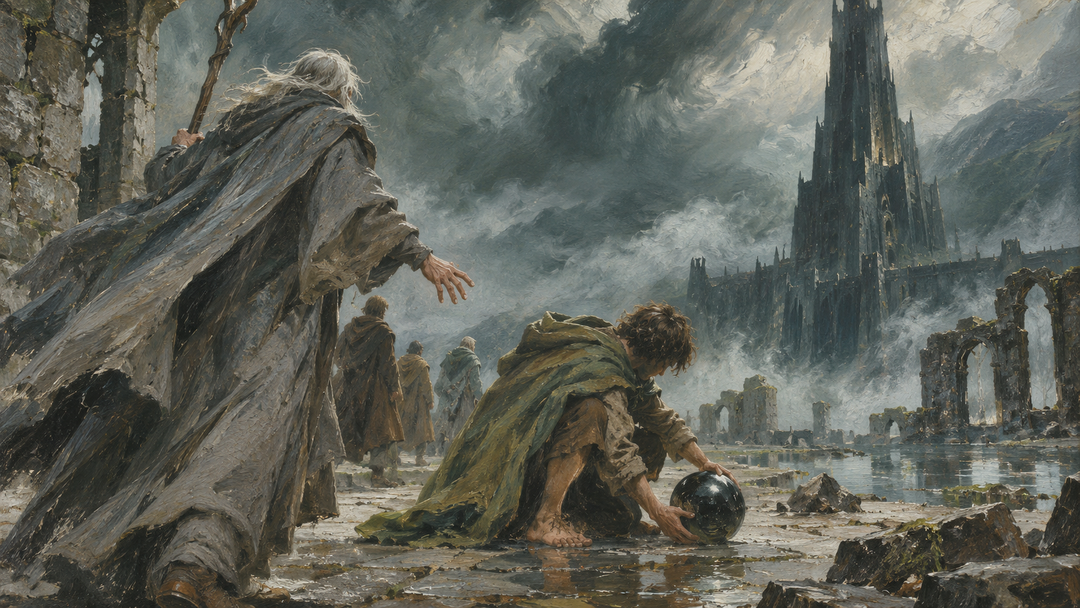
At Isengard, Pippin picks up a dark globe that has just fallen from Orthanc. Gandalf takes it from him, and nothing like the terrifying encounter that follows later occurs. The difference is especially striking in Peter Jackson’s films, where Pippin later confronts the Eye of Sauron.
The answer is that a palantír is not a trap activated by skin contact. In Tolkien’s books, using one involves looking into it, and the position of the stone matters. Pippin’s first handling is brief; later he deliberately studies it and, by extraordinary chance, places it so that he can make contact with Sauron. Yet the first encounter does leave Pippin dangerously curious.
What happened when Pippin first picked it up
In The Two Towers, the incident occurs in “The Voice of Saruman”, after Gandalf confronts the defeated wizard at Orthanc. Gríma Wormtongue throws a heavy, round object from the tower. Whether he intended to strike Gandalf or Saruman is left uncertain. The object strikes the stonework below, but survives. Pippin retrieves it, and Gandalf promptly takes possession of it.
This is the first physical encounter, not Pippin’s first successful use of the seeing-stone. Tolkien does not describe a vision, an exchange with Sauron or a seizure at this point. Nor does he attribute Pippin’s safety to magical protection. Gandalf simply removes the object from his hands.
Even Gandalf has not yet fully identified what they have acquired. He recognises that the globe is an extraordinary treasure, particularly given Saruman’s anger at its loss, but later admits that he did not immediately understand its nature. His attention had been concentrated on Saruman, and he was tired. That admission is significant: the story does not present the first encounter as a controlled experiment in which everyone knows how the stone works.
The impact also demonstrates the extraordinary durability later attributed to the palantíri. But surviving a fall says nothing about when a vision should appear. A seeing-stone can be carried, covered or handed from one person to another without automatically opening a conversation with its counterpart.
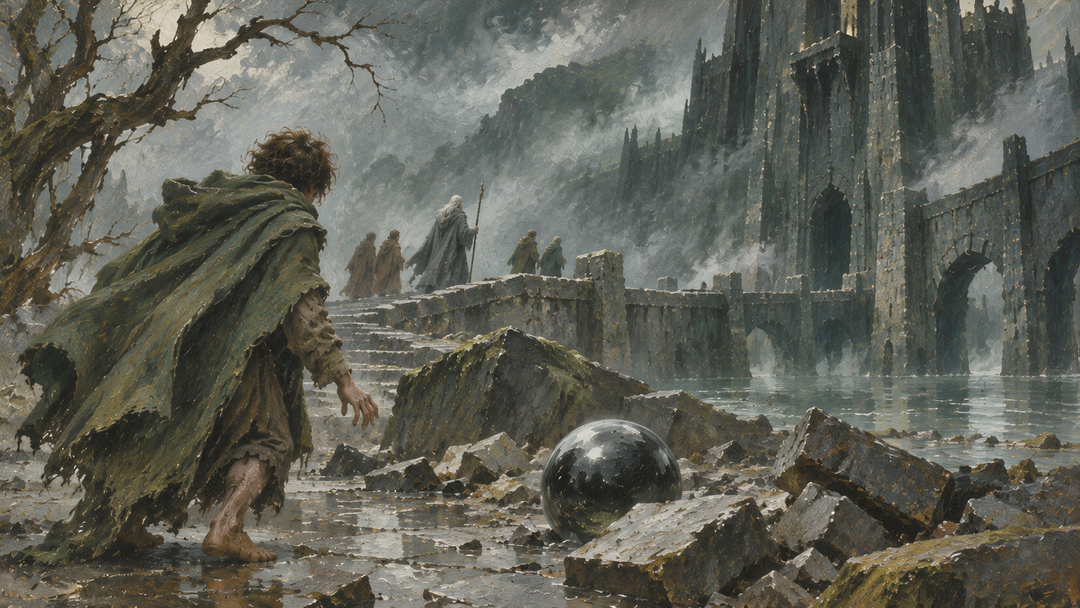
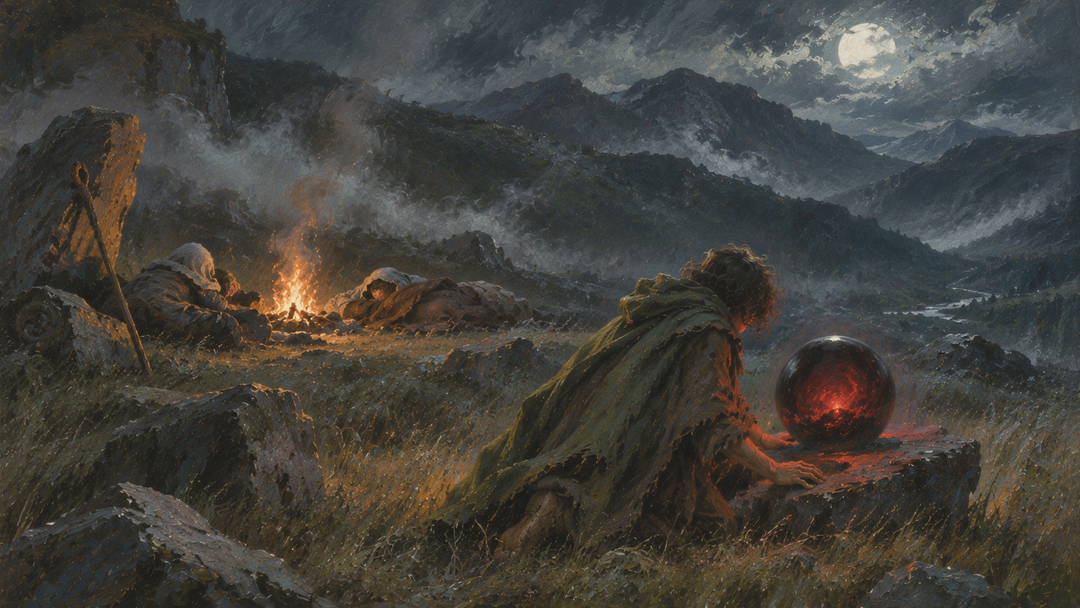
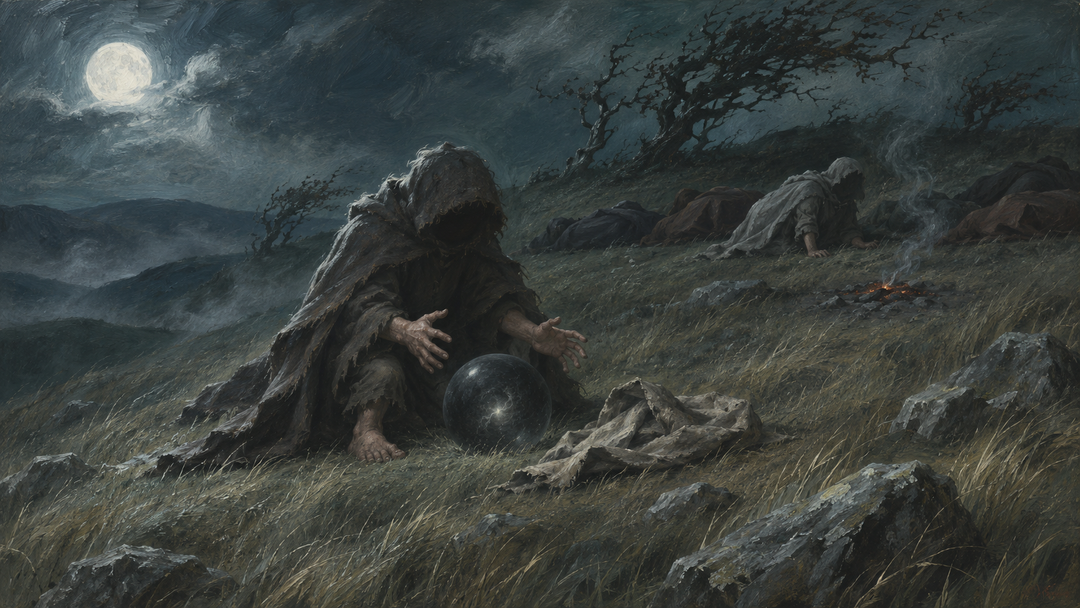
After the company leaves Isengard, Pippin cannot stop thinking about the globe. He presses Merry with questions, while Merry would rather sleep. At their night camp near Dol Baran, curiosity overcomes caution. Pippin takes the covered stone from the sleeping Gandalf, substitutes another object to conceal the theft, and withdraws to examine it. Now he wants to see what lies inside.
The first meeting was not entirely harmless: Pippin’s fascination precedes the frightening vision. Gandalf later treats that curiosity as part of the danger. Yet the text does not establish whether the stone itself actively tempted him, whether his temperament was responsible, or how much the two contributed. Pippin’s desire is real; a precisely described enchantment at first touch is not.
Why the stone’s direction and the viewer’s gaze mattered
The fuller explanation comes from Tolkien’s essay “The Palantíri”, published by Christopher Tolkien in Unfinished Tales. Made by the Elves in the West and brought to Middle-earth by Númenórean exiles, they were used for long-distance sight and communication. They were instruments of knowledge, not originally weapons created by Sauron, and their powers were subject to conditions.
The smaller stones, including the one kept at Orthanc, had fixed viewing directions. Their smooth surfaces offered no visible indication of their permanent poles. Correct placement required the lower pole beneath the upper. If a stone was dislodged, as the Orthanc-stone plainly had been, this alignment could be lost.
Direction also governed what the user could see. A properly placed stone could be viewed from different sides, but its faces were not interchangeable when wrongly turned. The Orthanc-stone’s eastward-facing side was relevant to Sauron, whose own stone was in Mordor. A random glance into a globe being carried away from a flooded tower was not equivalent to a correctly oriented viewing.
Tolkien makes the point unusually specific in Unfinished Tales. When Pippin later sets the stone down, he must, by chance, have positioned it approximately upright. He also happens to sit west of it, looking towards the east through the appropriate face. Thus an inexperienced hobbit made a connection he had not intended.
It would nevertheless overstate the evidence to declare that Pippin definitely held the stone at the wrong angle when he first picked it up. The earlier scene supplies no measured orientation, and Gandalf interrupts him quickly. Tolkien’s later account explains the unlikely success of the second encounter; it does not provide a frame-by-frame diagnosis of the first. Incorrect alignment is a plausible additional reason for the absence of a vision, not a separately confirmed event at Orthanc.
Nor does the alignment rule mean that looking alone guarantees a useful picture. Skilled users directed their attention and will, and the stones could show distant scenes as well as establish contact with another stone. Images depended on circumstances and the abilities of the person looking. Pippin lacked training, but he encountered an unusually dangerous correspondent who was prepared to dominate an unexpected exchange.
The word “silent” also needs care. Palantíri did not function as ordinary speaking devices with audible voices travelling through the glass. Communication between users could take the form of thought. Pippin’s later account of Sauron’s demands is therefore not evidence that the globe should have spoken aloud when he lifted it. The important difference is between unengaged handling and an opened, overwhelming connection.
Why Sauron appeared during the second encounter
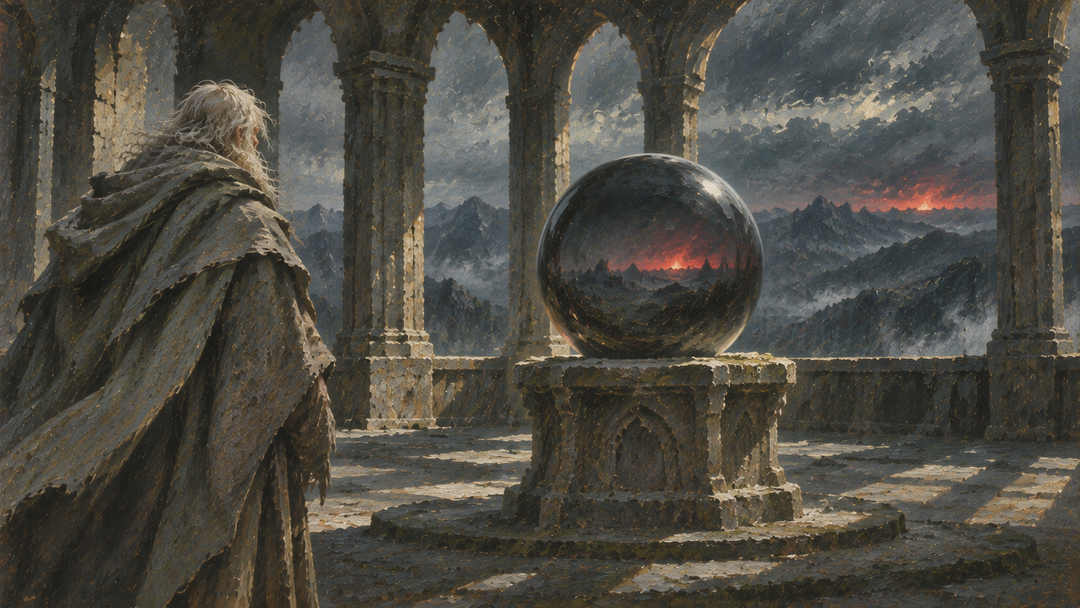
By this stage Sauron possessed the Ithil-stone, seized when Minas Ithil fell long before the War of the Ring. Saruman had used the Orthanc-stone to look abroad and eventually made contact with him. Gandalf concludes that this connection helped explain Saruman’s increasingly compromised judgement and the flow of information between Isengard and Mordor.
That history does not mean Sauron had manufactured the Orthanc-stone or permanently converted every touch into an attack. The instrument remained a palantír. The danger lay in its link to a hostile intelligence far stronger than an unprepared viewer. Even Saruman had proved vulnerable.
At Dol Baran, Pippin sees the stone change from darkness to an inner light and becomes unable to look away. He later reports an encounter with Sauron, who questions him and causes him severe distress. It is not a friendly communication, nor is Pippin exercising mastery over what he sees. Gandalf has to bring him back to awareness and establish what he has revealed.
Crucially, Pippin has not disclosed Frodo’s mission. Gandalf understands that Sauron has jumped to a mistaken conclusion: he assumes that Saruman has a hobbit captive and is displaying him through the stone. Sauron seeks the Ring and mistrusts Saruman, making the error understandable. Sauron orders a message to Saruman rather than extracting the truth about the Fellowship.
The error matters strategically. Sauron does not learn that Frodo is approaching Mordor with the Ring. Instead, he receives information that fits his suspicions about Saruman and a captured hobbit. Gandalf realises that the enemy may act on that misunderstanding. When a winged Nazgûl passes towards Isengard, the urgency of leaving becomes unmistakable.
There is a wider irony. Gandalf admits that he had contemplated investigating the stone himself. Had he established the connection, Sauron might have discovered something much more alarming than an unidentified hobbit. Pippin’s mistake therefore brings real suffering and danger while also preventing a potentially worse disclosure. Tolkien does not portray the venture as wise; its favourable consequences depend on Sauron misunderstanding what he has seen.
Later, Aragorn uses the Orthanc-stone deliberately. As Elendil’s heir, he has a claim to it, and he possesses the strength and purpose to confront Sauron through it. His act is a calculated challenge, not an accidental activation. In The Return of the King, that confrontation helps explain Sauron’s fear of a rival who might possess the Ring. Comparing Aragorn with Pippin shows that the same object can be used under radically different conditions.
What the films change, and what remains uncertain
Jackson’s The Return of the King brings the stone into Pippin’s hands through a different sequence. In the extended edition, Gríma kills Saruman at Orthanc, Saruman falls, and the palantír emerges from his clothing and ends up in the water. Pippin retrieves it; Gandalf immediately takes it away. In the theatrical edition, Pippin’s recovery of the stone remains, but the omitted confrontation with Saruman leaves its arrival in the water unexplained.
The film later stages Pippin’s encounter inside the hall at Edoras, rather than at the roadside camp of the novel. He uncovers the globe, looks into it and experiences the burning Eye of Sauron, with his hands seemingly trapped against the surface. Aragorn pulls it away and briefly struggles with its force. These are powerful cinematic signs of an attack, but they make the process seem much more like a physical curse triggered by touching the object.
The book’s technical account can provide a coherent explanation for the different outcomes in the film: the first time Pippin merely handles the stone; the second time he directs his gaze into it. Nevertheless, the camera does not establish that he has aligned the poles and faces as described in Unfinished Tales. Applying that exact mechanism to the film is an interpretation imported from Tolkien’s writing, not an explicit rule stated on screen.
The fiery Eye gives immediate visual form to Sauron’s influence, whereas the novel emphasises an older instrument that he has exploited. Pippin’s film vision includes the threat to Minas Tirith, providing Gandalf with information the book handles differently. These adaptation choices change the scene’s emphasis, not the basic point that prolonged looking is more dangerous than brief handling.
Several popular explanations go beyond the text. Fan speculation sometimes proposes that Sauron was asleep, distracted or unwilling to respond the first time, or that Gandalf’s presence created a protective field. Others suggest the stone needed time to recognise Pippin. Neither the novel nor the later essay establishes such theories.
There is a subtler question about fate. Tolkien’s account in Unfinished Tales treats Pippin’s correct placement as an extraordinary coincidence, with wording that invites readers to think about providence. Small, unplanned actions frequently upset the powerful in The Lord of the Rings. Still, no text says a higher power physically rotated the stone or selected Pippin for a vision.
The best-supported answer is therefore precise rather than mysterious. At Orthanc, Pippin handles a seeing-stone without establishing the sustained, correctly directed contact that later exposes him to Sauron. At Dol Baran, he deliberately gazes into it, happens to set it in the right position, and finds himself facing a will far stronger than his own. The first encounter was quiet, but not irrelevant: it planted the curiosity that made the second one possible.
Sources & Notes
- Tolkien Gateway — The Palantír — https://tolkiengateway.net/wiki/The_Palant%C3%ADr
- The Encyclopedia of Arda — Palantíri — https://www.encyclopedia-of-arda.com/p/palantiri.php
- Tolkien Gateway — Palantíri (use and orientation) — https://tolkiengateway.net/wiki/Palant%C3%ADri
Primary reading: The Two Towers, The Voice of Saruman and The Palantír; Unfinished Tales, The Palantíri. The later essay discusses orientation and Pippin's chance alignment. It does not record the exact angle of his initial handling at Orthanc; applying those mechanics to the film is interpretation.