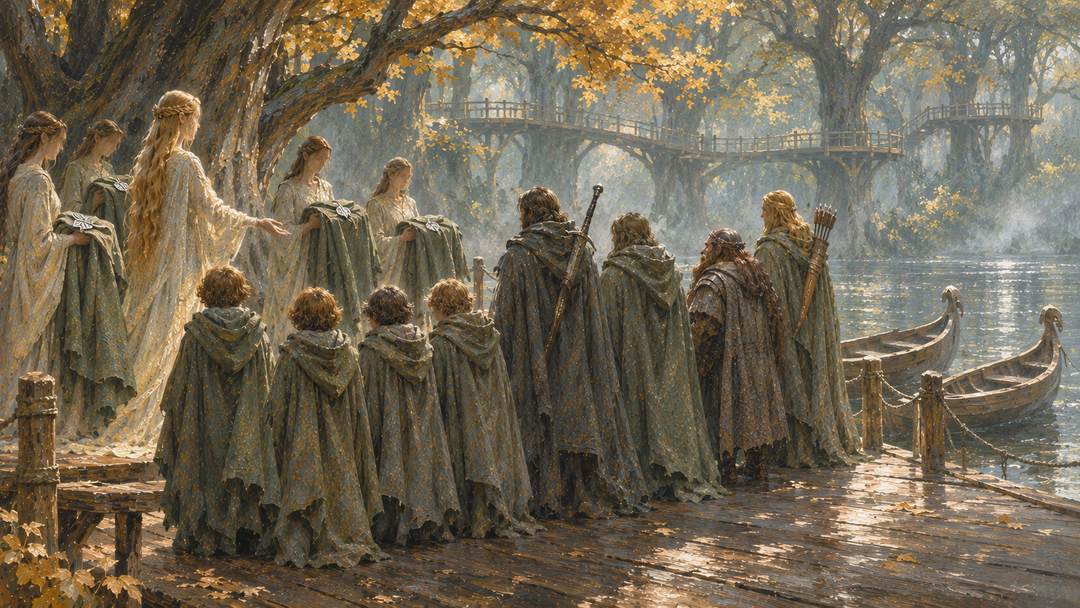
On 16 February in the Third Age year 3019, eight travellers prepared to leave Lothlórien by boat. The Elves brought each of them a hood and a cloak, cut to fit, with a silver-veined green leaf brooch at the neck. Yet the Fellowship had departed Rivendell with nine members. Gandalf had fallen with the Balrog in Moria a month earlier.
That is the answer to the apparent mismatch: eight members of the Fellowship were present to receive cloaks. The headline needs one qualification, however. Tolkien confirms that Galadriel and her maidens wove the cloth, but does not state that she made exactly eight cloaks in total, or that she chose that number before the travellers arrived. The text records eight recipients, not a complete inventory of her weaving.
Nine Walkers at Rivendell, eight guests in Lórien
The number nine was deliberate when Elrond chose the Company in The Fellowship of the Ring, in the chapter The Ring Goes South. The Nine Walkers were to oppose the Nine Riders, Sauron’s Ringwraiths. Their number carried symbolic weight, but it was not a promise that all nine would remain together throughout the journey. Elrond explicitly told the companions that no oath bound them to continue all the way.
The original party consisted of Frodo, Sam, Merry and Pippin; Aragorn and Boromir; Legolas and Gimli; and Gandalf. It brought together hobbits, Men, an Elf, a Dwarf and a wizard, despite their different loyalties and strained relations. The cloaks would eventually dress the surviving members alike without erasing those differences.
On 15 January, at the Bridge of Khazad-dûm, Gandalf confronted the Balrog and fell into the abyss with it. Aragorn assumed leadership of the remaining Company, and the eight escaped Moria into the eastern foothills of the Misty Mountains. They reached Lórien grieving and uncertain whether Gandalf could possibly have survived. At the farewell, no cloak was presented in his name.
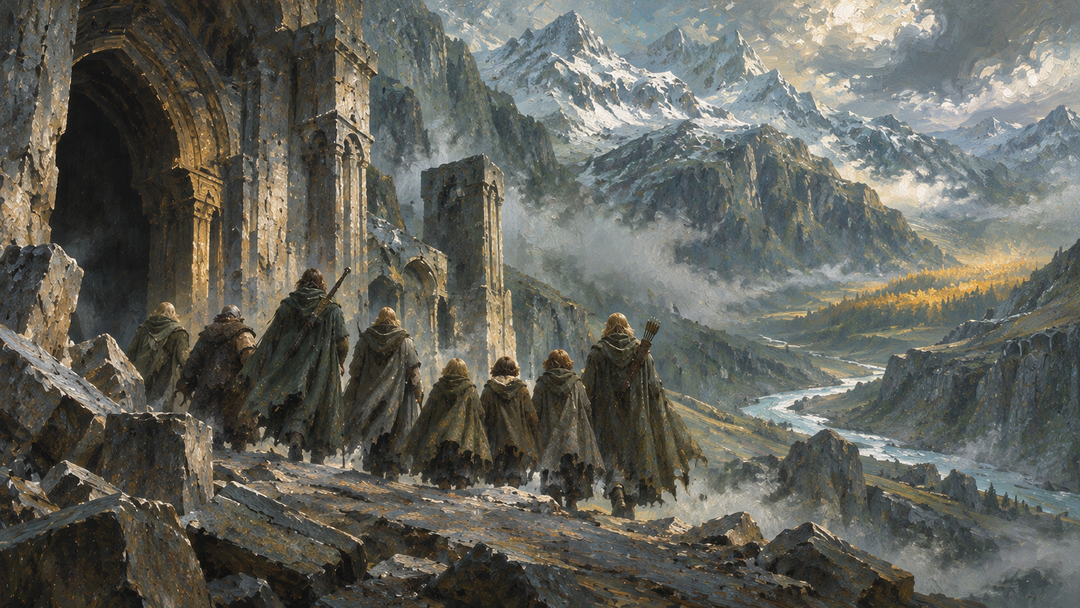
The surviving companions reached the city of Caras Galadhon, where Celeborn and Galadriel received them. They rested, received counsel and faced important questions about the Ring. Frodo’s encounter with Galadriel’s Mirror, and her refusal of his offer of the One Ring, belong to this interval. By the time they left, they needed equipment for the next stage of a dangerous journey, not ceremonial clothing for the original nine-man roster.
Appendix B of The Return of the King, The Tale of Years, places their departure on 16 February. The recipients were Aragorn, Boromir, Legolas, Gimli and the four hobbits. Gandalf was not. No missing ninth cloak needs to be explained away, because the narrative never depicts nine people standing there waiting to be dressed.
What Tolkien actually says about the weaving
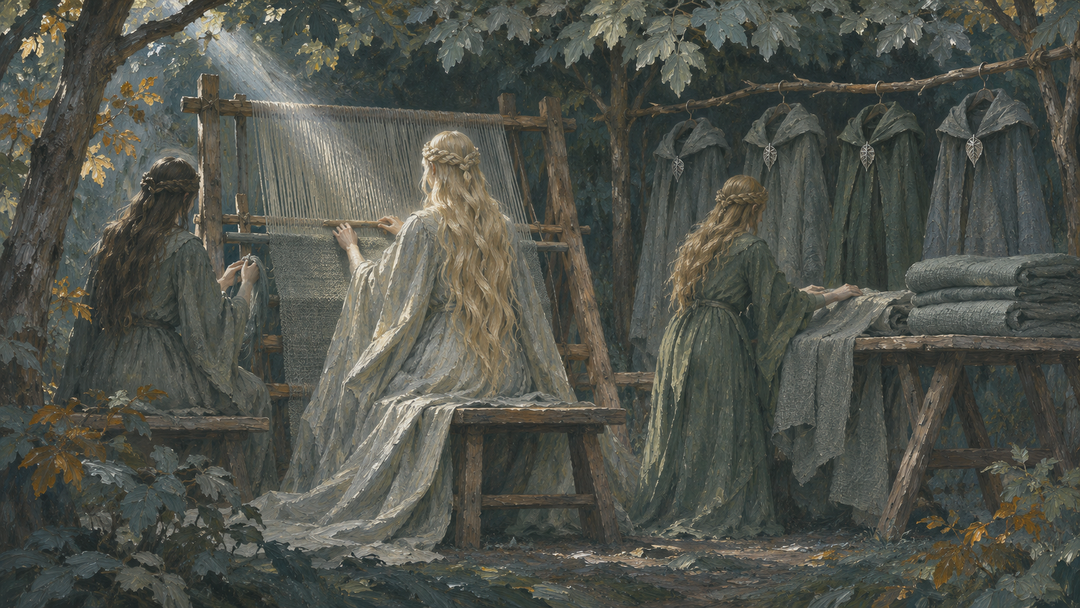
The relevant description appears in Farewell to Lórien, the eighth chapter of Book Two of The Fellowship of the Ring. Elves bring out garments made to each traveller’s size from the light, warm fabric woven by the Galadhrim, the Elves of Lórien. A spokesman later makes the gift more personal: Galadriel herself and her maidens wove the material. It is therefore fair to credit her with making the cloaks, provided that credit does not erase the work of her companions.
The passage identifies the makers of the cloth and describes cloaks supplied to each traveller; it does not offer a production ledger. Tolkien does not say when the material was woven, when the cloaks were completed or how many others were produced. Eight is the number handed out in this scene. Calling it the number Galadriel ever made goes beyond the evidence.
These were not standard grey capes. Their colour was difficult to pin down: grey in the shade of trees, green like foliage in motion, brown like fields at night, or silver-grey under starlight. They were hooded, light to carry and suited to changing temperatures. Each had a leaf-shaped brooch with silver veins. They offered camouflage and recalled the place that had sheltered the Company.
Pippin asks whether the garments are magical. The Elf’s reply resists a simple distinction between magic and skilled craftsmanship. The cloaks reflect the natural things the Elves love and the thought they put into making them. They can help conceal a wearer from hostile eyes, but they are not armour and cannot stop arrows or blades. They offer neither guaranteed invisibility nor protection against every threat.
The Elves say that strangers had never before worn their people’s clothing. This was no routine gift to passing travellers. Legolas, already an Elf, receives one alongside Gimli, whose people have an uneasy history with Elves. The shared cloaks mark the Company’s welcome into Lórien’s trust and show that its hospitality crosses divisions which matter elsewhere in the story.
It is useful to separate these common gifts from the individual presents bestowed later at the farewell feast. Galadriel gives Frodo the Phial containing the light of Eärendil’s star, Sam a box of earth from her orchard, Gimli three strands of her hair and Legolas a bow. Boromir receives a gold belt; Merry and Pippin receive silver belts. Aragorn receives a sheath for Andúril and the green Elfstone entrusted for him through Arwen’s family. Everyone present receives a cloak, but their personal gifts differ.
Eight cloaks that continue to matter
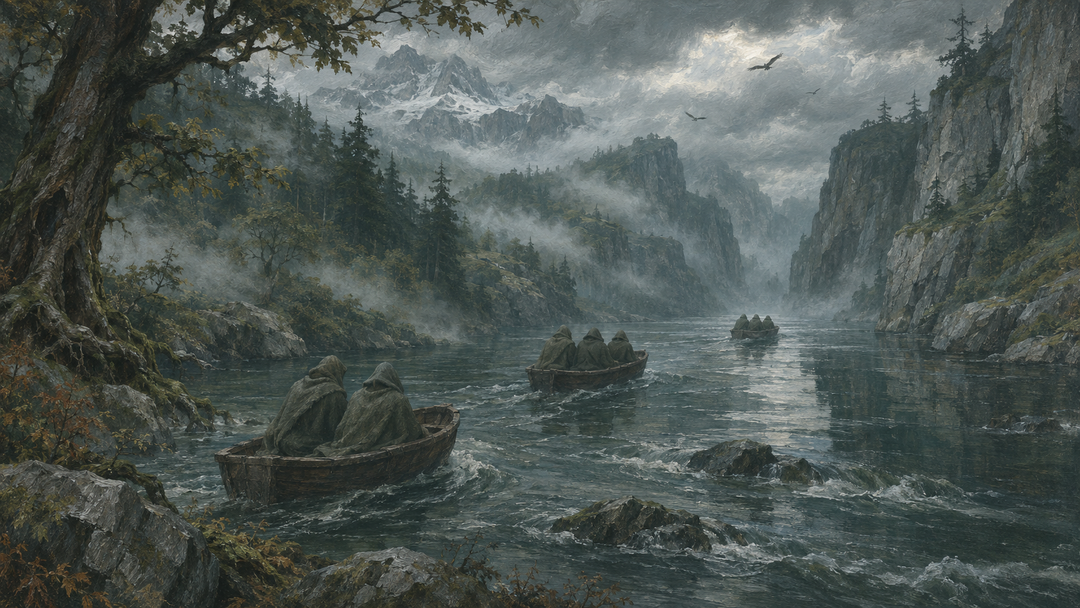
The cloaks are not merely souvenirs that disappear once the boats leave Lórien. Tolkien gives them practical consequences in later chapters. On the Great River, when the Company comes under attack near Sarn Gebir, the grey garments help frustrate enemy archers trying to pick out targets. They do not make arrows harmless; they make the travellers harder to see clearly. That is the aid the Elves promised.
After Boromir is killed defending Merry and Pippin, Aragorn, Legolas and Gimli lay him in one of the boats. His Elven cloak is placed beneath his head. This is a telling end for one of the eight garments: it accompanies a man who struggled with the Ring’s temptation but died protecting his companions. Later, Faramir sees the strange funeral boat carrying his brother down the Anduin. The clothing and its distinctive brooch help connect what he saw with Frodo’s account.
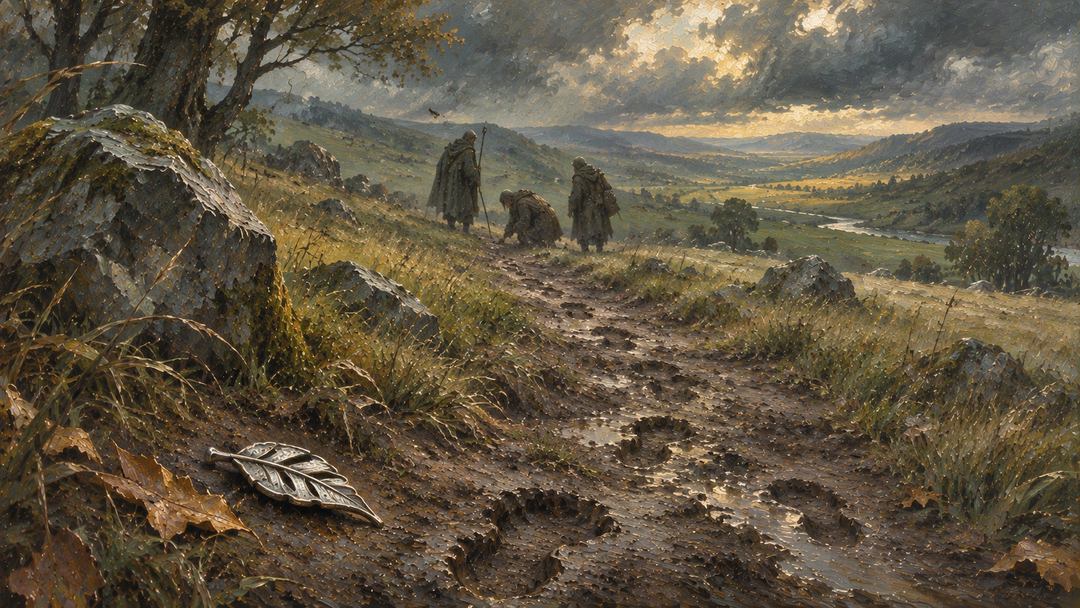
Another leaf brooch becomes a clue rather than a memorial. When Orcs carry Merry and Pippin away, Pippin deliberately drops his brooch along their route. Aragorn finds it while tracking the captives, confirmation that the hobbits passed that way and may still be alive. Its value lies in being recognisable evidence, not in enchantment.
The cloaks also serve the separated travellers. Merry and Pippin benefit from their concealing colours amid the confusion surrounding the destruction of their Orc captors. Aragorn, Legolas and Gimli wear the grey clothing as they move through Rohan, where it attracts suspicion as well as providing concealment. At Edoras, Gríma Wormtongue treats their connection with the Lady of the Golden Wood as a reason for distrust. A gift can reveal allegiance as readily as hide a body.
Frodo and Sam continue to depend on camouflage during their journey towards Mordor. The cloaks can hide them against stone and earth, but not from Gollum’s hearing or smell. Their usefulness is therefore situational, not absolute. In Peter Jackson’s second film, a more dramatic version of this property lets Frodo cover himself and Sam with a cloak that resembles a rock when enemy soldiers approach. That visual trick is a film invention, not a literal scene in Tolkien’s book.
The story gives one of the cloaks a final role at the Black Gate. In The Return of the King, the Mouth of Sauron displays Frodo’s captured possessions, including an Elven cloak and brooch, to intimidate Gandalf and the leaders of the West. The object once intended to conceal Frodo is now used to suggest that his mission has failed. It proves the enemy has his belongings, not that their claims are true. The cloak is thus both helpful equipment and a reminder of the Fellowship’s continuing vulnerability.
Gandalf’s return, film continuity and fan theories
Gandalf’s later story introduces a complication, but not a ninth recipient at the original farewell. In The White Rider, a chapter of The Two Towers, he explains that he defeated the Balrog, died and was sent back to finish his task. Gwaihir the Eagle, sent by Galadriel, carried him from the mountain to Lórien, where he was healed and clothed in white. He subsequently reappeared as Gandalf the White.
The chronology is decisive. Appendix B dates Gwaihir’s carrying of Gandalf to Lórien to 17 February, the day after the eight companions departed. Galadriel therefore helped all nine original members of the Fellowship, but not together in one clothing ceremony. Gandalf’s white clothing belongs to a separate event following his return, and Tolkien does not identify it as one of the eight hooded cloaks described at the boats.
There is room for a narrower uncertainty. Gandalf later appears with a grey outer cloak that can conceal the white garments beneath it. Readers may wonder whether some part of that clothing also came from Lórien. That is possible, but the text does not explicitly identify it as one of Galadriel’s matching Elven cloaks. Even if she gave him such a garment later, it would not alter the number of recipients at the departure or establish how many cloaks were woven beforehand.
Peter Jackson’s film adaptation of The Fellowship of the Ring preserves the broad sequence: Gandalf falls in Moria, and the remaining eight visit Lothlórien. The extended edition also develops Galadriel’s parting gifts more fully than the theatrical release. But scenes omitted, rearranged or amplified for film should not be used to calculate a hidden stock of cloaks in the novel. The film’s rock-like camouflage is a particularly clear example of adaptation embellishment.
Fan speculation sometimes suggests that Galadriel foresaw Gandalf’s fall and deliberately prepared only eight, or that she kept a ninth cloak ready for his resurrection. These are imaginative possibilities, not established facts. Her Mirror can show uncertain futures, and Tolkien gives her considerable insight, but neither fact demonstrates a prediction about this particular set of garments. Nor is there a passage saying that the ninth cloak was withheld, lost, saved or secretly presented later.
A counterfactual is different again. Had Gandalf reached Lórien with his companions, it would be reasonable to imagine the Elves offering him protective clothing too. Yet Tolkien never writes that version of events, so it cannot settle a factual question about the story we have. What he does write is both simpler and more meaningful: eight companions emerge from Moria, eight are welcomed and equipped in Lórien, and their missing guide receives help there only after his return. The eight cloaks record a changed Fellowship, not an oversight in Galadriel’s generosity.
Sources & Notes
- The Encyclopedia of Arda — Elven-cloaks — https://www.encyclopedia-of-arda.com/e/elvencloaks.php
- Tolkien Gateway — Farewell to Lórien — https://tolkiengateway.net/wiki/Farewell_to_L%C3%B3rien
- Tolkien Gateway — The Bridge of Khazad-dûm — https://tolkiengateway.net/wiki/The_Bridge_of_Khazad-d%C3%BBm
Primary reading: The Fellowship of the Ring, The Bridge of Khazad-dûm and Farewell to Lórien; The Lord of the Rings, Appendix B. Eight surviving companions receive cloaks after Gandalf's fall; the passage does not establish that only eight cloaks were ever woven.