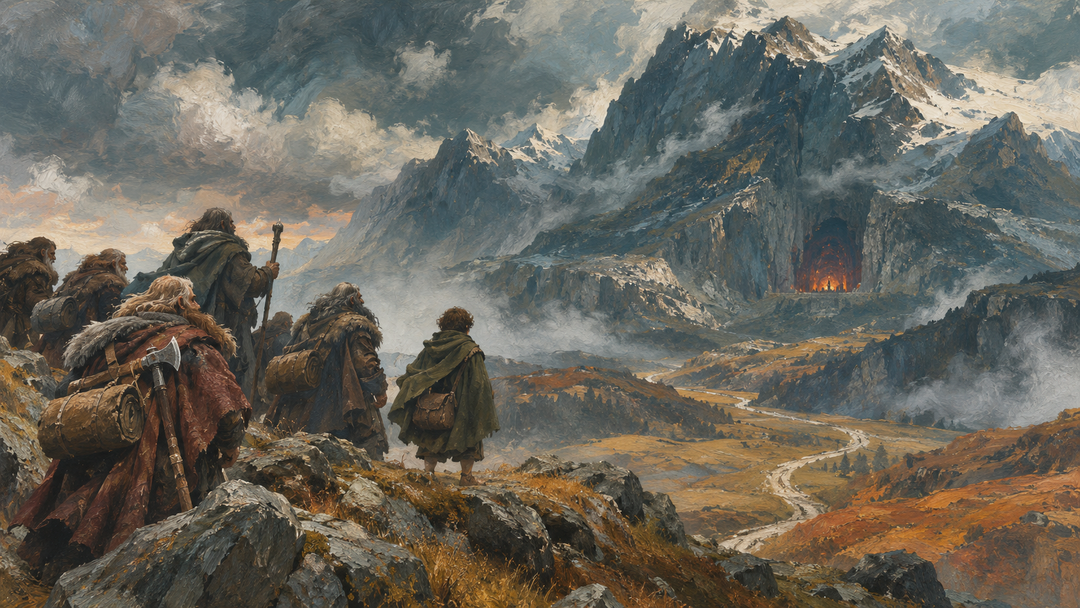
In December 2012, The Hobbit: An Unexpected Journey reached cinemas at 169 minutes, and Bilbo Baggins had still not reached the Lonely Mountain. Two more films followed, bringing the theatrical trilogy to 474 minutes, just under eight hours. For a compact 1937 novel, did that extra film deepen Tolkien’s story, or spread its strongest material too thinly?
On balance, two films would probably have made a better adaptation. Not because every departure from the book was misguided, or because a single novel must fit into a single film, but because the trilogy repeatedly shifts attention away from Bilbo’s choices towards prolonged action and invented conflicts. Three films offered some real advantages, especially for Thorin and the political aftermath of Smaug’s death. The question is whether those gains justified the extra weight.
How a two-film project became a trilogy
The films were genuinely conceived as two instalments. Guillermo del Toro was initially attached to direct before leaving the project in 2010, and Peter Jackson took over. On 30 July 2012, after principal photography had begun under the two-film plan, Jackson announced an expansion to three films. His reasoning included background material in the appendices to The Lord of the Rings. The novel was not simply divided into three equal portions.
Nor can we treat an imagined two-film version as a lost masterpiece. Scripts, footage and editing decisions changed as production developed. Nobody can establish exactly what the earlier plan would have produced. Arguments about that alternative are counterfactual judgements, not comparisons with a completed two-film cut.
There was material beyond Bilbo’s immediate journey to draw upon. In The Hobbit, Gandalf disappears for a time and later reports that a council of powerful figures has driven the Necromancer from his stronghold. Tolkien’s later writing identifies this enemy with Sauron and places the expedition within the wider struggle over Middle-earth. The appendices to The Lord of the Rings also give more history of the dwarves, their losses and their claim to Erebor. Such material can make Thorin’s mission feel historically and politically consequential.
But background information is not the same as a second full dramatic plot. The novel largely follows Bilbo’s limited understanding: he is often frightened, confused or left to manage without Gandalf. The films instead show the White Council, Dol Guldur and other events far beyond his knowledge. That choice helps connect the adaptation to Jackson’s earlier The Lord of the Rings films, yet it changes the centre of gravity. A story about an unexpectedly resourceful hobbit becomes, at intervals, an account of gathering darkness across the continent.
Page counts alone cannot determine a film’s length. Smaug’s conversations and the dwarves’ competing claims deserve time. Even so, nearly eight theatrical hours create a burden of proof: each added sequence ought to improve the story being told.
Where the extra running time weakens Bilbo’s journey
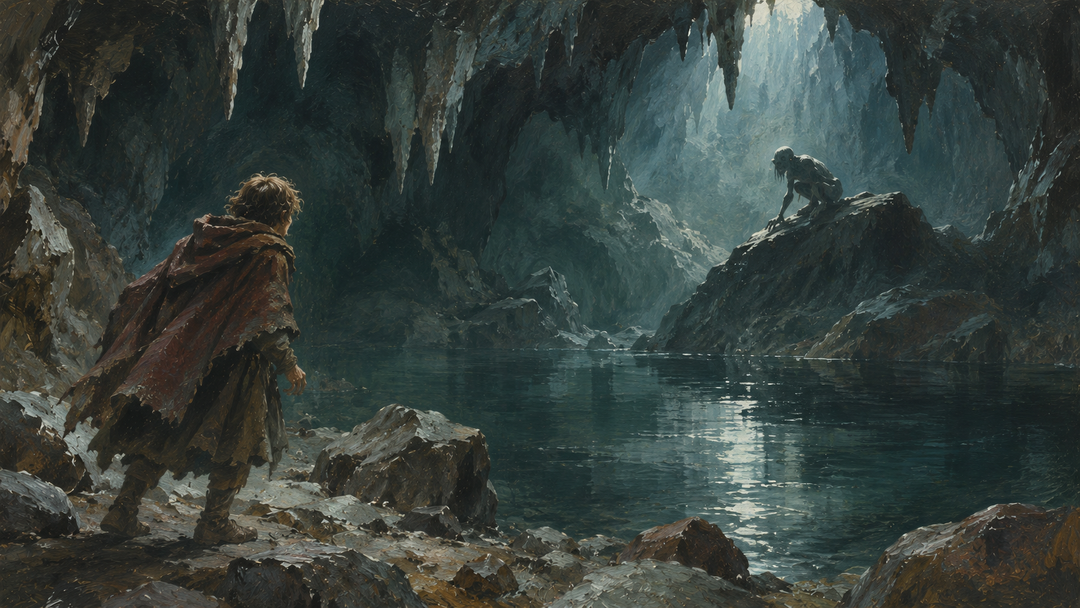
The strongest scenes demonstrate what the films might have prioritised. Martin Freeman’s Bilbo is persuasive when he is out of his depth but thinking quickly: deciding to leave home, finding himself alone with Gollum, and speaking cautiously to Smaug. The riddle contest in particular remains tense without requiring an army or a collapsing structure. It preserves the novel’s unusual combination of comedy, danger and moral uncertainty. Bilbo survives by noticing details and adapting to another creature’s rules.
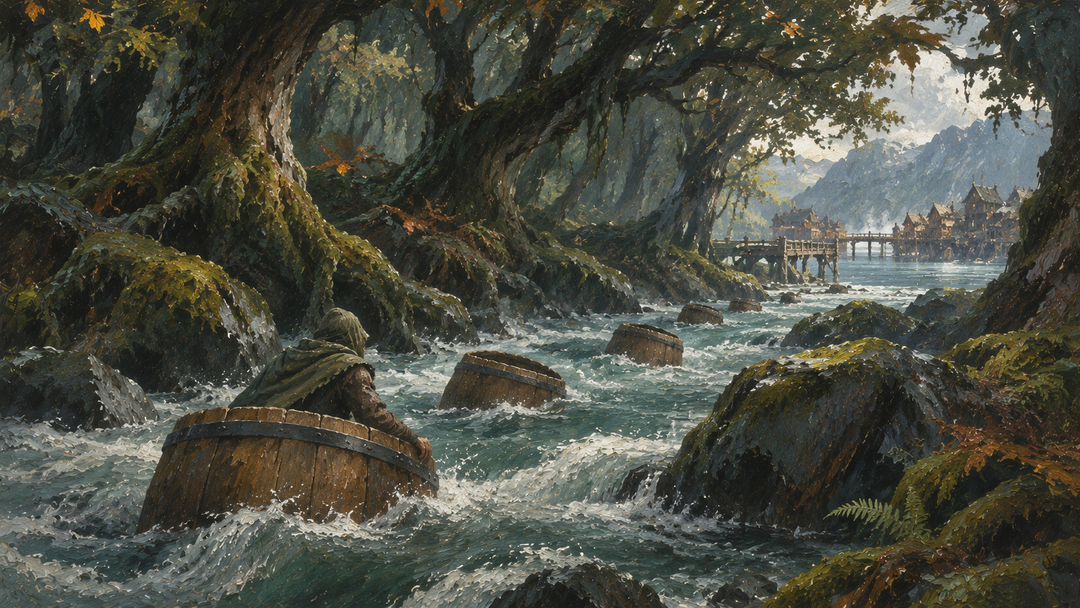
The novel also gives his courage a distinctive shape. He is not simply training to become a conventional warrior. His dealings with the spiders, his rescue of the dwarves from the Elvenking’s halls and his decision over the Arkenstone involve secrecy, judgement and considerable personal risk. In the book, the dwarves’ barrel escape is an ingenious but miserable solution to imprisonment. In the films, the sequence becomes a large running battle, complete with spectacular stunts. The action is energetic, but its scale competes with Bilbo’s ingenuity.
The same problem appears in the treatment of Azog. Tolkien’s later histories place Azog’s death long before Bilbo’s expedition, killed by Dáin after the Battle of Azanulbizar. The film adaptation keeps Azog alive as Thorin’s pursuing enemy. That is a film-continuity invention, not an unresolved point in the book. It gives the trilogy an easily recognised antagonist before Smaug takes centre stage, but it also repeatedly interrupts the journey with confrontations shaped like previews of a larger final battle.
Some inventions serve useful purposes. Tauriel, created for the films rather than taken from Tolkien’s novel, gives the Woodland Realm another perspective and creates opportunities to question isolationism. Her friendship and romance with Kíli, however, demand space for a plot whose emotional stakes are largely separate from Bilbo’s transformation. Legolas is an established character in The Lord of the Rings, but he is not named in The Hobbit; his extensive appearances here are an adaptation choice, not recovered scenes from the novel.
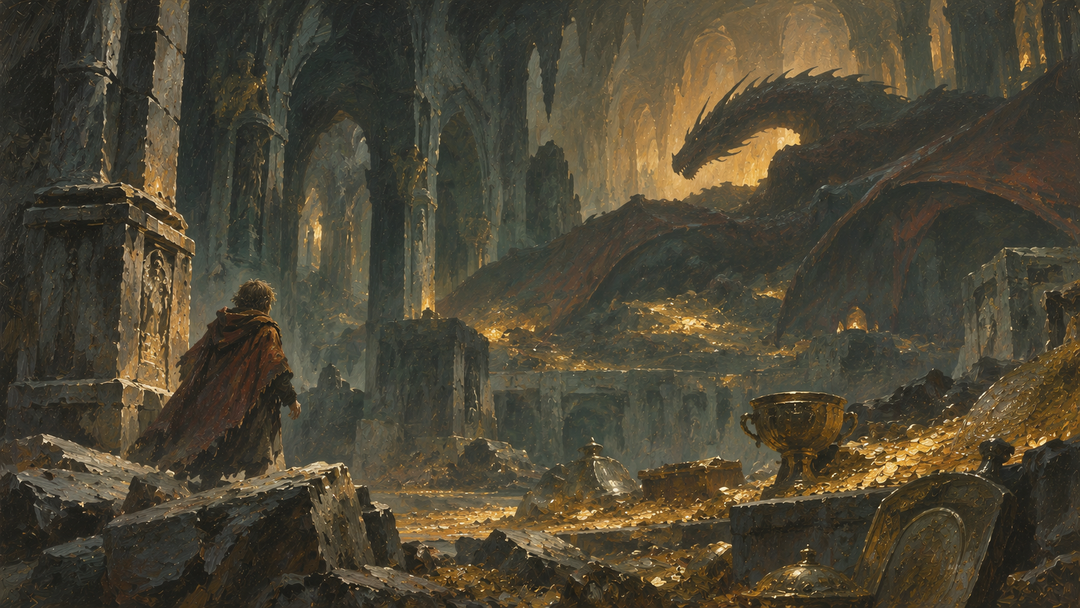
Thirteen dwarves are difficult to distinguish on screen, so additional character moments can help. Yet the films frequently prefer chases or duels to quieter encounters. Even Smaug’s confrontation with Bilbo becomes a lengthy pursuit through Erebor involving molten gold. The dragon’s intelligence and Bilbo’s verbal caution are more distinctive than the machinery surrounding them.
A two-film structure could have preserved the essential set pieces while reducing their repetition. It would not need to remove Gollum, Beorn, Mirkwood, Lake-town or the Battle of the Five Armies. It could instead shorten pursuit sequences, concentrate the political material around Erebor and reserve more attention for Bilbo’s difficult decisions. The point is not that everything invented is worthless. It is that invention works best when it supports the central character rather than constantly postponing his return to the foreground.
What a third film makes possible
The strongest case for three films is the shape of Tolkien’s ending. Slaying Smaug does not resolve the novel’s deepest conflict. His death exposes competing claims to the treasure, while Thorin’s growing possessiveness makes the company less admirable than it seemed on the road. Bard seeks compensation for Lake-town’s destruction; the Elvenking has interests of his own; the dwarves expect to recover their inheritance. This is not a tidy victory followed by a brief celebration.
Bilbo’s response is central. Rather than stand unquestioningly with Thorin, he secretly gives the Arkenstone to Bard and the Elvenking as a possible bargaining tool. It is a risky attempt to avert bloodshed, and Thorin sees it as betrayal. The episode matters because Bilbo has learned to act independently even when loyalty and conscience conflict. A compressed conclusion that treated the battle as the only remaining event could easily lose this moral complexity.
A longer adaptation can make Thorin’s fall and reconciliation convincing. Richard Armitage gives his pride and longing considerable weight, and his eventual recognition of their cost needs room to breathe. The deaths of Thorin, Fíli and Kíli are part of Tolkien’s narrative, not merely a screenwriters’ attempt to make the climax darker; in the book, the two younger dwarves die defending their uncle.
Nevertheless, the third film’s allocation of time is difficult to defend. The Hobbit: The Battle of the Five Armies begins by resolving the Smaug cliffhanger left by The Desolation of Smaug, then devotes much of its remaining running time to warfare and individual combat. In the novel, Bilbo is knocked unconscious during the battle and does not witness most of it. Tolkien does not supply a detailed sequence of heroic duels for the filmmakers to reproduce. Their spectacle is a creative expansion, not a fuller transcription of a neglected chapter.
Keeping Bilbo at the edge of the battle is part of the book’s design. It limits how much military glory the reader is invited to enjoy and returns attention to the consequences of conflict. A film cannot simply black out its protagonist for an entire climax without risking disappointment, so more visible action is understandable. But there were alternatives between that extreme and a battle dominating a whole instalment: show selected turning points, keep Bilbo’s interventions meaningful and spend more time on the cost of victory.
There is a further structural problem. Ending the second film as Smaug flies towards Lake-town creates a powerful cliffhanger, but it withholds the conclusion of the confrontation that gives that film its title. The dragon is then dispatched early in the third. More minutes have not automatically produced more satisfying divisions. A two-film version might have placed Smaug’s defeat and the dispute over the treasure within one final film, allowing cause and consequence to feel closely connected.
The better two-film version, and its limits
The most persuasive alternative would not be a frantic condensation of the existing trilogy. It would be a different arrangement of priorities. The first film could establish Bilbo and the dwarves, develop Thorin’s purpose, retain the encounter with Gollum and build towards the dangerous passage through Mirkwood. The second could carry the escape, Lake-town, Smaug, the struggle over the treasure and the final battle. That is an illustrative structure, not a claim about the producers’ abandoned editing plan. Other dividing points could work.
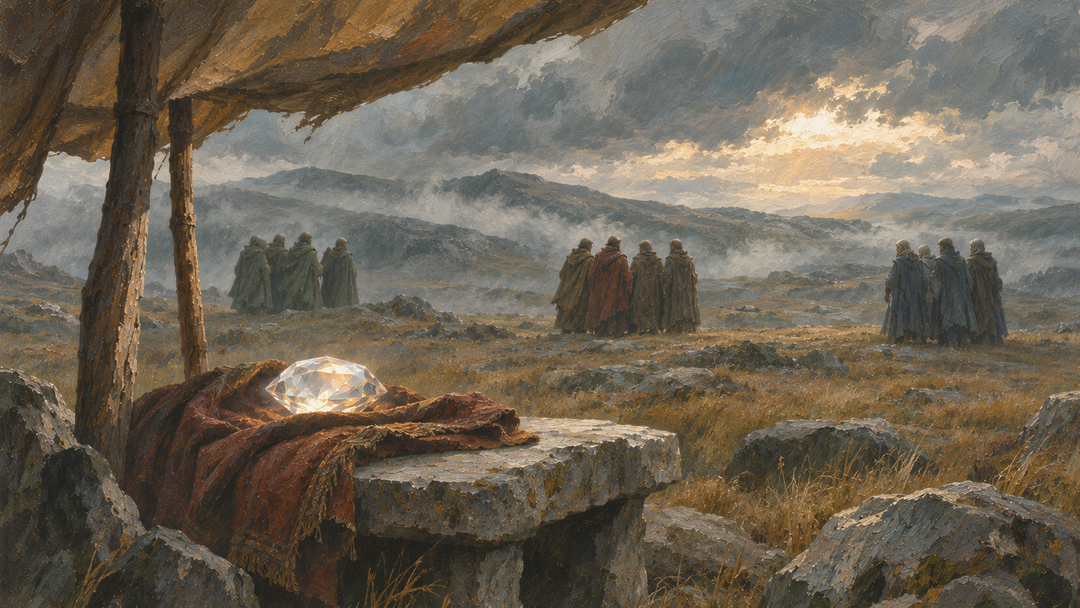
Such a version would still face difficult choices. Mirkwood offers natural suspense, but ending the first film there risks leaving viewers without a satisfying resolution. Moving the split further towards Lake-town gives the first film a longer journey and the second a dense series of climaxes. Two films do not guarantee clean pacing, and the White Council material might still compete with the main quest. More restraint in the writing and editing would matter at least as much as the number of instalments.
Tolkien’s own revisions complicate arguments about fidelity. Published before The Lord of the Rings, The Hobbit had its Gollum episode revised for the 1951 edition to fit the Ring’s later significance. The earlier edition treated Gollum and the Ring differently. It is therefore too simple to insist that darker connections to the later mythology inherently violate the book’s spirit. Tolkien adjusted its continuity, though that does not endorse any particular cinematic expansion.
The films’ historical connections are not evidence that Tolkien intended a trilogy about Sauron’s return. The White Council and the Necromancer belong to the wider legendarium, but the novel does not dramatise their campaign as the films do. The useful distinction is between what Tolkien wrote, what Jackson’s films establish and what viewers wish an alternative had done.
Fan-made cuts show interest in a leaner adaptation, but cannot prove an official two-film release would have succeeded. Likewise, the fan speculation that the third film was made solely for money is not an established account of the filmmakers’ motives. The documented expansion can be criticised without claiming knowledge of private decisions.
Two Hobbit films would probably have been better because they could have kept the story’s proportions closer to its strengths: Bilbo’s resourcefulness, Thorin’s tragic pride, Smaug’s menace and the uneasy moral settlement after the dragon’s death. The trilogy contains moving performances, memorable landscapes and scenes that justify generous running time. What it lacks is consistent discipline about whose story is being told. A third film made Middle-earth bigger; two more focused films might have made Bilbo’s journey matter more.
Sources & Notes
- Wikipedia, The Hobbit (film series) — production history: the project's long development as two parts, Guillermo del Toro's attachment and 2010 departure, Peter Jackson's takeover, and the confirmation on 30 July 2012 of a third film drawing on the appendices, with a theatrical runtime of 169 minutes for An Unexpected Journey. https://en.wikipedia.org/wiki/The_Hobbit_(film_series)
- Wikipedia, The Hobbit: An Unexpected Journey — the first instalment's 2012 release, 169-minute runtime, cast including Martin Freeman as Bilbo, and its adaptation of the novel's early chapters through the company's departure from Rivendell. https://en.wikipedia.org/wiki/The_Hobbit:_An_Unexpected_Journey
- Wikipedia, The Hobbit: The Battle of the Five Armies — the third instalment, its 144-minute runtime, its resolution of the Smaug cliffhanger before the battle, and the deaths of Thorin, Fíli and Kíli. https://en.wikipedia.org/wiki/The_Hobbit:_The_Battle_of_the_Five_Armies
- Tolkien Gateway, The Hobbit — the 1937 novel itself: Bilbo's journey, the riddle contest with Gollum, the Arkenstone, the Battle of the Five Armies and Bilbo's being knocked unconscious during it. https://tolkiengateway.net/wiki/The_Hobbit
- Tolkien Gateway, Azog — the Orc-chieftain who killed Thrór, was himself slain by Dáin II Ironfoot at the Battle of Azanulbizar in T.A. 2799 and succeeded by his son Bolg, establishing that the films' surviving pursuer is an invention of film continuity. https://tolkiengateway.net/wiki/Azog
- Tolkien Gateway, Tauriel — identified as a character appearing only in an adaptation, invented by Peter Jackson and Fran Walsh for The Hobbit film series and played by Evangeline Lilly, with no counterpart in Tolkien's writings. https://tolkiengateway.net/wiki/Tauriel
Primary reading: The Hobbit (1937), especially the Gollum riddle contest, Mirkwood and the Elvenking's halls, Bilbo's dealings with Smaug and the Arkenstone, and the aftermath of the Battle of the Five Armies; the production record is taken from the film-series documentation of the two-film plan, Guillermo del Toro's departure and the 30 July 2012 announcement of a third film. The linked reference entries document the theatrical running times, the appendices material and the two characters whose filmed roles depart from Tolkien's text. Judging that a two-film structure would have served the novel better is this article's evaluative argument; no completed two-film cut exists, so the comparison is counterfactual rather than empirical.