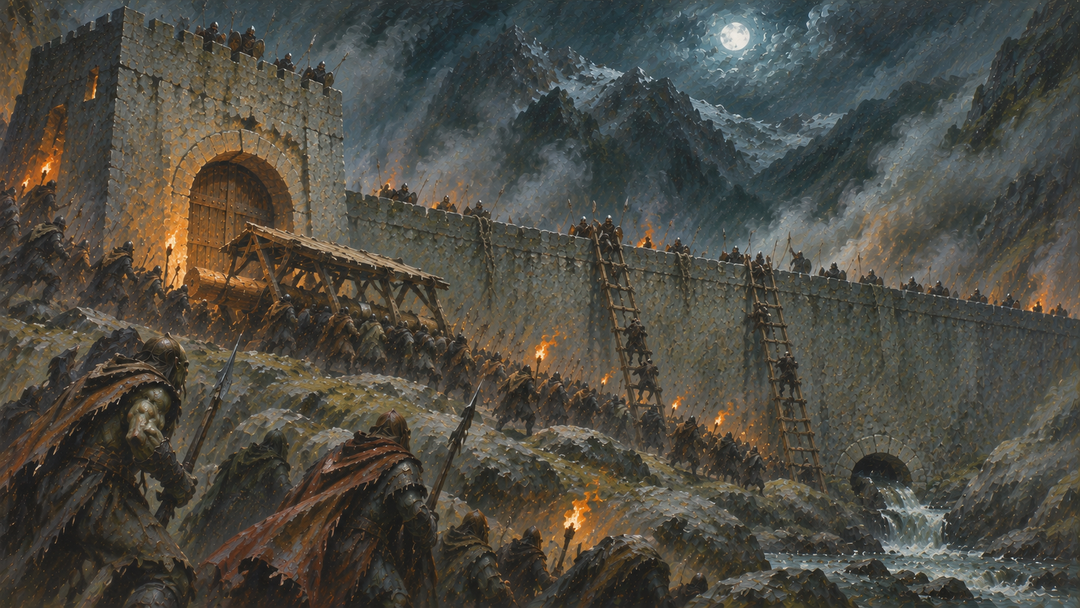
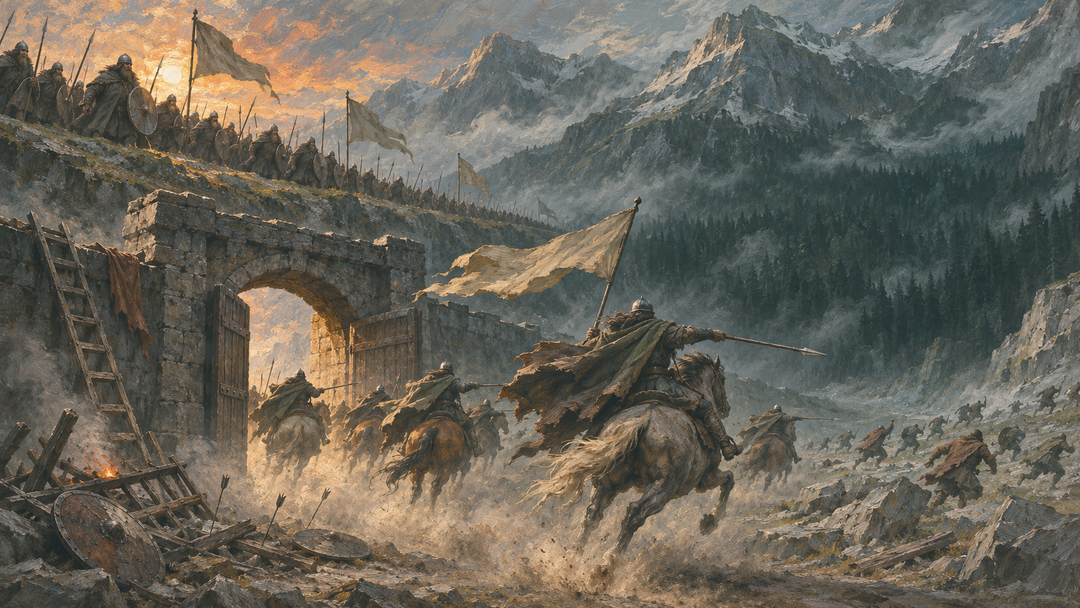
On the night of 3 March 3019, Saruman’s army followed the forces of King Théoden into the Deeping-coomb and attacked the Hornburg. Its troops did not simply pass the fortress and continue towards Edoras. They brought ladders, attacked the gate and eventually broke the Deeping Wall with a device using explosive fire. By dawn, however, the attack had failed.
The question presents two alternatives that are not quite alternatives in Tolkien’s account. The invaders had already fought through western Rohan, and they did besiege Helm’s Deep, although they attempted a rapid assault rather than a prolonged blockade. Their choice makes sense because the Hornburg protected an important Rohirric force, commanded the western approaches to the kingdom and, once Théoden arrived, contained the king himself. Tolkien also gives unusually direct strategic reasoning in Unfinished Tales, while leaving Saruman’s exact battlefield orders unrecorded.
The Hornburg was too dangerous to leave behind
Helm’s Deep is a gorge in the White Mountains, not the name of an isolated castle. The Hornburg stands near its entrance, with the Deeping Wall extending across the valley behind it. The road from the wider Westfold runs towards this refuge, and the fortifications provide a place where soldiers and civilians can shelter against a much larger army. Long before the War of the Ring, Gondor had fortified the site, which later became a stronghold of Rohan.
Crucially, the fortress was not an accidental destination chosen by frightened fugitives. Erkenbrand, lord of Westfold, had repaired its defences as war approached. After Théodred’s death at the Fords of Isen, he gathered men and provisions for the anticipated invasion. When Théoden reached the Hornburg, Gamling reported that much of Westfold’s population, including children and older people, was sheltering in the caves, together with substantial stores of food and livestock.
In the account of the Battles of the Fords of Isen published in Unfinished Tales, Erkenbrand reasons that Saruman would not dare advance eastwards against Edoras while the Hornburg remained strongly manned and supplied. That is the clearest textual answer to the question. It is presented as Erkenbrand’s military judgement, not as a surviving order written by Saruman, but the account explicitly treats his judgement as sound.
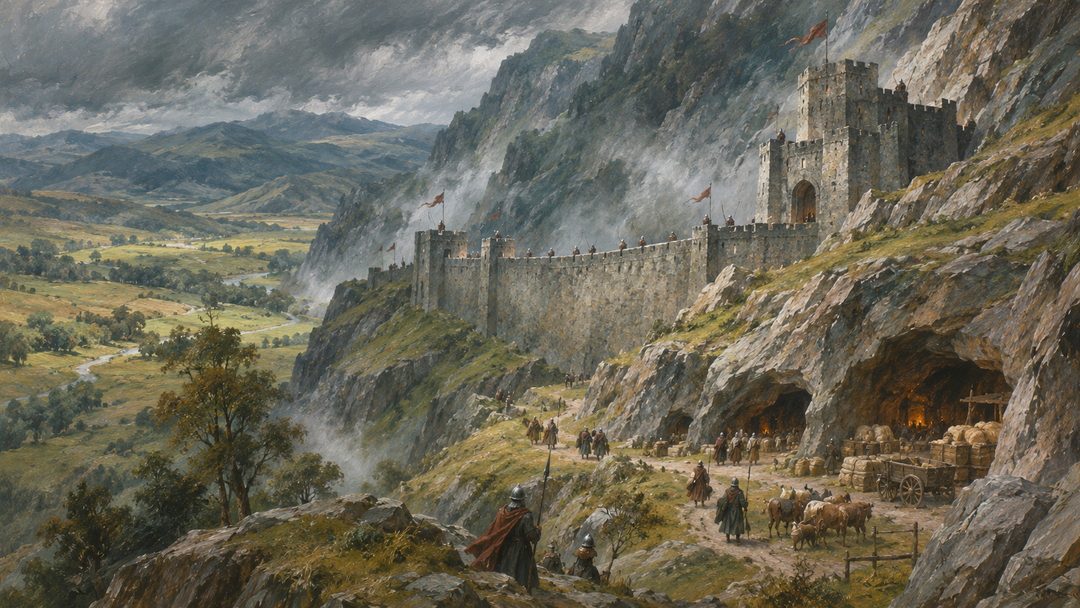
The military problem is easy to understand without imagining that the fortress physically blocked every route east. Saruman’s foot soldiers could, in principle, march past it. Yet a defended stronghold in their rear would threaten communications, supplies and any detached forces. Rohan’s cavalry could emerge to strike vulnerable parties or move against an army already engaged elsewhere. The invaders would then have to protect both their advance and the territory they claimed to have conquered.
Another commander, Elfhelm, had independently expected Saruman’s main army to overrun Westfold and invest the Hornburg before reinforcements could reach it. The fact that Rohan’s commanders disagreed about how to defend the Fords does not erase their shared concern about the western fortress. The later account therefore shows Helm’s Deep as a predictable campaign objective, not merely the place where Saruman happened to catch sight of Théoden.
Isengard had already invaded and devastated the Westfold
Saruman’s campaign began before the Battle of the Hornburg. He had spent years weakening Rohan through Gríma Wormtongue’s influence over Théoden, while assembling Orcs and allied Men in Isengard. At the First Battle of the Fords of Isen on 25 February, his forces killed Théodred, the king’s son and a principal defender of the western border. That was a purposeful attack on Rohan’s leadership, not an attempt to seize a picturesque fortress.
The second battle at the Fords, on the night of 2 March, broke the Rohirrim’s forward defence. The surviving units were dispersed rather than annihilated, a distinction that would matter at dawn on 4 March. Nevertheless, the way into Westfold lay open to an invading host. In The Two Towers, the people at Helm’s Deep describe enemy destruction in the vale, and the arriving Riders encounter slain fugitives and reports of Orcs and wild men spreading through the country.
Thus the idea that Saruman chose an assault instead of ravaging Rohan is misleading. Ravaging the land was already part of the offensive. Destroying farms and settlements could spread panic, deprive Rohan of resources and satisfy the hostility of Saruman’s Dunlending allies. But devastation alone could not reliably eliminate organised Rohirric resistance. A surviving king, commanders and mounted troops could still assemble an army, even after villages had been burned.
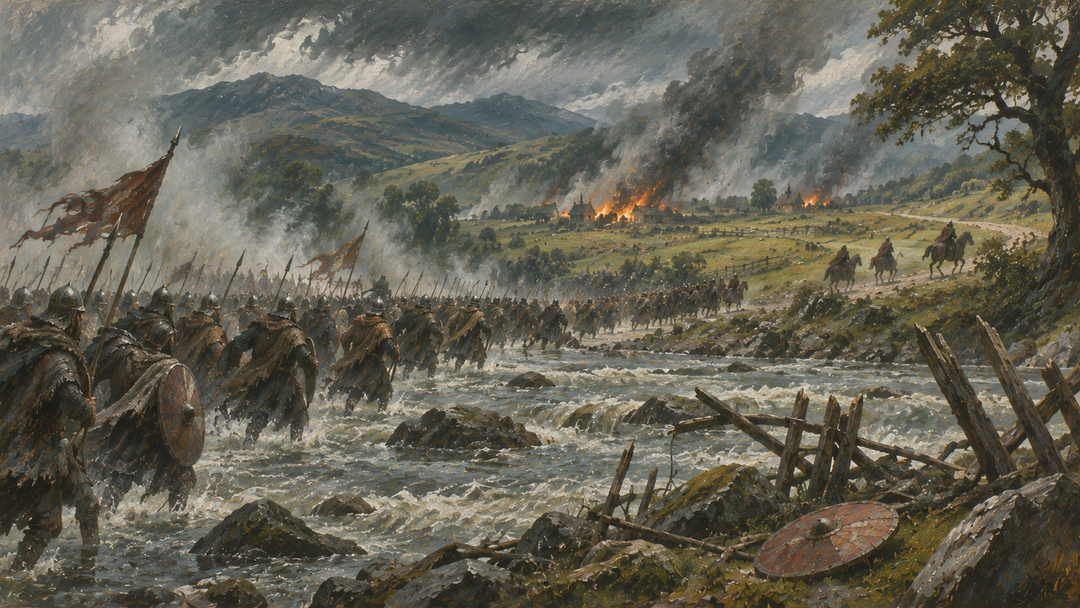
Théoden’s movements increased the importance of the fortress. After Gandalf restored him to effective command at Edoras, the king did not initially set out to hide in Helm’s Deep. He rode west to meet the enemy at the Fords. News of the defeat changed the plan. Gandalf advised him to make for Helm’s Deep, then departed to gather help. The king’s force reached the Hornburg with Isengard’s troops close behind.
Once Théoden was inside, a victory there promised more than the capture of walls. It might destroy the king’s field force, kill or capture key leaders and break the confidence of the remaining Rohirrim. Aragorn, Éomer, Legolas and Gimli were also among the defenders, although Saruman’s knowledge of every individual present is not established. It would be wrong to claim that he selected the target because he knew precisely who had entered it.
Nor was the attacking army simply a mass of identical Uruk-hai. Tolkien describes Orcs from Isengard alongside Men of Dunland, whose grievances against Rohan Saruman had exploited. The Uruk-hai were an important part of his military strength, but the Battle of the Hornburg was fought by a mixed host. Calling the whole force Uruk-hai is a convenient shorthand, not a precise description of the book.
Why assault the walls rather than wait?
A siege does not necessarily mean sitting outside a castle for weeks until its defenders starve. An army can surround a stronghold and immediately try to storm it. That is broadly what happens at Helm’s Deep. Saruman’s troops enter the valley, press the defenders back from the outer Dike and launch attacks on the gate and the Deeping Wall during the night. In ordinary usage the battle can be described as a short siege dominated by assault.
There were reasons to hope that speed would work. The attackers greatly outnumbered the defenders and arrived soon after the king. The Rohirrim had ridden out expecting open battle, not a lengthy confinement behind walls. Théoden acknowledges that his own company brought little food. Although the established refuge possessed considerable supplies, the new arrivals had limited time to settle into a coordinated defence against a large force arriving in darkness.
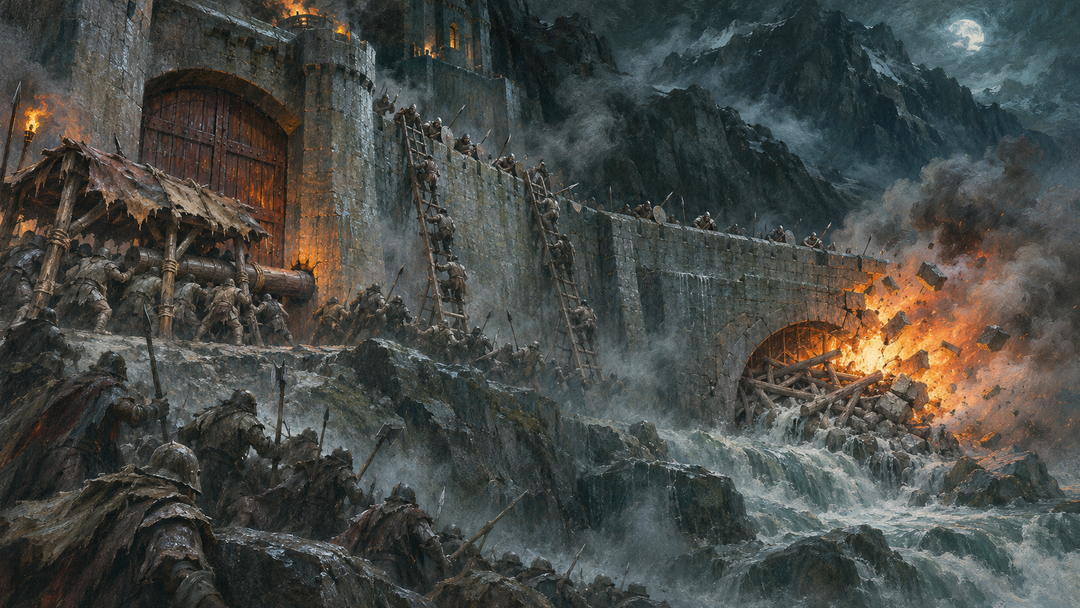
The attackers also had methods for overcoming fortifications. A ram threatened the Hornburg’s gate; ladders and grappling equipment brought Orcs against the walls. Small parties found a way through the culvert where the stream passed beneath the Deeping Wall. After that opening was blocked, Saruman’s forces used explosive fire to create a breach. The defenders were driven into separate positions in the Hornburg and the caves. This was a serious, nearly successful attack, not a futile charge made for dramatic effect.
Waiting had its own risks. A long blockade would require an occupying army to remain supplied in hostile territory while surviving Rohirric units were still at large. A fortified refuge with food gathered inside would not necessarily surrender quickly. The Isengarders could not assume that defeating the soldiers at the Fords had destroyed the whole army of Westfold. Indeed, many of those soldiers were merely scattered, and Gandalf was already working to find and reorganise them.
Tolkien does not provide an inventory of Saruman’s siege stores, a timetable for starving out the Hornburg or a council scene in which his generals compare the options. It is therefore speculation to insist that the attackers lacked provisions for a blockade, or that they had orders to win before sunrise. What the narrative demonstrates is narrower: the army possessed equipment for a rapid assault, concentrated its strength on that attempt and came close to breaking the defence.
The failure was not caused solely by stubborn walls. At daybreak Théoden and Aragorn led a sortie, while the defenders emerged from the caves. Gandalf arrived with Erkenbrand and roughly a thousand men gathered from Westfold. A mysterious forest of Huorns had appeared across the invaders’ route of retreat; the fleeing Orcs entered it and did not return. These interventions help explain why a force that had achieved a breach was nevertheless destroyed. They do not prove that Saruman could have won by waiting.
What Tolkien establishes, and what the films change
Peter Jackson’s The Lord of the Rings: The Two Towers changes the lead-up enough to make the question seem sharper. Its Théoden is reluctant to fight Saruman in the open and leads a large body of refugees from Edoras to Helm’s Deep. In the book, he rides towards the Fords intending to meet the enemy, then turns to the fortress after learning that the western defence has collapsed. The civilians from Edoras are instead entrusted to Éowyn and sent towards Dunharrow.
This does not mean there are no civilians at Helm’s Deep in the novel. Westfold families are already sheltering in the caves. The distinction matters because the film makes the site look primarily like a refuge chosen by the king, inviting the question of why Saruman does not simply attack an unprotected capital. The book presents a developed western stronghold whose garrison and stores would remain a military problem even if the king had not arrived.
The relief force is different too. The film brings Éomer back with Gandalf, following an invented separation between Éomer and the king, and adds Elven reinforcements under Haldir. In the novel Éomer fights beside Théoden at the Hornburg; Gandalf returns with Erkenbrand’s men, and no company of Elves marches to the defence. Those changes affect how viewers perceive both the army trapped inside and the options available outside.
There is also a wider strategic failure that the attackers could not properly account for. While Saruman commits his strength against Rohan, the Ents attack Isengard and overwhelm its works. Gandalf later explains that Saruman had sent his full force towards Helm’s Deep and diverted his servants from other tasks. That helps establish the scale of the commitment. It does not establish that the Uruk-hai were told about the Ents, nor that Saruman deliberately sacrificed the defence of his own base.
A plausible counterfactual is that Saruman could have left troops to contain the Hornburg and advanced east with the rest, or tried a longer siege instead. Neither alternative is impossible as a matter of geography. But both require assumptions about numbers, supplies, intelligence and what the scattered Rohirrim might do. Tolkien gives no decisive test of those scenarios. Treating a hypothetical plan as obviously superior would mistake hindsight for evidence.
The strongest conclusion comes from reading The Two Towers alongside the military discussion in Unfinished Tales. Saruman had already damaged Rohan and broken its border defence. The Hornburg remained a stocked, defensible base from which resistance could continue, and Théoden’s arrival made it an even more valuable target. Isengard therefore besieged and stormed it in an attempt to secure a quick decision. The error was not necessarily choosing the fortress; it was committing the campaign to a battle that failed, leaving Saruman without the army needed to exploit his earlier victories.
Sources & Notes
- Tolkien Gateway, Battle of the Hornburg — account of the night assault of 3–4 March T.A. 3019: the Dike, the ram on the Hornburg gate, Orcs through the culvert, blasting fire breaching the Deeping Wall, Théoden and Aragorn's dawn sortie, and the arrival of Gandalf with Erkenbrand and the Huorns. https://tolkiengateway.net/wiki/Battle_of_the_Hornburg
- Tolkien Gateway, Helm's Deep — the gorge in the White Mountains, the Hornburg and the Deeping Wall, the fortification's Gondorian origins and its later role as a Rohirric refuge whose caves sheltered Westfold's people and stores. https://tolkiengateway.net/wiki/Helm%27s_Deep
- Tolkien Gateway, Erkenbrand — Lord of Westfold and Marshal of the West-mark, his repair of the Hornburg's defences before the invasion, his gathering of Westfold's remnant after the Fords, and his return with Gandalf to relieve the fortress. https://tolkiengateway.net/wiki/Erkenbrand
- Tolkien Gateway, Battles of the Fords of Isen — the First Battle of 25 February T.A. 3019 in which Théodred was killed, and the Second Battle of 2 March that broke Rohan's forward defence and opened the way into Westfold. https://tolkiengateway.net/wiki/Battles_of_the_Fords_of_Isen
- Tolkien Gateway, Elfhelm — Marshal of the East-mark and commander of the Muster of Edoras, his judgement that the Fords were a trap and his independent coordination with Grimbold during the western campaign. https://tolkiengateway.net/wiki/Elfhelm
- Wikipedia, Battle of Helm's Deep — encyclopedic overview and analysis of the battle, including its literary history, material from Unfinished Tales, and the changes Peter Jackson's The Two Towers makes to the retreat from Edoras, the Elven reinforcements and Éomer's return. https://en.wikipedia.org/wiki/Battle_of_Helm%27s_Deep
Primary reading: The Two Towers, Book III chapters 7–8 (Helm's Deep and The Road to Isengard) and Book III chapter 6 for the westward ride from Edoras, together with the account of the Battles of the Fords of Isen in Unfinished Tales, where Erkenbrand's reasoning about the Hornburg is given directly. The linked reference entries document the fortress and its geography, the night assault on the Deeping Wall by culvert and blasting fire, Erkenbrand's and Elfhelm's roles in the western defence, and the scholarly discussion of how Peter Jackson's film changes the lead-up to the battle. Reading Saruman's choice as a deliberate bid for a quick decisive victory rather than an accident of pursuit, and treating his failure as a commitment error rather than a targeting error, is this article's interpretation; Tolkien records no surviving order from Saruman and no council scene weighing siege against assault.